
+++ BENTLEY ’s off-road Bentayga has moved from internet curiosity to something the company’s own CEO won’t rule out. Frank-Steffen Walliser told in an interview that the Bentayga X concept shown in January got a reaction inside and outside the company that surprised him. Walliser didn’t announce a production date. But he said the project is “on the horizon,” which is about as close as a sitting CEO gets to confirming a future model without confirming it. Walliser described the public response to the X concept as “really surprisingly positive”. Asked directly whether Bentley was considering building it, he answered: “yes, we have this on the horizon. Time will tell us when it’s ready”. That’s a confirmation of intent. No powertrain, trim name or on-sale date has been locked in and Bentley hasn’t said whether the production truck would carry the X badge or something else entirely. The current Bentayga has been on the market since the 2016 model year as a first-generation product. Walliser confirmed a redesign is coming, though he gave no specifics on when or what changes beyond styling and architecture. That redesign is where an off-road variant would most logically slot in, built from the ground up instead of bolted onto the aging platform. Bentley hasn’t said whether the X treatment debuts alongside the redesign or follows it. The concept that started this conversation debuted at the FAT Ice Race in Austria, built off the 641 hp twin-turbo W12 Bentayga Speed. Bentley raised ride height by more than 2 inches and widened the track by nearly 5 inches over that donor car. Ground clearance topped 12 inches, with a wading depth rated at 21.6 inches. Those are substantial numbers for a luxury SUV wearing a flying B badge. Forged 22-inch wheels wrapped in all-terrain tires rounded out the concept’s off-road-specific hardware. None of that guarantees a one-to-one translation to a showroom model. Suspension travel, wheel size, and wading depth are the kind of figures that get revised once engineers move from a show concept to something that has to pass crash tests and emissions rules. Whatever Bentley builds, it stays petrol-powered. Walliser reiterated the Bentayga will continue alongside the brand’s electric Torcal, arriving for the 2028 model year. That pairing gives Bentley a combustion flagship and a battery-powered one running in parallel, with the off-road variant as a third pillar built on the gas side. +++
+++ BMW has pushed over-the-air updates to 16 million vehicles across 88 countries. The company’s newest package lands in December. Software Update 11/2026.3 adds 24 new and enhanced functions spanning driver assistance, navigation, charging, infotainment and comfort features. The update applies across BMW Operating System 8.5, 9 and X, but what each owner actually gets depends on their specific vehicle and market. Joachim Post, a member of BMW AG’s Board of Management for Development, highlighted the milestone: “For more than 7 years, our customers have been receiving over-the-air updates. Today, we can update 16 million BMW vehicles. With BMW Software Updates, we are already creating the foundations for tomorrow’s innovations when the vehicle is delivered”. BMW has run its over-the-air update program since 2018, letting owners get new vehicle functions without a dealership visit. The scale has grown enormously since then. BMW now counts 16 million vehicles across 88 countries as eligible for wireless updates. That reach makes BMW’s program one of the largest software-update operations in the auto industry, covering everything from recent electric models to combustion-powered cars built on newer electrical architectures. Not every one of those 16 million cars runs the same software platform. BMW Operating System 8.5, 9 and X all support update delivery, but each generation handles different hardware and offers a different limit on what new features can actually do once installed. The push toward software-defined vehicles has made OTA capability a selling point across the industry. BMW’s fleet-wide numbers give it a sizable head start over rivals still building out comparable infrastructure. The December package breaks down into 5 new functions and 19 enhanced ones, touching driver assistance, navigation, charging, infotainment and comfort systems. Most of that content is reserved for Operating System X, BMW’s newest platform. 9 of the 24 functions also reach vehicles running 8.5 and 9. On the driver assistance side, the Highway & Commuting Assistant gains new behavior in the US. Vehicles with Operating System X can now brake to a stop at a red light and either set off automatically or prompt the driver once the signal turns green. Infotainment additions include Prime Video access, an AI avatar, and new widget layouts for BMW’s Panoramic Vision display. Navigation functions get updates too, including Google Maps place information, charging station feedback tools and tighter integration between BMW Maps and the driver assistance stack. Comfort tweaks range from adjustable greeting sequences to refreshed ‘My Highlights’ screens tied to the central display and the My BMW app. BMW has been explicit that availability depends on vehicle, equipment and market. That’s why 2 owners with the same model year can see different results from this rollout. A car built for Europe may unlock navigation features unavailable in the US, while equipment tied to a specific options package determines whether a driver assistance upgrade applies at all. That variability runs through BMW’s whole software strategy, following the lineup of new BMW models arriving in 2027 that will rely further on this update structure. +++
+++ Mate Rimac has revealed how he went against the wishes of Volkswagen Group executives to save BUGATTI from an all-electric future. Despite building his reputation on electric hypercars, the Croatian entrepreneur believed battery power wasn’t the right direction for the French brand. Getting everyone else on board, however, was anything but easy. In an interview, Rimac recalles that the VW Group initially wanted Bugatti’s Chiron successor to be a 4-seat electric SUV. Yes, an SUV. The idea might sound bizarre today, but the company considered it around 2020 when enthusiasm for electric vehicles was running high and automakers were scrambling to electrify their line-ups. Rimac’s company was involved in developing the electric powertrain, with plans to adapt technology from the now-discontinued Nevera for the proposed high-riding Bugatti. However, he quickly realized that making the project work would be extremely difficult. The engineers couldn’t simply borrow an existing platform for the electric SUV, meaning the VW Group would have had to spend billions developing a dedicated architecture. The business case never added up and the project eventually stalled without approval from Germany. With Bugatti lacking a viable Chiron successor, Rimac saw an opportunity. He approached VW Group management with a proposal for his company to develop and build the entire vehicle, leaving the German conglomerate to sell it. This is where the story takes an interesting turn: During a meeting, a VW Group executive asked, “Why don’t you just take over the company?” Rimac initially thought the suggestion was a joke. He didn’t even mention it to anyone after returning home. A few months later, the executive called again and asked why he hadn’t responded. That’s when the Croatian entrepreneur realized the offer was serious. What followed was a 2,5 year negotiation process. When discussions turned to Bugatti’s future, VW Group and Porsche executives told Rimac that the next hypercar had to be fully electric. It wasn’t an unreasonable suggestion on paper. Rimac had founded an electric-car company, developed the Concept One and Nevera and was already working with major carmakers on battery technology. Yet he strongly disagreed with the proposed direction. “I went into a huge fight with them because I thought that was the wrong thing for Bugatti. So I said, ‘No, I don’t want to make an electric Bugatti’ “. The VW Group eventually agreed to let Rimac pursue a hybrid instead, but another disagreement followed. The proposed compromise involved using the existing Chiron platform to limit costs. That would have imposed packaging constraints to accommodate the battery, resulting in what Rimac considered a compromised product. Before the transaction with the VW Group was even completed, Rimac’s company paid Cosworth out of its own pocket to begin work on the new combustion engine. To prove the concept, engineers built a 4-cylinder prototype representing a quarter of the planned 16-cylinder engine. It retained the same combustion chamber and cylinder-head design, allowing the team to evaluate performance, emissions, costs and development timelines. The results supported the V16 approach, giving Rimac the evidence he needed to convince everyone involved. The eventual result was the Tourbillon, featuring a naturally aspirated 8.3-liter V16 paired with a hybrid powertrain. 6 years after development began, Rimac says the decision has paid off. Bugatti has sold every Tourbillon it plans to build. That’s why Rimac was willing to fight VW Group’s initial plans, even though an electric Bugatti might have seemed like the obvious choice coming from the man behind the Nevera. The irony is hard to miss: The guy who built one of the world’s fastest electric cars was also the one who convinced the VW Group that its flagship brand shouldn’t go fully electric. The Tourbillon’s V16 is arguably a pretty convincing argument that he was right. +++
+++ The next-generation MAZDA CX-3 , as teased in a company presentation earlier this year, might not make it to Europe, despite an admission that the brand needs to focus on “volume segments” instead of niche markets as it has done in the past. When asked about the elephant in the room (the maker’s lack of presence in the lucrative B-segment SUV class), a spokesman said: “We’ve just got to be clear, as a relatively smallish brand, about what you bring to the market. It needs to work across multiple national sales companies and probably outside of Europe, as well as within Europe”. The suggestion, I assume, is that until Mazda chooses to electrify the next-generation CX-3 with a hybrid or plug-in hybrid powertrain (or launch an EV-only CX-3e), the brand’s hands are tied. In response, the spokesman mentioned the jacked-up Mazda CX-30 was “doing well” alongside the Toyota Yaris-based Mazda 2 Hybrid, which has recently replaced the petrol-powered 2 as the maker’s sole supermini offering. The new CX-3, which is expected to make its debut in Japan in 2027, was confirmed in August via a shadowy teaser image and accompanying ‘Next-generation CX-3’ scripture.
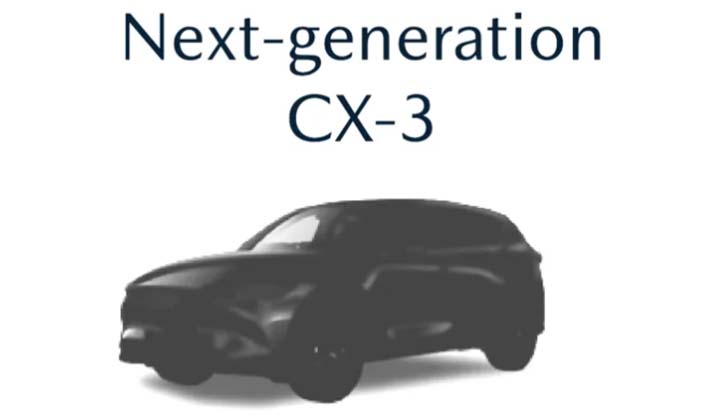
However, the brand has been quiet ever since and no prototypes have yet been caught testing. There is no news on Mazda extending its joint venture with Chinese automotive giant Changan, either; a partnership that this year has seen the launch of 2 new EVs: the Mazda 6e and CX-6e, boosting the company’s presence in the fleet market. The spokesman acknowledged that the project “clearly has the potential for more”, insisting “the route Mazda will go to filling other car lines to get electrification, whether that’s developing its own products in-house, or utilising the relationships it has elsewhere, is to be determined”. He continued: “All I can say is there are segments we will continue to focus on and particularly volume ones”. Many of Europe’s best-selling cars are small SUVs, and it’s an area of the market that Mazda has been absent from since the first-generation CX-3 was taken off-sale back in 2021. Unrelated to the Changan-Mazda joint venture, the next CX-3 will be a homegrown Mazda. This means that it’ll feature a range of combustion powertrains, possibly including that aforementioned hybrid option that we know is already in development. It also suggests that the car may be front-wheel drive only and could even include a 6-speed manual gearbox on non-hybridised models. Much like the all-new Mazda CX-5, I expect the smaller CX-3 to be one of the more capable cars in its class in terms of driving dynamics. We also expect to see the next generation of Mazda’s latest interior design language, as well as fresh digital interfaces and updated safety technology. What will really set the new CX-3 apart from most of its competition, though, is the design, which could draw inspiration from the Mazda Vision X Concept revealed at last year’s Japan Mobility Show. The dark silhouette featured in Mazda’s financial report gave very little away, but we suspect that many of the concept’s new design elements, such as the fared-in front grille, could be seen on the production model. +++
+++ PORSCHE has filed a patent for fins that pivot out of the front trunk lid and rear glass to generate sideways force in a corner. The idea is to push the car’s body into a turn the way a boat’s rudder redirects water. The filing published earlier this month describes a system meant for high-speed handling that Porsche says adds grip and stability beyond what the car’s electronic stability systems already manage. According to the patent, Porsche claims the result would be “increased lateral acceleration potential at high speeds and stabilization capabilities beyond those of” the Electronic Stability Program. That’s a specific, testable promise, and it’s partly why the filing is getting attention from engineers and fans alike. The mechanism works by deploying large fins that angle into the oncoming airflow as the driver turns in. That angled surface catches air and converts it into lateral force, essentially helping steer the car’s body in the same direction as the wheels. Porsche’s filing places one set of rudders on the front trunk lid, ahead of the windshield, and a second set near the rear glass. Splitting the hardware between both ends lets the system balance front and rear grip instead of adding downforce in one spot. The patent also describes the fins helping absorb body roll, the lean a car’s chassis takes on mid-corner under lateral load. Less roll generally means more predictable grip. Porsche is pitching this as a track tool, not a comfort feature. A related application, DE102025119020A1, was published days earlier. It outlines separately movable air-guide elements that pivot between retracted and extended positions to adjust lift or downforce. Porsche isn’t alone in chasing unconventional ways to manage airflow around a car’s body. Other manufacturers have patented systems like fan-based suction to the road, and Porsche itself has filed other wild ideas ranging from a simulated manual transmission to disappearing racing stripes. Deploying fins near the rear glass raises an obvious problem.
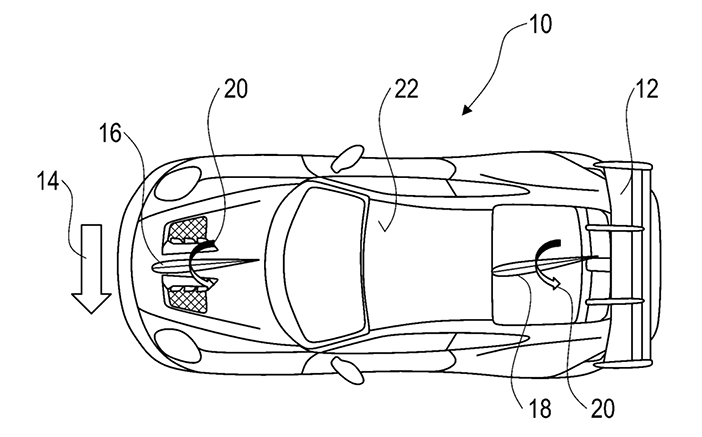
Anything tall enough to catch meaningful airflow is tall enough to block what a driver sees in the mirror. Porsche’s separate rear-wing patent concept uses split wings that move independently, addressing the same visibility concern from a different angle. Crosswinds complicate things further. A fin designed to catch air on purpose during cornering can just as easily catch a gust on a straightaway, acting like a sail and nudging the car off its line. Porsche’s own filing points toward closed circuits as the intended environment. None of this means the system is headed for production. Patent offices emphasize that applications exist to protect technical ideas, and automakers patent far more concepts than they ever build. Porsche has a track record of filing unusual aerodynamic and mechanical patents that never reach customers, alongside others that eventually do. The rudder concept joins a growing pile of the automaker’s recent filings exploring active aerodynamics, a pattern also seen in Ferrari’s aerodynamic taillights, which likewise remains unconfirmed for production. +++
+++ STELLANTIS is making a rather interesting trade-off: fewer factory-backed racing programs in exchange for more exciting road cars. The automotive giant has announced plans to end its involvement in the FIA World Endurance Championship (WEC) and Formula E, promising to redirect those resources toward customer racing and high-performance vehicle development. In other words, the company wants to spend less time chasing trophies and more time building cars enthusiasts might actually want to drive. That’s an intriguing proposition from a conglomerate overseeing brands such as Alfa Romeo, Peugeot, Lancia, Opel and Maserati, all of which have plenty of performance heritage to draw from. There is, of course, a catch. Stellantis isn’t simply scaling back its motorsport operations. It’s effectively ending its official participation at the FIA World Championship level, with Peugeot’s WEC program concluding by the end of 2026 and its Formula E efforts involving Citroën and Opel following after Season 13, which ends in the summer of 2027. The decision marks a significant change in direction for Stellantis Motorsport, but the company insists its competition expertise won’t go to waste. Instead, it wants to apply that knowledge to products customers can actually buy. The biggest potential winners are the brands with established performance sub-brands. Stellantis specifically mentions continued development of exclusive high-performance models for Alfa Romeo and Maserati, alongside Veloce, GTi, HF and GSE derivatives for Alfa Romeo, Peugeot, Lancia and Opel, respectively. That’s encouraging news for enthusiasts who feared the group’s financial troubles might lead to further cuts to its more interesting products. Peugeot could get more GTi-badged models, Lancia has room to build on the Ypsilon HF and Opel could expand its GSE lineup. Alfa Romeo and Maserati, meanwhile, could benefit from more expensive, exclusive performance models. All of this falls under the FaSTLAne 2030 strategy, which calls for 50 product launches and updates in Europe over 5 years, including 25 entirely new models. Stellantis is essentially betting that investing in showroom products will deliver more value than maintaining expensive factory racing programs. To be clear, Stellantis isn’t abandoning competition altogether. Customer racing will remain a priority, with the company planning to build on its existing multi-brand rally-car business. That’s a more commercially focused approach, allowing private teams and customers to buy competition machinery without Stellantis having to bankroll factory entries in expensive world championships. The company also says it intends to retain and redeploy employees affected by the decision, finding them positions in customer racing, performance vehicle development, and other areas of its business. Still, pulling out of WEC and Formula E represents a significant retreat. Peugeot’s 9X8 will no longer compete in endurance racing, while Citroën and Opel will finish their Formula E commitments after the 2027 season. Stellantis is walking away from 2 major international championships at a time when motorsport remains an important marketing tool for several of its brands. The real test will be whether the promised road cars make up for the loss of factory racing programs. More Quadrifoglio models, proper GTi hot hatches, HF derivatives, and exciting Maseratis would certainly make the decision easier to swallow. But enthusiasts have heard plenty of promises before. Stellantis now needs to turn its motorsport expertise into something more tangible than another corporate strategy presentation. +++
+++ Last month’s Super Taikyu Round 6 had plenty of metal to look at, but the most interesting thing TOYOTA said there had nothing to do with horsepower or lap times. Speaking to the company’s official magazine, Toyota Times, Tomoya Takahashi, president of Gazoo Racing, explained why the company keeps investing in sports cars. It boils down to one worry: that people will stop caring about driving. Takahashi opens with a simple premise. To him, cars are the ultimate objects of passion and people will always love the thrill of driving. No enthusiast will argue with that. What makes his comments notable is who’s saying it: an executive at one of the world’s biggest automakers, not someone running a small boutique brand with a niche audience to flatter. Sure, Gazoo Racing is now a separate sub-brand, but it still sits firmly under the Toyota umbrella. The obvious counterargument is that self-driving technology will eventually make driving irrelevant. Takahashi doesn’t buy it. Even as autonomous driving advances, he doesn’t believe we’ll reach a point where nobody wants to drive for pleasure. His conclusion is a call to action rather than a prediction. If anything, he says, carmakers need to keep giving people opportunities to experience the joy of driving. The stakes, as he sees them, go beyond a few enthusiast models. Without those opportunities, more and more young people will lose interest in cars, potentially leading to the decline of the automotive industry. His response is 5 words long: “We can’t let that happen”. What follows is the closest thing to a mission statement you’ll hear from a Toyota executive. The company wants to keep making sports cars and ensure they’re available to people who love driving. Takahashi says that’s what motivates the team. He also spells out the flip side: if Toyota pulls out, he thinks sports cars will eventually disappear. “Even as autonomous driving advances, I don’t believe we’ll ever reach a point where nobody wants to drive for pleasure. If anything, we need to keep giving people opportunities to experience the joy of driving. Otherwise, more and more young people will lose interest in cars, which could lead to the decline of the automotive industry. We can’t let that happen. We want to keep making sports cars and ensure they remain available for people who love driving. That’s what motivates us. If we pull out, I think sports cars will end up disappearing”. This is essentially a domino-effect argument. If nobody gets to experience what a good driver’s car feels like, nobody grows up wanting one. Eventually, the market that supports the entire automotive industry, not just the fun stuff, could shrink along with it. Whether you agree with Takahashi or not, it’s a more convincing reason to build sports cars than the usual “halo” talk. Just so we’re clear, this is more a statement of intent than a product announcement. Nevertheless, Toyota is pledging to keep the sports car flame alive at a time when most mainstream automakers have already moved away from this shrinking segment. Mazda has vowed to give us another generation of the MX-5, but such cars are becoming part of a dying breed. The backdrop isn’t easy, as stricter regulations have accelerated the gradual demise of sports cars. But Toyota has hinted that it doesn’t see electrification as the end of driving fun, though. +++
+++ VOLKSWAGEN ’s subsidiary Elli has turned a parked electric car into a source of income for European customers. The company’s new BiDi Charger lets a compatible EV feed power back into the electricity grid, paying owners for every hour they stay plugged in. Elli, Volkswagen’s in-house energy and charging arm, is preparing a Vehicle-to-Grid launch for private customers in Germany, with real-world testing already running in selected households. The offer pairs new hardware with 2 electricity tariffs and an app that handles the scheduling automatically. The Elli BiDi Charger is a compact DC unit rated at up to 11 kW, built for either indoor or outdoor installation. It works with both 400 volt and 800 volt vehicle architectures, and it supports the international ISO 15118-20 communication standard. That standard lets the charger and the car manage a 2-way flow of electricity. Elli says the same communication layer leaves room for more compatible vehicles to be added down the line. Owners can still use Elli’s existing smart-charging features, which already shift charging to hours when solar power is cheap or abundant. Those tools manage when the car charges, while the BiDi Charger adds the separate job of stabilizing the grid by sending energy back. Elli is already testing the setup with early customers before the market launch in Germany. It’s installing the charger in selected homes to check how the hardware, the car, and the grid connection work together under real conditions.
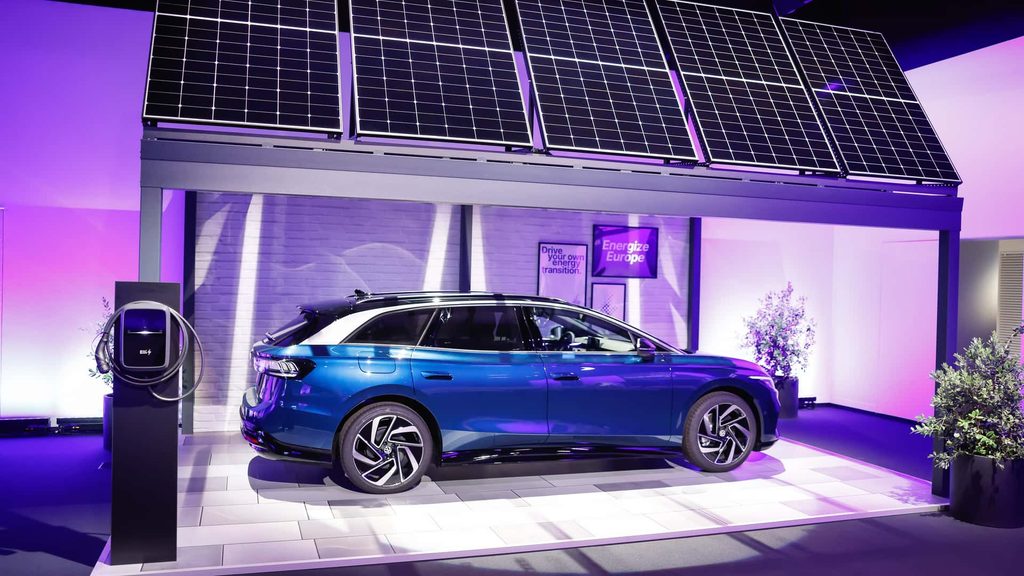
The incentive is straightforward. Elli pays a plug-in bonus of €0.24 per hour for every hour a compatible car stays connected to the DC charger, whether or not energy actually moves. At 250 hours a month, that adds up to roughly €60 monthly, or €720 over a first contract year. A session has to run at least 3 hours to count toward the bonus. Customers are expected to eventually get the option of feeding electricity back into the grid and receiving €0.40 (about $0.44) per kilowatt-hour for that energy, with no guaranteed minimum amount drawn in any given session. 2 linked tariffs make this work. ‘V2G Flow’ covers household power use and vehicle charging. ‘V2G Return’ is the separate feed-in tariff that governs payment for electricity sent back from the battery, both on 12-month contracts. Signing up requires a compatible smart meter, which Elli recommends arranging early since installation can take time. Once the system launches, customers complete a digital site check online before an installation partner provides a quote and the charger can be ordered. Vehicle-to-Grid sends a car’s spare battery capacity out to the wider energy market. Vehicle-to-Home works differently: it lets that stored energy power the house directly. That’s most useful for owners with rooftop solar looking to use their own power after dark. Elli tested V2H for 12 months across 20 households in Germany, first shown publicly at IAA Mobility 2025. The chargers logged about 85.000 hours online and completed more than 6.500 bidirectional charging and discharging sessions over the pilot. Those results are feeding into a standalone V2H product Elli plans to launch in 2027. The underlying hardware comes from Elli’s partner, The Mobility House Energy, whose FlexEngine platform aggregates battery capacity for the energy market. Whether a given car qualifies depends on which bidirectional functions Volkswagen has approved for that specific model. More than one million MEB-based EVs across Europe are already built with the hardware for bidirectional charging, including about 360.000 in Germany alone. +++