
+++ BMW is preparing to take its X7 flagship further upmarket next year with a new second-generation model to rival the Range Rover with bold Neue Klasse styling, an Alpina V8 range-topper and (for the first time) a fully electric option. BMW is moving to more obviously differentiate its largest SUV from its core line-up and position it to compete directly with traditional luxury rivals such as the Mercedes-Benz GLS and Range Rover, as well as the new wave of Chinese competitors headed by BYD’s Yangwang and Zeekr’s 9X. Following the latest X5, the new X7 (and electric iX7) will be based on a heavily revised version of BMW’s Cluster Architecture (CLAR). This versatile structure has been re-engineered in its largest form to accommodate conventional internal combustion engines as well as a fully electric drivetrain. Sources in Munich suggest the iX7’s battery could be as much as 150 kWh in capacity, in a bid to provide a WLTP combined range in excess of 800 km. Much of the engineering programme for the new X7 has been focused on ensuring the EV and ICE derivatives are all but identical, with the same exterior design, driving position and interior packaging. This comes as part of BMW’s attempts to further integrate electric models into its traditional model ranges. The decision distinguishes the X7 from the new 3 Series and the closely related X3, which are sold alongside related, but technically different, i-badged EVs. But the move brings the model in line with the X5 and iX5, which are almost indistinguishable from one another and share the same core hardware. While the exterior styling remains under wraps, prototypes reveal a larger car extending to more than 5.200 mm in length, with a familiar shape but extensive new detailing. The split-headlight arrangement introduced on the facelifted X7 appears to have been retained alongside a new, taller interpretation of BMW’s trademark kidney grille, which, in line with recent design developments, will be joined by a distinctive new lighting signature. The front end is expected to draw heavily on the appearance of the facelifted 7 Series, while the flanks will receive winglet-style door handles similar to those on the new X5. More prominent wheel arches and a chunky sill beneath the doors also add visual mass, and wheels are expected to range from a standard 19 inch up to a generous 23 inch in diameter. The new X7 is set to use a conventional one-piece tailgate in place of the outgoing car’s two-piece arrangement. It will both improve boot access and simplify production. The most extensive changes, however, are planned for the interior, with which BMW intends to position the X7 much more closely to the 7-series in terms of comfort, equipment and rear-seat accommodation. The dashboard will adopt BMW’s Panoramic Vision display, which projects driving and other information across the lower section of the windscreen, together with the new iDrive X operating system, which dispenses with the rotary controller. At the centre of the dash sits a 17.9 inch trapezoidal display, angled towards the driver and paired with a new 3D head-up display at the base of the windscreen. As in the 7-series, rear seat passengers are expected to have their own touchscreen controller mounted in the rear doors for controlling climate and comfort functions. A 31.3 inch Theatre Screen for the second row and a separate front-passenger display are also thought to be planned, while the options list should include ventilated and massaging rear seats. Automatic doors are also thought to be under development. The new X7 will continue as one of few seven-seat luxury SUVs on the market, rivalling Audi’s new Q9 and indirectly replacing the now axed three-row X5. The ICE car’s powertrain line-up will be underpinned by a mildly hybridised 3.0-litre six-cylinder petrol engine, which is shared with the X5 and should send 400 hp and 540 Nm of torque to both axles in entry-level xDrive40 guise. A 6-cylinder MHEV diesel is also planned for Europe, likely matching the oil-burning X5 with 313 hp and 650 Nm. The M60 xDrive is set to retain BMW’s twin-turbo 4.4-litre V8, with a modest increase over today’s 530 hp range-topper. The most powerful X5, the M60e plug-in hybrid, produces a combined 612 hp, so the V8 will need a similar output if BMW wants its largest SUV to keep pace with the X5, particularly given that the larger car isn’t due to receive a PHEV powertrain. Details of the EV are yet to be revealed more than six months out from the iX7’s unveiling, but the new iX5 60 xDrive gives an idea of what to expect. The most potent iX5 has 585 hp and 800 Nm from its dual-motor drivetrain, drawing on the sixth generation of BMW’s eDrive technology with an 800V electrical architecture, bidirectional charging capability and cylindrical battery cells with 20% more energy density than the prismatic cells they replace. The iX5’s 144 kWh battery accepts up to 460 kW on a DC charger and delivers a WLTP range of between 640 and 840 km. The iX7 is likely to offer similar or greater outputs and will give BMW a direct rival to the Mercedes-Benz EQS SUV and Range Rover Electric. The expansion of the X7 line-up will also include a new Alpina derivative, known internally as G69 and planned to follow the standard X7 into production in 2028. It is set to use a specially tuned version of the new X7 M60 xDrive’s twin-turbo 4.4-litre V8, with dedicated engine management software, transmission calibration and suspension tuning. It will follow the first Alpina model developed under BMW ownership, a V8-powered derivative of the new 7-series, which recently topped 300 kph during high-speed tests at the Nardò ring in Italy, in a showcase of Alpina’s new ‘speed, not sport’ ethos. A fully electric Alpina derivative is also understood to be under consideration (which would be the marque’s first EV), although no decision has been taken. +++
+++ Tougher emissions standards are coming into force this winter. All new cars arriving on the European market and being type-approved for road-legal status from 29 November must conform to the much stricter EURO 7 regulations. These require testing in real-world driving conditions and now cover non-tailpipe emissions from components such as tyres and brakes. Although exceptions have been made for certain low-volume manufacturers, cars that are already on sale will have until 29 November 2027 to either be adjusted to meet the new regulations or removed from the market altogether; something we’ve already seen in the cases of the Honda Civic Type R and the Audi RS 3. Examples already registered and on the road won’t have to comply with the standards. Under the forthcoming regulations, among other particulate restrictions, new petrol and diesel cars sold in Europe are required to produce no more than 0.06 and 0.08 grams of nitrogen oxide respectively. This is the same as in the previous Euro 6 regulations, but the testing new cars will undergo will now be much more stringent. For starters, Euro 7 cars will be tested in temperatures of up to 45 degrees celsius, as well as in stop-start traffic and on short journeys. This, experts believe, will give a more rounded and accurate perspective on a vehicle’s real-world emissions. Speaking of which, Euro 7 will also, for the first time, limit the amount of particulates a car can produce from its brakes and tyres. Hybrids, plus petrol and diesel cars, will be limited to seven milligrammes of particulate matter per kilometre, versus 3 mg for EVs; due to their regenerative braking systems, electric cars tend to use their brakes less, hence the stricter limit. Finally, Euro 7 is designed to protect the longevity of new cars. Emissions control systems, such as catalytic converters, must be effective for up to 10 years and 200.000 km (double the previous limit) while EV batteries must retain at least 80 percent of their original capacity after 5 years or 100.000 km. Onboard diagnostics systems must also monitor emissions in real time and notify the driver if something goes wrong and the car begins exceeding legal requirements. All of this is due to the fact that nitrogen oxide, as well as other pollutants and particulate matter, are detrimental to both the environment and human health. A report by the British Centre for Research on Energy and Clean Air estimated that between 2009 and 2015, excessive levels of particulate matter caused around 124.000 premature deaths in the UK. The introduction of these new regulations won’t be immediately noticeable to consumers; manufacturers have been slowly preparing for Euro 7 since its announcement in November 2022. However, this won’t be the end, because you can expect a Euro 8 standard to arrive in a few more years’ time as the rules surrounding electrification become tougher. +++
+++ Progress on a 6 billion euro EV battery factory in Somerset in the United Kingdom has taken a heavy knock as the project loses its second building contractor in 5 months. TSL, which was leading the construction on the new Agratas plant in Bridgwater, is walking away from the site after failing to agree terms with the Tata-owned battery producer. Tata announced the Agratas factory in 2023 ahead of a targeted start date for production of 2026, which was subsequently pushed back to 2027. Planned to supply electric car batteries for sibling firm JLR and other partners, the Bridgwater plant is due to create 4.000 jobs and have an eventual capacity of 40 GWh, making it the UK’s largest battery factory. But TSL’s exit from the project raises questions about the likelihood of production beginning next year as planned. An earlier report said a new deadline of January 2028 is set to be missed too. TSL is the second building firm to leave the site in 5 months after Agratas fired previous contractor Sir Robert McAlpine in June over disagreements about budget. That came just weeks after building services contractor TClarke left the project’s mechanical and electrical delivery team, with reports attributing the decision to strained relations with Agratas. Agratas and TSL disagreed on funding and timelines and the building firm will wrap up its involvement in 2 to 3 months. NG Bailey, which is currently leading the mechanical, electrical and plumbing elements of the build, is one option to take over. JLR , which will use foreign-built batteries for the electric Range Rovers and Jaguar Type 01 until the plant opens, has no comment on the matter. Sources say morale was already suffering within Agratas’s UK operations after the firm relocated staff from a Tata facility in Coventry to a new site 120 miles away in Somerset, near the factory. Some of the affected workers are expected to opt for redundancy instead of moving, which could intensify staffing issues following the departure of several senior members of the Agratas team in recent months. Despite the setbacks, the shell of the Agratas factory is largely built and work on a crucial dedicated substation has begun. That means it is far closer to fruition than the Britishvolt battery factory project was when it collapsed in 2023. Another crucial UK battery producer is Nissan partner AESC’s newly expanded plant in Sunderland, which supplies the car maker’s factory next door. Having supplied batteries to Nissan since the first-generation Leaf entered production there in 2012, the plant was recently significantly upsized to boost capacity from 1.8 GWh to 15.8 GWh. +++
+++ The new MERCEDES G-CLASS BABY has been spotted once more undergoing testing, this time in Germany. The prototype is still heavily camouflaged, but there’s no disguising its boxy aesthetic, which closely follows that of the G-Class proper, just downsized a bit. Electric versions of the baby Mercedes G-Class will probably provide the brand with a rival to Land Rover’s upcoming, all-electric Defender Sport and the new Jeep Recon. Just as those 2 cars do, the baby G-Class should keep traditional fans happy with much more off-road ability than road-biased electric SUVs such as the Audi Q6 e-Tron. It was previously thought that the baby G would be electric-only, but Mercedes has backtracked, apparently at the behest of dealers in the USA. As for the pricing of the ‘baby G-Class’ or ‘baby G’, I expect the electric car to kick off from around €80.000 when it launches, making it more expensive than the aforementioned Defender Sport and Jeep Recon. This estimate is based on Mercedes’ other all-electric SUVs that could potentially rival the baby G. There’s the new GLC Electric, which is a similar size to the new smaller G-Class and starts at €64.000, and the GLB Electric that starts at just under €52.000. The cachet of the G-Class name is likely to command a premium over these cars, but nowhere near the €154.284 Mercedes currently asks for the full-size electric G-Class. Should a petrol/hybrid version of the little G come to the Netherlands, it’d undercut the EV, but probably not by much.
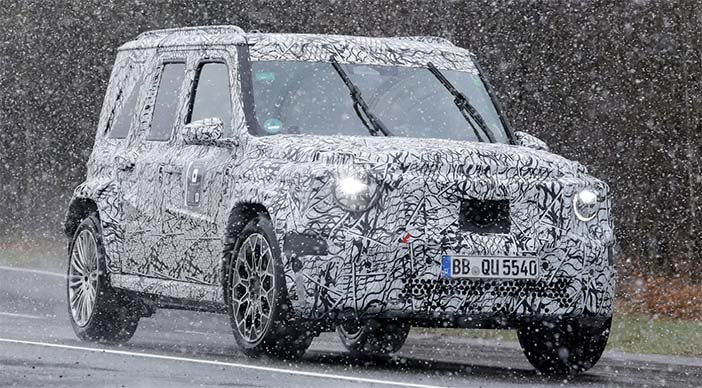
I’m still waiting on confirmation from Mercedes on precisely what the electric SUV will be called. Way back in 2023, CEO Ola Källenius referred to it as ‘little G’, though Mercedes also has registered trademarks of G 250 and G 300, which would make sense alongside the larger G 580 with EQ Technology. Speaking of which, the ‘with EQ Technology’ is likely to be placed at the end of the model names for the EV derivatives. Whatever the new electric SUV from Mercedes will be called, thanks to the spy shots, we know it’ll draw heavy inspiration from the full-size G-Class, especially in its design. In short it’ll look like an electric G-Class that’s been shrunk in the wash. The Mercedes ‘baby’ G-Class is expected to feature a bluff front end with distinctive round headlights, a boxy silhouette, a flat bonnet and an upright windscreen. There’s also the trademark flat rear end featuring a spare wheel cover on a side-hinged rear door; even the clunky door handles (rather than contemporary flush-fitting handles offered on other electric Mercedes models) have been retained. It’s worth noting that the spare wheel cover will probably provide a space to store the charging cables, just like you’d find on the G 580 with EQ Technology. On that car there’s also a no-cost option of the traditional spare wheel on the back door, if you’d prefer. The interior, like the exterior, should gain plenty of inspiration from the current G-Class, with squared-off turbine air vents, an oversized grab handle for the passenger and an upright driving position. It will also run Merc’s latest MBUX system with vast touchscreens and slick user interfaces. +++
+++ If, as the old saying goes, nostalgia is a drug, then much of the car industry seems hooked. From the Citroën 2CV and the Peugeot e-T16 to the Renault 8 Gordini and Alpine A310, many of the big concept cars revealed at the recent Paris motor show have names and designs that are mightily familiar. And they follow revivals of cars such as the Renault 5, 4 and Twingo, the RETRO-infused Fiat Grande Panda and more. Even car firms that aren’t necessarily launching outright retro models are leaning on throwback design trends. BMW, Mercedes-Benz and Volkswagen, for instance, have all recently introduced new design languages that take inspiration from their respective histories. Retro designs aren’t new, of course. It has been 25 years since BMW reinvented the Mini as a stand-alone brand, and while its range has long since expanded beyond Sir Alec Issigonis’s imagination, design-wise it remains rooted in classic Mini styling cues. Soon after the Mini came revivals of the Fiat 500, which remains hugely popular today, and the Volkswagen Beetle, which does not. But that blip of retro revival activity has become a full-on movement in recent years. “You see a trickle and now it has become a wave”, says Renault Group design boss Laurens van den Acker. The French firm has been at the forefront of the recent retro revival. In 2017, it relaunched its Alpine brand with a retro A110 sports car but, more pertinently, it was the revival of the Renault 5 as the embodiment of former group boss Luca de Meo’s ‘Renaulution’ strategy that really kick-started the trend. “It has become a little bit of a recipe”, says Van den Acker, “but we saw it coming. We talked about doing iconic designs 5 or 6 years ago and it’s becoming the new thing”. The spark for the influx of retro models was the switch to electric vehicles, but Van den Acker says it’s developing beyond that now: “At the time we thought it was because of EVs, because with an electric architecture everyone would have the same ingredients. You couldn’t make a difference with a 6-cylinder or 8-cylinder or 12-cylinder engine. Companies used to be identified with their engines, but we thought once you go to EVs, everyone picks a battery off the shelf and the performance is the same. So we were pushing iconic design, because if everyone’s electric, what makes us different?” For European firms, there’s another reason to turn to familiar names and designs. “There is a very strong trend for retro design and it’s very logical, given the time we live in”, says Fiat design boss François Leboine. The Frenchman has form here: at Fiat he has designed the Grande Panda, the retro-drenched Topolino and Microlino quadricycles and the new Multiplay concept, and in his prior job at Renault he created the concept version of the 5 E-Tech. “There is strong competition at the moment, where some historical brands need to fight against newcomers, and one answer to that is to use your story, your roots, to be stronger and give a reason for your cars”, says Leboine. Van den Acker agrees: “With the arrival of competitors from the East, it has become even more of a trump card, because it’s a card we can play that cannot be copied easily”. In other words, new Chinese firms can enter the European market with cars packed full of technology at competitive prices, but they simply haven’t got the history to draw on (although, given China’s legacy of copycat designs, that might not stop them trying). The success of the 5 proves there’s a market for retro design. Of course, it’s impossible to really tell how much of that success is down to the 5’s retro styling. The Zoe that it essentially replaced was a success, too, and a new generation of that car using the 5’s platform probably would have sold well. And the larger, similarly retro 4 has been slower to sell. Perhaps the key to producing a model with a retro design or name is ensuring it’s authentic (in a broad sense) to the original. “The real question is: what is your reason to be on the market?” says Leboine. “It can be historical because you were already there in a segment for good reason, and you are the best historically at doing something”. Leboine highlights the Multiplay concept, which recalls the spirit of the cult-classic 1990s Multipla, which drew considerable attention for its three-wide seating and divisive design. “You can build the future in a different way and you can use your roots, just not as a copy-paste or a continuity of something”, he says. “It’s using the philosophy of what you’ve done before, because the philosophy is timeless. “With the Multiplay, we tried to understand the genius of the coolest car in the history of Fiat. It wasn’t only cool for the aesthetic. It was cool for providing customers a way to live differently”. That approach also led Citroën to revive the 2CV name and design for its new entry-level EV, designed to take advantage of the European Union’s planned E-car regulations. Under various managements, the firm worked through multiple design iterations for the car, many of which weren’t overtly retro in any way. But it was new CEO Xavier Chardon who gave the go-ahead for the clearly nostalgia-fuelled concept. “Reinventing the 2CV isn’t about replicating a car from the past”, he says. “It’s about reinventing what made it unique: its simplicity, its accessibility and the freedom it offered”. As Stellantis’s global design chief, Ralph Gilles oversaw many of the retro concepts at this year’s Paris show and he argues that a design can’t succeed on nostalgia alone. “Our design staff are quite young, so they look at retro from a romantic view. They don’t depend on retro to make a car work”, he says. “They look at the original and know what they like about it, and mine the best pieces and infuse it into the new design. The 2CV is clearly heritage, but if you put it next to the original, it’s completely modern. It’s just that your mind sees what it wants to see. So I’d argue none of the cars are actually heritage. They’re inspired by old cars but they’re not retro”. That raises a wider question of where retro stops and nostalgia starts. For example, BMW’s Neue Klasse EVs are determinedly modern but the kidney grille treatment harks back to older cars. Does that make them retro or simply show a brand staying true to its design? The Porsche 911 has always maintained a similar layout and styling to the original, so is that a retro car? Tobias Sühlmann, Porsche’s new design chief, recently unveiled the new Mission S concept to showcase his future design direction for the brand and it clearly leans on the past. But he says: “You don’t need to look into the mirror. Let’s not hang in the past all the time. We acknowledge the past and celebrate the past, but we look forward”. Gilles highlights Alfa Romeo’s Paris motor show concept, the Cuorerosso, and says: “You want to think it’s retro, but there’s nothing retro about it. The surfacing is completely modern”. That philosophy is shared by Volkswagen design chief Andreas Mindt: he has rooted the brand back in a familiar design language that he labels the firm’s “secret sauce”, seen in the design of the new ID Polo. But he says: “I don’t want to repeat the same design over and over again. There’s a dead end to it. We had it with the New Beetle. We do one Beetle, then another new Beetle, and then how can you succeed from there? There’s a stop somewhere”. Notably, while the Mini and Fiat 500 arguably revived the ethos of the originals, the New Beetle was largely a styling exercise rather than a true attempt to develop a new ‘people’s car’. Mindt’s approach, therefore, “is to have the values right”, he explains: “I say ‘stable’, and in the past the Beetle was running and running and running, because it was mega-reliable. That’s a value, and I can express that value with a design, with strong surfacing and a thick C-pillar. This is somehow retro, because the value is coming from the past. It’s more fundamental than the outside shape. We do new designs and go to the future, but the values are from the past. That’s the differentiation”. While Leboine has designed more overtly retro cars, he echoes that argument. When he joined Fiat, the brand was arguably overshadowed by the success of the 500, with its line-up featuring oddball models such as the 500X and 500L, which copied its styling but abandoned its ethos. The Grande Panda’s success has helped create the space for a second ‘family’. “The goal of the Grande Panda was to make a bridge that allows us to make the Grizzly”, he says. “Now we can begin to build something out of it. There is no retro design in the Multiplay, but it’s about respecting your past in the storytelling and the philosophy”. That chimes with Renault’s approach: while the firm’s small-EV line-up is infused with retro models, it has deliberately ensured that its combustion cars feature fresh design. “We need to pace it a bit with retro design”, says Van den Acker. “We need to balance future icons with legendary icons”. The other question is about how far retro design can go. There are only so many household-name cars out there and some firms are beginning to look for deep cuts to continue the nostalgia push. The Renault 8, for example, isn’t exactly as celebrated as the 5 or Twingo. So can retro design go too deep? “We thought it would be an issue with the R5, because it’s a car from the ’70s,” says van den Acker. “But we’ve been very surprised that our sons and daughters love the car, and they don’t know the history. They appreciate them much more than we thought, because it’s just a cool car and it’s a modern car, because it’s an EV and has all the tech”. And nostalgia isn’t just a trend in the car world, which is why it’s here to stay. “I recently talked to a girl in her twenties about the R5 and said: ‘Why on earth do you like this?'” says Van den Acker. “She said her generation loves history; they love the story. It’s the same thing as young kids listening to old music now too. My daughter listens to Fleetwood Mac, but she also listens to modern stuff. For them it’s all there. You don’t have to go to a vintage store to find it; you just go to Spotify”. +++
+++ The STEERING WHEEL is arguably the most important control you have in a car, but when you’re stationary it’s not needed and takes up a lot of space. Solving this dilemma is BYD’s new Tai 9, which features a collapsible steering wheel. The Tai 9 isn’t the first vehicle to try to reinvent the steering wheel. In 2024, Ford unveiled a fold-up offering for the Transit Custom, which turned into a table. BYD’s solution, however, is far more involved, with the wheel tucking away entirely into the dashboard.
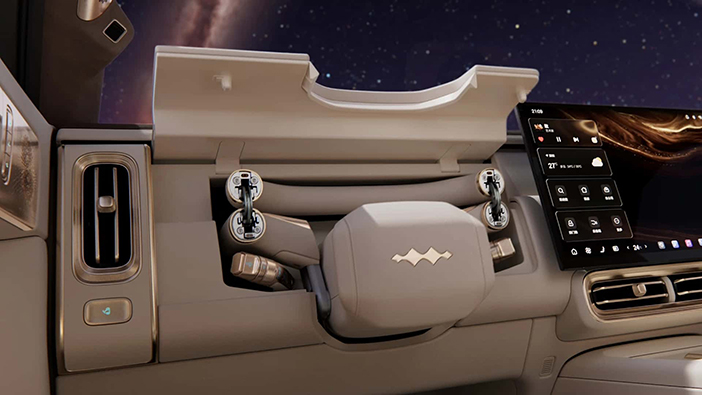
It takes around 10 seconds for the wheel to disappear or reappear from the dash and when it’s stored away, there’s space for a tray table, or for the driver to stretch out and relax. Obviously, the only time the steering wheel can be folded is when the Tai 9 is not moving. There’s no physical steering column in the car, which makes the process possible; instead, the Tai 9 comes with a steer-by-wire system. The Tai 9 itself has just gone on sale in China under BYD’s premium sub-brand Fangchengbao.
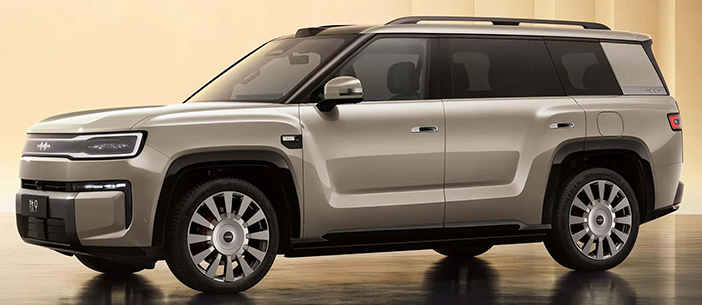
However, there are no plans as yet to sell the Tai 9 in Europe. That will be a relief for the likes of the Hyundai Santa Fe and Kia Sorento, because the 6-seat plug-in hybrid Tai 9 comes with plenty of impressive figures. Its huge 66.4 kWh battery allows a ridiculous 320 km electric range and with the 1.5-litre turbocharged petrol engine and 2 electric motors working together, there’s 535 hp on tap. That means the 2.865 kg, 5.3-metre long Tai 9 can launch from zero to 100 kph in 4.8 seconds. There’s also a load of technology on board, including a fold-down display for rear passengers, BYD’s adaptive ‘DiSus-A’ suspension system that we’ve tried on the Denza Z9GT, rear-wheel steering and the latest ‘God’s Eye B 5.0’ driver- assistance system. +++
+++ A former VOLKSWAGEN engineer admitted to trading on secret information about the German carmaker’s planned $5 billion joint venture with electric-vehicle maker Rivian Automotive. Michael Stamp, 31, pleaded guilty to securities fraud in federal court in Manhattan as part of a deal with prosecutors, confessing that he used his brokerage accounts to buy Rivian shares and options while in possession of confidential information about the merger he had learned from another employee. “I knew that what I was doing was wrong and a breach of my duty to my employer”, Stamp said at a hearing before a federal judge. +++