
++ BYD says it plans to challenge a legal decision that’s seen its Ti7 SUV banned from sale in Europe. This new ruling by the Hague District Court comes as the latest development in the legal battle brought by Jaguar Land Rover to protect the intellectual property of its Defender, which it says has been breached by the Ti7. The ruling to ban the BYD Ti7 from sale in Europe was made on Friday 20 November in a Dutch district court. JLR’s lawyers brought the case after BYD announced on its website that it would begin taking orders in the United KIngdom for its 7-seat SUV in January 2027. The ban takes effect one week after the ruling and prevents the sale of the Ti7 in the European Union, but it does not impact BYD’s activities in the UK market. Following the decision, BYD says it “strongly disagrees with today’s judgment and will appeal it. “The Ti7 is the result of BYD’s own independent design work and infringes none of JLR’s rights”, a spokesman said. Nevertheless, the court ruling stated: “In these summary proceedings, the preliminary relief judge rules that the Ti7 infringes the EU design of Jaguar Land Rover. The characteristic and distinctive elements of the design are reflected in the BYD Ti7”. BYD says it will “pursue every legal avenue to demonstrate that this decision is incorrect”, while JLR has reaffirmed that it will “protect its intellectual property and take legal action when necessary”. The BYD Ti7 went on sale in China, where it is known as the Fang Cheng Bao Tai 7, in 2025 and this new European sales ban is separate to the ongoing copyright case that JLR is pursuing through the Dutch courts. Earlier in November, JLR had been ordered to destroy seized materials following a raid on BYD offices in the Netherlands. In August, JLR bailiffs had executed an ‘ex parte’ (in other words, without prior warning to the defendant) seizure of digital files from BYD’s Schiedam and Hoofddorp offices. This followed the original claim that BYD not only copied the Defender’s exterior design for the Ti7 but also stripped down an example to reverse-engineer it. The raid was intended to secure files before they could potentially be deleted by BYD. Branded a “fishing expedition” by the Chinese firm’s lawyers, JLR is said to have recovered files regarding the Ti7’s development, as well as company financial data. However, a ruling at the District Court of The Hague ordered JLR to destroy all seized materials within 24 hours of the ruling or face a fine of up to half a million euros. Judges stated that the retrieval of such documents was unnecessary at that stage to prove any infringement, also pointing out that: “it is not in dispute between the parties that BYD does not currently offer (or has not already sold) the Ti7 on the market in the European Union. The foregoing means that the alleged threatened infringement cannot yet have led to any damage for JLR”. BYD’s subsequent moves to put the Ti7 on sale in Europe clearly triggered the JLR legal team to seek the sales ban. JLR is no stranger to having Chinese brands bring out models that resemble its own. Infamously, the LandWind X7 looked so much like the Range Rover Evoque that JLR won a legal action against its makers. More recently, we’ve observed that JLR’s products appear to be a frequent source of ‘inspiration’ for Chinese carmakers. Many Land Rover Defender-esque vehicles are on sale in China, while the hugely popular Jaecoo 7, for instance, has become known colloquially as the ‘Temu Range Rover’ in the UK. As for the BYD Ti7, Land Rover Defender comparisons have been widespread since it was confirmed the SUV would be coming to the UK market. At 5 metres in length, it’s a similar size to the Land Rover Defender 110, but it undercuts the cheapest 110 by almost €25.000 and even more if you compare it with the plug-in hybrid model. Many prospective buyers will be doing just that, because the BYD will only be offered in PHEV form at launch. This powertrain comprises a 1.5-litre petrol engine, alongside a pair of electric motors which, according to BYD, will propel the Ti7 from 0-100 kph in just 4.8 seconds; only half a second slower than the high performance Land Rover Defender Octa. A huge 35.6 kWh battery provides a 130 km electric-only range. A fully-electric version of the BYD Ti7 has been announced in China, but we don’t yet know if it’ll make it to the UK. While attempting to defend its intellectual property in court against BYD, Jaguar Land Rover has entered into a joint venture with rival Chinese automotive giant, Chery. The resulting Freelander 8 SUV will be sold in the UK. +++
++ Designers of cars from CHINA are copying European designs to achieve a ‘familiar’ look that will speed their growth in western markets. That’s according to the design boss at Lepas who also thinks a more distinct style for Chinese cars will arrive in time. The comments come following fierce criticism from both press and consumers that some Chinese models are copies of original designs from legacy brands. Design chief at Chery’s new premium export brand Lepas, Ivan Dulanovic, told during an interview: “I think what’s required for this process is time. When we’re talking about Europe, it has the longest heritage of car design”. The Jaecoo 7 from Lepas’ sister brand, for example, has garnered the nickname ‘Temu Range Rover’ after buyers noticed distinct similarities between it and the baby Range Rover Evoque. Parent firm Chery’s iCaur brand, which is set to arrive in the UK next year, boasts a fleet of SUVs and off-roaders, all with designs reminiscent of the Mercedes G-Class and Land Rover Defender. Speaking of the Defender, rival brand BYD has recently also come under allegations of copying the Land Rover 4×4. The BYD Ti7 SUV has been banned from going on sale in the EU after European courts claimed it “infringes the EU design of Jaguar Land Rover”. The claim in the JLR-BYD case is that the Ti7 copies both its design and some of its mechanicals from the Defender. Dulanovic, nevertheless, admitted that the aim of Chery, which until very recently was an unknown entity for European buyers, has long been to present “friendly” designs that were more familiar to help it break into western markets. “I hope in the future, say in 20 years, I would like to see Chinese companies push onto Chinese aesthetics”, he said. “But I think before that, what is to be recognised globally, is where we are right now. We approach this with a friendly face and overall exterior designs that associate with people from Europe, where the recognition of a good car is something you’re already aware of”. “With this approach, it may happen that the cars may look similar”, Dulanovic conceded. There are signs that some originality is beginning to be cultivated by Chinese marques; recently, Lepas debuted its first design concept, which takes the brand in a unique new direction, specifically with the use of leopard eye-inspired headlights and gaping, illuminated grilles. Dulanovic says this highlights the evolution of Chinese cars from perceived cheap copies to original designs that stand on their own two feet. “We already see the change happening, and the market share also is a testament to that”, he claimed. Before joining Chery, Dulanovic cut his teeth at the Milan Design School, following this with a stint at Italian design house, Italdesign. Obviously keen to flex his European design muscles, Dulanovic admitted that “I’m a sedan guy. I look forward to the day when we finish the line-up”. First to arrive from Lepas will be the production version of the Aura concept: a family hatchback with either hybrid or full-electric power. It’s unclear whether the final car will get the same striking looks as the concept, or a more sedate face pulled straight from the L6 EV, which is already on-sale. Regardless, we won’t have long to wait, with the next Lepas model expected to be revealed at some stage in 2027. +++
+++ DACIA is preparing a new generation of its Jogger to join the next Sandero that’s due to arrive in 2028, repeating a successful recipe that should see a fully electric model offered in the range for the first time. The new Jogger is destined to share the current car’s core proportions and layout, but come with more advanced powertrains, including a full electric option. Dacia’s head of design, David Durand, confirmed that a new Jogger is very much part of the firm’s future product offensive as it approaches a new phase of model launches. “This is a big part of our job in this strategic moment of redefining the future line-up of Dacia; how Dacia should evolve and question what fields we are and are not involved in”, he said. “The Jogger is very Dacia, in the sense that we have no competitors. There are no European or Chinese brands in front of us; there is no real 7-seater on the market at that price or weight. There is perhaps a €10.000 difference for a 7-seater, and 300 kg in terms of weight, which is important today”. Dacia is typically able to offer its cars at a low price due to a prudent approach to building the business case for each model by leveraging existing assets and tech from the Renault Group, combined with strict cost control. This enables the Romanian brand to price the Jogger at a point lower than rivals at all costs, and it’s a position that will continue for this next-generation model. But given that the current version is so distinctive in the marketplace, we queried whether its success would give Dacia a mandate to include more fundamental variation in design and packaging as it developed the car. Durand responded: “If I were to start with a clean sheet of paper, I would definitely try to move forward the windscreen because it works well to emphasise the roominess of the car. But think of the advantage of sharing the front end with the Sandero. We are saving a lot of money; we can manufacture it on the same line, and there’s a heavy cost advantage to sharing so much with the Sandero”. The next Jogger will mimic the new Sandero that’s in development. But from the B-pillar backwards, the expanded bodywork will accommodate 2 further rows of seats and a reasonably sized boot in a rear end that’s styled to sit somewhere between an MPV and an estate. However, the Jogger’s technical package will be quite different next time around, as Dacia prepares a more flexible architecture for various powertrains in its next Sandero, and by extension the Jogger, too. Key to this is Renault’s CMF-B platform, which can support ICE and all-electric variants. In the case of the next Jogger, expect to see the option of hybrid, full electric power and compressed natural gas (CNG), too. The hybrid set-up will be familiar from the current model, with a 155 hp 1.8-litre engine matched to a small e-motor and battery pack. The all-electric model’s battery size is almost certain to be governed by the packaging constraints of the CMF-B platform. Currently, the largest pack available in a car running on this architecture is found in the Renault 4 and 5, which have 52 kWh capacities good for around 400 km. However, Renault is constantly updating its electric powertrain technology, so a more powerful, smaller and cost-efficient battery pack could be on the cards, if for no other reason than to keep the 5 E-Tech competitive against its own crop of tough new competitors. But the Jogger will have no such rivals and will continue to offer customers a versatile, flexible and practical family car at a very low cost. Dacia’s CEO Katrin Adt put it very clearly: “We are always looking at it from the perspective of customer needs, and we can see that we have a very specific offer, with a loyal customer base. So it has a very specific position, and we’re in constant discussion on how to carry that forward”. With the addition of a battery-electric option that should offer close to price parity between ICE and BEV powertrains, Dacia’s future Jogger has never been more relevant. +++
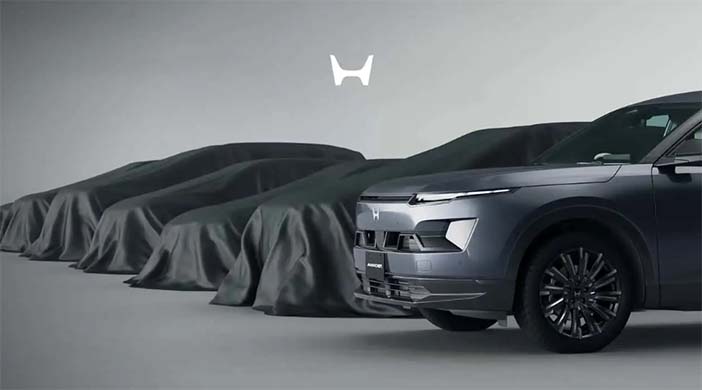
+++ +++ HONDA ’s official Avancier video is easy to watch and move on from, and that’s exactly how we almost missed what is perhaps even bigger news. In the final seconds, the camera pulls back to show more cars sitting under covers next to the SUV. Honda doesn’t say what they are, but the timing makes the message clear: the Avancier is just the first of several new hybrids due from 2027. What Honda did explain, in a detailed press release, is what’s underneath them. A new Honda Hybrid system replaces e:HEV, a shared modular platform spans the C- and D-segments, and a new electric all-wheel-drive setup ditches the propeller shaft. Honda promises 10 percent better efficiency and a 30 percent cut in hybridization costs. Before anyone gets too excited, note the baselines: efficiency is measured against 2018 models, and the cost reduction is against 2023. This isn’t a 10 percent jump over what Honda sells today. Still, how the company gets there is more interesting than the headline. +++
+++ 5 people, one question, and the room did not need a second to answer. A group of mechanics at a family-owned repair shop in Middleton, Wisconsin weighed in on used JEEP cars, and only 1 of 5 said yes, with a catch that narrows the field to nearly nothing. The informal poll, posted as a video, caught Sam, Sandro, Evan, Brian, Stacia and Logan answering the same question back to back. Five gave a flat no. One drew a hard line at the 2005 model year. The clip from Aeschbach Auto’s Instagram carried their shop-floor reactions without further explanation of the reasoning behind each answer. Sam did not just rule out a used Jeep. He went further, saying he would not buy one new either, and left it there without elaborating on specific models or years. Sandro kept his answer even shorter. “No. Short answer, no”, he said, declining to buy a used Jeep when asked directly. Evan took the same stance as Sam. “No. I would not buy a new Jeep”, he said, pairing his rejection of used Jeeps with a rejection of new ones too. Brian and Logan closed out the no votes. Brian answered with a single word, while Logan’s response left no room for interpretation: “No. Never”. Stacia broke from the group, but her yes came wrapped in a condition tied to a specific production era rather than a blanket endorsement of the brand. “Yes, if it is old. I would say pre pre-05. Pre-05 I would buy a used Jeep”, she said, drawing a line at model year 2005 as her cutoff for consideration. Anything built after that point was off the table for her just as firmly as it was for her colleagues. “Anything newer than that, hell no”, she said, closing the gap between her answer and the rest of the room’s. The split, 5 against with 1 conditional exception, lines up with broader experiences. Reliability and running costs are the recurring themes in similar stories, even when the gripes do not always target the same Jeep models or trims. One owner traded in her Grand Cherokee for a different SUV entirely, a dealership trade-in that hit a snag. Not every Jeep story on this site ends in regret, though. A 707-horsepower Grand Cherokee Trackhawk built before the newer generations has shown up as a used-buying recommendation, covered in a guide to that specific high-performance SUV, suggesting the staff’s blanket no does not necessarily extend to every used Jeep built in the brand’s history. +++
+++ Several automakers have seen sales decline amid growing competition from Chinese brands expanding globally with more affordable vehicles. As such, some brands like Range Rover have shifted their focus from chasing sales volumes to offering more bespoke vehicles, which typically have higher margins. ROLLS-ROYCE is already a household name in this space, and its latest multi-year creative exchange with Chinese master artisans could help improve customization options for its ultra-luxury vehicles. This program explores traditional craftsmanship and could introduce new materials and techniques, which may prove crucial, given that China is the brand’s second-largest market behind the U.S. It would also strengthen the brand’s relationship with Chinese buyers, particularly those interested in incorporating local cultural heritage into their cars. However, Rolls-Royce hasn’t announced a specific production vehicle incorporating learnings from this creative exchange. What the press release disclosed is that the British luxury marque is working with the Li Keran Art Foundation, a Chinese organization dedicated to preserving traditional art and craftsmanship. Moreover, the first project focuses on Chengxintang paper, a traditional Chinese handmade paper historically produced for the imperial court. Only one original sheet of Chengxintang paper is believed to survive. Rolls-Royce is studying a modern reconstruction developed through 20 years of research. The reconstructed Chengxintang paper will be featured at an exhibition in Beijing running from November 19, 2026, through January 10, 2027. The exhibition could offer an early glimpse of the Chinese craftsmanship and materials that may eventually make their way into the automaker’s customization catalogue. The partnership could also showcase Chinese cultural traditions to a wider global audience, thanks to the brand’s reputation and influence in the luxury car market. Chris Brownridge, Rolls-Royce Motor Cars Chief Executive, said, “Every exchange of this kind brings new insights for all involved. What our craftspeople have already learned in Anhui Province will inform them throughout the years to come, and in time, it will be seen in what we make”. While the “what we make” part is still unknown, Rolls-Royce’s relationship with China dates back to the 1920s, when its first car arrived in Shanghai. Last year, the automaker introduced three Bespoke commissions inspired by ancient Chinese mural paintings in Dunhuang. The latest effort complements the more than €350 million expansion of its Goodwood plant, designed to increase capacity for Bespoke and Coachbuild projects. +++
+++ VOLKSWAGEN is preparing to install a brand new engine in its flagship Golf R with a 48 volt mild hybrid system that’ll power a small electrically driven supercharger alongside a new turbo. Reinhold Ivenz, Volkswagen’s head of R, told at the launch of the T-Roc R: “So Golf R will also change in the middle of next year with Euro 7 emissions regulations. It’s progress because we have more power from zero rpm and thanks to dynamic start, it’s also quicker than the old version”. This change will be implemented on the new variant of VW’s iconic ‘EA888’ 4-cylinder engine that was revealed under the bonnet of the latest T-Roc R. This ‘evo5’ version shares a 2.0-litre capacity and single turbo layout with the old engine, but features a raft of new technology that allows it to pass the tough new Euro 7 emissions regulations, which will need to be adhered to by the end of 2027. New elements include a 48 volt mild hybrid system that powers a starter motor generator that takes the place of a traditional alternator and starter motor. However, it is also then able to power a small electrically driven supercharger (similar in practice to those found in high-end 6-cylinder AMG engines) which will help improve engine response and produce more torque at low engine speeds. Building further on this is a new variable geometry turbocharger. In the new T-Roc R, this set-up produces 333 hp and 420 Nm of torque. This is the same as the current Golf R; however, the benefits, beyond a reduction in emissions and fuel consumption, are that those figures are available lower down the rev range. This will make the engine feel faster than it does presently, and could also yield an improvement on paper to today’s 4.8 seconds 0-100 kph time. This engine will be connected to a 7-speed dual-clutch transmission and all-wheel drive. However, we expect the torque-vectoring rear differential to be given the same fresh software as in the new T-Roc R, giving the new Golf even more dynamic handling characteristics. While the specifics of when we’ll see the new engine have yet to be confirmed, it will have to be implemented by the end of 2027 in order to remain compliant with the Euro 7 deadline. VW is also quite partial to an anniversary limited edition, and given that 2027 will mark 25 years of the R sub-brand, I also expect to see the introduction of a special celebratory Golf R alongside the updated series-production model. +++