
+++ The teaser campaign for the Torcal, the first-ever BENTLEY all-electric vehicle, is ramping up, and today, the British automaker provided a new glimpse of the SUV, specifically its new interior and the materials used therein. While an all-electric product marks a departure from traditional internal combustion for Bentley, everything else about the Torcal will feel just like any other car made in Crewe, and that means a gorgeous cabin dressed in the finest materials available. Even more preferable would be for the EV to approach luxury with a view to innovation, and the Torcal does just that. Bentley says the new Torcal will still embrace the use of leather and wood, but those seeking something new will be catered to as well, starting with the introduction of Merino wool. In the fashion world, this material is desirable for its softness and warmth, but with butts and backs moving back and forth and side to side over seating surfaces, wool hasn’t historically provided the durability required by automotive applications until now, so in partnership with Fox Brothers, a Somerset, England-based cloth maker that has been working with wool since the 1700s, Bentley has developed a weave that gives us “the world’s first 100 percent Merino wool automotive fabric capable of meeting the exacting demands of a luxury vehicle”. Despite its resilience and robustness, the fabric managed to achieve 100 percent certification under the Responsible Wool Standard, and Bentley has added six new interior colourways to match.
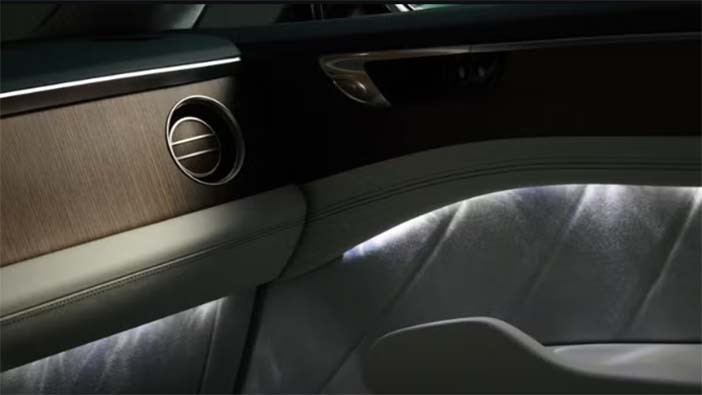
Also new to Bentley and making its debut on the Torcal is Ombre Veneer, which combines sustainably sourced walnut off-cuts with recycled paper. Over 1.000 individual layers are carefully selected and then pressed together. This mass of arboreal material is then sliced to less than a millimeter in thickness; the end product lets four shades of walnut (deep black, dark smoke, light smoke, and natural walnut) flow together, creating a unique pattern for every vehicle. Another new addition is Sunburst Aluminium by Mulliner, reinterpreting Bentley’s traditional engine-turned aluminium dashboards with a special 3-way brush pattern. At first glance, it almost looks like a metal-interwoven carbon fiber. +++
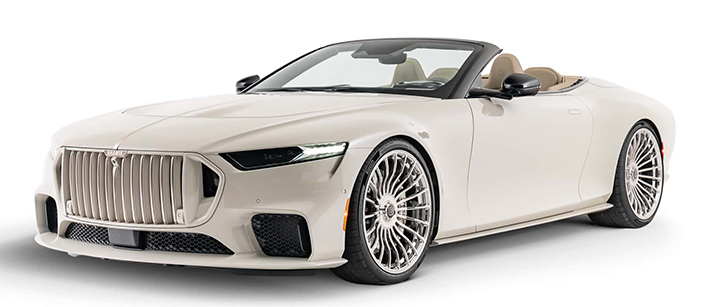
+++ The roof is gone, the numbers are up, and BRABUS just rolled its wildest creation yet into the Monterey sun. Unveiled on August 14 at The Quail, the Brabus Bodo Cabriolet is the open-top counterpart to the already-outrageous Bodo Hyper-GT coupe, and it arrives as a 1.000-horsepower carbon-bodied statement piece. This is coachbuilding turned up to eleven: an Aston Martin Vanquish Volante chassis and cabin architecture wearing a completely new carbon fiber body, a heavily reworked V12, a 7-figure euro price tag, and a production cap in double digits shared with the fixed-roof car. Under that long carbon fiber hood sits Aston Martin’s twin-turbo 5.2-liter V12 mounted in a front-mid position, reworked by Brabus with new hardware and calibration to deliver 1.000 horsepower and 1.170 Nm torque to the rear wheels. Brabus pairs it with an 8-speed automatic transmission and a limited-slip differential, giving the cabriolet the same headline output as the Bodo Gran Turismo coupe. The body is entirely carbon fiber made using a pre-preg process at Brabus’s Bottrop facility, helping hold dry weight to 2.760 kilos kilos despite the size and the hardware. Measuring 5 meter long, 2 meter wide and 1,3 meter tall, it is more hyper-GT than compact supercar, with presence to match the power and the €1.077.000 (taxes not included) base price, roughly mirroring other Brabus Bodo Hyper-GT pricing and details. The Bodo Cabriolet rides on 22-inch Brabus Monoblock Z-GT wheels and runs an active aerodynamics package that includes an integrated front carbon spoiler and an electrically extendable rear wing. If you follow coach built restomods like the Mercedes 600 restomod by Brabus or high-end projects such as the Mercedes-Benz 190E Evo II restomod, this car is cut from the same bespoke cloth, but its mechanical bones and cabin layout clearly trace back to the Vanquish donor. The Bodo Cabriolet is limited to 77 units worldwide, and that figure is shared between it and the existing coupe, making each open car even scarcer. Brabus describes it as a fully coach built, open-top supercar built to individual order, and its CEO Constantin Buschmann frames it as being created “in every detail as he would have driven it”, underscoring how personal the project is inside the company. Performance claims match the drama of the spec sheet. The Bodo Cabriolet is said to sprint from 0 to 100 km/h in 3.0 seconds and to an electronically limited top speed of 360 km/u. These numbers align with earlier Bodo roadster performance previews and other ultra-rare open-top supercar launches at Pebble Beach. +++
+++ JLR (Jaguar Land Rover) is finally putting real weight behind an American manufacturing push, and it is doing it with help from Stellantis. The plan is not to simply ship today’s Defender across the Atlantic, but to create new Defender-branded vehicles built in the United States for American buyers. That idea hits several pressure points at once: tariff costs, currency swings, and how a relatively small luxury player can gain scale in a truck and SUV market. Jaguar Land Rover chief financial officer Richard Molyneux told investors that the company signed an exploratory memorandum with Stellantis in May to explore “complementary capabilities” in US product and technology development. He said this framework is expected to include Defender-branded models built at Stellantis plants in the United States, with a specific manufacturing agreement targeted around the end of this year. Molyneux described the North American push as “new vehicles, new segments” under the Defender badge, aimed squarely at US customers, and pointed to volume limits as the reason not to just localize the existing Defender. JLR sells roughly 30.000 Defenders a year in America and he argued it “can never localize efficiently at 30.000 units or even at 50.000 units”, which is why Stellantis-built products are on the table instead of copying the current SUV. Those future American Defenders are widely expected to use a Stellantis platform, likely related to the Jeep Wrangler. The collaboration is also about money. Reporting on the strategy notes JLR has been paying hundreds of millions of pounds in tariffs, and the company itself has highlighted tariff exposure and currency risk as reasons to look at US production. If US-built Defenders move forward, they would sit alongside imported Range Rover and Jaguar models, not replace them. Stellantis brings something JLR does not have today: an established US factory footprint with truck and SUV capacity. The group is already reshaping sites such as Belvidere, Illinois, for future Jeep models, and analysts see that broader network as the kind of asset JLR wants to tap instead of funding a clean sheet North American plant of its own right away. +++
+++ It’s been over a decade since LAMBORGHINI last offered a manual transmission in its cars. The last one was the Gallardo, and it was available with 3 pedals and a stick shift until it was retired in 2014. As for the last V12-powered model with a clutch pedal, that would be the Lamborghini Murciélago LP 670-4 SV, and only 5 were reportedly made. The Gallardo’s successor, the Huracan, was dual-clutch only, while the Aventador’s sole transmission choice was an automated manual. The same rings true for the current supercars, as both the Revuelto and Temerario shift with a dual-clutch and nothing else. Given that there are ultra-exclusive hypercar manuals and even Ferrari putting it back in one of its cars, what about Lamborghini? Longtime Lamborghini CEO Stephan Winkelmann was recently asked if the brand will follow in the footsteps of some boutique automakers and Ferrari in reviving manuals. For those hoping that the executive will give a scoop of some sort, don’t hold your breath. Regarding that matter, Winkelmann said: “For me, this is something which is not on our priority list, because we have a lot in the pipeline”. He then added: “The manual gearbox is mostly for collectibles, and today we don’t have any plans to do so”. Well, that’s as straightforward as it gets. While the door isn’t completely closed on that idea, he sounded firm in his decision. While electrified manuals are possible, it’s not for full-hybrid systems just yet. At most, mild-hybrid systems can be fitted with manuals, but given how series and parallel hybrids are built now, it simply isn’t possible. The workaround is to build something like what’s fitted to the 12Cilindri Manuale, but even that is more of a shift-by-wire system that simulates a manual. Even then, the 12Cilindri Manuale isn’t electrified in any way. As Winkelmann said, manuals, at least in the space that Lamborghini occupies, are for the top-shelf stuff. At the moment, the Italian automaker isn’t cooking up ultra-limited-run models save for 1 or 2 special editions. Also, it’s mulling over a grand tourer in the same vein as the Espada, so it’s likely that the company is devoting its efforts to that model over a one-of-ten vehicle. But as technology progresses, we’re certain that these high-performance plug-in hybrids will get some form of manual transmission someday. However, it isn’t Lamborghini’s top priority. +++
++ MINI has started work on the next-generation Cooper, which is due in the coming years bearing the most significant transformation since BMW took charge of the marque 3 decades ago: a shift from front- to rear-wheel drive. Bosses promise, however, that the new car will remain rigidly true to the brand’s roots. The current hatchback arrived in 2024 with the choice of both petrol and electric power; the latter then one of the few small EVs on sale. Its only true rival was the Fiat 500e, but it was also priced to compete with larger alternatives such as the Peugeot e-208 and Cupra Born. A whole swathe of electric superminis have arrived since, however, with many (such as the Renault 5 E-Tech and Fiat Grande Panda) offering comparable style, dynamics and kit plus more range for less money. Mini has responded with price cuts, and a facelift is due in the next couple of years to freshen up the Cooper, but the pressure is piling on as a wave of new entrants muscle in on the small EV segment, with models including the Volkswagen ID.Polo, Cupra Raval and Alpine A290. Combined with the might of Chinese newcomers such as BYD and Geely, that competition has forced the most radical rethink of Mini’s trademark model in generations. “We have started to work on the next generation of Mini, and what follows now is a look at the entire portfolio”, new design chief Holger Hampf confirmed, explaining that he will use a wave of facelifts and new derivatives in the meantime to set the tone for the British brand’s future. Every iteration of the Mini to date has been front-driven, with agility and smart interior packaging key to the car’s identity over the past seven decades, but now that’s set to change. The current Cooper Electric is built by Mini joint-venture partner Great Wall Motor in China, on a bespoke front-driven platform that it shares with the Aceman. For the next generation, the hatchback is being lined up for a move onto parent company BMW’s new, natively rear-driven Gen6 platform, which underpins the firm’s new Neue Klasse electric cars, beginning with the iX3 and i3. The Gen6 doesn’t currently accommodate front-driven cars. The rear motors used in the iX3 and the i3 have gearboxes, but the smaller drive units mounted on the front axles of those cars’ four-wheel-drive variants don’t. BMW Group engineers told at the launch of the Gen6 that the firm had no plans to develop a viable front drive unit and that could force the Mini to make the landmark shift. As previously reported by Autointernationaal.nl , the BMW 1 Series (which currently shares the petrol Mini’s UKL platform) is set to return to rear-wheel drive as it gains an electric option on the new platform, and BMW’s development boss Joachim Post has previously told the Mini could follow suit. “We will see what the future is”, he said, when asked about scope for a rear-drive next-generation Cooper. He suggested the company would choose “the optimum for the package” and said “sheer driving pleasure” is the priority for future models. The decision would also have significant ramifications for the petrol Cooper, which is expected to carry on through the 2030s, possibly with the addition of hybrid powertrains, still driving the front wheels. Although they share a fundamental design, the current petrol Cooper is an overhauled version of the previous-generation car, while the electric Cooper is based on the Chinese JV platform; opting for the new BMW architecture could bring a bigger gulf between the look of the 2 models. Regardless of any technical revolution, Hampf is resolute in his commitment to maintaining the brand’s signature look. “You can ask a Brit or a German or an Italian, you can ask a 5-year-old, and they will recognise a Mini based on the proportions of the car”, he told. “Especially when it comes to the 3-door hatch, it’s a very short car with wheels at its corners, short overhangs, with some signature elements such as the facial impression. This is the most important to me: the combination of round headlights and grille”. Referring to future versions of the flagship hatch, he added: “Every 5-year-old will know this is a Mini. It’s my job to treat it with respect”. Hampf said his “number-one” priority is maintaining the Mini’s proportions and “this is non-negotiable”. Mini’s long-running commitment to retro design will also become a virtuous circle with the next generation of the hatchback. Hampf suggested this will take inspiration from the ‘R50′, the first of the BMW Minis. He said: “Many people out there don’t actually have a recollection of the classic Mini but they do have a recollection of one of the Minis we have done in BMW’s ownership in the past 25 years. I will make sure to connect to this past. And this isn’t to say that we will become vintage, not at all. It’s an interpretation in the modern way of what we’ve done: a clever use of space or some smile-creating surprises in the car. Certainly some Britishness”. Hampf also hinted at a desire to shrink the Cooper. Asked about 2011’s Rocketman concept, a 3-door just 3.4m long, he said: “The size discussion about Mini growing smaller, bigger and so on, we have that every day”. He added that the existence of the Countryman covers the brand’s bases “where a Cooper falls short in some use cases”. However, the Cooper must still be able to accommodate the safety structures and driver-assistance technologies required of today’s cars and can’t entirely compromise practicality for design flair. “Maybe this is my personal belief, but a Mini was always good for going out to the market in the morning, driving your kids to school and going to the opera in the evening”, Hampf said. “I’m not saying going smaller isn’t a possibility, but it has to fit into today’s lifestyle as well”. He suggested that Mini’s commitment to compactness means the 3-door body option (one of only a few such superminis left on sale in Europe) will continue into another generation. The smaller car is “the product we always care about as much as possible”, he said, adding that “it will always be our anchor”. +++
+++ PEUGEOT plans to reinvent the 308 hatchback as a coupé-SUV fastback, as it seeks to spark car buyers’ imaginations with a new bodystyle pitched between traditional SUVs and hatchbacks. Models such as the 308, Volkswagen Golf and Opel Astra have lost market share as punters have migrated from hatches to SUVs, with Ford giving up on the once-mighty Focus altogether. But Peugeot refuses to abandon the segment, vowing to explore a third way with a car that’s more efficient than an SUV, more practical than a hatchback and more stylish than either: a 308 Fastback. The inspiration is the 408 Fastback, the French brand’s near 4.7-metre-long flagship, a cross between an SUV and a liftback whose aggressive design resembles the Lamborghini Urus from some angles. This concept could be downsized to around 4.4 metres, slightly longer than today’s hatch, because an extended rear overhang will be needed to catch a swoopy, coupé-like roofline while ensuring sufficient boot space. Peugeot has promised to introduce 7 new cars by 2030, with the 208 and 2008 first to the starting line. Then comes the task of revamping its 3 mid-sized family cars in the C-segment. “We’re going to replace the 3 cars in the future and I’m confirming that we’ll explore different things rather than just renew the 308, 308 SW and the 408”, Peugeot CEO Alain Favey told. “We’re trying to find other things that will contribute to these cars extending our territories”. Parent company Stellantis has designated Peugeot as one of its 4 ‘global’ brands, asking it to grow its line-up to cover 60 percent of the market (up 15 points on today). A dramatic-looking, higher-riding fastback could be ideal to boost sales in markets such as the Middle East, Africa and Turkey. “We have the green light to develop 3 new C-segment models, so what’s the best way to do it? Is it going in different directions?”, Favey asked me during a meeting at the Le Mans 24 Hours race earlier this year. His preference is to use customer clinics to explore different body styles. “You need time to innovate and test them, to make sure you’re not going the wrong way”. The boss admitted Peugeot was toying with a “compact SUV” as one of the test trio, which would have a knock-on effect on the 2008 and future 3008. Today’s smaller SUV is 4.3 metres long (big for its class) while the 4.54-metre 3008, although stylish, is arguably too close to a fastback, compromising its rear-seat space and cargo capacity. If its replacement is more upright, spacious and longer, it would create space in the line-up for another C-SUV, or a 308 Fastback. Is that a possibility, I asked? “Another route could be something completely new, like we tried with the 408”, Favey agreed. “Everyone is trying to find the next thing after SUVs, and of course we are, too”. It’s a concept Peugeot’s head of design, Matthias Hossann, is eager to explore. “We will have more and more creativity around this new kind of body type, which is exciting”, he explained. And he’s determined to boost the “emotional” connection with Peugeot design, to help its cars stand out amid new Chinese entrants. Hossann loves the 408 Fastback’s stance: the relationship between the car’s chunky body and glasshouse, big wheels helping raise the ride height and the sloping roofline. The body style hides a battery slab better than a saloon, which would end up looking tall, and it harbours more space. The 308 Fastback would also encapsulate Peugeot’s ‘Feline Future’ design language, with a posture resembling a cat poised to pounce, reckons Hossann. It will build on the design of 2025’s Polygon concept, which looks clean and modern with only a few well chosen lines, creating a visual simplicity that belies the way its curved bodysides juxtapose with an exaggerated, flat shoulder line. The head of design says he was inspired by the clean panels of Peugeot’s 205 and 405 cars from the eighties. While Peugeot’s current range of models features vertical ‘claw light signatures’, these are being reconfigured horizontally, like the plastic strips across the 205 GTi’s tailgate. “But we want to project this light signature in the future with three horizontal stripes. It reflects our heritage without doing something which is purely retro”. The 308 Fastback and its sister cars will be based on Stellantis’ new STLA One platform. Conceived electric first, the architecture is being developed to accommodate petrol/electric hybrid power, too. A big development is its ‘cell-to-body’ architecture, where the battery pack acts as the car’s floor. Pioneered by Tesla and BYD, this helps eliminate unnecessary structure to cut weight. Such painstaking engineering, along with the 308 Fastback’s more raked windscreen and aerodynamic roofline compared with a boxy SUV, will maximise range for the electric variant. That should ensure the sleeker 308 eclipses the 700 km range of today’s 3008 Long Range variant on the WLTP test cycle. Set for its first application under next year’s 208, STLA One also boasts steer-by-wire technology. This replaces the mechanical link between the steering wheel and the front axle with a digital connection; sophisticated software processes myriad data points then determines the necessary steering inputs. Steer-by-wire tech has two main benefits: variable steering maps, with super-fast responses to make parking a doddle, or greater stability on the road, for instance. Eliminating the steering column also saves parts and cost, and allows the dashboard to be reconfigured, creating more space in the cabin. This could allow the next generation of both 208 and 2008 to feel more roomy without physically growing. While Peugeot will take the lead in exploring the C-segment fastback concept, OPEL could also embrace the bodystyle. Opel CEO Florian Huettl told me that while the next-generation Astra will be available as an ST estate, “it doesn’t necessarily mean that the new Astra is a traditional hatchback”. Does the bodystyle need to be shared across multiple brands to justify the investment, I asked Favey? “Peugeot is free to do whatever we think is right for Peugeot”, he shot back. “There’s more to it than for other brands to take over what Peugeot’s done and do a reskin of it to fit their needs. I don’t think someone would say, ‘Peugeot cannot do that because it doesn’t suit Opel’. We try to find common interests but different profit pools. And there’s no censorship for whatever Peugeot wants to do based on other brands’ desires”. Development work is in full swing and Peugeot may use October’s Paris Motor Show to gauge some public reaction to a new concept: “You will have a nice surprise in the coming months,” design boss Hossann told us while we were in Le Mans. But, if the 308 Fastback gets the green light, don’t expect a production car soon: even though Peugeot is moving to 24-month development cycles. “The first car will come at the end of 2029 and the others in 2030: it’s very early in their development”, said the CEO. Let’s hope the 308 Fastback makes the grade: it could be just the concept to reinvigorate the mid-size family-car market. +++
+++ Chinese brands have been climbing EV-sales charts almost everywhere, but SOUTH KOREA apparently missed the memo. Tesla is having its moment there, as the Model Y is the best-selling new car in the country, ahead of not just every other import. Tesla has cleared 10.000 units in Korea in each of the past 5 months. July brought 10.237, down from the 11.119 it managed in June, though that still worked out to 33.1 percent of every imported car registered in the country that month. BMW came second with 6.533, Mercedes-Benz third with 3.959. The rest of the top-24 consists of: 4. BYD 2.846. 5. Lexus 1.474, 6. Toyota 1.340, 7. Volvo 958, 8. Audi 935, 9. Porsche 635, 10. Mini 632, 11. Volkswagen 471, 12. Land Rover 308, 13. Polestar 248, 14. Jeep 73, 15. Lamborghini 61, 16. Cadillac 42, 17. GMC 41, 18. Lincoln 39, 19. Bentley 36, 20. Peugeot 35, 21. Ford 32, 22. Ferrari 18, 23. Rolls-Royce 12, 24. Honda 11. Just like in other markets, it’s the Model Y that is dominating Tesla sales. A total of 8.705 were delivered in July, allowing it to surpass the Hyundai Grandeur as the nation’s best-seller that month, of which 8.532 units were sold over the same period. The Model Y Premium is the most popular, accounting for 6.612 sales, while 2.092 Model Y Premium Long Range models were sold. Tesla has been performing extraordinarily well in South Korea through the first 7 months of this year. Total sales over this period hit 66.376 units, up 149.8 percent compared to the same period last year. Of these, 52.064 were Model Ys while 10.392 were Model 3s. In general, Koreans prefer to buy from local brands, which explains why models from Hyundai and Kia largely dominate local roads. However, the Tesla Model 3 and Model Y are proving they’re open to new and compelling vehicles from foreign brands. Trailing far behind the Model Y as the country’s second-best-selling imported vehicle so far this year was the BMW 5-Series, with 13,756 units sold. +++
++ Since the $7,500 federal EV tax credit expired in September 2025, the electric-vehicle market in the UNITED STATES has posted decline after decline. June 2026 showed some signs of improvement, with EV registrations topping 100.000 for the first time since the incentive ended. Still, the month marked the market’s ninth straight year-over-year decline. Automotive News reported that U.S. EV registrations fell 11% year over year in June to 100.515 vehicles. For shoppers, the softer demand could mean continued discounts and other incentives as automakers work to move inventory. Hybrids, meanwhile, have gained ground with U.S. buyers, adding pressure to the EV market. Needless to say, Tesla topped the June rankings with 61.813 registrations, an 8% increase from the same period last year. It accounted for 61.5% of new U.S. EV registrations, while its bestselling model, the Model Y, captured 42% of the market on its own. Interestingly, Rivian surpassed Hyundai to take second place with 4,535 EV registrations. That represented a 1.7% year-over-year decline, but nearly half of its total came from commercial vans, whose registrations rose 43% to 2.061. Registrations for the R1T and R1S both declined. It is worth noting that the R2 (expected to become the brand’s volume seller) only began customer deliveries in June, so the California-based automaker’s numbers could improve in the coming months. Chevrolet placed third with 4.094 EV registrations, down 57% year over year, followed by Hyundai with 4.011, down 23% and Cadillac with 3.931, down 4.6%. Toyota, which was slow to embrace EVs during the segment’s rapid rise, registered 3,690 vehicles; a 167% increase from the same period last year. To be fair, the redesigned BZ4X only arrived in the second half of 2025, while the C-HR+ reached U.S. dealerships earlier this year, giving the company a low comparison base. The silver lining in the declining registrations is that the EV market appears to be stabilizing faster than the bleakest forecasts expected. However, no major rebound is expected anytime soon, with automakers reportedly hesitant to commit more resources to EVs. Demand is currently shifting toward hybrids, an interesting development given that surging fuel prices have also increased interest in all-electric cars. That trend is particularly visible in California, America’s largest EV market, where hybrids accounted for more than 22% of first-half registrations, ahead of EVs at roughly 16%. +++