
+++ In a sea of choices, which brands have the BEST new cars, and which brands’ certified pre-owned programs are the most competitive? To answer those questions, the U.S. News & World Report evaluated 39 automakers across 6 segments to shine a light on the brands worthy of your consideration, whether buying new or used. The brand awards cover cars, SUVs, pick-up trucks, EVs and the luxury segment, with winners from Japan, Korea and the U.S., but not Germany. In fact, for the second consecutive year, Genesis has taken top honors in the Best Luxury Brand category, beating formerly prolific Porsche once again. This was credited to a vastly improved dealer experience compared to the brand’s early days, one that continues to make customers feel valued while giving them the freedom of myriad bold customization options without the Porsche Sonderwunsch price tag. Meanwhile, Lexus won the Best Certified Pre-Owned Program award, keeping the dream of a heavily depreciated LC 500 beyond reach for yours truly. Award winners for the 2027 model year include many of the usual suspects, and in the Best Car Brand category, Mazda claims the top spot for an award category Volkswagen might have been expected to dominate just a few years ago. The publication highlighted the Mazda 3 and MX-5 for their fun driving dynamics, general refinement and relatively upscale interiors, which are not typically dominated by oversized and distracting touchscreens (though not all Mazdas are quite so lucky). U.S. News Autos‘ managing editor, Alex Kwanten, told me that Honda was also considered for this category, but price and safety deficits to Mazda ultimately swung the vote in favor of the Hiroshima-based automaker. When considering the Best Electric Vehicle Brand, a wide variety of products that work just as well as their combustion counterparts makes Hyundai an easy choice, particularly on the merits of the Ioniq 5 and Ioniq 9, serving some of the most popular vehicle categories in America. It’s also worth mentioning that Hyundai’s impressive warranty backing helps make switching to an EV less daunting, though Mitsubishi also offers compelling coverage. If you want your EV to be a little fancier, Lucid wins its second Best Luxury Electric Vehicle Brand award. You may have heard that Lucid products have often exhibited software shortcomings, and that cannot be denied, but based on their outstanding driving range, innovative hardware, and upmarket vibe, the brand was still deemed deserving. Once the software is up to scratch, arguing in favor of a German, Japanese, Korean or alternative American EV may prove difficult. On a more down-to-earth note, Ram has won the Best Truck Brand category for the 8th year, thanks to the Ram 1500 and Ram 2500 continuing to balance labor and relative luxury beautifully. Will Ram’s stranglehold be broken by refreshed Ford and Chevrolet trucks for 2028? Possibly, but it’s not the only monopoly in town. To wrap up, I return to Seoul. Once again, I circle back to Hyundai, which won the Best SUV Brand award for the third consecutive year. Why not a brand with products that are more rugged or off-road-focused, you may ask? Well, as Kwanten explained, serious adventurers are modifying their vehicles far beyond factory capabilities anyway, while the majority of everyday SUV buyers are looking for practical, well-made, reliable, and spacious vehicles, and the Palisade, Tucson and Sante Fe continue to be all but impossible to ignore for the average real-world consumer. +++
+++ HONDA just showed the world what its hybrid future looks like. A 3-row SUV called the Avancier is the first model out of the gate. The Avancier carries a new logo, a new platform and a hybrid system Honda is rolling out across its entire line-up. None of it is coming to American driveways anytime soon. Honda’s world premiere focused on Asia. The Avancier’s next-generation hybrid system and all-wheel-drive setup preview hardware that will underpin other models sold in the US. The Avancier is a seven-seat SUV built under what Honda calls its “Grand-Journey” concept. It wears the company’s new H logo for the first time. Honda says the vehicle previews the design language that will spread across its next wave of hybrids, including the redesigned next-generation CR-V. Honda confirmed the Avancier will launch in Thailand first, followed by Japan, China and other markets primarily across Asia. Japan’s debut is set for spring 2027. Regional reporting points to Australia and New Zealand joining the rollout later in 2027, each getting 3-row hybrids. Honda’s own global and local channels haven’t published detailed timing for those 2 markets yet.
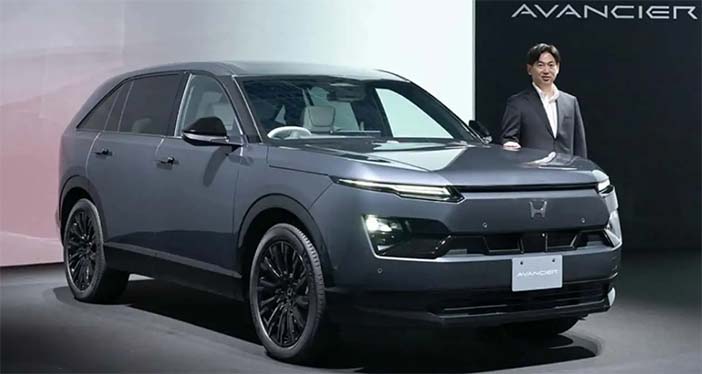
Inside, Honda fitted a 12-speaker Bose premium audio system with Dolby Atmos, a large dashboard-mounted touchscreen and a digital instrument cluster. Honda says it will keep building out in-cabin technology under a new “MyCabin” branding umbrella and apply the same approach to handling and ride under “MyMotion”. Honda hasn’t said whether the Avancier itself will come to the US. Nothing in its announcement points to American pricing, specs or a launch date. The platform and powertrain underneath it are a different story. Honda has already confirmed the next-generation hybrid system will anchor a 15-model push worldwide. The Avancier is the first production model to run Honda’s newly named “Honda Hybrid” system, an evolution of the 2-motor hybrid architecture the brand has used for years. Honda says the update widens the engine’s efficient operating range and shrinks the drive unit. It hasn’t released combined horsepower, torque or fuel-economy figures yet. Riding alongside it is DualPower eAWD, Honda’s first system to let separate motors drive the front and rear axles independently rather than through a single shared unit. Honda says that setup helps the SUV launch from a stop and shifts power front to rear as road conditions change. Both technologies sit on a platform Honda built from scratch for mid-size SUVs and sedans, sharing the engine bay and rear underbody across future models. Honda says the structure uses roughly 40 percent more high-tensile steel than its outgoing architecture, stiffening key areas while trimming weight elsewhere to sharpen handling. Honda is treating the Avancier as the opening shot in a broader plan: 15 next-generation hybrid models worldwide by the end of its fiscal year on March 31, 2030. +++
+++ HYUNDAI has revealed the striking new Elantra saloon at the LA motor show, and could bring the model to Europe as a cut-price, petrol-powered rival to the BMW 3 Series. Shown in Korea earlier this year as the Avante, the new Elantra is the eighth iteration of a model that has long ranked among Hyundai’s global best-sellers. Slightly larger than the car it replaces, it adopts a chunky, muscular new look that’s in line with Hyundai’s sharp new Art of Steel design language, with slim lights, creased panels and swollen wheel arches among its defining features.
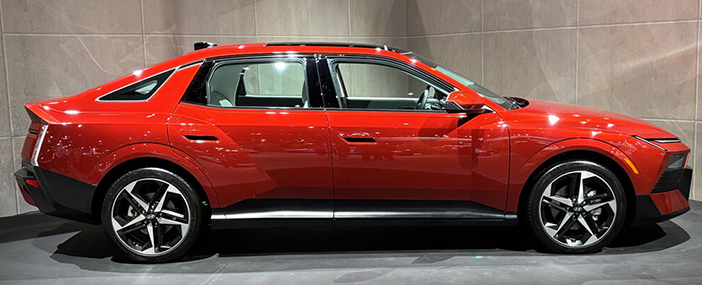
It is offered in Korea and the US with a choice of 2 petrol powertrains: an unassisted 2.0-litre engine with 150 hp and a 1.6-litre hybrid set-up that’s already offered in other Hyundai models in Europe, producing 158 hp. Hyundai has not officially confirmed plans to take the model global for this latest generation, but has been testing the new Elantra in Europe, and could seek to take advantage of a reduced field of rivals in the mid-sized petrol saloon market. At 4.8 meter long, the Elantra has a similar footprint to the BMW 3 Series, Mercedes C-Class and Audi A5, but if it came here it would be likely to undercut them on price, as it does in the US. Close rivals in price terms would likely be the Skoda Superb, Volkswagen Passat and BYD Seal 6. Inside, it has been designed to be “cozy and comfortable”, according to Hyundai. The dashboard and door cards’ designs cocoon around the seats, with customisable LED backlighting. As in the Ioniq 3 hatchback, the driver’s display is set high on the dashboard. This is intended to keep important information in the driver’s line of sight, so they do not have to divert their attention away from the road to check their speed or remaining range. A large infotainment touchscreen, measuring either 12.9 inch or 14.6 inch, takes centre stage. It runs on Hyundai’s new Pleos operating system, which will allow new functionality such as installing navigation and music apps in the screen, rather than having to use smartphone mirroring. An array of switches and dials for the climate control system sits just below the main screen. The previous-generation car was not available in Europe, despite having been tested there. However, it has not been ruled out for the latest iteration, suggesting Hyundai may have had a change of heart. A high-performance Elantra N is also in the works, adding a second petrol-powered model to Hyundai’s performance car ranks, with the i20 N hot hatch due to return next year, too. +++
+++ Customers have made it abundantly clear: They want real, physical buttons in their cars, not more touchscreens. And some automakers are finally taking note. MERCEDES-BENZ was among the first to embrace screen-heavy interiors, but even executives in Stuttgart recognize that the company may have gone too far. Mercedes CEO Ola Källenius admitted that replacing physical controls with touchscreens wasn’t necessarily the best way to design a modern car interior. After years of moving toward increasingly digital cabins, the company is now bringing back buttons and switches in places where they make more sense. According to Källenius, the shift toward touchscreen interfaces was largely driven by the industry’s broader move toward digital technology. Screens gave automakers more flexibility, making it easier to add features, introduce new functions, and update the in-car experience over time. He said: “We basically just moved on with the times. It became a trend more and more for cars to become more digital, which played a part in us adding more functions to our models”. But the CEO also recognizes that physical controls have advantages that screens can’t always replicate. He understands why drivers find traditional buttons and switches easier to use, and even admits he prefers some of them himself: “I do love a good rocker and roller on a steering wheel myself”. More importantly, Mercedes has learned that replacing physical controls with touchscreen functions doesn’t automatically make for a better interior. That’s why the company is starting to reverse some of those decisions. Källenius pointed to several recently introduced or updated models that put more emphasis on physical controls, including the GLS, GLE, S-Class, GLC EQ and GLB EQ. The company is also bringing back physical controls in other upcoming models, although he didn’t specify which ones. Still, Mercedes isn’t ready to abandon digital interfaces altogether. Källenius said simply returning to the way things were isn’t the answer, either. Instead, the automaker wants to strike a better balance between traditional controls and newer ways of interacting with a vehicle. He said: “Simply turning back the clock is not the right approach. I think we can all agree that new ways of interacting with the car must continue to be created… moving towards digital controls felt right and for the most part, still feels like the right thing to do in terms of developing modern day cars”. Mercedes isn’t the only automaker facing criticism over increasingly screen-heavy interiors. Drivers have pushed back against the loss of dedicated buttons for climate controls, audio adjustments, and other frequently used functions. Digital dashboards and larger displays aren’t going anywhere, but Mercedes’ change of direction suggests automakers are beginning to recognize that not every function needs to live on a touchscreen. +++
+++ Elon MUSK has a case of buyer’s remorse. The world’s richest person said he feels “pretty foolish” about spending big on Republican candidates in the midterms. The leading GOP backer and Trump ally gave more than $445 million during the latest election cycle, an outsized sum that drew backlash from some voters and was seized on by victorious Democrats including Texas Senator-elect James Talarico. +++
++ The expected partnership between OPEL and Leapmotor is now official. A ‘cooperation agreement’ between the 2 brands has been signed, relating to a new C-segment SUV that’ll go on sale in 2028. This all-new model offers a fresh design matched to cutting-edge technology developed from the Leapmotor joint venture within Stellantis. But it won’t replace an existing model, and instead will sell alongside the Grandland, Frontera and Mokka in the brand’s SUV line-up. This is not just a rebadged Leapmotor, either; instead it’s the first in a new generation of high-speed, high-tech collaborations between the brand and Stellantis to create new models that combine the expertise of both. It’ll do this by taking advantage of low cost bases, electronic architectures and battery electric powertrains from Leapmotor, in tandem with the high-fidelity engineering, design and driving dynamics typical of legacy brands from Europe. The new car will be built in Zaragoza, Spain, where the Corsa is currently made. Opel CEO Florian Huettl said of the news: “This agreement marks an important milestone in Opel’s growth and electrification strategies. Innovation requires the courage to take new paths. By bringing together the engineering capabilities of Opel and Leapmotor, we’re building a bridge between 2 strong technology ecosystems and combining the best of both worlds. This forward-looking approach to co-development brings together speed, technological strength, and engineering expertise to create a highly attractive new Opel C-segment SUV for our customers”. If you can’t beat them, join them, as the old saying goes, and Opel’s doing just that with a new all-electric SUV that will arrive in early 2028. News of the tie-up first emerged earlier this year. Huettl at the time said: “This will significantly allow us to make yet another step when it comes to affordability of electric models to a great level. We are entering a new world of opportunities by entering into this collaboration”. However, this won’t be a ‘simplified’ low-cost model in the sense of the Frontera, as the SUV’s positioning will be governed by its size, not its platform. As such, I expect the model to be priced underneath the Grandland and above the Frontera, splitting the pair with a price point that could start at around the €35.000 mark, or even lower. Huettl continued: “The positioning of the car goes by its dimensions. We’re looking at the mid C-segment, which is 450 cm, so it sits in between the Frontera and Grandland. This is a very popular market in Europe, which Opel has not yet covered. We see this as a vehicle that gives us additional coverage in the market”. The brand is keen to emphasise that this won’t be a ‘Chinese car with Opel badges’, and says that it will be optimised for European tastes. Huettl continued: “Opel is firmly rooted in the north and east of Europe; these are our home markets and the particularity of these markets is that they’re more prone to C-segment SUVs and BEVs”. This also means it’ll feature the now familiar design language of current Opels, with elements such as the cross-hair motif front and rear, and the now-ubiquitous Vizor grille. Opel has not released any images of the new model yet. Inside, Vauxhall will make use of the advanced digital architecture from Leapmotor, while offering the physical controls that European customers insist upon. Huettl said: “We’re looking into the ways of making best use of Leapmotor’s expertise in electronic architectures, which includes the screen. What’s important, though, is that we are Opel, and we use buttons, that’s part of who we are and that’s part of what we do and that’s what our customers like”. At a length of 4.5 metres, this will be firmly aimed at cars that sit just below the Grandland in terms of size. This will see it rival the Ford Explorer (itself a model built in collaboration with Volkswagen), the Skoda Elroq and the Kia EV5, although it’ll be a touch smaller than the forthcoming Volkswagen ID.Tiguan. No information has been released in regards to battery size, but it will feature LFP battery technology to keep a lid on costs, and won’t tread on the toes of the larger Grandland with its 640 km range. While Opel has stopped short of confirming the car’s name, it has told us that it’ll draw on its long history for inspiration. So what’s your guess? Vectra? I don’t think it will be called Manta, it looks like they’re still saving that one. +++
+++ Elon Musk wants to sell you on a TESLA that seats a whole family, minus the driver. At the New York Times DealBook Summit, the Tesla CEO said the company plans a version of the Model Y with no steering wheel and no pedals, built to carry 6 or 7 people. Musk said it would be a companion to the 2-seat Cybercab. The idea is a driverless people-mover for groups too big for Tesla’s smallest robotaxi. “We still need autonomous vehicles if you’ve got 4 or 6, or a whole family”, Musk said at the summit, describing a Model Y variant built around group trips rather than solo rides. He gave no name for the vehicle, no price and no launch date. That vagueness isn’t an accident of a live interview. Every outlet that covered the announcement, from trade press to financial media, came back with the same gap. No production site, no regulatory filing, no sign Tesla has even started building one. Musk did offer one number. He said the Cybercab, Tesla’s existing steering-wheel-free robotaxi already running in Austin, should cover about 90 percent of passenger miles on its own. The bigger Model Y would handle the rest for families and larger groups the two-seater can’t take. Whether Tesla sells this vehicle to consumers or keeps it inside its own robotaxi fleet is unclear. Musk didn’t say. Tesla’s established robotaxi operations today run on regular Model Y’s with steering wheels and pedals. Cybercab is being added on top of that base as it rolls out. Those Y’s carry up to 4 passengers, a limit the proposed 6- or 7-seat version would surpass. The Cybercab sits at the other end of that range with 2 seats, no manual controls and newly deployed in Austin. It’s already drawing federal scrutiny. The Cybercab’s federal safety probe focuses on roughly 1.000 steering-wheel-free cars in that city. There’s also a conventionally controlled option already on sale. Tesla launched the 3-row Model Y L in July. Consumer appetite for a car with no manual controls at all remains thin. Cox Automotive’s 2026 Autonomous Vehicle Study found just 10 percent of US consumers prefer a fully driverless Level 5 vehicle, down from 17 percent when the firm first asked in 2016. The most popular choice was Level 4, full autonomy with the option for a human to take over, picked by 28 percent of respondents. Only 38 percent said they would feel safe in a Level 5 vehicle, against 87 percent for a modern car with basic driver aids. +++
+++ VOLKSWAGEN ’s push to make electric cars more affordable is running into an unexpected problem: buyers can’t get their hands on them fast enough. The new ID.Polo is proving so popular that customers ordering the entry-level version could be waiting as long as 21 months for delivery. That’s nearly 2 years for a car designed to bring electric mobility within reach of mainstream buyers. And it’s not just Volkswagen struggling to keep up. The closely related Cupra Raval and Skoda Epiq are also attracting more customers than the Volkswagen Group anticipated, putting pressure on production facilities in Spain. Interestingly, buyers willing to spend more on higher-spec versions are getting considerably shorter delivery estimates, creating a situation we’ve seen far too often in the EV market in which paying extra could mean getting an electric car considerably sooner. According to German publication Edison, Volkswagen had received approximately 30.000 ID.Polo orders by mid-September. Since then, the figure has nearly doubled, putting the company’s production plans under considerable pressure. The ID.Polo Trend, equipped with a 37 kWh battery and starting at €24.990, is now reportedly facing delivery times of up to 21 months. The entry-level model offers a WLTP-rated range of 334 kilometers. Volkswagen also offers a larger 52 kWh battery. The expensive configurations have become particularly popular, with buyers generally opting for higher equipment levels and additional options. The production situation has become so unusual that Volkswagen is reportedly prioritizing more profitable configurations. One company manager told Edison that basic versions effectively clog up the production line. Consequently, the entry-level Trend sits at the back of the queue, while the sporty ID.Polo GTI reportedly has a waiting period of around 7 months. Volkswagen is not the only Group brand dealing with unexpected demand. The Skoda Epiq, which shares a platform with the ID.Cross, has racked up more than 80.000 orders globally. Production takes place at Volkswagen’s Navarra facility in Spain, where the company is also building the ID.Cross. According to Edison, delivery estimates for the Epiq 55, featuring a 55 kWh battery, have reached approximately 17 months. The smaller-battery Epiq 40 is reportedly looking at around 11 months. Buyers choosing the range-topping Sportline, however, could receive their vehicles in roughly 5 months.
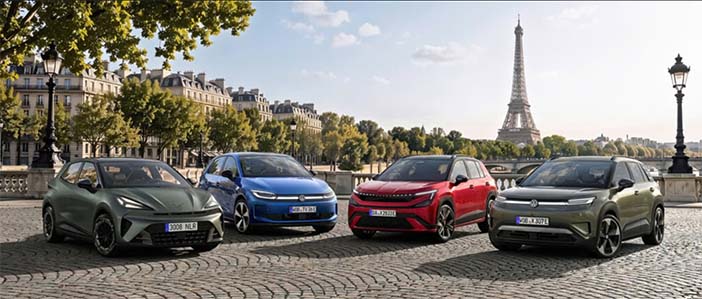
The wider Electric Urban Car Family, which includes the ID.Polo, ID.Cross, Cupra Raval and Skoda Epiq has attracted nearly 150.000 orders combined. Volkswagen is now considering production-capacity increases, including potentially shifting resources away from combustion-powered models. For buyers, the popularity of these affordable EVs is certainly encouraging. However, waiting almost 2 years for an entry-level electric car is hardly ideal, particularly in the European market where incentives and eligibility deadlines can make delivery dates financially important. +++