
+++ BYD might be exploring entering a new segment with a direct rival to the Smart #2. The 3D renderings are part of a design patent filed in December 2025 at China’s National Intellectual Property Administration (CNIPA). They depict a pint-sized 2-door hatchback with single-volume proportions, tiny overhangs and sleek surfacing. The model appears to have C-shaped led headlights and taillights, glass-like doors and futuristic wheel covers with a 4-spoke design. Another highlight are the hidden A-pillars, creating the illusion of a single-piece greenhouse, interrupted by thick B-pillars right above the pronounced rear fenders. Finally, we can expect 2 bumps on the roof, symmetrical graphics on the bumpers, and a glass tailgate with an integrated roof spoiler. The patent is accredited to BYD global design chief Wolfgang Egger, alongside Zhao Binggen, Xu Ziyan, Huang Xi and Zhang Xi. Egger worked for Alfa Romeo, Seat, Audi and Lamborghini before joining BYD in 2017. The highlight of his career is the Alfa Romeo 8C Competizione, which is widely considered one of the most beautiful cars of our time. Now, the German automotive designer is setting the styling direction for BYD’s luxury brands (Denza, Fangchengbao and Yangwang). The lack of mirrors and door handles in combination with the sci-fi-inspired wheels and unconventional greenhouse strongly suggest that the pictured model is a concept study. Still, BYD could always evolve it into a production model, entering a segment which is relevant in China and Europe. Currently, the entry-level BYD in most markets around the world is the Seagull, also sold under the names Dolphin Surf, Dolphin Mini and Atto 1 depending on the region. The fully electric 5-door hatchback with the Huracan-style headlights measures 3.780 mm long. This means there is room for an even smaller EV to rival the all-new Smart #2, which is up to 2.763 mm long.
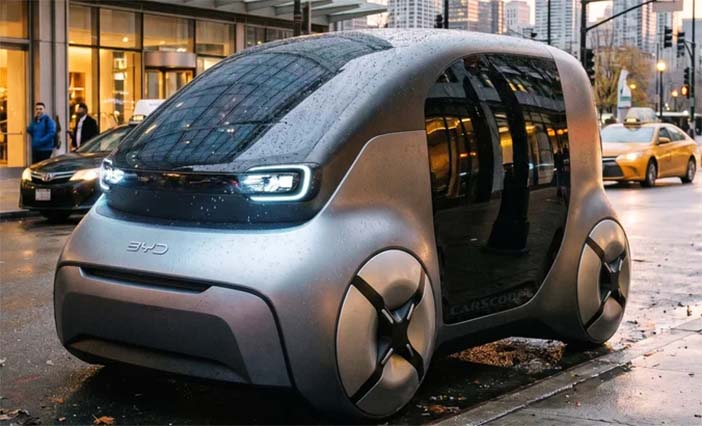
At the same time, such an offering could compete with other Chinese microcars. Unfortunately, the patent filing doesn’t include technical specifications, or any other information about the mysterious model. I also don’t know whether it is an ongoing project or one of the countless designs that never see the light of day, remaining locked up in the drawers of the studio. +++
+++ While the United States has seen ELECTRIC CAR sales decline since the expiration of the $7.500 tax credit last year, they have fared better in other parts of the world. In fact, CommBank reported that electric vehicles now account for a record 31% of global passenger vehicle sales, or roughly 1 in 3 new cars changing hands. First, it’s worth noting that the study included both plug-in hybrids (PHEVs) and battery-electric vehicles (BEVs) in the EV category. The 2 vehicle types are capable of driving without relying on petrol, though PHEVs tend to offer significantly less electric-only range. Still, the reported figures stand in stark contrast to demand in the U.S., where conventional hybrids are experiencing strong sales growth. Much of the global EV sales growth came from Europe, with the region’s EV sales rising 37% year over year. China still has a strong EV market share, reaching a record 67% in September, but its EV sales fell 13% during the first 9 months of 2026. The report also noted a surge in electric truck adoption, though charging requirements and trade-offs between payload capacity and driving range remain barriers, particularly for long-haul operations. Other markets with reported year-over-year EV sales growth include Brazil (+164%), Japan (+80%) and India (+76%). In the U.S., Cox Automotive reported that the BEV market posted its first year-over-year sales increase of 2026 in October, with an estimated 83.262 units sold, up 3%. However, it is worth noting that October was the first year-over-year comparison against a month after the federal tax credit expired on September 30, 2025. Tesla remained the EV sales leader, followed by Rivian, Cadillac and Chevrolet. CommBank cited higher fuel prices and energy security concerns as some of the reasons why more buyers are considering EVs. Europe has also seen a wave of relatively affordable electric cars, including the Volkswagen ID.Polo. However, Europe’s EV sales momentum could slow in 2027 under the EU’s proposed annual cap of 350.000 Chinese-made plug-in hybrid imports, though sales could pick up ahead of its potential December 2026 implementation. Despite less favorable market conditions for EVs in the U.S., automakers continue to invest in new models, including Ford with its $28,350 Fathom electric truck. However, many are also turning toward hybrids, including General Motors, whose earlier focus on fully electric vehicles left the Chevrolet Corvette as its only hybrid nameplate in the U.S. Looking ahead, recent developments in the electrified vehicle market suggest that adoption continues to advance, albeit at a slower pace than at the start of the decade. This gives buyers more time to adjust while allowing automakers to better tailor their offerings to regional demand. +++
+++ GENERAL MOTORS ’ strategy was clear: bring on a tech executive with software and self-driving smarts, and give them a shot at earning the automaker’s top job. It’s a plan that’s put Sterling Anderson in a strong position to succeed Mary Barra, GM’s chief executive since 2014. People familiar with the board’s thinking say the prevailing idea is GM’s next leader should be savvy in the very areas that Anderson concentrates on as global product chief. The question is whether Anderson, who’s 43 and been with GM for just shy of 18 months, is ready to lead its tens of thousands of engineers and union workers into a highly uncertain future for the global auto industry. +++
+++ The automotive industry is a business, and businesses need to make money. Which means that not every pricey, low-volume sports car concept we see will make it to production, no matter how much we beg. HYUNDAI ’s radical N Vision 74 might be the latest victim. Simon Loasby, the head of the Hyundai Design Center, said that Hyundai has no current plans to turn the concept into a production car. Rumors began circulating in 2023 that Hyundai was considering building the retro-inspired EV. The company denied the report at the time, but that didn’t stop the speculation and whispers of a possible production model. Then, in August 2024, Hyundai mentioned the N Vision 74 in its Investor Day presentation, but the dream of a new Hyundai supercar is dead. Loasby said: “It comes down to the maths of how you judge what the business case is. And that if you’re very tight with the business case on only that car, the volumes of that car and the impact, you got no chance. If you open it to the overall brand-raising profile value of that, you have a bigger chance”. Hyundai put considerable effort into the project after its debut, even building a few prototypes. According to Loasby: “We were really on it. We had the production clay model of it and the exterior, interior and so on”.
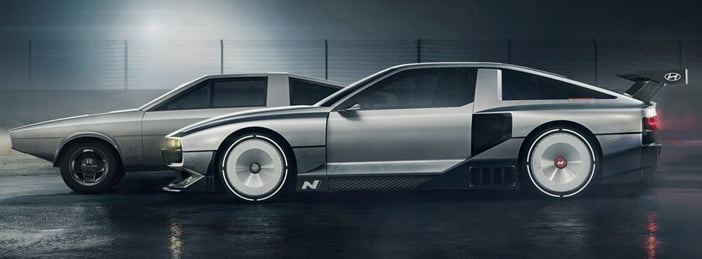
Although Hyundai has no plans to produce the car, the N Vision 74 is inspiring future models. The new Elantra features similar styling, which may be even more evident on the upcoming Elantra N and I expect to see other design cues on other upcoming cars. The Hyundai N Vision 74 debuted in July 2022 as a hydrogen-powered battery-electric vehicle. It had a hydrogen fuel cell, a battery, and a pair of electric motors powering each rear wheel. Hyundai said the 74 produced 671 horsepower and could travel up to 600 km with a full battery and fuel cell. Rumors once suggested the company would build 100 examples, but it never happened. +++
+++ KOENIGSEGG is bringing heavy institutional firepower into its corner to fund its next era of hypercar dominance. The Swedish boutique automaker signed a new investment agreement with global firm 65 Equity Partners, combining a primary capital injection with a secondary share purchase. Existing New York-based investor Chieftain Capital Management is also increasing its shareholding alongside them. Crucially, founder Christian von Koenigsegg remains majority owner and CEO, keeping the company’s creative steering wheel firmly in his hands. This fresh infusion arrives amid explosive financial momentum in Ängelholm. Koenigsegg pulled in €155 million in revenue during 2025, capping off an 80 percent annual growth rate since 2022. With roughly 800 employees and a multi-year order backlog where every build slot is sold ahead of production, demand easily outpaces supply. After recently wrapping up Jesko production, the brand will channel this capital into technology development, expanded capacity, and upgraded business systems. Since 1994, Koenigsegg has punched far above its weight class by building proprietary engines, radical transmissions and record-breaking aerodynamics in-house. That obsession with mechanical perfection has yielded everything from quarter-mile dominance to audacious racing projects showcasing its uncompromising DNA. Unlike luxury rivals reliant on corporate parts bins, Koenigsegg treats every chassis as a rolling laboratory, turning its ultra-limited hypercars into blue-chip collector assets. However, scaling a bespoke hypercar operation requires more than brilliant engineering: it demands sophisticated global logistics and deep pockets. Bringing on 65 Equity Partners as an active minority partner gives Koenigsegg access to an international network built to scale founder-led businesses globally. More notably, leadership will work alongside its new backers to evaluate future strategic options, explicitly including a potential public stock listing. Securing institutional backing while preserving majority founder control is a smart play for an independent automaker operating at the bleeding edge of performance. Developing bespoke powertrains and scaling production for sold-out models like the four-seat Gemera burns through serious cash. Having patient partners like 65 Equity Partners and Chieftain Capital gives Christian von Koenigsegg the financial runway to keep innovating without relying on legacy automakers. Still, floating an eventual IPO introduces intriguing tension for a brand built on zero-compromise engineering. Public shareholders famously demand predictable quarterly margins, whereas Koenigsegg thrives by obsessing over wildly expensive mechanical breakthroughs that take years to perfect. As long as Christian von Koenigsegg retains majority voting power, the company’s wild engineering spirit stays safe—even if Wall Street eventually gets a piece. +++
+++ When MCLAREN dropped the McL 820 name, I (and pretty much everyone else) figured it was the next step after the 750S. Makes sense, right? 820 is close to 750, so by McLaren’s naming logic, it’s next. Plus, the 750S is already heading for retirement. But now, a fresh report says the McL 820 is actually taking over from the Artura, not the 750S. That flips the script on what I thought McLaren was up to, especially as the brand gears up for a new era with its updated naming game. The McL 820 will take the place of the Artura in McLaren’s lineup. The new supercar could make its debut sometime in the first or second quarter of 2027. Apparently, McLaren’s cooking up 2 flavors of the McL 820: a regular version and an HDK model. The HDK should come with a high-downforce kit, so expect some wild aero bits for track junkies. As with the succession, McLaren hasn’t confirmed any of this yet, but having 2 versions would let the automaker please both the Sunday drivers and the hardcore track crowd. The McL 820 is expected to retain a twin-turbo V6 hybrid setup, but don’t expect a straight-up Artura hand-me-down. The engine is getting a serious overhaul, with insiders calling it “nearly new”. We’re talking a jump from the Artura’s 690 hp to around 820 hp. That’s a hefty boost, and it should help the McL 820 throw down with the latest crop of hybrid supercars. McLaren’s also aiming for a weight around 1.550 kg. If they pull that off while cranking up the power, the McL 820 could be a real step up in performance, not just a numbers game. McLaren’s already locked in the McL 820 name and this car is set to kick off a whole new naming style for the brand’s future line-up. The name first popped up in a kiwi-themed display in London, a nod to Bruce McLaren’s New Zealand heritage. The McL prefix is part of a bigger naming shakeup, following the McL 6GT concept that teased some of McLaren’s future design moves. Again, the McL 820 should land in 2027, but McLaren’s still keeping specs, looks and price under wraps. For now, it looks like the Artura’s replacement is about to steal the spotlight instead of the 750S. +++
+++ The MG 2 electric B-segment hatchback is edging ever closer to production, with the maker gearing up to show a production version of the MG GO! concept car in the New Year. It’ll go on sale later in 2027, challenging the new-era small car elite including models such as the Volkswagen ID.Polo and big-selling Renault 5 E-Tech. The new MG was previewed by the racy looking MG Go! concept at the 2026 Goodwood Festival of Speed, but we’ve had very little official information since. However, an array of new images would suggest the brand is getting ready to drip feed key details about the show car’s successor, possibly within the coming months. The sporty hatch is set to go on sale in summer. At its reveal, MG said the Go! concept was “more than a glimpse at a future new B-segment electric hatchback”.
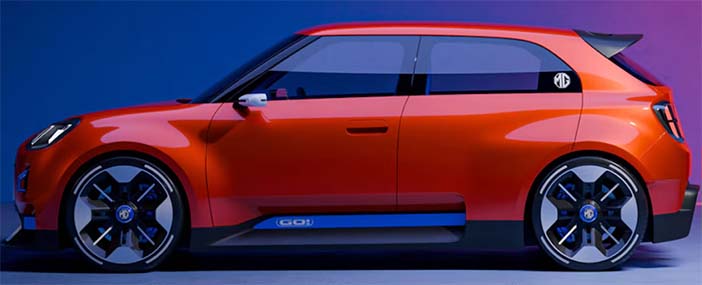
The model apparently represents “genuine aspiration to bring desirability to the electric mainstream”, signalling a step-change in MG’s ambitions to smother the market with functional models at rock-bottom prices. The MG Go! (at least in its current form) is a dynamically styled B-segment electric hatchback that is said to “explore a retro futuristic idea informed by some of MG’s most youthful and expressive designs from the mid-20th century”. The brand’s designers looked to cars like the MGB GT, as well as the MG Metro Turbo and MG ZR, which they say “embodied everyday elegance, joy and presence without excess”. The latest image doesn’t show me anything new, but the extra angles and complementary sketches provide our best look yet at the car’s design. They also show it moving for the first time, although we shouldn’t read too much into the racetrack backdrop; this isn’t likely to be anything more than an AI mock-up. The front of the MG Go! features an almost Mini-like set of headlights and a similar trim treatment, but with huge air vents, a deep splitter and an exposed tow hook for a shrunken touring-car vibe. Many of these details (along with the wide track and lowered suspension) are expected to be toned down for the production car, which MG UK’s director of product and planning, David Allison, previously told me is due “towards the middle of next year”, reiterating “sooner is better” as far as he’s concerned. The large wheels are also likely to be swapped out for a more urban-friendly design, with a deeper tyre sidewall that makes them less susceptible to kerbs and potholes. The 5-door design (possibly with a hidden rear door handle, like the concept) is expected to be carried over; the electric-specific platform, already used on the MG 4 Urban, should ensure the future MG 2 offers plenty of space inside for 4 adults. The rear is where I expect the most changes to take place, with little more than the vertical tail-lights likely to be carried over from the concept. The huge wing and prominent diffuser will be ditched for a more conventional look; the design team will also need to find space for a number plate, either on the bumper or boot lid. +++
+++ STELLANTIS is reportedly planning to halt investments in its motorsport operations in a cost-saving exercise that will see the end of Peugeot’s Le Mans programme, the Opel and Citroën Formula E teams and the reborn Lancia rally team. The shutdown of Stellantis Motorsport is due to be officially announced Monday, according to a report in France’s Le Figaro newspaper. Stellantis confirmed that an extraordinary meeting of the Work Councils (CSE/CSEC) has been called to discuss with employee representatives of Stellantis Motorsport on Monday. However it said it couldn’t provide more information on what was being discussed. Stellantis Motorsport costs the company around €300 million a year to run, according to the report. Axing it will help repair Stellantis’s finances in Europe, where it lost €311 million in the 3 months ending September. “Europe remains challenging, with ongoing Chinese competition and a difficult pricing environment”, CEO Antonio Filosa told investors on the company’s third-quarter earnings call. The decision would end the Peugeot 9X8 hypercar programme that competes in the World Endurance Championship (WEC), including Le Mans. The striking hypercar was launched in 2022 and was in the process of being overhauled for the new season after failing to record a win since it first competed. The closure of Stellantis Motorsport would also halt Opel’s entry into Formula E, which was only announced in March this year after the brand signed a 4-year contract to compete with the new Gen4 cars. Also affected is Citroën, which took over Maserati’s Formula E team in 2025. The team is run by MSG Racing and is likely to continue with a new sponsor. Lancia’s re-entry into the World Rally Championship is another programme expected to be axed. The Lancia Corse HF team started in the WRC2 category this year with the combustion-engined Ypsilon Rally2 HF Integrale and has already notched up wins. Customer teams will still be supported, according to the report. Motorsport is often one of the first expenditures to be cut when a car maker’s finances are tight. Earlier this year, Alpine announced it was ending its WEC programme at the end of this season, also citing a tough market, while Porsche pulled out of the series in 2025. Porsche remains in Formula E. +++