
+++ The combination of luxury and off-road ability is tough to pull off, but nearly 4 decades after its introduction, the Mercedes-Benz G-Class continues to dominate its particular niche, with only JLR’s Defender offering a similar blend of classic angular styling and contemporary capability. The rumor mill says that BMW wants to create something in the same vein and AUDI is reportedly considering a G-Wagen rival too, which spies may have recently spotted testing in Europe. I can’t be certain because spies couldn’t get too close (the prototype was spotted at a top-secret Audi center, which is why the entire background had to be deleted) and so all we know for sure is that this is a Volkswagen Group product. But the clues all point to a luxury off-roader to be revealed in 2027 or 2028. While there haven’t been any direct confirmations of a new Audi SUV, the brand itself has hinted at the possibility of producing something more capable than its current SUV range-topper, the Q9. If it happens, the new SUV may be built on the same architecture as the upcoming Scout Motors Terra and Traveler, which means either an all-electric powertrain or a range-extended electric powertrain, where a combustion engine never directly contributes to motion.
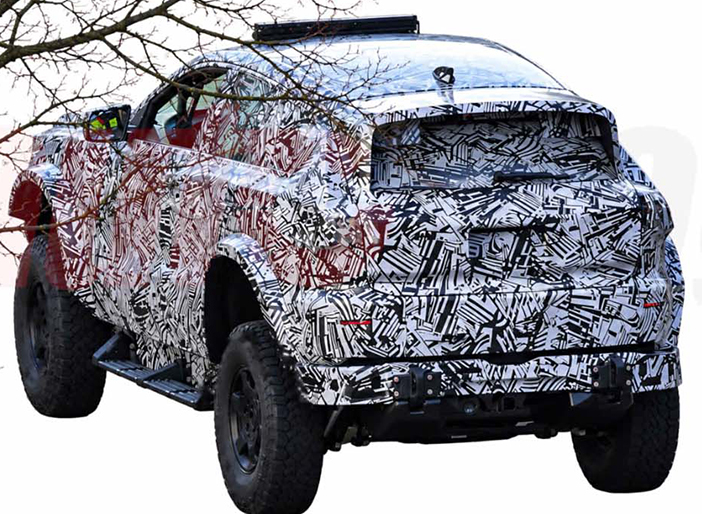
Whatever the case, this prototype is certainly far more capable off-road than anything currently sold by the VW Group, including the Touareg and its corporate cousins, with 6 bolts fastening the BFGoodrich-shod wheels to the hubs. In addition, the side steps look capable of sliding over boulders without so much as a dent, apparently being fastened directly to the chassis, and the ride height certainly creates plenty of room for suspension travel. The departure angle looks good, and there appear to be beefy skid plates underneath. Some very thick recovery points are also visible, as is a temporary light bar on the steeply sloped roof, which culminates in a significant spoiler. Sadly, spies couldn’t get any shots of the front end, but it’s clear that this has a strong approach angle, as there’s no clear bodywork ahead of the extra-wide front arches. It should also be noted that the front fenders and rear doors are heavily swollen, and the open driver’s window shows a roll cage, indicating that testing will be strenuous. We can catch a glimpse of the driver-info display, too, with what looks like yellow or orange contrast stitching around the binnacle. +++
+++ Automakers are constantly pushing the boundaries; it’s part of their nature to always think about the overall driving experience and try to “revolutionize” it for the driver. One trend that has dominated the modern car world is minimalist interiors, removing as many buttons as possible, to the point where every single setting has to be accessed through these massive infotainment screens or worse… gesture controls. Another thing brands have been doing is outlawing certain features that once made the driving experience more convenient. Apple CarPlay or any screen mirroring feature is an essential part of the everyday drive, but a lot of major car brands have done away with third-party software, citing different reasons, mainly privacy. BMW is one of the few automakers that isn’t afraid to innovate, and as such has taken a lot of directions when it comes to drivers’ experiences. The German automaker has gone on record about its future plans when it comes to convenience. Specifically, BMW has no plans to introduce the updated and more intuitive Apple CarPlay Ultra system into its cars. BMW refuses to include the expanded CarPlay Ultra, which lets you mirror not just to the infotainment screen but to all screens, because of privacy concerns. However, BMW is considering reworking the heavily minimalistic layout and design of the Neue Klasse cars, according to Claudia Maier, BMW manager of digital. Maier said that they are evaluating customer feedback constantly, which could see the return of physical buttons in future models, which is something everyone is clamoring for. It’s also important to note that while BMW isn’t bringing in CarPlay Ultra, it’ll still keep the regular CarPlay and Android Auto functionalities in its infotainment systems. Maier added that CarPlay Ultra doesn’t fit into BMW’s plans or philosophy; the automaker wants to keep all of its data in-house and secure. Currently, CarPlay Ultra isn’t gaining as much traction in the industry as expected. So far, only Aston Martin has launched and integrated it into its cars. Kia, Hyundai, Genesis and Porsche have committed to eventually launching Ultra versions. While no confirmation was given on whether physical buttons will return, strong customer feedback might change BMW’s mind. Maier said they still believe drivers and owners will eventually get accustomed to the Panoramic iDrive layout, which uses voice commands. +++
+++ GLOBAL AUTOMOTIVE RANKINGS have been reshuffled for the first time in 7 years as Chinese carmakers expand their presence overseas. Hyundai Motor Group rose to third place, while China’s BYD entered the top-5 for the first time. The Toyota Group ranked first with 2.74 million vehicles sold in the third quarter, followed by Volkswagen Group with 1.89 million and Hyundai Motor Group with 1.76 million. BYD sold 1.32 million cars, overtaking the Renault-Nissan alliance, which fell out of the top-5. Weakness in the Chinese market weighed on sales at established automakers. Volkswagen Group’s deliveries in China fell 38.5 percent on-year to 406.000 vehicles in the third quarter, compared with a decline of about 4 percent in regions outside China. Toyota also recorded its 8th consecutive monthly sales decline in China, with September sales falling 19.7 percent. Within the Hyundai Motor Group, Kia posted a 6.9 percent increase to 829.000 units, while Hyundai Motor recorded a 10.1 percent decline to 931.000. Hyundai was affected by domestic production disruptions caused by labor strikes, as well as weaker sales in Europe and China. The group’s modest decline narrowed its sales gap with second-ranked Volkswagen Group to approximately 125.000 vehicles. BYD, meanwhile, offset weaker domestic demand with overseas expansion. Its third-quarter volume grew 18.7 percent on-year, while exports surged 137 percent to 551.000 units, accounting for approximately 42 percent of the total. The company’s international push helped counter intensifying competition in its home market. The Renault-Nissan Alliance’s third-quarter sales fell 11.1 percent from a year earlier. Nissan was particularly weak in China, where sales plunged 61.6 percent. General Motors sold 1.03 million vehicles, up 5.2 percent, as strong pickup truck and large SUV sales supported its performance despite a decline in US electric vehicle sales. While established automakers face mounting pressure from local competitors in China, Chinese brands are expanding their presence in overseas markets. Intensifying domestic competition and the international expansion of Chinese automakers are reshaping the global automotive industry. +++
++ JLR (Jaguar Land Rover) ’s CEO has said he “does not accept the infringement of our intellectual property” in his first comments over his company’s case against BYD and its Defender-aping Ti7. The Land Rover manufacturer is pursuing the case in the Netherlands, where BYD’s European headquarters is located, ahead of the sales of the plug-in hybrid Ti7 in Europe. “Our vehicles are getting built on decades of heritage, engineering, excellence and, of course, the capability and the craftsmanship that these cars execute”, PB Balaji said on a call to journalists. “Therefore we will do what it takes to protect them”. The Ti7 is one of multiple homages to the Defender in China, where the vehicle is held up as a epitome of what a premium off-roader should look like. It’s by far the most successful of this new crop of large SUVs. Despite measuring almost 5 metres long, it has moved into China’s top 10 best-sellers list this year. The 7-seater starts at £47.995 in the United Kingdom, undercutting the equivalent Defender by around £20.000, while offering a 110 km electric-only range from a 35.6 kWh battery pack. The resemblance to the Defender can be clearly seen in elements such as the body-coloured panel in the rear side window and the impression of a floating roof created by blacking out the door pillars. JLR started the legal process in August after initially hearing about BYD’s plan to sell the Ti7 here. The company obtained a court order to seize documents from BYD pertaining to its exact sales plan. BYD complained that the scope of the documents taken was excessive, calling JLR’s actions a “fishing expedition”. A judge agreed and on November 12 ruled that the JLR should return the files and pay BYD legal expenses. Balaji said the files were no longer needed, given that BYD has now announced sales plans for the Ti7 in Europe. The case is expected to be heard later this month. In 2019, JLR won a case in China against local manufacturer Landwind, whose X7 was found to be too similar to the Range Rover Evoque. However, it was unsuccessful its 2020 legal case to stop Ineos from selling the Grenadier on the grounds that it was too close to the original Defender.
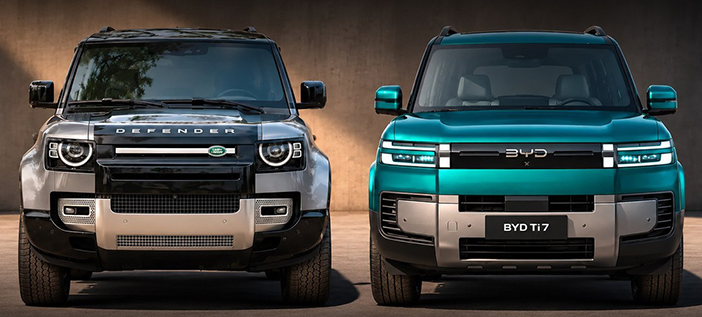
Other car makers have been successful in blocking Chinese companies from selling copycat models, including in 2008 when GWM was blocked from bringing its Peri into Europe on the grounds it look too much like the Fiat Panda; and BMW prevented sales of the Shuanghuan SCEO after successfully arguing that it was an X5 clone. The Ti7 is arguably not the worst of the Defender clones. Even closer in looks is the new BAIC Xingtan 5X, which like the Ti7 comes as a PHEV and an EV in China. The 4.865 mm-long SUV has been described by media commentators there as a “poor-man’s Defender”. Its off-road capabilities are described as “light”. However, the Defender costs 5.5 times more than its equivalent in China. Sales there plummeted 39% in the 3 months to the end of September, even as they rose elsewhere, but the Defender remains JLR’s best performer globally, taking 28.465 sales in the quarter, up 16%. +++
+++ KIA said Friday it plans to invest $2 billion in a second manufacturing plant in India to expand its production capacity in the growing automobile market. Kia India signed a memorandum of understanding with the government of Andhra Pradesh in south-eastern India to build the plant in Anantapur, where it already operates a manufacturing facility built in 2019. The new plant, scheduled to begin production in early 2030, will have an annual capacity of 200.000 vehicles, bringing Kia’s total production capacity in India to more than 600.000 vehicles a year. Kia currently sells a range of vehicles in India, including the Seltos, Sonet, Syros, Carens, Carens Clavis and Carnival. The investment is part of Hyundai Motor Group’s broader efforts to strengthen its presence in India, the world’s third-largest automobile market after China and the United States. In October, the automotive conglomerate announced plans to invest $15.5 billion in India between 2026 and 2032. +++
+++ We all know that the Toyota Group of companies is the least in love with electric-vehicle propulsion. Led by an outspoken leader, Akio Toyoda, the approach to BEVs has been measured and slow for both Toyota and LEXUS . Lexus’s first full-electric dedicated model is the RZ (Radiant Zero), which was introduced 4 years ago. 4 years is considered an aging model in today’s world, so it makes sense that Lexus is planning to introduce an updated RZ model, first in its home country of Japan. The specific additions and changes to the updated RZ have been published on Lexus Japan’s website. One of the highlights of the new RZ is the update to the Sport mode of the brand’s patented Interactive Manual Drive (IMD) system installed in the RZ 550e. The new feature is called the “Interactive Manual Drive Engine Sound”. In essence, the system mimics the sensation of driving a manual transmission car while also simulating the sound of a traditional engine, which, according to Lexus, will make the driving experience more exciting and engaging. A few subtle changes are also set to be included for the RZ; the exterior will get black-painted shark fin antennas for a sleeker look. Inside, the RZ will now come standard with a digital rear-view mirror to improve convenience while driving. The RZ 500e and RZ 450e will also get updated interiors, called L-tex in a Greyscale finish, a new material that promises to be more durable and functional without sacrificing a premium feel. Lexus’ official website also notes revisions to the RZ’s driving dynamics. Lexus said the behavior of the Direct 4 all-wheel drive system was reworked to provide a more natural, enjoyable driving experience. The update also includes an improvement to the steering feel and ride quality. The RZ started out as a very niche, slower-selling model for Lexus, but according to this year’s data, it quickly became the brand’s fastest-growing model. During the first half of the year, the RZ outpaced all its other Lexus siblings, rising over 106% year-over-year in terms of new vehicle deliveries in the United States. +++
+++ Less than a month after PORSCHE unveiled the Mission S supercar concept, it’s already at the Nürburgring. No squealing tires or wailing engine accompanies the car as it passes: the photo wasn’t made during a shakedown; it’s a photoshoot. The mid-engine supercar, designed to sit above the 911, has a distinct rumble that sounds fantastic, but the automaker hasn’t confirmed what powers it. The Mission S might have a rumored flat-8 engine, likely hybridized. In other clips, the car sounds like it’s hiding an 8-cylinder powertrain. Porsche has received “really overwhelming feedback” on the Mission S, and customers are asking how to buy one, but the automaker has no plans to put it into production anytime soon. The supercar concept is a “vision model” that previews the brand’s future design direction and a new super sports car platform.
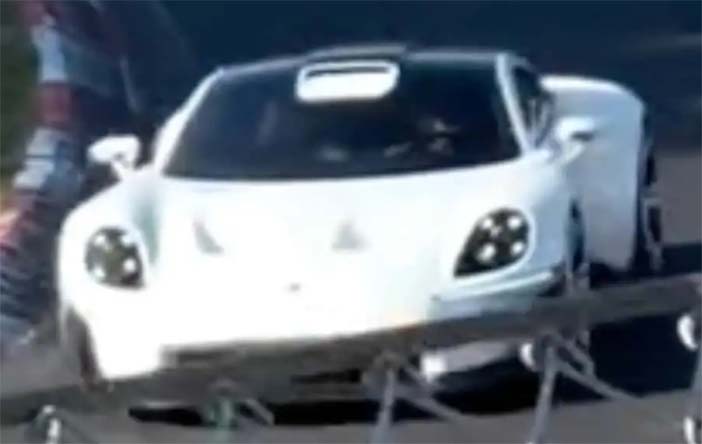
The car has a stunning design inspired by Porsche greats like the 911, 959, 917 and GT1. The exterior design language is called “Floating Volumes” and inside the Mission S has analogue gauges mixed with digital displays, in an otherwise sparse interior, there’s no big screen on the dash. While powertrain details are a mystery, a future version of the concept could come with a manual transmission, if enough customers want one. Porsche CEO Michael Leiters said, “Customer demand will define what we build on this platform”. Beyond the car’s stunning design and the video clips of the exhaust note, Porsche hasn’t provided any details about the car. Technical specs, performance figures, and a possible price (other than expensive) are well-guarded secrets. The automaker hasn’t even hinted at a possible production date for a new supercar. It’s a design study that has hit it out of the park, and people are eager for it to become more than just a concept. +++
+++ SUBARU is set to begin selling a new WRX with 6-speed manual transmission in Japan on Thursday, the automaker’s first model in 7 years that will feature a manual transmission.
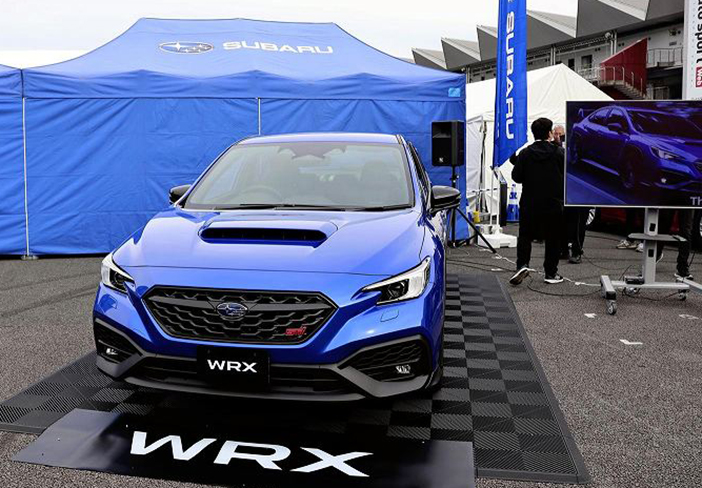
As the popularity of manual cars has increased, particularly among car enthusiasts, Subaru aims to increase its presence in this group while enhancing its brand image. Subaru previously ended production of the manual WRX, the company’s core sport sedan model, in 2019. It plans to offer the option of a manual transmission with the WRX and 2 other models by 2027. The new WRX will feature a 6-speed manual transmission with improved handling and a more responsive throttle. The car will have an estimated retail price of ¥5.48 million including taxes. “We want to deliver cars that give drivers the pleasure of driving with a higher level of driving performance”, said Masaaki Kobayashi, product general manager of Subaru, at a press conference in Oyama, Shizuoka Prefecture. +++