
+++ AUDI has released a software update for its first electric car, the e-Tron, which unlocks a slight increase in maximum range. The upgrade cannot be done over the air, however. It is available for e-tron owners now and is free of charge. but only by visiting an Audi service centre. Once installed, 2019 and 2020 build e-Tron 55 Quattro versions of the e-tron can travel a further 20 km on a charge. As a result, the car can now do an official 441 km on a charge, according to WLTP homologation. The update applies only to 55 models with this size battery, and not the smaller battery e-Tron 50 Quattro. However, it is available for e-Tron 55 Sportback cars too. The company has achieved the increased range through an increase in the usable capacity of the e-Tron 55’s 95 kWh battery. This increase in usable battery capacity is combined with software updates enabling more efficient decoupling of the electric motor at the car’s front axle. In effect, the motor remains disconnected from the drivetrain and powered off until maximum power is required. Until that point, the e-Tron 55 Quattro is rear-wheel-drive only. The software update also makes the cooling of various electrical components more efficient, by reducing the flow rates in the cooling system, which in turn cuts energy consumption, all of which counts towards the greater overall range. Maximum charge rates of 150kW remain as before, so when hooked up to a rapid charger the car can reach 80 % in just 30 minutes. Similarly, it takes just 10 minutes to add 110 km to the range. +++
+++ CHINA is expected to scale up the ratio of non-fossil fuel vehicles sold in the country to 40 percent by 2030, up from 11 percent in the first 3 quarters this year, which would help drive the fast-growing NEV sector in the country. The goal is part of an action plan by the State Council, China’s Cabinet, which was released to peak the country’s carbon emissions by the end of the decade. China will slash the ratio of gasoline and diesel vehicles in its overall production and sales, introduce electric vehicles into public service fleets, and promote electric, hydrogen and liquefied natural gas-powered trucks, the action plan said. The China Association of Automobile Manufacturers estimates total vehicle sales in China would reach 30 million in 2025. Even if the market stabilizes at that level by the end of the decade, the 40 percent goal would be an addition of 12 million electric, plug-in hybrid, and fuel cell vehicles in 2030. This would create room for growth for vehicle makers that have been shifting toward electrification. New energy vehicles, which are comprised of electric, plug-in hybrids and fuel cell vehicles, started to take shape in 2009 in China, when most other countries thought it would be premature to develop the sector. They have become a serious choice for car buyers after a decade of development, according to the CAAM. In September, 357.000 units were sold, which means almost two of 10 vehicles delivered in the month were either electric or plug-in hybrids. Their cumulative sales in the first three quarters hit 2.16 million units, accounting for 11.6 percent of total vehicle deliveries in the period, CAAM said. The ratio was even higher, at 13.7 percent, in the segment of private vehicles during the same period. Private cars make up around 80 percent of sales in China. “Considering the speed and trend, we will hit the 40 percent goal in 2030, or even ahead of schedule”, said Cui Dongshu, secretary-general of the China Passenger Car Association. Carmakers have even more ambitious plans than the goal for the country set in the action plan. China’s most popular NEV maker BYD sold 337.600 electric and plug-in hybrids from January to September this year, around 75 percent of its total sales in the period. In June, China’s largest SUV and pickup maker, Great Wall Motors, said its annual sales will reach 4 million vehicles in 2025, with 80 percent of them being electric cars, plug-in hybrids and fuel cell vehicles. SAIC Motor, China’s largest carmaker by sales and partner of GM and Volkswagen, expects its sales of new energy vehicles to reach 2.7 million units in 2025, making up at least 32 percent of its total deliveries in the year. International carmakers, from Germany’s Volkswagen to Japan’s Honda, are also ramping up efforts in EVs to tap into the growth potential of the world’s largest vehicle market. Honda plans to introduce 10 electric models into China in 5 years, estimating NEV sales to account for 40 percent of its total sales by 2030. Volkswagen, whose sales in China are around 40 percent, is already selling such models, with 10.000 delivered last month alone. Japan’s Toyota and South Korea’s Hyundai are exploring China’s hydrogen fuel cell vehicle market, with both setting up plants to produce fuel cells in the country. Oh Seung-chan, head of Hyundai’s fuel cell plant in Guangdong province, said its plant will start production in late 2022, with its annual capacity reaching 6.500 units. Oh said 3 pilot zones in China, including Shanghai, Beijing and Guangdong, are planning to have 30.000 fuel cell vehicles on their roads in 4 years. In addition, 40 percent of energy for other transport means will be shifted to non-fossil by 2030, the State Council’s action plan said. Globally, transport is a major source of greenhouse gas emissions. Last year, it was responsible for 24 percent of direct CO2 emissions from fuel combustion around the world, according to the Paris-based International Energy Agency. Road vehicles (cars, trucks, buses and two- and three-wheelers) made up nearly 75 percent of transport CO2 emissions, and emissions from aviation and shipping continued to rise as well, the IEA said. +++
+++ Contemporary Amperex Technology Ltd (CATL), China’s largest automotive lithium-ion battery maker, signed a technology licensing and partnership agreement with HYUNDAI , granting its CTP (cell to pack) technology to the auto supplier from the Republic of Korea (ROK). CATL will also support Hyundai in the supply of CTP related battery products in the ROK and globally, according to the agreement. By directly integrating cells into packs without modules, CTP technology improves system energy density, simplifies manufacturing and helps reduce costs. The partnership will enable both parties to sharpen their competitive edge by working together to develop more innovative technologies for the global electric vehicle (EV) market, CATL said in the statement. The partnership also initiates a new model for global technology cooperation in the industry, and helps CATL to spread its battery technology worldwide. Headquartered in Ningde, in east China’s Fujian province, CATL posted net profit growth of 131.45 percent in the first half of 2021 amid a booming new-energy vehicle (NEV) market. +++
+++ Total domestic output by 8 major automakers in JAPAN fell 49.7 percent in September from a year earlier to 398.075 units amid an ongoing global chip shortage and delays in procuring parts from Southeast Asia due to the Covid-19 resurgence this summer, data showed. The drop was the sharpest since May last year, when domestic production fell 61.8 % from a year earlier due to the initial outbreak of the novel coronavirus, and marks the second consecutive month domestic output has fallen below the previous year. Output and sales by automakers bottomed out in May 2020 and had begun to recover after being hit hard by government lockdowns around the globe. However, recent production cuts have been prolonged due to a parts shortage since the beginning of 2021. The Dai-ichi Life Research Institute estimates that a 10 percent drop in annual domestic output of automobiles compared to 2019, when 8.33 million units were produced, will result in a loss of 5.3 trillion yen ($47 billion) in nominal gross domestic product. “This could become the main cause of Japan’s economic downturn and negatively impact a wide range of industries”, said chief economist Toshihiro Nagahama. All of Japan’s 8 major automakers except Mitsubishi reported a decline in domestic production in September, with Subaru experiencing the largest drop of 74.8 percent due to a 12-day suspension of 3 of its domestic plants. Output by Daihatsu, reflecting the impact of supply chain disruptions in Malaysia and Vietnam, also plunged by 68.2 percent. Toyota, the largest automaker in Japan, saw its production fall by 55.3 percent, with Honda logging a 55.5 percent drop. But Mitsubishi saw a 20.0 percent rise in its domestic output, exaggerated by a drop last year that was larger than its competitors. Total global output by the 8 automakers fell 35.5 percent in September from a year earlier to 1.56 million units, while worldwide sales were down 21.6 percent at 1.82 million units. Toyota’s global output dropped 39.1 percent in the reporting month to 512.765 vehicles, tumbling for the second consecutive month. The automaker also said its global sales declined 16.4 percent to 700.122 vehicles, falling for the first time in 13 months. +++
+++ MERCEDES will use the new MSA spaceframe platform underpinning the new AMG developed SL in the next Mercedes-AMG GT, which may have to be repositioned as a more hardcore offering, according to AMG high-ups. AMG boss Philip Schiemer and chief technology officer Jochen Hermann outlined the subtle differences between buyers of the new SL, which has been rebooted as a sportier car for its seventh generation, and those of the AMG GT, plus what this may mean for the next version of the brand’s performance flagship. “With the GT which is now coming to the end of its lifecycle, we have some new ideas”, said Schiemer. “Our GT drivers are people who love to go with their vehicle on the race track. We see this every weekend and we see this when we do our events and driving academies. This is the place where the GT drivers are meeting. The classical SL owners are not so much on the racetracks, but more interested in cruising”. Schiemer said that the MSA platform would be used by the brands in “many ways” in the future, while Hermann added: “And of course, with the MSA architecture, there’s room for a successor car for the GT. But it wouldn’t make sense for example to have a GT Roadster in the future because this will be overlapping. Of course, the GT will be a very different car from the SL because even if we use the same powertrain layout and the basic principles of the body in white structure for example, we have to make the GT an even sportier car”. +++
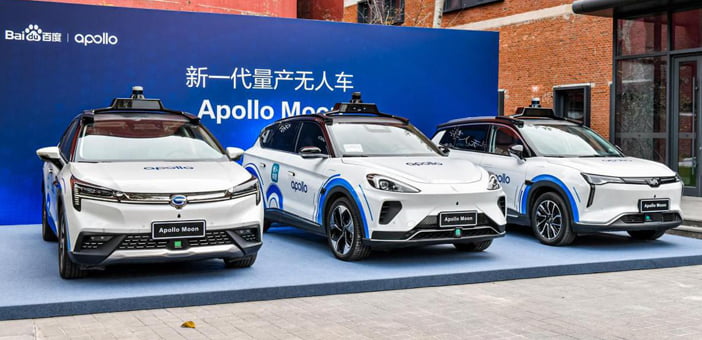
+++ Chinese tech giant Baidu unveiled 3 models to its ROBOTAXI fleet (Apollo Moon Arcfox, Apollo Moon WM Motor and Apollo Moon Aion), as part of its broader drive to speed up the commercialization of autonomous driving technology. The Apollo Moon robotaxi models utilize a leading navigation pilot product that can reduce the weight of autonomous vehicle kits while sharing intelligent driving vehicle data to create a closed-loop information ecosystem, according to Baidu. The company said by combining these capabilities along with a customized LiDAR and corresponding unmanned redundancy functions, fully autonomous driving can be realized. It has expanded its safe road test mileage from 6 to 18 million kilometers, marking a significant achievement for Baidu Apollo in its development of autonomous technology. “The launch of Apollo Moon is an important breakthrough signifying the powerful linkage between China’s leading autonomous driving technology and the most advanced smart vehicle platform, marking a landmark step in the field of robotaxi ride-hailing services globally”, said Li Zhenyu, senior vice-president at Baidu. In addition, Baidu unveiled its new 5G remote driving for enterprises, which expands the number of unmanned vehicles supportable in a single scenario to three. With several patented technologies, 5G remote driving can recognize abnormal traffic conditions such as road closures and assist the vehicle in navigating around these conditions safely and efficiently. Recently, Baidu Apollo has begun to roll out robotaxi ride-hailing services in Beijing, Shanghai, Guangzhou, Chongqing and other cities. +++
+++ Chinese automaker SKYWORTH AUTO , the electric car division of tech giant Skyworth Group, has begun selling electric cars in Israel through the Israeli dealership Caduri Group, both companies said. This is the long-range version of the SUV model Skywell ET5, with a length of 4.7 meters and a wheelbase of 2.8 meters. It has a 72 kWh battery capacity, which gives it a driving range of about 520 km. It regularly takes about 11 hours to charge the vehicle’s battery, while fast charging of 30 to 80 percent of the battery takes about 30 minutes. The ET5 comes with advanced safety and technological specifications that include comprehensive active safety systems, semi-autonomous driving in traffic jams, laser headlights, and an advanced multimedia system. “This is a historic day for us as we launch operations in Israel, a start-up nation that has launched the world’s leading technologies”, said Skyworth Auto chairman Stephen Wong. Skyworth Group, founded in 1988, mainly engaged in multimedia, smart system technology, smart electrical appliances and modern service businesses. +++
+++ TOYOTA is kicking off its first series of electric vehicles bound for the global market with a battery-powered SUV that the Japanese automaker says embodies the reliability and efficiency underpinning the Toyota brand. The bZ4X, which resembles Toyota’s popular RAV4, is set for release in North America, Japan, China and Europe in mid-2022, the company said. With an estimated range of around 500 kilometers per charge, the bZ4X is the first of 7 bZ series EV models the automaker plans to introduce globally by 2025. Toyota, the world’s biggest automaker, has been slower to build its presence in the EV arena compared with rivals such as Volkswagen, which began shipping its flagship ID.3 in 2020. Even so, the bZ4X is based off more than 2 decades of experience with battery-powered cars, according to Toyota general manager Daisuke Ido. Since releasing the world’s first mass-produced hybrid car, the Prius, in 1997, Toyota has gained a strong command of batteries and energy efficiency, according to Ido. The car’s heating system and battery temperature-control mechanisms work to boost efficiency, enabling it to drive long distances on a battery that’s not too bulky or heavy, Ido said. The car is also equipped with a slew of Toyota’s latest technologies. They include the “Toyota Safety Sense” driver assistance system, which, along with multimedia systems in the car, will be capable of over-the-air updates. Some models will come with a rectangular “steer-by-wire” yoke that enables drivers to maneuver the vehicle without having to change hands. The bZ4X, unveiled earlier this year at the Shanghai auto show, will come with the option of rooftop solar panels. They will help charge the vehicle when parked outside and are capable of generating enough electricity to drive an extra 1.800 kilometers a year, according to Toyota’s estimates. The electric SUV sits on Toyota’s e-TNGA platform, which the company says can be fitted to a broad range of vehicle sizes. The platform will speed up deployment of new EVs, reducing development time and allowing different models to be designed in parallel. While certain key elements remain fixed, the battery and electric motor (the most expensive parts of an EV) can be adjusted based on the model. Toyota declined to comment on pricing, but Ido said the company’s intention is to offer an EV that’s “user-friendly” in terms of keeping costs from rising too high. Along with EVs, Toyota sees hybrid, fuel-cell and traditional gasoline-powered cars playing a role in its fleet over the coming decade. By 2030, Toyota plans to sell around 8 million electrified vehicles, of which 2 million will be EVs and fuel-cell cars and the remaining roughly 6 million hybrids. “We’re contributing to carbon neutrality with a full lineup of practical and sustainable cars”, chief engineer Kouji Toyoshima said. That is, “we’re laying down the Bz series as one puzzle piece in the frame of carbon neutrality”. +++