
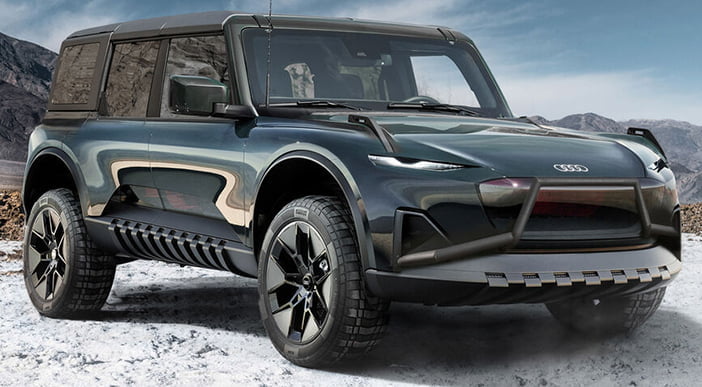
+++ AUDI engineers are formulating plans to possibly build a “super saloon” luxury off-roader SUV in 2027, It would compete in a segment that now includes the Land Rover Defender and Mercedes-Benz G-Class. According to Audi designer Marc Lichte, the platform for the new model could be borrowed from the Volkswagen Group’s recently announced sister brand, Scout Motors, which is currently developing electric-powered concepts and prototypes. While Audi has developed a PPE (Premium Platform Electric) architecture for its base EV lineup, that would be replaced in the planned model with Scout’s ladder chassis to provide the steep departure angles and ground clearance needed to negotiate tough terrain, as well as with the latest generation of Audi’s Quattro four-wheel-drive technology. Audi is well into development of its Activesphere project, an enticing design blend of coupe and sportback. The Activesphere uses PPE, co-developed by Audi and Porsche, and will appear in a production Audi product by the end of this year. Beyond that, “I think there is space for a rugged SUV in Audi’s passenger car lineup”, Lichte said. “There is potential because there are only 2 premium players” in this particular segment” (Mercedes-Benz and Land Rover) “and I think there is a space for a third one”. The upscale Defender was by far Land Rover’s bestselling car last year, with 66.805 sold, and the G-Class set a new sales record the previous year with 41.174 moved worldwide. Audi obviously would like to capitalize on this popularity of the rugged 4×4 segment. The proposed competitor, said Lichte, “will not look like a G-Class and it will not look like a Defender, I can promise you. It will be something else”. +++
+++ Shares of Nio and other U.S.-listed Chinese electric car makers revved up as Tesla boss Elon Musk said its largest rival will likely come from CHINA . “The Chinese market is the most competitive. They work the hardest and they work the smartest”, he said during a call with analysts after Tesla reported record quarterly earnings. There is “probably some company out of China as the most likely to be second to Tesla”, he added in venturing a guess about which company could be Tesla’s largest competitor. Alongside a rally in Tesla shares, NIO stock gained 3.2%, Li Auto charged up 7%, XPeng advanced by 3.4% and BYD gained 4.8%. The Chinese electric vehicle market is huge and growing, and that success has many wondering what’s next. About 27% of new vehicle sales in China last year were electrified (either pure EVs or hybrids). And given the number of Chinese buyers, those sales made up about two-thirds of the global EV market. Despite Covid lockdowns, other headwinds impacting consumer sentiment and the economy and government EV subsidies phasing out, it’s an exciting time for the Chinese auto industry, bolstered by the country’s long-standing and inimitable EV supply chain. EV companies like Geely, Xpeng, Li Auto, NIO and more are gaining traction. Their market share in China rose 17% in 2022, while that of non-Chinese automakers dropped 11% (BYD alone sold nearly 1.8 million battery electric vehicles and plug-in hybrids in China last year, surpassing Tesla’s 1.3 million worldwide). Even if others catch up, China will continue to dominate global EV sales this year. So naturally, industry watchers think a move into the US could be imminent. “What happens in China will not stay in China”, said Bill Russo, CEO of advisory firm Automobility. “If you have that kind of supply chain, that kind of position on the chess board, then why wouldn’t you take that internationally?” Chinese automakers would have a number of advantages in the US, chief among them the relatively low cost of their cars compared to American makes. “There’s a difference between people’s allegiances to their country and what they buy at the store”, Russo said. “One thing that’s absolutely universal is people buy affordability”. And after all, Japanese, Korean, and European automakers have had plenty of success in the US: Toyota was the country’s top-selling brand in 2021. On the other hand, the Inflation Reduction Act’s EV tax credit rules mean that vehicles manufactured in China won’t qualify for the US-final assembly requirements that could earn electric car-buyers a $7,500 credit. Political sentiment and having to battle entrenched companies in a mature market are also barriers. “By far the biggest obstacle is politics”, Deutsche Bank analyst Edison Yu told. “You have a lot of anti-China sentiment. If they can somehow overcome that, I think a lot of Chinese auto companies would love to get a crack at the market”. BYD, for example, has a focus on global expansion, but those sentiments and recent developments with Tesla have put those plans on pause. “They’ve very hesitant to expand because of this”. Even if it doesn’t dominate the U.S. car-buying market, China can play a starring role by leaning on its control of so much of the global EV battery supply chain, including raw materials, processing, cell manufacturing and more. China controlled about 75% of all battery cell manufacturing capacity and 90% of battery anode and electrolyte production in 2022. As it stands, U.S. automakers like GM and Tesla have been reliant on companies in China, like giant CATL, for their battery needs. Even as the U.S. shores up more minerals extraction here and the U.S. battery-making industry grows, much of these materials are still sent to China for processing and China is still expected to control a majority of the production capacity in 2027. “The automotive industry, in the early part of the 21st century, has been dominated by foreign brands”, Russo said. That has shifted, as “Electrification leveled the playing field”. Tesla jumpstarted a price war in China, the world’s largest auto market, by reducing prices in October and in January. The price changes “really make a difference for the average consumer”, Musk said in his call with analysts. Tesla posted a record fourth-quarter profit of about $3.7 billion. Its earnings were higher than a forecast. Wedbush analyst Dan Ives raised his Tesla price target to $200 from $175 (it is now $160) and said Tesla has a beatable vehicle-delivery target of 1.8 million in 2023. +++
+++ FORD has had some issues with its backup cameras in recent years, and the troubles are continuing with yet another recall announced today. In this recall, certain Ford vehicles equipped with the 360-degree parking camera could lose the rear-view camera feed. The newest recall affects some 462.000 vehicles worldwide. The recall includes to the 2020-2023 modelyear Explorer. The remedy involves dealers updating the vehicles’ image processing module software free of charge. This latest issue expands a previous recall, and applies to vehicles that have already been serviced. Owners will be notified by mail around February 20. Ford told the NHTSA that it first became aware in October 2021 of a small number of complaints of a blue screen from the rear camera feed on vehicles that had already been repaired. Ford worked with suppliers to track down the potential issue and said warranty claims remained low until December 2022, when it started to see more claims for blue screens in vehicles produced after the last remedy, at which point Ford ordered a stop-ship on those vehicle lines. Ford said it’s aware of 17 minor accident reports related to the issue, but no injuries. In addition to this recall, Ford has had other camera issues in the past few years that resulted in recalls.Last year, Ford recalled 330.000 Mustangs for faulty cameras. In 2021, the NHTSA opened an investigation into whether Ford was slow to recall more than 620.000 vehicles for faulty cameras. +++
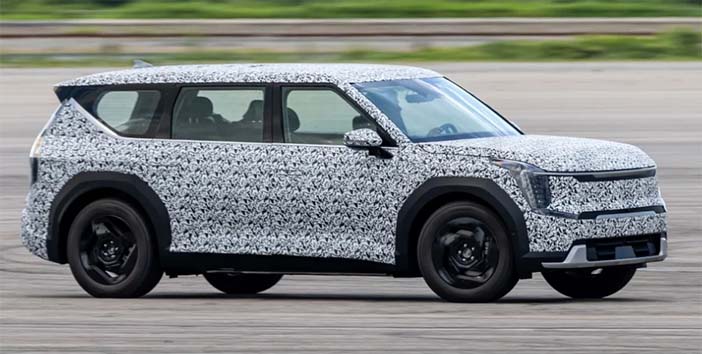
+++ KIA ’s enlisting current customers to help the automaker finalize specs for the coming EV9 electric SUV with 3 rows of seats. A survey was made by Kia inquiring about potential EV9 specs. The survey wanted to know which EV9 the buyer would choose from among 5 unnamed trims given price, range, horsepower and torque, seating capacity, towing capacity, wheel size, and 0 to 100 time. At the bottom, a €75.000 (Dutch pricing) entry-level SUV offered a 350 km range, likely 1 motor with 229 hp and 350 Nm of torque, 7 seats, zero towing capacity, and an 8.7-second lope to 100 km per hour on 19-inch wheels. The variant just above this provides the longest range of the 5 candidates at 465 km, at the same time as it seats 6 thanks to second-row captain’s chairs and can pull 1.000 kilos. The flagship could be a €97.000 trim able to go 425 km on a charge, 2 motors producing 430 hp and 585 Nm, seat 6, tow 2.000 kilos and get to 100 kph in 5.4 seconds on 21-inch black wheels. The larger wheels help add another 0.4 of ground clearance, and it’s said to get black exterior trim. One of the flashiest options is a $4,800 package providing semi-autonomous driving. There aren’t enough options to have a properly close competitive set yet. Among the 3-row crossovers that shoppers can buy now, at the low end, the all-wheel drive Mercedes-Benz EQB 300 makes 228 hp and 390 Nm, is rated to go 423 km, and starts at €65.382 in then Netherlands. Its third row isn’t recommended for anyone above 1,70 meter, however. The $53,490 Tesla Model Y Long Range with a 533 kom range offers a third row that is similarly headroom-challenged. Kia confirmed sending a survey to customers but would not be drawn on any specifics in the survey. The EV9’s due for a launch around the middle of the year before going on sale toward the end of the year. +++
+++ Elon MUSK is gung-ho on the prospect of selling 2 million Tesla vehicles this year after recent price cuts, but a Wedbush analyst says the carmaker is having to “sacrifice margins for volume”. Musk’s upbeat outlook comes after the electric-vehicle maker reported on Wednesday 4th-quarter earnings that topped Wall Street expectations. The company said its revenue grew 37% to $24.32 billion, beating market projections for $24.16 billion. In an earnings call with analysts, Musk said he expects car deliveries to hit 2 million this year, per Reuters. That’s despite the fact that he’s predicting a “pretty difficult recession this year”. “We think demand will be good despite probably a contraction in the automotive market as a whole”, Musk said on the call. Tesla strong earnings come after the carmaker made some aggressive price cuts recently in a bid to boost demand. It slashed prices across global markets, including a reduction of up to 20% for the Model Y in the US. “These price changes really make a difference for the average consumer”, Musk said. Despite the earnings beat, Tesla’s automotive gross margin declined to 25.9%, the lowest in 5 quarters. Musk said the dismal figures reflected increased costs, higher raw material and commodity prices. That shows the company is enduring an erosion of margins in order to prop up sales volumes, according to Dan Ives, an analyst with Wedbush Securities. “They’re ultimately needing to sacrifice margins for volume. And now the question is, with a price war happening in China, what does the trajectory look like in 2023”, Ives told. +++
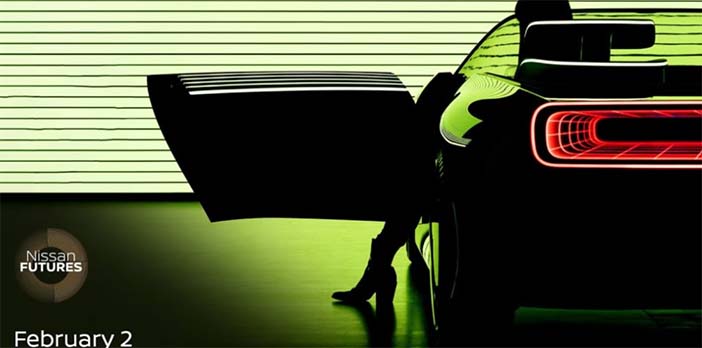
+++ NISSAN ’s showing a new electric concept on February 1. Or it could be the physical version of a concept we’ve seen. The tagline for the livestream encourages all to tune in and “see what happens when virtual becomes physical. Discover how our latest concept car takes zero emissions mobility to the max!” The placeholder image includes the rear corner of the Max-Out concept, which was one of Nissan’s concepts promoting the automaker’s Ambition 2030. The initiative involves a 2 trillion yen ($17.7 billion U.S.) investment over the next 5 years, part of which will pay for launching 23 new electrified models, 15 of those being pure electric. The other models could use the company’s e-Power powertrain, which adds a gasoline range-extender engine. Nissan wants its lineup and the Infiniti range to be 50% electrified globally by 2030, with goals differing for various markets. Europe is targeted for 75% electrified sales in the next five years; the aim for the U.S. and China is 40%. Nissan described the Max-Out as “so responsive it feels a part of you”, the convertible concept aiming “to deliver a new driving experience with its superlative stability and comfort. Dynamic cornering and steering response are balanced with limited body roll to optimize driver and passenger comfort, creating a feeling of oneness with the car”. Other than the expected EV concept bits like a full-width screen for the instrument panel, the concept featured lightweight construction and a passenger’s seat that could be stowed to create more cargo room. The Max-Out debuted alongside 3 more virtual-only concepts, the Chill-Out crossover, Hang-Out SUV and Surf-Out pickup. In a previous video about those concepts, the automaker touted its EV technology vision as being “ultra lightweight” with “ultimate hardware”, “minimal components” and “innovative integration of the body, chassis, and battery”; the latter being solid-state batteries. These would all be an evolution of Nissan’s Advanced e-4Force dual-motor powertrain that debuted at the end of 2019 on a modified Leaf. Combined output came to 304 horsepower and 670 Nm of torque. The system debuted late last year on the 2023 X-Trail in Europe, with 214 hp and 330 Nm of torque. What does this mean for the debut in a few days? In December, Nismo boss Takao Katagiri told Nissan is developing a news sports car for North America and Europe, conjectured to be some sort of preview of a GT-R successor that will have hybrid and pure electric power. We expect a physical version of the Max-Out this week, but we aren’t sure how far ahead the concept casts its vision and how much of what we’re expecting from Nissan will be included in that vision. So, as the TV commercials say, tune in Wednesday to find out. +++
+++ RENAULT will slash its stake in partner Nissan as part of a deal rebalancing the rocky alliance between the 2 companies, the firms said Monday. The deal will also see Nissan take a stake in Renault’s new electric vehicle venture Ampere, though the size of the investment was not immediately announced. The agreement comes after months of painstaking negotiations and repeated delays, as the 2 firms sought to reset their decades-old alliance after years of tensions. The automakers called Monday’s announcement “an important milestone” in “discussions on defining new foundations for their partnership”. The agreement is intended to “strengthen the ties of the alliance and maximise value creation”, the statement issued simultaneously by both companies said. Renault will reduce its stake from 43.4 percent to 15 percent, the same size as Nissan’s stake in its French counterpart, in what the firms said would produce “a balanced governance”. Nissan will also invest in Ampere, “aiming to become a strategic partner”, the firms said, without specifying how large the Japanese automaker’s stake would be. In November, Renault announced that it would split its operations in 2 units: Ampere and a separate subsidiary for petrol, diesel and hybrid cars that will pair up with China’s Geely. But concerns at Nissan about future technology transfers to the Chinese carmaker, as well as details over the sharing of electric vehicle intellectual property, complicated the negotiations. The French and Japanese automakers plan to reset their decades-old alliance after years of tensions. The agreement is expected to be signed next week following board approval from both sides. The international auto alliance began in 1999, when Renault rescued Nissan from bankruptcy. They were joined by Mitsubishi in 2016, when Nissan took a 34 percent stake in its struggling Japanese rival. But the union was destabilised by the 2018 arrest of Nissan boss Carlos Ghosn, who claimed the charges against him were intended to prevent him from bringing the Japanese and French automakers closer together. Discussions have been held behind closed doors and the announcement was repeatedly previewed but then postponed. Still, analysts have described the rebalancing of the deal as a way to build confidence between Nissan and Renault, particularly after the fallout from the Ghosn scandal. There is also scope for the firms to cooperate on electric vehicles, given Nissan’s existing technologies and Renault’s greater access to the European market. After the deal is signed, the French automaker will not immediately sell the outstanding 28.4 percent of its Nissan shares because the current market value is lower than that registered in Renault’s accounts. Instead, the shares will be placed in a trust for sale when prices improve, with no time limit placed on the process. Its voting rights will be “neutralised” for most decisions, the companies said, but it will retain rights to dividends and shares’ sale proceeds until it sells. +++
+++ TESLA cars are expensive to repair. So much so that the automaker and insurers are addressing the issue in sharply different ways. Chief executive Elon Musk says Tesla is making design and software changes to its vehicles to lower repair costs and insurance premiums. Insurance carriers, meanwhile, are writing off low-mileage Model Ys that have been in crashes, and sending them to salvage auctions after deeming many too expensive to repair. During Tesla’s 4th quarter earnings call, Musk said premiums from third-party insurance companies “in some cases were unreasonably high” and that the EV maker’s insurance arm was putting pressure on those carriers by offering lower rates to Tesla owners. Musk also said “we want to minimize the cost of repairing a Tesla if it’s in a collision”, citing changes to vehicle design and software. “It’s remarkable how small changes in the design of the bumper and providing spare parts needed for collision repair have an enormous effect on the repair cost”, he said. “Most accidents are actually small: a broken fender or scratched side of the car”. So far, Tesla’s reputation for expensive vehicle repairs does not seem to have dampened demand, which Musk says is running well ahead of the company’s ability to produce. The data on crashed low-mileage Teslas showing up at auction presents a slightly different, and previously unreported, picture. Of more than 120 Model Ys that were totaled after collisions, then listed at auction in December and early January, the vast majority had fewer than 16.000 km on the odometer, according to online data from Copart and IAA, the two largest salvage auction houses in the United States. The retail prices of those cars ranged from about $60,000 to more than $80,000. Copart and IAA auction listings note whether the vehicles were involved in front, rear or side collisions, and typically include after-crash photos of each vehicle. But the listings do not disclose specific details on the type of damage suffered. Insurance companies typically “total” a vehicle. That is: choose to scrap it and reimburse the owner when the estimated cost of repair is deemed too high. Copart listings in some cases included the names of insurance companies that had bought back crashed vehicles, then listed them at auction. Those companies include State Farm, Geico, Progressive and Farmers. Geico is part of Warren Buffet’s Berkshire Hathaway. Tesla launched its own insurance affiliate in August 2019, promising rates up to 30% lower than competitors. During the earnings call, chief financial officer Zachary Kirkhorn said Tesla Insurance at year-end was generating premiums at an annual rate of $300 million and growing at a quarterly clip of 20%; “faster than the growth in our vehicle business”. All the Model Ys in the analysis were 2022 or 2023 models, and were built at either the Fremont plant in Northern California or the Austin, Texas, plant. Of the 15 Model Y Long Range vehicles built in Austin from June through November and sent to auction after being totaled in crashes, all but one had fewer than 16.000 km on the odometer. An Austin-built 2022 Model Y Long Range involved in a front collision and listed by IAA in early January had a retail price of $61.388 and estimated repair cost of $50.388. The vehicle’s owner was not listed. A second Austin-built Model Y, involved in a side collision and listed by IAA, had a retail price of $72.667 and estimated repair cost of $43.814. +++
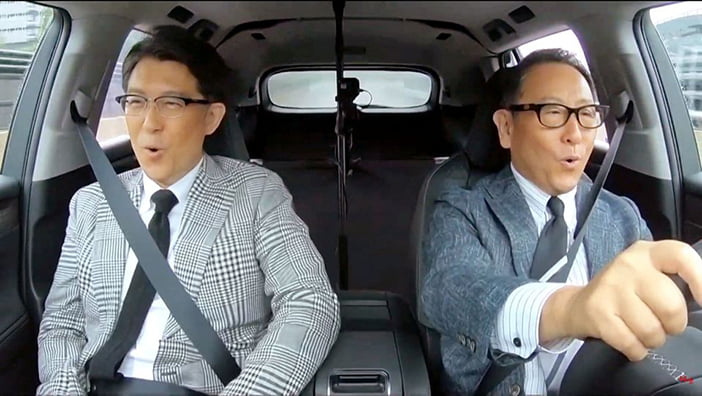
+++ Koji Sato, who was named on Thursday as the future CEO of Japan’s top automaker TOYOTA , is an engineer with a background in diesel engines who will be tasked with navigating the company’s shift to clean energy. Currently the CEO of Toyota’s luxury brand Lexus, Sato will succeed Akio Toyoda as the CEO of Toyota on April 1. Under Toyoda, the automaker has followed a go-slow approach to electric vehicles, arguing that the hybrid technology it pioneered with the Prius will remain important along with investments in hydrogen. Sato studied diesel engine combustion at university and joined Toyota in hopes of “contributing to society by creating the future of diesel engines”, according to an interview on the website of Gazoo, Toyota’s motorsport brand. Although the 53-year-old oversaw the creation of Lexus’s first fully electric model, he has also spoken of keeping other options for powering vehicles open. He spoke of the potential of hydrogen last year in Thailand, where Toyoda himself drove a hydrogen-powered Toyota race car at an endurance race. “It won’t be an immediate substitution for electric vehicles, but it’s good for people to know that there are other options available, when the increase of EVs eventually plateaus”, Sato said of hydrogen-powered vehicles. Sato started his career at Toyota in 1992, before rising through the ranks to become chief engineer of Lexus International in 2016, based on his profile on the Toyota website. “The industry itself is facing a once-in-a-century disruption, with many unknowns to navigate”, said John Shook, a former Toyota manager who now consults on the lean management techniques pioneered by the company. “I can imagine that Akio thought now is the time to transition so his successor can steer the ship through the uncertainty ahead”. Sato has held positions as the president of Lexus International and Gazoo Racing Company since 2020. He also took on an executive role at Toyota and became its chief branding officer in January 2021, which is good news for the company as the industry undergoes change, said Christopher Richter, deputy head of Japan Research at investment group CLSA. “Having somebody who’s sensitive to the need to develop a brand, that’s all the more critical right now as you’re heading into the EV age, where a lot of what made the brand changes”, Richter said. “Car companies used to live and die by their engines. You’re changing to a different type of vehicle. Building a brand around this new type of architecture, this new type of drive is key”, he added. In his spare time, Sato enjoys visiting temples in Kyoto and practices Japanese tea ceremonies, according to a profile on the Gazoo website. He drives a Toyota Supra that was handed down from his father-in-law, the profile said. One of the main reasons Sato was elected as a successor was his love of creating cars, Toyoda said during the official announcement which was broadcast online. That passion was obvious in a brief video clip released in 2021, where Sato sits next to Toyoda as they test-drive a Lexus. As Toyoda accelerates and whoops excitedly, Sato can be seen with a wide grin and occasionally laughing, unable to contain his delight. +++
+++ In the UNITED STATES , General Motors and Ford are expected to report strong profits for 2022 next week, powered by premium-priced pickups and SUVs. Now, the Detroit rivals must convince investors that last year’s profit formula can keep working when costs for EV batteries are rising, high interest rates are cutting consumer purchasing power, and Tesla is slashing prices. Already there are signs the Detroit automakers are scaling back spending to offset competitive and economic pressure. GM has shelved for now plans to build a 4th EV battery plant in North America. Ford is in talks with German unions to cut thousands of jobs in its European operations and possibly sell a German vehicle assembly plant. In October, it stopped funding autonomous vehicle affiliate Argo AI. GM and Ford both rely on sales of pickups and SUVs in the United States for the bulk of their global profits. This year, both automakers plan to ramp up sales of much less profitable electric vehicles in North America and other markets. The risk to the Detroit automakers’ profitability would be a challenge in the best of times. But now, GM and Ford must factor in forecasts for a slowdown, or even a recession, in the U.S. economy. EV battery raw material costs are rising, but U.S. EV market leader Tesla is cutting prices on its bestselling Model 3 and Model Y vehicles by as much as 20%. The Model Y competes with Ford’s Mustang Mach-E, GM’s Cadillac Lyriq and with combustion SUVs the Detroit automakers sell. Morgan Stanley estimated increased prices added an average of $3 billion a year to Ford’s pre-tax bottom line and was the equivalent of more than 200% of the improvement in the company’s pre-tax profits for 2022. GM, the No. 1 U.S. automaker by sales in 2022, said higher prices added $2.1 billion to pre-tax profits in the third quarter compared to the same quarter in 2021; equivalent to nearly half of pre-tax profits for the period overall. The company has told investors it will spend $35 billion on electric and automated vehicles between 2020 and 2025. Ford has put its planned EV investments at $50 billion through 2026. “If we are entering a downturn”, Morgan Stanley analyst Adam Jonas said, “what steps can they take to keep investing and remain strong?” +++