
+++ AUDI SPORT is to resurrect the RS6 Limousine as an electric-powered rival to the likes of the recently unveiled BMW i5 M60 and the Mercedes-AMG EQE 53. Scheduled for introduction in 2025, the new 4-door performance model is planned to be sold under the RS6 e-Tron name as a sibling to the RS6 Avant e-Tron, according to sources at the engineering headquarters in Neckarsulm, Germany. The impending return of the RS6 Limousine to the Audi line-up has been revealed 13 years after the combustion-engined model ceased production in 2010, making way for the more sportingly styled RS7 saloon at the time. The RS6 e-Tron Limousine and Avant build on the upcoming A6 e-Tron which is already confirmed for a launch in 2024. Central to their performance is a newly developed electric drivetrain, elements of which have been engineered in partnership with Porsche, which will use the dual-motor system in an upgraded version of the Taycan, also due to be unveiled in 2025. The 2 new electric Audi Sport models are claimed to have more performance than the existing combustion-engined RS6 Avant and RS7 saloon, with up to 610 hp and over 1.000 Nm of torque. In combination with a 2-speed gearbox on each motor and a fully variable electric Quattro 4-wheeldrive system, the 2 new performance EVs are shaping up to be the fastest-accelerating saloon and estate combinations yet. Like their lesser A6 e-Tron siblings, the new RS6 e-Tron Limousine and Avant are based on the Premium Platform Electric (PPE) structure developed in an engineering partnership between Audi and Porsche. It supports an 800 Volt electric architecture as well as a silicon-carbide inverter. Other upcoming new models based on the PPE platform include the Audi Q6 e-Tron and Q6 e-Tron Sportback as well as the Porsche Macan Electric. The A6 e-Tron concept revealed in 2021 provides clues to the dimensions of the upcoming RS6 e-Tron Limousine. With a length of 4.960 mm, width of 1.960 mm and height of 1.440 mm, it is 9 mm longer, 74 mm wider and 18 mm taller than today’s fifth-generation A6 saloon. Initial plans called for combustion-engined successor models to today’s A6 Limousine and A6 Avant to be renamed as the A7 Limousine and A7 Avant in keeping with a new naming system developed under former Audi CEO Markus Duesmann. It called for electric models to receive even-numbered model designations and combustion models to switch to odd-numbered model designations. However, the appointment of Gernot Döllner to the head of the German car maker has led to an internal review of future operations and the naming system, say insiders at the company’s Ingolstadt base. Before the new electric-powered RS6 arrives, Audi plans to provide the existing combustion model with a further upgrade in the form of a car known to insiders at the Audi Sport division as the RS6 GT Avant. Inspired by the RS6 GTO concept revealed in 2020, its twin-turbocharged 4.0-litre V8 is claimed to develop an added 20 hp and 50 Nm over the existing RS6 Avant Performance at up to 650 hp and 900 Nm. Prototypes of what is possibly the last non-electrified RS6 Avant model recently spied testing at the Nürburgring feature a revised aerodynamic package, including a larger wing element above the tailgate as well as a new diffuser. Whether the new GT model will be offered in RS7 Limousine guise is not yet clear, although it is claimed to be the fastest-accelerating RS6 Avant yet. Autointernationaal has been told to expect a 0-100 kph of “around 3.5 seconds” in combination with a top speed “limited to 300 kph”. +++
+++ It may have only launched in 2020, but the 2 Series Gran Coupe is already one of the oldest offerings within BMW ’s range of models. It’ll soon gain a facelift however as an updated version has just been spotted testing. The timing of the second-generation 2 Series Gran Coupe’s refresh should mean it’ll remain competitive to its nearest rival, the Mercedes CLA, which got its own mid-life update earlier this year. The revised 2 Series will take on an evolutionary approach in terms of design. We can expect a more aggressive and angular front bumper with squared-off intakes, similar to the new M2. A new grille shape will also be implemented and we can expect to see a new light signature for the front and rear lights too. As with the upcoming 1 Series facelift, a new selection of alloy wheel designs should be made available. Unlike the new 2 Series Coupe which utilizes a rear-wheel drive CLAR platform, the 2 Gran Coupe will retain its UKL2 platform. This means it should keep its mix of front and four-wheel drive layouts but also gain fresh powertrains using hybrid technology. As with the 1 Series we could see a plug-in hybrid engine option like that found in the latest X1. There’s also the possibility of 48 Volt mild-hybrid power; something Mercedes has implemented across the recently updated A-Class. As for this sportier M235i variant, I expect to see a more powerful version of BMW’s 306 hp, 2.0-litre turbocharged 4-cylinder engine judging from the revised air intakes. As with the outgoing M235i, power will be sent to all 4 wheels. We’re yet to see inside the new 2 Series Gran Coupe but it should look identical to the upcoming facelifted 1 Series hatch, with a 12.3-inch digital driver’s display and 10.25-inch touchscreen taken from the new 2 Series. I expect the iDrive rotary controller to be removed in favour of a touch-only screen as BMW plans to reserve the feature for its larger models. +++
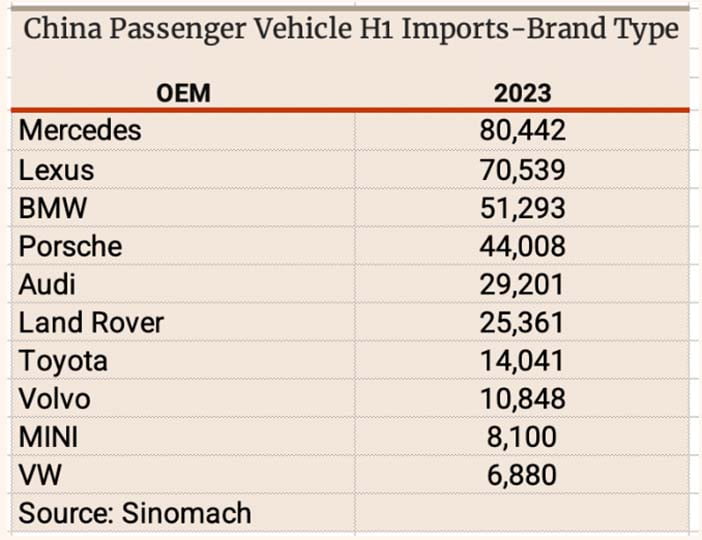
+++ Auto imports in CHINA slow down as 2022 low base effect weakens and consumer campaigns promote NEVs (New Energy Vehicles). China imported 338.000 passenger vehicles in the first 6 months of the year, a 23.3% decrease compared to 2022. In the same period, 365.000 imported cars were sold or 0.6% less than the first 6 months of the last year. Sales of the imported cars are slowing down as 2022 low base effect weakens and consumption boost campaigns organized by the local governments release the demand for electric vehicles and plug-in hybrids, the country’s leading car importer, Sinomach, analyzed. SUVs made half of imported vehicles, while sedans recorded over 40% share with MPVs getting a little over 3% share. MPVs recorded the highest drop at over 20 percent. Luxury brands made 91% of the imports in the first half of the year. At the same time, non-luxury cars made 9.3%. Non-luxury brands had the highest growth in the past 6 months at over 8 percent. Mercedes led the manufacturers, with Lexus and BMW following at second and third spot. Among top 10 importers, 5 of them are based in Germany. BMW and Mini recorded drops year-over-year as they started domestic production of certain models. The automotive imports to China have been slowing down since 2017, when the country recorded 1.28 million imported vehicles. In 2022, the imports were around 880.000 units. The imports have been decreasing on average at 10% annual rate based on CPCA data. This year’s slow down is primarily due to Mini and BMW localizing their production, and Lexus having a bad sales year. Japanese automaker saw its sales being cut in half this year as it is trying to find electric products that will be recognized by the local market. Lexus saw a 20% drop in sales this year. +++
+++ FISKER ’s smaller-than-expected quarterly loss and first revenue from deliveries of its electric SUVs helped counter an annual production cut, sending its shares up more than 2% in premarket trading on Friday. The company now expects to produce between 20.000 and 23.000 vehicles in 2023; down from 32.000 to 36.000 units projected in May. A key supplier required additional time to ramp up capacity to meet the company’s production schedule in the second half of the year, Fisker said. A month ago, the company reported production of 1.022 Ocean SUVs in the second quarter, missing its target of 1.400 to 1.700 units due to a shortage of components. Electric vehicle startups have faced supply chain issues with component providers prioritizing larger EV makers with proven production capacity and demand. The California-based company, however, recorded its first quarterly revenue from sales as the electric sport utility vehicle (SUV) maker kicked off deliveries in Europe and the United States. The company reported $825,000 in revenue in the second quarter. An Austrian unit of Canadian auto parts maker Magna International makes the SUV for the company, disqualifying it for $7.500 federal tax credit in the United States. Analysts expect the company to record an operating profit in the 4th quarter. +++
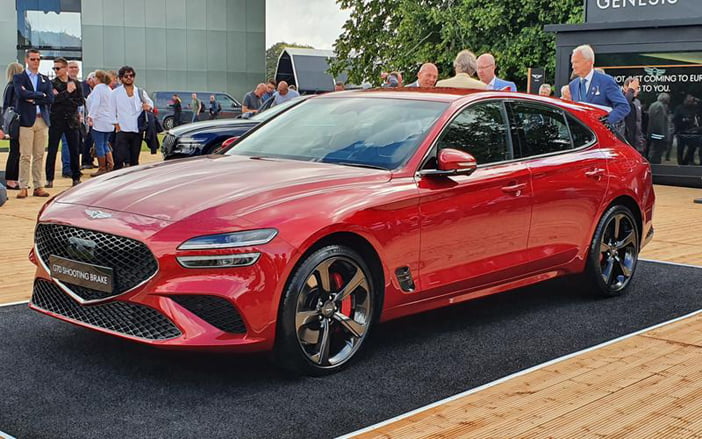
+++ The excellent GENESIS G70 is reportedly no longer getting a successor. The reason? We’ll give you one guess. If you said, “Because customers want bigger vehicles”, you win 1 million internet points. The report comes from South Korea’s JoongAng Daily, who spoke with an unnamed source “directly related to the project”. This source told the newspaper that development of the car, internally named the RN2, had been officially halted. For what it’s worth, Genesis parent company Hyundai declined to comment on the matter while stating that “nothing has been confirmed”. The Genesis G70 is one of the best luxury sports sedans money can buy right now. A test of a G70 3.3T confirmed it to be one of the best-handling 4-doors on the market, with BMW levels of luxury and a sledgehammer-esque twin-turbo V6 punching out 365 horsepower and 500 Nm of torque. Oh, and it’s better looking than a Bimmer and more affordable than its German rivals too. The current model comes with only an 8-speed automatic, but a stick shift was offered until 2021. Sadly, the most customers wouldn’t know engaging driving dynamics if they slapped them on the forehead. JoongAng Daily says G70 sales have dropped sharply as customers congregate among larger sedans and SUVs. In fact, their source says that the next-generation would have grown in size and gotten too close to the G80. The RN2 would have also been all-electric as part of Genesis’ commitment to to all BEV by 2025. Ironically, the Genesis G70 had its best sales year ever in the United States in 2022, with 12.649 units moved. Figures for 2023 seem on-pace with that number. The story is quite different Europe, where only 96 G70s were sold in 2022. In case you were wondering, even the drop-dead sexy G70 Shooting Brake (photo) that’s been cruelly denied to American buyers outsold the G70 sedan in Europe with 144 examples. The G70 was the first car offered under the Genesis marque when it spun off from Hyundai. If this report is true, it will have existed for just one generation. The report says upcoming models like the G80 coupe and G90 flagship are still on track. That’s good news, because it would be a crime to let achingly gorgeous designs like the X Concept and X Convertible go un-made. +++
+++ The upcoming PORSCHE MACAN EV, the German brand’s critical first entry into the electric SUV segment, has been spotted in its closest production-spec form to date. Sporting no camouflage at all and importantly no covered exhausts (previous mules had used ICE Macan bodies), the SUV shows off a slightly different design from the combustion car it will be sold alongside, which itself received a facelift last year (and a technical boost this year) that distinguishes the pair. Key changes have resulted in a more angular face, replacing the current Macan’s blockier design. This also gives the headlights a sharper shape, more in line with those of the bigger Porsche Cayenne, and the front daytime light bars have been replaced by 2 sets of twin circular lights. A close relationship to the Cayenne is also apparent at the rear, where the Macan EV swaps the previously bulbous design for a more angular one. Deliveries of the Macan EV, which will share its PPE architecture with the similarly sized Audi Q6 e-Tron, are scheduled to start in 2024. It was originally planned for this year, but was delayed by development difficulties at Cariad, the Volkswagen Group’s software division. Antoon Janssen, Porsche powertrain manager for the Macan line, told that it intends for the Macan EV to be the sportiest car in its class. As such, it receives a pair of permanently excited electric motors (1 per axle) similar to those used in the Porsche Taycan. However, these have been heavily reworked to boost power density and efficiency, featuring a new ‘double V’ magnet arrangement and switching from a silicon semiconductor to silicon-carbide. The latter reduces switching losses (effectively power leakage) in the motors’ pulse inverters. These improvements yield power outputs of up to 610 hp, with more 1.000 Nm of torque, sent to all 4 wheels. The firm has not commented on whether an ‘overboost’ function (as offered on the Taycan Turbo S to temporarily raise power and torque) will also be available on the Macan EV. Rear-wheel drive is also possible on the PPE platform, said Janssen, although this will initially be used only to decouple the front motor when cruising to reduce rolling resistance (and conserve energy). Dynamics have also been a point of emphasis for the Macan EV. Model chassis manager Dominik Hartmann confirmed that it will have a “performance rear axle”, with the motor mounted as far back as possible. This gives a weight distribution of 48% at the front and 52% at the rear, to maximise traction. For reference, the Taycan’s mass is divided 49:51 front to rear. Porsche also confirmed that the tyre widths will be more staggered than on the current Macan (the existing GTS variant uses 265 mm-wide rubber up front, but 295 mm-wide tyres at the rear) to accommodate the rearward weight bias and further improve grip. The Macan EV will also be the first model to receive Porsche’s 2-valve dampers, which are said to enhance ride comfort because they enable independent adjustment via the Porsche Active Suspension Management (PASM) system. This will also lower the suspension at certain speeds to improve the car’s aerodynamic profile and reduce energy consumption. To improve manoeuvrability, the steering angle has been increased by 15% over the petrol car, and rear-wheel steering up to 5.0 degrees (below 80 kph) has been added. The most expensive versions of the Macan EV will also get an electronic locking differential mounted at the rear axle, designed to improve its front-rear torque-vectoring capabilities. All variants will receive a 100 kWh lithium ion battery, which, Porsche stated, is the optimum size for minimising journey times. The company has offered no range prediction, but an optional 93 kWh battery gives the lower Taycan enough power for 500 km per charge. The PPE platform’s 800 Volt architecture allows maximum charging rates exceeding 270 kW. However, trick hardware and software developments mean that the battery can respond to 400 Volt chargers by splitting the single 800 Volt battery into 2 halves. This boosts charging speeds, said Janssen, although he did not confirm how significant this impact was. Janssen also confirmed that the PPE platform could be extended to fit more battery modules. The Macan uses 12 prismatic cells. This implies that the eventual Porsche Cayenne EV (which is tipped to also use the PPE platform) could have an even greater battery capacity in order to compete with the Mercedes-Benz EQS SUV. Nonetheless, the long-term goal for Porsche’s road-going cars is to reduce the size of the batteries, according to Florian Modlinger, the firm’s Formula E boss. This “must be the target”, he said, although he acknowledged that this “will take longer” than in motorsport. The Macan EV is the next model in an assault of Porsche EVs due over the next few years, which include the 718 Boxster EV (2025), the electric Cayenne (2025) and the Panamera EV (2026). Later this decade, a new electric SUV, known to be a 7-seater codenamed the K1, will arrive. It is thought this model will be Porsche’s most expensive car and represent a complete styling revolution for the marque. Porsche aims for electric vehicles to account for 50% of its global sales in 2025, and 80% by 2030. +++
+++ TOYOTA may be planning to replace its time-limited GR86 sports car as early as 2025 with a redesigned hybrid version that sits on a new platform and uses the turbocharged 3-cylinder engine that already powers the much-admired GR Yaris. Reports from Japan suggest that the current version of Toyota’s 2-door sports coupé, launched early in 2021, will need to be removed from sale within 2 years because it will no longer comply with forthcoming Japanese fuel consumption and emissions standards. Another factor is that its windscreen dimensions may no longer suit the advanced European safety systems (believed to be traffic light recognition cameras) that will be required in new cars from next year. Toyota chief technology officer Hiroki Nakajima declined to confirm the plan for an all-new GR86 hybrid but agreed that such a car was “a good idea”. “Hybrid systems are always a good solution for environmental cars”, he said, “not just for passenger cars but for sporty cars as well. We can build them at a lower price than battery-electric models, and we know how to make them fun to drive”. Nakajima added that there are still nearly 12 years to go before the sale of hybrid cars partly powered by internal combustion engines will be outlawed in Europe. Toyota has long been outspoken on the virtues of hybrid technology, positing electrified combustion-engined cars as a more efficient and impactful use of currently limited battery resources. The firm has previously voiced plans to deploy its long-awaited solid-state batteries in hybrids before pure-EVs, but this is the first time it has hinted at the potential for a hybrid mass-market sports car. Toyota’s Gazoo Racing performance division has form in the hybrid sphere, of course, having won the Le Mans 24 Hours 5 times on the bounce between 2018 and 2022 with its TS050 and GR010 electrified hypercars. Plans for a road-going ‘GR Super Sport’ variant of the latter were, however, shelved in 2021, and the firm’s sports car line-up remains entirely combustion-powered, at least for now. On the subject of the much-talked-about electric Toyota GR car, Nakajima said reducing the height of traction batteries carried in the floorpan of BEV models will be “the breakthrough” needed to build lower, sleeker and more interesting electric cars. He said a lower battery height was “the key to success” for the dynamic and desirable saloons and sports cars Toyota wants to build in the future, because it would promote aerodynamic shapes, reduce frontal area and allow ‘more emotional’ designs. Better aerodynamics, working in tandem with Toyota’s recently announced solid-state battery technology, would make delivering a 1.000 km-plus battery touring range seem “not so special”. Nakajima added: “If we also downsize major components like a car’s airconditioning system, we can lower the cowl height and get a very good Cd value. We can realise a 1.000 km range easily”. Currently, Toyota and other BEV manufacturers work to a 150 mm battery height, which suits the current BEV crossover and SUV models because there’s enough space to accommodate a bulky battery. However, Toyota is already changing to 120 mm units and has a further reduction in its sights. “Our target is 100 mm”, said Nakajima, “so that in future we can build a battery Supra, for example”. Toyota chairman Akio Toyoda recently revealed that he had driven a prototype for an electric GR sports car, but he gave no details on its size, shape or positioning. According to Nakajima, the challenge in building 100 mm batteries for big scale production is meeting current quality standards and delivering a fast-enough charging capability. The company is currently working on these problems through the 50/50 joint-venture company it owns with the electronics giant Panasonic. Meanwhile, Toyota continues to make industry-leading progress at bringing its smaller, more energy dense solid-state batteries to production. Insiders say the company is determined to bring a “true” solid-state battery to market, not one of the gel-based “semi-solid” versions that are under development elsewhere. Current expectations are for the first Toyota-Panasonic solid-state application to be a relatively short-range mid-size van, due for launch at the end of 2026. A van is considered an ideal first application because a small battery can be carried in a well-protected space. Solid-state units need ultra-rigid mounting because they could be prone to cracking if flexed. +++
+++ TOYOTA MOTOR CORPORATION president Koji Sato said the automaker will maintain its “all-round electrification strategy” for decarbonization in a recent interview with The Yomiuri Shimbun. The automotive giant’s strategy includes a variety of decarbonization options, such as electric and hybrid vehicles. Sato expressed his intention to focus on the development of electric and fuel cell vehicles powered by hydrogen. “Ultimately there will be a balance between the two pillars of electricity and hydrogen”, he said. Sato believes electric vehicles have the potential to increase people’s sense of value in cars. EVs “will make cars more interesting to drive”, he said, adding that Toyota will promote the development of “exactly the kind of EVs a car craftsman would make”. Regarding hydrogen vehicles, he said, “We’ll probably proceed with commercial vehicles as the core. We’ll promote consumption of hydrogen in order to create a hydrogen society”. +++
+++ In the UNITED KINGDOM , the new car market recorded its best July for registrations since the Covid-19 pandemic following a huge uptick in sales to fleets last month. According to the Society of Motor Manufacturers and Traders (SMMT), the fleet market grew by 61.9% compared with July 2022. Sales to fleets accounted for 56% of the UK’s total figure last month, which reached 143.921 units. This total represents a year-on-year increase of 28.3% in new car sales but it is still behind the 157,198 recorded in July 2019, before the Covid-19 pandemic. Sales of battery-electric vehicles (BEVs) increased 87.9% compared with June 2022, to 23.010 units. However, BEVs’ market share was “broadly consistent with that seen so for this year”, the SMMT said. A similar sales boost of 79.1% was also seen for plug-in hybrids. These increases are explained by the significant tax incentive offered to fleet users for running BEVs and PHEVs. Pure-petrol engines remained the best-selling powertrain, recording 58.150 sales; a 5.3% decline in market share year on year. They were followed by mild-hybrid petrols, with 23.590 sales. The SMMT welcomed news that 3.056 public EV chargers were installed between April and June (a quarterly record) but it urged the government to build more “ahead of need”. It said: “To reach the government’s minimum target of 300.000 chargers by 2030, the installation rate must treble to almost 10.000 chargers per quarter, every quarter”. SMMT chief executive Mike Hawes added: “Government must pull every lever, therefore, to make buying, running and, especially, charging an EV affordable and practical for every driver in every part of the country”. According to the latest SMMT forecast, BEVs’ market share will reach 17.8%, up from the current 16.0%, by the end of the year. It anticipates that this will rise to 22.6% next year, in line with the government’s zero-emission-vehicle mandate requiring that 22% of all sales be ZEVs in 2024. The best-selling car in the UK last month was the Ford Puma, which recorded 4.124 registrations. It was followed by the Kia Sportage (3.060) and the Nissan Qashqai (3.032). The Qashqai was the UK’s overall best-seller in 2022. +++