
+++ The U.S. securities regulator has asked LUCID MOTORS for documents related to an investigation into its blank-check deal, joining a growing list of companies that have come under scrutiny for their merger with shell companies. Shares of the luxury electric-car maker fell about 14 % in pre-market trading after disclosing that it had received a subpoena from the U.S. Securities and Exchange Commission. “The investigation appears to concern the business combination between the company (Churchill Capital) and Atieva, and certain projections and statements”, Lucid said in a regulatory filing. Lucid’s deal with veteran dealmaker Michael Klein’s blank-check acquisition firm had given the combined company a pro-forma equity value of $24 billion and was completed earlier this year. It was one of the biggest in a string of deals with Special Purpose Acquisition Companies (SPACs) that included electric vehicle makers such as Nikola and Fisker. The California startup joins many other electric-car makers being investigated by federal agencies and regulators as they rush to meet production targets and catch up with Tesla which is producing nearly 200.000 cars every quarter. Nikola is working with U.S. regulators to pay a $125 million penalty to settle a charge against its founder Trevor Milton for using social media to repeatedly mislead investors. Lordstown Motors is being investigated for vehicle pre-orders and its merger with blank-check company DiamondPeak Holdings. Founded in 2007 as Atieva by former Tesla executive Bernard Tse and entrepreneur Sam Weng, Lucid Motors is aiming to achieve production target of 20.000 vehicles in 2022 and 50.000 in 2023. Lucid had in September secured $4.4 billion it needed until the end of next year. It was funded initially by Chinese and Silicon Valley venture investors, with additional funding from backers like state-owned Chinese auto maker BAIC Motor and Chinese technology company LeEco. +++
+++ When MASERATI debuted the Ghibli at the 2013 Shanghai Motor Show, the executive tourer was meant to establish itself as a sporty alternative to the BMW 5 Series set and help Maserati increase its global sales 8-fold. Neither of those happened. The product push didn’t materialize and the Ghibli failed at its task because it never managed to be the smooth, dynamically masterful Italian it could have been, its rough edges inexcusable in a sedan that once started at about $76,000 and is now nearly $80,000 after destination. Even so, I never wished the Ghibli ill, I wished Maserati would sort it out. That’s not going to happen: production is expected to stop at the end of 2022 and the car will not be replaced. Assuming this happens and the Ghibli takes a final ride into the sunset, it will have had almost 10 years on the market. The model launched Maserati’s electrification push, the Ghibli Hybrid and its 48 volt mild-hybrid system coming online last year. At the same time, the model finally acquired the raucous V8 one would have expected at launch or shortly after, in the guise of the Trofeo trim we do get. Like all other automakers, though, Maserati has a huge to-do list over the next 5 years and it can’t coddle laggards. Last year, the automaker’s product roadmap called for a pile of new and new-generation models. The MC20 flagship is out, the Grecale crossover is due early next year in ICE and battery-electric forms, followed by the new GranTurismo and GranCabrio with ICE and EV powertrains, plus the MC20 Spider and pure-electric MC20. In 2023, the new Quattroporte will return that nameplate’s former glory as the only sedan in the lineup, followed by a new Levante, both with internal combustion and electric powertrains. +++
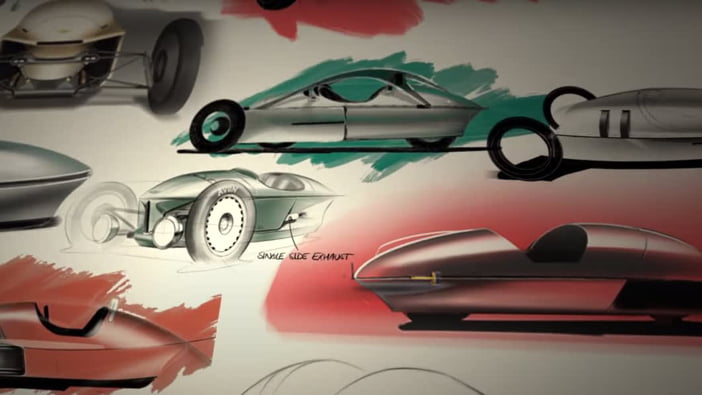
+++ In preparation for the release of its new 3-Wheeler, MORGAN has released a cornucopia of design sketches. All of them vary wildly from each another, showing possible directions for the cyclecar’s next iteration. One thing’s for sure, though: you won’t mistake them for anything other than a Morgan. The designs do reveal that the 3-Wheeler is evolving with the times. The outgoing car could easily be confused with something from the early 1920s (or a Richard Scarry book, for that matter), but the next iteration will be a leap forward in design. For Morgan, that means something inspired by the early Jet Age. Sure, that era might be 90 years behind us, but for Morgan, a company that still uses wood as a key structural material in body construction, that jump to late-1930s styling will be downright futuristic. Various sketches show a more streamlined body, possibly made of polished aluminum for that jet fuselage look. Some ideas even show very aeronautic vertical and horizontal stabilizers. Many show an enclosed nose, some cone-shaped like that of a plane, some more like a streamliner-era locomotive. Others have a teardrop shape to the rear, evoking the lakesters that American hot rodders built out of airplane fuel tanks in the 1950s. Amusingly, some sketches call out “touring options”, which include such niceties as a windshield or 2 leather straps on the side of the car just big enough to hold a duffel bag. Others have an enclosed compartment that looks to be just large enough for a briefcase. Both exposed and enclosed suspension options make the rounds, as do single- and double-headlight designs. Some illustrations even show a canopy-esque enclosed cockpit … progress! Regardless of what it looks like, the next Morgan will ditch its V-twin engine for a Ford-sourced 3-cylinder. If it’s the European Fiesta’s mill, that should translate to at least 85 hp. Even with this shift in design, the Morgan 3-Wheeler will remain decidedly old school. It’s refreshing to see a company stick so staunchly to its guns, making cars of the same basic layout since H.F.S. Morgan designed his personal cyclecar in 1908. The next Morgan 3-Wheeler will debut sometime in 2022. +++
+++ We’ve known for some time that Elon MUSK has a problem with using radar sensors on Teslas. We’ve also known that the automaker is under federal investigation for crashes involving Autopilot, and that U.S. senators and others have decried the use of the terms Autopilot and Full Self-Driving as deceptive and dangerous. For several years, Autopilot incorporated radar, and for a time Tesla worked on developing its own radar technology. But 3 people who worked on the project said Musk had repeatedly told members of the Autopilot team that humans could drive with only 2 eyes and that this meant cars should be able to drive with cameras alone. Musk insisted a Tesla should be capable of driving door-to-door unassisted, using only cameras. Tesla engineers disagreed with this technological direction, as did outside experts; some left the company, while others followed Musk’s marching orders. But for this reason, along with cost, Musk’s view of a radar emitter’s aesthetics on the vehicle, and his preference not to use third-party suppliers, he pushed for cameras-only technology and in May announced that Tesla was dropping radar. Yet computer-vision specialist Schuyler Cullen, who oversaw autonomous-driving research at Samsung, says a cameras-only approach was fundamentally flawed: “Cameras are not eyes! Pixels are not retinal ganglia! The FSD computer is nothing like the visual cortex!” Engineers on the project also objected to the marketing team’s plan to dub the driver-assist technology Autopilot, for the same reasons that Tesla’s critics and regulators have since cited: it implies capabilities the technology does not have. Their preferred alternative name was Copilot. Musk made pronouncements over the years that autonomous driving was just around the corner, when it clearly was, and is, not. Engineers believed Musk was promising capabilities that are not possible. They were “surprised and concerned” when Musk as early as 2016 was promising that all Teslas then being built had the components for “full self-driving.” Less than a month after a fatal crash involving Autopilot in May 2016, Musk stated that autonomous driving was “basically a solved problem” and that Teslas could already drive more safely than humans. Amnon Shashua, chief executive of Mobileye, a former Tesla supplier, advises: “One should not be hung up on what Tesla says. Truth is not necessarily their end goal. The end goal is to build a business”. +++
+++ TESLA boss Elon Musk said the much-anticipated Tesla Cybertruck would come with a high-end 4-motor variant. “Initial production will be 4 motor variant, with independent, ultra fast response torque control of each wheel”, Musk said in a tweet. Calling the electric pickup truck an “insane technology bandwagon”, Musk said the Cybertruck would have both front- and rear-wheel steer that would “not just turn like a tank, it can drive diagonally like a crab”. The vehicle would compete with pickup trucks such as GMC’s Hummer EV, Ford’s F-150 Lightning and Rivian’s R1T. Of those, R1T is driven by 4 individual motors powering all 4 wheels, and GMC’s Hummer can drive diagonally. Tesla’s pickup truck, first announced in 2019, is made of stainless steel used in rockets, and Musk has claimed to have received several hundred thousand orders for the Cybertruck when preorders were opened. Musk said he would give updates on the Tesla product roadmap on the next earnings call. Cybertruck development has faced delays, but production is currently expected to begin next year and reach volume production in 2023. +++
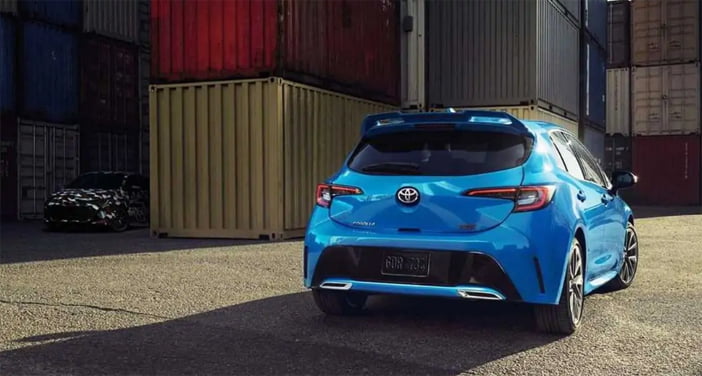
+++ TOYOTA has once again teased the upcoming GR Corolla hot hatchback. This time, the teaser shows the camouflaged prototype a little more clearly. It also confirms that it will have all-wheel drive like its GR Yaris cousin. The prototype is tucked into the shadow of a stack of shipping containers. It’s actually in relatively plain view, though the low resolution of the image makes it hard to make out any details. It does have a really huge lower grille that makes it look aggressive and should provide good cooling. The camouflage notably wears the logo “GR Four”. This is the name for the all-wheeldrive system used on the GR Yaris, and is a clear indication that the Corolla will get the same equipment. This is exciting, because the all-wheel drive is one of the highlights of the Yaris. It has a center differential that can adjust front and rear torque split. In the Yaris, it’s also available with front and rear limited-slip differentials. Hopefully the option carries over the Corolla. The Yaris is only available with a manual, too. If the Corolla uses the same driveline, I’d bet it will have a manual, too. I also noticed that one of the shipping containers also has the “GR Four” printed on it, along with “G16” for the engine, and “NA”, which probably indicates North America. But that’s about all we could spot. I’m expecting to see the GR Corolla sometime next year, and it’s rumored to make nearly 300 hp. +++
+++ TOYOTA has selected a site for its proposed $1.29 billion U.S. battery manufacturing facility. The automaker said it would build the plant on the Greensboro-Randolph Megasite, a tract of land located in Randolph County in central North Carolina. When the facility is complete sometime in 2025, it will consist of four production lines, each capable of producing batteries for 200,000 vehicles per year. Toyota plans to eventually expand the facility to produce enough power cells to support up to 1.2 million cars annually. The plant is part of a broader $3.4 billion investment the automaker has earmarked to expand its battery production capabilities in the U.S. When Toyota first announced the $1.29 billion facility, it said it would create approximately 1.750 jobs. The company notes it picked Greensboro-Randolph Megasite for a handful of reasons. One of the more notable is that it’s a location with access to renewable energy. Toyota says it’s “committed” to using 100 percent clean energy to produce batteries at the facility. The scale of the project is an acknowledgment by the automaker that it needs to diversify its electrification strategy. More so than any other automaker, Toyota invested significantly in fuel cell technology. So far, it has little to show for its efforts. Outside of California, you can’t buy its Mirai fuel-cell sedan. However, the company’s latest plan is to offer 70 different electric models, including 15 battery electric vehicles, by 2025. +++
+++ Vingroup JSC, Vietnam’s largest conglomerate, said it is planning to list its car unit on the U.S. stock market in the second half of next year, in an offering expected to raise at least $3 billion. Just last month, an official said the listing may happen within the next couple of years, as the company joins a growing list of electric vehicle startups taking advantage of investor excitement to raise funds. VINFAST , Vingroup’s automaking arm, had flagged in April it was seeking an IPO slated for the second quarter of this year, eyeing a $60 billion valuation with expectation to raise at least $3 billion. In the statement, Vingroup said it had set up a Singapore-based holding company owning a stake in Vinfast’s operations in Vietnam to fuel the IPO process. “The new company, VinFast Singapore, is a step to turn VinFast into a global company and prepare for its U.S. IPO”, the company said in the statement. “Vingroup will be a major shareholder of VinFast Singapore”. The Vingroup is also seeking $1 billion from global investors for VinFast in pre-IPO fundraising. VinFast became the country’s first fully fledged domestic car manufacturer when its gasoline-powered models built under its own badge hit the streets in 2019. VinFast is betting big on the U.S. market, where it hopes that its electric SUVs and a battery leasing model will be enough to woo consumers away from the likes of Tesla and General Motors. Vingroup said it was targeting global electric vehicle sales of 42,000 units next year, up from its previous plan of 15,000. +++