
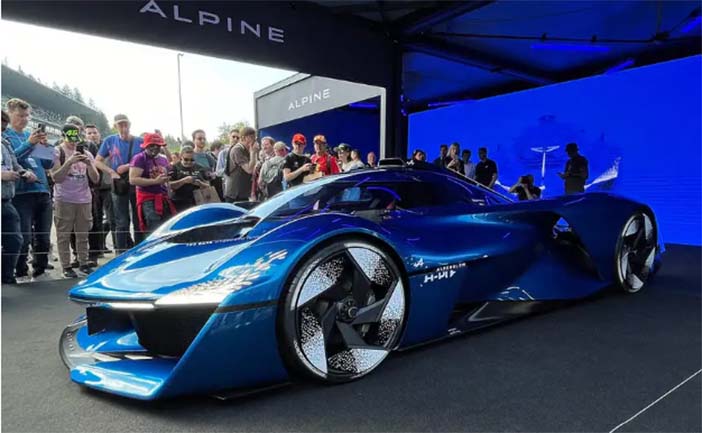
+++ ALPINE is exploring the possibility of putting the extreme Alpenglow concept into limited production as a road-going supercar with a hydrogen-combustion engine. First shown in 2022, the Alpenglow recently nudged closer to a potential production car when it became the Hy4: a rolling prototype fitted with the French brand’s first hydrogen combustion engine. It was due to conduct its first public demonstration at the recent World Endurance Championship round at Spa-Francorchamps, Belgium, but failed to start. This was due to an electrical fault, Alpine said. Before the ill-fated test, Alpine design chief Antony Villain strongly hinted at the prospect of it becoming a production car. “When we designed the Alpenglow, we had 2 fields in mind: the production car and the racing car”, said Villain. He explained that the concept was initially designed in parallel with the firm’s Le Mans Hypercar racer, the A424, but has become even more road-focused in its most recent evolution. For example, the Hy4 ditched the original single-seat interior in favour of a more conventional 2-seat configuration. This is because the new car is underpinned by a Ligier LMP3 racing chassis, rather than the concept’s bespoke frame. Commenting on the Alpenglow’s prospects of making it to production, Villain said: “Why not? Why not have that on the roads? We want to keep both ways hydrogen-combustion and battery-electric possible. Maybe we could do a little series of these cars for the road. That could be just right”. Villain added that the process of turning the Alpenglow into a viable production car had been considered from the outset of the project. “We have already got these steps in mind, and the next steps”, he said. He said that “it’s more of a programme rather than a car” and that “the next one will be another evolution, styling-wise, with more and more credibility”. Key to the Alpenglow’s progression is the ongoing development of a new V6. Unlike the engine in the Alpenglow Hy4, which is a 4-pot sourced from motorsport firm Oreca, it’s being worked on entirely in-house at Alpine. The priority for the V6 is improved efficiency. According to Alpine, the Hy4 is capable of driving around 100 km at race pace between fill-ups. Racers at the 24 Hours of Le Mans (which will include a hydrogen-combustion class for the first time in 2027) typically complete 10 to 20 laps of the 15 km circuit before they pit for fuel. Alpine also plans for the V6 to put out more power than the Hy4’s turbocharged 2.0-litre unit, which makes 340 hp. Although the V6 is being developed with a view to eventually go racing, it’s possible that it could also be deployed on a road car, thanks to user-friendly power delivery. “It’s not going to be an F1 engine revving very very high”, said François Champod, Alpine’s director of racing vehicles. He added that it would drive comparably to existing petrol engines. But that isn’t to say that it would drive identically. Pierre-Jean Tardy, Alpine’s chief hydrogen engineer, told that the nature of hydrogen would bring some key differences. He explained: “From the passion point of view, it’s almost the same sound, almost the same response. However, there could be some elements that could bring a difference to the response. Running clean on hydrogen means that you have to make sure that your NOx emissions will be low. Low NOx emissions (and also for efficiency) you want to run lean, and leaner than for gasoline. Running lean with hydrogen produces lower-temperature exhaust gas, which means that for a turbocharger, you have to work the compressor harder with less energy available on the turbine. There’s a sort of imbalance between the turbine and the compressor, which is even higher than on a diesel engine. This could cause some lag time problems that you will have to get around by other means”. Tardy added that mitigating engine knock is also a big challenge for hydrogen engines, because hydrogen is flammable over a wider range of fuel-to-air concentrations than petrol is. Hydrogen burns at concentrations from 4% to 76%, whereas petrol vapour ignites from 1.4% to 7.6%. This means that within a single combustion chamber the air-hydrogen mix can simultaneously be lean and rich. “We will learn from this engine how that works, how to improve the combustion process and how to improve the mixture preparation”, said Tardy. He explained: “It’s much more difficult to properly mix a gas like hydrogen with a gas like air (gas-to-gas) than with gas droplets vapour in air. This isn’t easy to figure out, but it’s the truth. Especially when hydrogen comes out of the injector: it comes with a massive velocity, and that makes it more difficult to mix properly with air. “The more you increase the speed of the engine, the less time you have to inject. The more you increase the power, the more thermal load you have. So you also have more risk of abnormal combustions knock”. This creates issues not only in cooling the engine but in ensuring that you manage temperatures “homogeneously” in each combustion chamber. Several Alpine executives conceded that the hydrogen-combustion project was still at an early stage. The new V6 recently entered dynamometer testing, and the brand has committed to it powering the Alpenglow by the end of this year. Alpine is expected to enter a hydrogen-combustion car into the 24 Hours of Le Mans in 2027, but it has yet to make a firm commitment to the event. It said in a statement that it’s “paying close attention to changes in competition regulations”. As for when a hydrogen-burning road car could be ready, Champod said: “It’s early days, it’s going to be research years. For the road, it’s not all in our hands. It’s all about infrastructure and these kinds of things. So I can’t really say how far it’s going to progress”. Villain said hydrogen “could be for a very limited number of cars”, given the existing limitations to the global hydrogen filling network. However, he also pointed to the Renault Group’s joint-venture for hydrogen-fuel-cell Vans, Hyvia, as a means for infrastructural development that could support the launch of a road car. He added: “Probably the network will be driven by trucks and light commercial vehicles, because there will be a lot of need for trucks everywhere in Europe to get a network of hydrogen. That could help us, because of course it doesn’t make sense to develop a network just for a sports car. The next phase will be driven by trucks and light commercial vehicles, and we will probably benefit from this. “Afterwards, it’s a matter of storage, either gas or liquid, because the tanks take up a lot of space: more than 350 litres of gas instead of 50 litres of petrol, so we have to package all this in the car”. Further complicating the infrastructural element is that Alpine feels the use of hydrogen is only justified when it is decarbonised, either ‘blue’ or ‘green’. Blue hydrogen is made from natural gas, emitting CO2 which is then captured and stored instead of released into the atmosphere. Green hydrogen, meanwhile, is made by electrolysing water with renewable electricity, without any carbon emissions. According to a January 2024 report by consultancy McKinsey, “nearly all” new hydrogen production is expected to be “clean” from next year. Villain said: “Green hydrogen is mandatory, otherwise that doesn’t make sense”. Tardy followed: “We will use any colour which is decarbonised. What we want to do is bring our contribution. Our contribution is typically in the technologies in using hydrogen”. +++
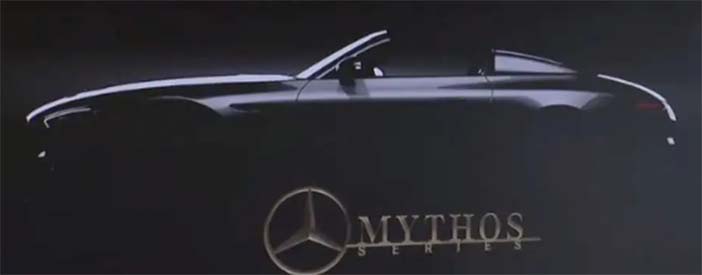
+++ AMG plans to launch a new speedster variant of its 7th generation SL as part of a series of limited volume Mythos models, according to Mercedes insiders. The secret open-top car is planned to be shown to selected customers in an event planned to take place at Mercedes’ Centre of Excellence in Sindelfingen, Germany, between 6 and 8 June prior to being taken public later this year and deliveries starting in 2025. Invitations to the preview event describe the SL speedster as an “open vehicle concept with an extremely low silhouette, without a roof or windscreen, and featuring a motorsport halo roll protection system and requiring the use of a helmet for a high-speed driving experience”. An earlier teaser photo of the 2-seater revealed that it receives altered body styling with prominent domes behind each of the front seats. The space reserved for the rear seat on standard versions of the SL is expected to be used to accommodate the rollover protection measures. Technical details of the new AMG are yet to be revealed, but the limited-volume SL is based on the SL 63 4Matic+ with a 585 hp twin-turbocharged V8 petrol engine and a fully variable 4-wheel drive system. First hinted to by Mercedes chairman Ola Källenius at the company’s annual general meeting in 2022, the Mythos series is planned to include a series of limited-volume Benz, AMG and Maybach models. Together with the SL speedster, Mercedes-AMG is known to be working on a SL Maybach, a photo of which was uploaded to Instagram by Mercedes design boss Gorden Wagener in 2022. The photo showed a 2-tone SL altered with a Maybach-inspired grille featuring vertical chrome elements and a hood with Maybach logos. The limited volume Mythos cars are planned to go one step beyond Mercedes’ Manufaktur programme with even greater scope for vehicle personalisation. +++
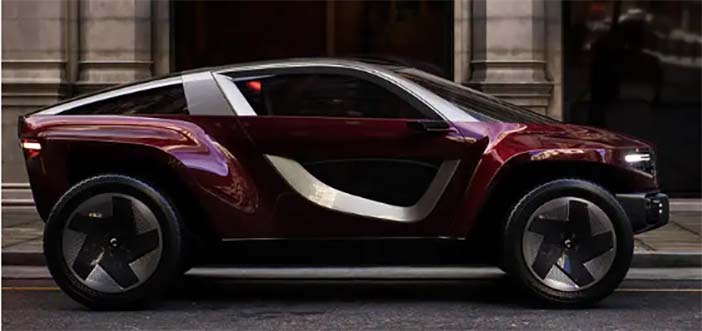
+++ The CALLUM SKYE , an electric all-terrain sports car created by ex-Jaguar designer Ian Callum, is now available to order, priced from €95.000 (Dutch pricing). The first bespoke car from Callum’s eponymous design agency has gone on sale just ahead of its public debut at this week’s Savile Row Concours in London, having been revealed in digital form late last year. Prices for the Skye range from €95.000 to €125.000, lining the off-road EV up against the similarly conceived Ariel Nomad, which is due to enter its new generation later this year, with an electric option set to follow. The Skye will be available in 2 guises: 1 tailored more towards off-road ability, the other 1 for on-road dynamics. Callum hasn’t said how many it will make, but it will be an “exclusive” proposition. Positioned as a compact dual-motor, 4-wheeldrive, 2-door car with a 50:50 weight distribution, it has a 42 kWh battery giving a claimed range of 280 km and offers the option of a fast charger that can top up the battery in less than 10 minutes. Measuring 4.047 mm long and 1.900 mm wide, the Skye is of a similarly compact footprint to the Renault Clio and Dacia Sandero. The chassis is a rugged steel spaceframe with plenty of ground clearance and travel for its bespoke all-independent suspension, and it supports a lightweight composite body for a total heft of 1.150 kg, making this one of the lightest EVs on the market. The Skye’s bold shape, which the company says is driven by its capabilities, is based on a strong accent loop surrounding the door apertures, with a horizontal body structure running through the whole car and providing mountings for the 2 large doors, which are glazed below the waistline as well as above it. Callum has also shown the interior of the Skye for the first time, which has been designed to mirror the exterior but with a focus on minimalism. It features a stacked centre console with touchscreen rotary dials to control the heating and ventilation, similar to the Jaguar F-Type. Sitting on top of the dashboard is a central touchscreen, the size of which is not yet known, with smartphone mirroring. As befits its versatile credentials, the Skye’s boot is accessed via a hinged tailgate, and the rear bench (big enough for children) can be removed altogether for additional room. “We’ve edited our vision to only include necessary design elements, giving the driver and passengers everything they need while avoiding wasted space” said Callum. The Callum company’s total staff now runs to more than 20 people, although Ian Callum says the firm’s intention is always to remain “small and agile”. As the first all-new Callum model, the Skye succeeds successful programmes unveiled since the company was founded in 2019, including a highly individualistic reinterpretation of the 2001 Aston Martin Vanquish (an Ian Callum original), a string of impressive forays into product design and some still-secret collaborative projects. +++
+++ HONDA is working on a Tesla Model 3-rivalling saloon as 1 of 7 radical new electric cars it will bring to market by 2030. The saloon is part of the firm’s new 0-Series, which represents a total reset of how Honda develops EVs. The 7 0-Series cars will prioritise weight reduction and aerodynamic performance and stand out for “the joy of driving”, the company said. Honda is developing the models with a thin ethos, minimising the number of parts used in each model and adopting lightweight aluminium chassis structures. Those chassis will eventually be die-casted (a technique pioneered by the Tesla Model Y) to reduce part complexity and therefore weight and costs. The firm also hailed the development work enabled by its line-up of hybrids, such as the Civic, in reducing the weight of its next-generation electric powertrains. These ‘e-axles’ will comprise a motor, inverter and gearbox within a single unit, providing a claimed weight saving of around 100 kg compared with Honda’s existing EVs. The company added that its EVs will have all-wheel drive, suggesting that each model will use a pair of e-axles. Heavy components such as the power unit and battery will be mounted low and centrally, Honda said, which indicates that the cars will use a skateboard platform. This will have a reduced floor thickness, further saving weight and providing a more sporting driving position. Complexity will be further reduced by the deployment of a central computer, rather than the array of chips deployed on more conventional cars. The 0-Series’s systems will be controlled by this ‘brain’, reducing costs and improving the speed of digital functions. This more powerful computer hardware will also enable level-three assisted driving technology, in which the car takes full control in limited conditions, such as a traffic jam in clear weather. Each 0 Series car’s technical specifications will be anchored by a range target of more than 500 km (WLTP). Key to achieving this figure while keeping weight down will be a focus on aerodynamic performance, as with the striking 0 Saloon concept shown earlier this year. “We’re not particularly aiming for this shape”, said Honda R&D creative director Toshinobu Minami, “but we’re trying to create the shape of the function while making it emotional”. The other anchor for Honda’s future EVs will be the requirement for a 5% return on sales; a lofty goal, given many manufacturers are currently losing money on their electric cars. Honda CEO Toshihiro Mibe previously suggested that different battery chemistries would play a role. “Instead of reducing battery size, we want to think about battery technology”, said Mibe. In addition to technical developments, Honda will look to produce batteries in-house to cut costs. The firm said a joint-venture battery factory with Korea’s LG will start building batteries in the US from 2025, with a plant capacity of 40 GWh per year. Honda will also investigate battery recycling and raw material procurement to further reduce its outgoings, which could cut the cost of a battery by 20% by the end of the decade. Honda is aiming to reduce its overall production costs by 35% by 2030. The company will launch 7 0-Series cars by 2030, starting with a saloon in 2026. It will be joined by “midsize” and “entry-level” SUVs that same year, with a 3-row Kia EV9 rival arriving in 2027. A “compact” competitor for the Model Y will follow a year later, before a “small-size” SUV is launched in 2029 and then the Model 3-sized saloon in 2030. +++
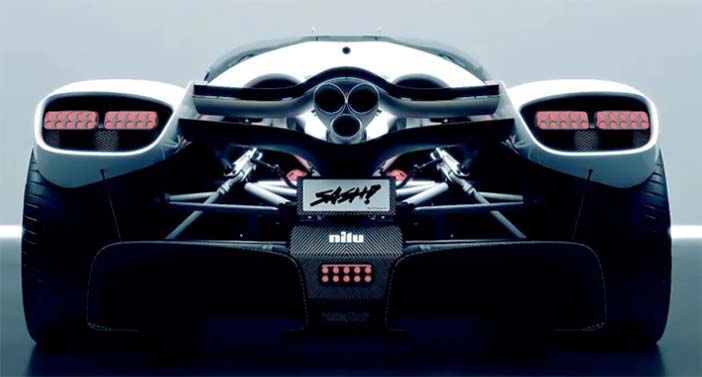
+++ The former head of design for Koenigsegg and Bugatti, Sasha Selipanov, has decided to take a leaf out of Horacio Pagani’s book and launch his own hypercar brand called NILU27 . The new brand will unveil its first wild creation on 15 August during the Monterey Car Week. The brand’s mission statement is to build cars that are “in equal measure beautiful and brutal” and based on the brief teaser video Nilu27 shared on social media of its as-yet-unnamed hypercar, Selipanov hasn’t held back with the design. The rear suspension components are fully exposed for everyone to enjoy, while the spoiler curves around a tri-tip exhaust pipe. Below that is an intimidating diffuser with an F1-style fog light in the centre, and we can see that the car will feature a set of gullwing doors. All those elements remind us of the Aston Martin Valkyrie, which is no bad thing. Nilu27 has also given us a taste of the car’s soundtrack, but hasn’t shared any details about the engine itself so far. It’s unlikely to be part of a hybrid powertrain like the Valkyrie’s however, as Nilu27 is apparently “unfazed by digitalization, electrification and other distractions, we’re focusing on the ultimate automotive experience with a healthy dose of ‘holy s***’ mixed in for good measure”. You may not have heard the name Sasha Selipanov before, but you’ll certainly be familiar with his previous work. His career began in the Volkswagen Group where he contributed to the design of the Lamborghini Huracan, among other projects, before taking on the role of Bugatti’s head of exterior design. During his time in Molsheim, Selipanov penned the Bugatti Chiron, as well as the wild Vision Gran Turismo and much more elegant Atlantic concepts. After that he worked for Hyundai’s luxury spin-off Genesis creating show cars like the adorable Mint concept. Selipanov became the head of design for Koenigsegg in 2019, where he was responsible for the CC850 (an homage to the Swedish brand’s first car), the CC8S and the Gemera 4-seat hypercar. +++
+++ SKODA has teased its new Elroq multiple times already with some official renderings, but this is our first real-world look at the Czech firm’s upcoming EV, which will arrive later this year. Following on from Skoda’s first bespoke EV, the Enyaq, the Elroq will be the first of four more all-electric offerings from Skoda by 2026, including the production version of the Vision 7S concept, an electric estate and a smaller Kamiq-sized EV. Sitting on the same MEB architecture as the Enyaq, the Elroq will be positioned under Skoda’s large EV SUV model and with a length of 4.5 metres it’ll be a little bigger than the combustion-engined Karoq. We can see the Elroq’s proportions will feature stubby overhangs front and rear, with a long wheelbase that should help promote interior space. As for the Elroq’s design, this test car may be fully decked out in camouflage, but we can clearly see some key details not seen from previous renders. The front end has a sleek headlight cluster that flows into the grille, although I suspect this area may be completely blanked out. There’s another light cluster beneath which feeds into an air curtain that’ll channel air around to the side of the car. A lower grille is visible here, too. Down the side it all looks fairly conventional. There are no digital wing mirrors or flush-fitting door handles, while the rather large wheels look similar to the 21-inch ‘Betria’ alloys of the Enyaq. The rear features a large roof spoiler and those rear lights look similar to the Enyaq’s, too. I expect to see an Enyaq-inspired cabin with Skoda’s array of different ‘Design Suites’ available to change elements like trim material and colours. The Enyaq’s 13-inch screen will probably be used in the Elroq, too, running the latest infotainment system from Skoda. Of course, there should be the usual selection of Skoda’s ‘Simply Clever’ touches like an umbrella in the door and built-in ice scraper. With the MEB architecture in use for the Skoda Elroq we should see the same 58 kWh and 77 kWh batteries taken from the Enyaq with the options of a single-motor rear-wheel drive and dual-motor four-wheel drive for the higher-spec versions. In terms of pricing I expect the Elroq to sit just below the Enyaq. The Enyaq will receive a “comprehensive update” next year according to Skoda, which could push pricing up, meaning a starting price of around €45.000 for the Elroq could be likely. +++
+++ An American District Judge has ruled that TESLA will need to face a proposed class-action lawsuit in court that alleges the carmaker has lied about the autonomous driving capabilities of its vehicles. Tesla owner Thomas LoSavio initially brought the complaint against the world’s most valuable automaker before the court in 2022. In 2018, LoSavio paid $8.000 to have Full Self-Driving fitted to his Tesla, but despite Tesla and Elon Musk’s claims that full autonomy was coming, such advanced features haven’t been introduced. Last year, Judge Haywood S. Gilliam Jr. dismissed the suit, asserting that customers need to pursue arbitration with Tesla first. LoSavio was allowed to amend his complaint and has now done just that. According to Judge Rita F. Lin of the Northern District of California, the complaint can proceed. “Every year after LoSavio’s purchase, Musk allegedly repeated that Tesla’s cars were getting closer and closer to full automation, and that the next year (every “next” year) the cars would drive themselves,” the judge said. “As LoSavio noted during the hearing, these were not mere recitations. With each iteration, Musk’s statements became more specific”. “For example, in April 2017, Musk allegedly said that Tesla owners could sleep while their cars drove in about 2 years. The next year, Musk allegedly claimed that Tesla would have over 1 million robo-taxies on the road in 2020. And in January 2021, Musk allegedly said he was “very confident” that Tesla would achieve Level 5 autonomy soon, based on the technical roadmap and beta iterations”. In January, Tesla tried to get the complaint dismissed, alleging that LoSavio’s case was “on its last legs…and should go no further”. The court will rule on whether the case qualifies for class-action status at a later date. The news comes just a week after the National Highway Traffic Safety Administration questioned the efficacy of a Tesla recall involving more than 2 million vehicles equipped with its Autopilot driver-assistance system. +++