
+++ DACIA is on a roll at the moment and things seem to just keep getting better for the budget car brand. The latest piece of good news is that owners of the Duster are happier with their purchase than owners of any other new car on sale in the United Kingdom. As reported in yesterday’s Newsflash, the Dacia Duster has topped the 2024 Driver Power car customer satisfaction survey. Every year Driver Power askes British motorists to rate their cars across a whole range of different criteria. The results make the Driver Power survey the definitive measure of car customer preferences and satisfaction for the British market. It is a good guide for car buyers looking to choose their next car and car companies looking to improve their products. This year it’s the Dacia Duster that reigns supreme in terms of making the people who own it happy. The conspicuously good value compact SUV beat the Tesla Model 3 into second place and saw off challenges from the Toyota Yaris and Toyota RAV4 in third and fourth place respectively. The Mini Hatch rounded-out the top-5. Perhaps unsurprisingly, it was that value for money criteria that gave the Dacia Duster an edge but it also scored very well for its easy-to-use controls and touchscreen. The Tesla Model 3 romped home with three category wins as the best car in the powertrain, running costs and safety sections of the survey. “The Driver Power survey once again tells the story of what these cars are like to live with, written by the people that have bought and paid for them”, said editor Paul Barker. “We have always loved the Dacia Duster, and our results show that owners wholeheartedly agree. Driver Power has once again shone a light on where consumers can find peak motoring satisfaction”. +++
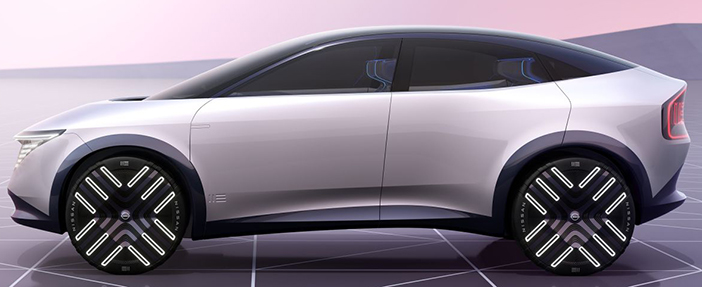
+++ We’ve known for some time that the trailblazing NISSAN Leaf will transform from a family hatchback into an SUV for its next outing. Earlier this year, Nissan president and CEO Makoto Uchida confirmed that the brand’s Chill-Out concept, revealed back in 2021, would inspire the next-generation Leaf. Nissan’s vice-president of Design for Europe, Matthew Weaver, provided clarity on how close the designs are: “Obviously linking concept to production, there’s always a bit of a gap, but I can say that it’s pretty true to form. “It’s been quite a journey with the new Leaf. The Chill-Out concept was very clean, very cool, and those elements are still coming through on the production-ready version”, Weaver told. “We’re nearing completion, and things like aerodynamics, packaging on a car like that, they’re at the forefront of the importance. There have been some changes, but you definitely see where the DNA has come from”. However, the headlight signature differs slightly, and the production car will have a more pointed nose as well. I know this because shadowy images of the new Leaf were included in a video Nissan shared recently to promote its latest business plan, which involves launching three new electric cars in Europe by 2026. Signature Nissan design traits such as the boomerang light shape and a black V-motion grille will feature, but otherwise the Leaf shouldn’t resemble any other model in the line-up. Weaver explained: “We don’t want to do clones. We try to make each car quite individual, even looking across the global range”. The new Leaf will sit on the same Renault-Nissan AmpR Medium platform (formerly CMF-EV) used on the Renault Megane, which is designed to utilise the packaging benefits of a pure-electric powertrain. I expect the Leaf will use the Megane’s 220 hp electric motor and 60 kWh battery for a range of 450 km or more. Inside, the Leaf should offer plenty of space, and feature Nissan’s newest infotainment system that was introduced in the facelifted Qashqai. It’s based on Google’s Android Automotive OS (the same software architecture used by Renault) but with Nissan’s own graphics, so it’ll be more familiar to existing owners. As with the first and second-generation Nissan Leaf, the new edition will be built in the United Kingdom at the company’s Sunderland plant. Up to €3,5 billion of investment is earmarked for the facility, which in time will consist of 3 gigafactories to handle production of the new Leaf, and the next Juke plus Qashqai. Nissan’s European boss Guillaume Cartier told in 2021 that the UK plant’s strong history was the key factor in its success in securing the deal to make the new model. “The heritage was why Sunderland was selected”, he said. “The demonstration of what this factory is able to do (having the Leaf already, the e-NV200 Van), this expertise, the capacity for innovation. That’s the reason why we’ve been able to build the future”. Nissan hasn’t confirmed when the Leaf will be revealed, but it’s rumoured to go into production in early 2025. The Juke, and a successor to the Micra supermini, based on the new Renault 5, will follow. +++
+++ Thrilling, rear-wheel drive sports cars with fiery combustion engines are becoming increasingly rare and in October 2025, production will cease on the 718 Cayman and Boxster models, killing the mid-engined icon we’ve come to know and love. PORSCHE ’s 718 models have been living on borrowed time for quite a while. The carmaker has been hard at work developing electric vehicles for a few years now and confirmed the 982-generation models would be the final ones with a combustion engine. An exact date for when the Cayman and Boxster will be killed off has not been provided by Porsche, but information from an American dealer portal claims it’ll happen in the fall of next year. It says that “end of production for all 982 models is currently planned for October 2025”. That means keen shoppers have less than 18 months to secure an allocation before the 2 models go the way of the dodo. While it’s a shame the 718 duo will be killed off as we know it, we thought it may be axed from global markets before the 4th quarter of 2025. Porsche has already been forced to stop selling the 2 models in Europe because they fail to comply with new EU cybersecurity laws that take effect on July 1, 2024. The idea of electric Cayman and Boxster models may not sound too appealing to many, but if one carmaker can make an EV that’s fun and engaging to drive, it’s Porsche. No other brand builds products quite like it and spy shots of the all-electric 718 models have already revealed they’ll be largely identical in size to the combustion models. Underpinning the duo will be Porsche’s SSP Sport electric car architecture which offers flexibility for rear and all-wheel drive layouts. Details about the battery pack that’ll power the 718 EVs aren’t known. +++
+++ RENAULT has partnered with a Chinese engineering firm to develop its €20.000 Twingo city car after talks with Volkswagen about a potential collaboration proved fruitless. The 2 firms had been evaluating the prospect of co-developing their respective entry-level city EVs. But Volkswagen will now work independently to bring its similarly conceived ‘ID 1’ to production in 2027. Renault will instead be assisted by the unnamed Chinese manufacturing outfit, which is understood to be a supplier rather than a car maker. “I wanted to show that European industry could work together as a team, so I think this is a lost opportunity”, Renault Group boss Luca de Meo told after the talks ended, but work on the Twingo has continued. The retro supermini is scheduled to be revealed in late 2025 and in showrooms in the first months of 2026 on current timings. The concept freeze took place at the start of this year and Renault is committed to a 24-month development cycle. De Meo has told that partnering with the unnamed Chinese firm is crucial to achieving this ambitious development timeframe and identifying efficiencies that the firm can employ to reduce costs. Asked how Renault will make the Twingo profitable, he said: “We’ll do it by radically changing our production engineering and our component sourcing. Normally, we specify big components like HVAC systems from big tier-one suppliers. We send them a 1.000-page holy book about how a Renault HVAC system should be, and they create a new one. But maybe these things are already there in our other cars. If they are, we’ll use them in future. We will be able to do a car on a cycle below 24 months”. Slashing development lead times is important because it will allow Renault to be “more agile, more virtuous and more competitive”, de Meo has said previously. But another benefit of making the development and production process more efficient is that it could drastically reduce its cars’ environmental impact. “We have research that proves that from cradle to grave, a new Twingo will have 75% less impact on the environment than an average European car now”, said de Meo. “If all of the cars in Paris were as small and economical as a Twingo, it would free up road space equivalent to the area of 60 football fields! And Paris is quite a small city”. Accelerating the development of small electric cars like the Twingo is especially important in this context, suggested de Meo, because “authorities are going to close cities to cars with engines”. Product boss Bruno Vanel said collaborating with a Chinese firm means Renault has better oversight of “the technology that is coming, and we can better adapt the new technologies, take less risk and spend less in terms of development”. Renault has yet to decide which plant will build the Twingo, but Vanel said the company’s ElectriCity industrial complex, centred in the north of France, gives “a footprint which is very concentrated” and allows it to build locally at competitive rates. Vanel said: “We’ve got the batteries produced and assembled close to the plants. The electric motor is built not too far away, at Cléon. The plant that produces the Scenic and Mégane will build Renault 5 E-Tech, so all electric cars in quite big volumes, reducing the cost”. As evidence of the viability of building small cars in Europe, Vanel pointed to the €25,000 starting price of the 5. “This car is produced in France, and this car is profitable”, he said. He even suggested that cheaper versions of the 5 could be added to the line-up if new battery technology allows, and they too would have a profit margin built in. The question of localising EV production has become particularly poignant for Renault as the French government has begun offering substantial EV purchase incentives that favour European-built cars. Subsidies of €5.000-€7.000 are available on cars with a carbon footprint of below 14.75 tonnes, which inherently favours local production. The hugely popular Dacia Spring, for example, is imported from China and the resulting increase in carbon footprint makes it ineligible for the grants. This pushes its entry price from just over €17,000 to more than €22,000 in France. Vanel acknowledged that it is difficult to compete at that price, emphasising the need to ensure the similarly sized Twingo is engineered, assembled and shipped as cost-effectively as possible. +++
+++ SUV s accounted for almost half of all global car sales last year as hatchback, estate and sedan volumes dipped, new figures have today revealed. SUVs have been growing in popularity over the last decade, with manufacturers expanding their line-ups to compete in what has become the industry’s most competitive segment. Last year, SUV sales rose by 16% to hit 36.72 million, automotive data firm Jato Dynamics has revealed. This accounted for 47% of the 78.32 million sales last year; SUVs’ highest ever market share. A big reason for SUVs’ popularity was the success of the Tesla Model Y. +++
+++ It’s confirmed: the TESLA Model Y was the world’s best-selling car in 2023, marking the first time an EV has topped the global car sales charts. The Model Y, which has been on sale since 2022, has spearheaded the continued success of Elon Musk’s EV firm, occupying the top-spot as the best-selling electric car for 2 years running in several countries, picking up from where the Tesla Model 3 left off in 2021. With over 1.2 million units sold last year, Tesla’s electric family SUV beat long-time global bestsellers such as the hybrid Toyota RAV4 (2022’s chart topper) as well the historical best-selling car of all time, the Toyota Corolla. The data has been compiled by automotive industry intelligence firm, Jato Dynamics. In total, 78.32 million new cars were sold last year across 151 countries, with SUVs accounting for almost half of global sales. Most notable was the fact the Model Y managed to secure its top spot, despite Tesla’s lack of presence in many emerging markets. Jato Dynamic’s senior analyst, Felipe Munroz, dubbed Tesla as “a brand made for the developed world”. “While it cannot currently target these markets, there is potential for emerging markets to be explored as an additional source of growth in the future”. +++
+++ It is fair to say that the transition to electric mobility is not going as well as most car manufacturers had imagined. Several of them are now postponing their ambitious targets and are no longer so sure when the transition to an all-electric manufacturer will be complete. Just last year, VOLKSWAGEN estimated that electric cars would account for 80 percent of annual sales in Europe by the end of the decade. The rather lukewarm reception of its own ID models is now prompting the Wolfsburg-based company to adjust its strategy. Of the €180 billion set aside in 2023, primarily for next-generation electric cars, Volkswagen will now divert a third to the development of combustion engines. This announcement comes from Arno Antlitz, Chief Financial Officer and Chief Operating Officer of the Volkswagen Group. The company is therefore planning to spend a good €60 billion to “keep our combustion cars competitive”. Antlitz spoke at a Reuters event in Munich and added: “The future is electric, but the past is not over yet. It is a third and it will remain a third”. This is a remarkable departure from the original plan that was adopted at the end of 2022. It stated that the company wanted to sell only electric cars in Europe from 2033. Last year, Volkswagen brand boss Thomas Schäfer spoke disparagingly of the combustion engine as an “old technology” in connection with e-fuels. He said that the discussions about synthetic fuels were nothing more than “unnecessary noise”. This is despite the fact that sister company Porsche is actively involved in the production of synthetic fuels in Chile. Other luxury brands from the VW empire are also taking a close look at how sustainable fuels are developing. Bugatti is even thinking about designing petrol stations that could be installed in customers’ homes and filled with synthetic fuel. Lamborghini, on the other hand, believes that the combustion engine can be saved if it can be fuelled with something other than fossil fuels. Bentley is also researching almost CO2-neutral fuels. The luxury car manufacturer from Crewe has postponed its goal of being EV-only by 2030 by three years. Ford also no longer believes it will be purely electric in Europe by 2030. Aston Martin has also reconsidered its course and will now build cars with combustion engines into the next decade. You can see that more and more car manufacturers are adapting their ambitious e-car strategies to reality. After all, you can’t completely impose on customers what they should buy. This puts companies in a dilemma, because the emissions regulations are naturally becoming more and more humourless. And that in turn requires investment in cleaner combustion engines. At the same time, the electric offensive from China is another cause for concern for the global players in the automotive industry. +++