
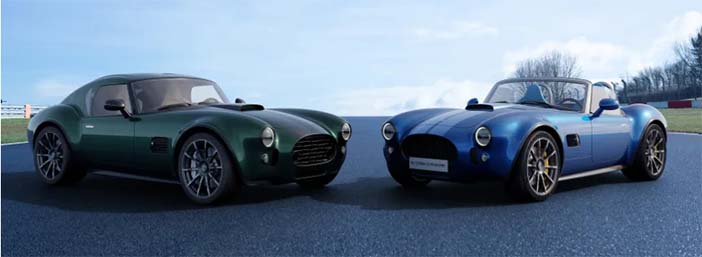
+++ The AC COBRA is synonymous with having a hulking great American V8 lurking beneath its elegant bonnet, but the iconic British sports car is getting a new powertrain. The car will be available from 2026. Back in 2023 we saw the AC Cobra GT revived with 5.0-litre V8 suitably sourced from Ford, but AC Cars has announced a ‘high-performance’ 2.0-litre engine will join the line up, too. While there are few technical details yet, AC Cars expects the 2.0-litre to produce up to 400 hp; judging by this it’s almost certainly a turbocharged unit. “Working in conjunction with a global leader in hybrid and internal-combustion powertrain solutions, AC Cars will develop the engine to suit the characteristics and potential that its GT platform delivers”, the company said in a statement. Whatever engine it is, it’ll be paired with either a new dual-clutch automatic gearbox or a 6-speed manual transmission. 2 states of tune for the engine will be available, and AC Cars adds the 2.0-litre will be “inherently lighter” than the 1.500kg V8 model. The 2.0-litre will get the same underpinning however, with a new chassis made from carbon fibre and aluminium that is designed to meet European safety homologation. The exterior of the 2.0-litre model is pretty much identical to the V8, with a slightly different inset grille design the only noticeable difference thus far. I expect to see the same modernised interior, with a retro-style oval dashboard and analogue dials plus carbon-backed bucket seats and a contemporary steering wheel equipped with an airbag. AC Cars boss David Conza said: “Offering clients a wider choice of performance engines will broaden the appeal for our exclusive sports cars, and means we can reach the markets that impose higher taxation on large-displacement engines”. +++
+++ Large luxury coupes and convertibles haven’t fared well, and this pushed Mercedes to kill the S-Class Coupe and Cabriolet. Rumours have also suggested BMW would follow suit by axing the 8-Series Coupe and Convertible. Fast forward to today and it appears that rumour is starting to come true. According to a dealer bulletin, the M8 Coupe will go out of production early next year. As part of the retirement, no new orders are being accepted. Early in January, the model will be retired from BMW’s line-up. The car and its configurator are also slated to be removed from the company’s website next month. Through the first 9 months of the year, BMW sold 4.058 members of the 8-Series line-up in America. That was a decline of 7.4% from a year ago. While the company doesn’t give a detailed sales breakdown, those numbers are spread across the Coupe, Convertible, and Gran Coupe as well as their M variants. +++
+++ The President of the European Commission, Ursula von der Leyen, has extended her hand to the car manufacturers she intends to meet in January. However, Luca de Meo, president of the European Automobile Manufacturers’ Association (ACEA) and CEO of the Renault Group, calls for immediate action. Immediate action on CO2 standards is needed before the end of 2024, to avoid damage to competitiveness and employment. The European industry remains committed to the EU’s 2050 climate neutrality target and the transition to zero-emission mobility, the association reiterates, but time is running out because the new CO2 limits for cars and vans will come into force in 2025, i.e. in a few days’ time. Those who will exceed the new limit set by Brussels on the average CO2 emissions of cars, will be forced to pay EUROPE hefty fines, in the order of €95 for every gram of CO2 exceeding the limit imposed for each group, all multiplied by the number of cars sold in a year in the EU markets. De Meo reiterates the need for a clear political statement from the European Commission by the end of 2024, recalling that a reminder to this effect has also come from the German, French, Italian and other European governments. ACEA, which is now counting again on Stellantis (which had abandoned it in 2022 at the behest of Carlos Tavares), points out in the press note that the automotive industry (which employs 13.2 million people in Europe) risks losing up to €16 billion in investment capacity by paying penalties, reducing production, regrouping with foreign competitors or selling electric vehicles at a loss. For these reasons, we cannot wait until January to start the Commission’s strategic dialogue on the future of the automotive industry or the revision of the CO2 legislation in 2026. ACEA points out that sales of electric vehicles are currently stagnating at around 13 percent market share and that therefore the transition, which remains the goal, is not supported by the market. “In a well-functioning system, paying penalties should be the exception, not the norm. And avoiding penalties should be based on sound economics, not inflicting damage”, says De Meo. The ACEA members have promised €250 billion in the transition to green mobility and, just like everyone else, we want it to succeed. Unfortunately, the honest assessment must be that the transition is not going as planned and that sticking to legal rigidity leads to potentially irreversible damage. Legal flexibility, on the other hand, will keep the investments flowing and the transition on track”. In spite of what was stated a few days ago by the European Commissioner for Climate, Wopke Hoekstra, replied with a dry “No. The answer is no” on the subject of postponing the new CO2 limits. Who knows, maybe a car incentive plan could be launched at a European level, as recently requested by the Italian Government, as could be seen from the point that speaks of “strengthening the financial resources of the sector”. Certainly, there will also be talk of duties on Chinese electric cars, a measure that started a few weeks ago and was opposed by some manufacturers, Germany first and foremost. +++
+++ The near future of MERCEDES-BENZ cars will be electric, in the meantime, however, the House of the Star continues and will continue to believe in diesel, especially for high-end cars. While it is true that with the new CLA (which will be presented in Rome in March 2025) the company is about to unveil a new mild hybrid petrol engine, which promises to be super-efficient. It is also true that for more upmarket cars, historically dedicated to those who churn out a high amount of miles every day, diesel will continue to be an important choice, with both 4- and 6-cylinder engines. Indeed, the Stuttgart-based company has explained that it does not intend to stop investing in this fuel as a transitional technology, which it will continue to do at least for as long as it is allowed to. We find out all the whys and hows of the matter in this short insight. According to a company statement at an event dedicated specifically to diesel power, diesel still accounts for 74 percent of customer preferences in the ‘Cars’ segment and 90 percent for commercial vehicles with the Star in the grille. According to the company, the success is due to the continuous investments made in this technology over the past decades, which have led to a significant reduction in consumption and emissions. Today, in fact, the latest generation of engines, such as the OM654 and OM656, not only comply with the most stringent pollution regulations, in fact, but also integrate very well with hybrid solutions, including plug-in hybrid versions capable of travelling up to 120 km in electric mode, which we have had the opportunity to test in depth in our numerous road tests. As we have often reported in our Real Consumption column, the new OM654 four-cylinder diesel in particular may (at least for as long as it is available) be a winning choice even in the lower segments led by the evergreen A-Class, which during our Rome-Forlì test with the 2.0 diesel engine with 116 PS managed to achieve an average consumption of 3.4 l/100 km, while with the 1.3 turbo petrol engine with 163 PS it stopped at 4.0 l/100 km. Turning now from the present to the future, as far as the next few years are concerned Mercedes has announced that it has decided to focus the future of diesel in the upper segments, starting with the C-Class, a strategy which, according to the manufacturer, will in the long term allow the benefits of this technology to be maximised for larger and heavier vehicles, where diesel even today remains unsurpassed in terms of torque and consumption. But where did the love between the Star and this type of fuel come from? The answer is called 260D of 1936, the first car in history on which a diesel engine was installed as standard, a solution that then evolved thanks to turbodiesel technology in the 1970s and thanks to the Common Rail system in the 1990s. But that’s not all, because in the mid-2000s the company pioneered AdBlue technology, which made its debut on the Euro 6 evolution of the V6 OM642, first on the E-Class 320 Bluetec and then on the ML, GL and R 350 Bluetec, a solution that was at the time definitively pioneering in minimising NOx and particulate emissions. Finally, the latest generation of engines was designed already compatible with advanced biofuels such as HVO100 and today represents the pinnacle of the evolution of this technology. +++
+++ “People love cars, yet many (non-industry) journalists and politicians make us believe that they no longer like them. This is false and we put the car at the centre of our strategy”. These are the words from Arnaud Belloni, RENAULT ’s global marketing director, the man behind the French manufacturer’s image change along with president Luca de Meo. I had the opportunity to speak with him at a press briefing, during which the French manager explained how he wants to change Renault’s communication, without transforming it in a way that distorts its DNA: “The recipe is simple: put the car back at the centre. We have never doubted that people love cars. We started from the principle that all our lives we will be ambassadors of the car. For this to work you have to be intellectually honest, you have to make cars that people like, that people want. Rather than spending time making cars that people don’t like and trying to convince them that they should like them instead. That is the basis of marketing. Since I’ve been at Renault, I no longer look at what the car industry does in marketing, because it has lost its knowhow. The industry that works best in this field is the luxury industry. I think many manufacturers made a mistake with electric cars, imagining that BEV buyers didn’t like cars. They made models with an ugly design, they look like fish. Why? Because they didn’t believe in the electric car. I always thought that if we want people to buy electric cars they have to be more desirable, better, more beautiful than combustion cars. That is our strategy. With the Renault 5 you are looking at a beautiful car. And it is electric and since it has no other powertrain you will buy it that way. We realised earlier than others that customers will find it difficult to switch from diesel to electric without a discount. Many were wrong in their predictions, we were cautious and said: let’s develop 2 technologies. We keep efficient combustion engines, we also have the hybrid, ideal for those who are afraid to switch to pure electric. Then there are those ready for BEVs. So we created 2 parallel ranges”. When asked if a customer is not made for the Renault 5, will he buy a Clio, Belloni answered: “I don’t think they are the same people. In November we launched the Renault 5 in France and we had the same number of sales as the Clio, so it didn’t reduce its numbers. They are not the same buyers. But it is true that we will have to apply the same care on the next hybrid models, we will have to make sure that they are just as sexy and seductive as our electrics. However, it will take time to completely change the range. The younger generation really loves technology. They want to find everything on the car that they have on their phone. For our generation it’s unbelievable, because we think people like the car for the performance. They don’t care. They want a car that looks good and is very technological. There is also a great sensitivity about the recycling aspect”. +++
+++ TESLA has a problem in Europe. In fact, you could say that Europe has a problem with Tesla. In any case, the latest registration figures show that the market for electric cars on the Old Continent is down on last year. But on closer inspection, this decline is mainly attributable to lower volumes recorded by the company headed by Elon Musk. In November alone, Tesla delivered 26.200 vehicles in Europe (including EFTA countries and the United Kingdom). In the same month of 2023, it delivered 10.000 more. That’s a fall of 28.4%, but it gets worse. Since the start of the year, the American brand has sold 282.700 cars in our part of the world. Last year, Tesla reached 327.600. That’s a fall of 13.7%. The situation could have been even worse if Tesla had not lowered its prices and increased production of the Model Y at its Berlin factory. But why is Tesla a problem for Europe? Indeed, the overall sales figures for electric cars on the Old Continent show a contraction of 1.4%, but if Tesla is taken out of the equation, the figures are up by 1.3%. In short, the other manufacturers generally sold more than last year, but Tesla’s contraction ‘hides’ this trend. Tesla is therefore beginning to come under attack from increasingly fierce competition. How will it catch up? It’s hard to say. Perhaps with the arrival of the two new affordable models expected in 2025, things will change. But will they really arrive? Furthermore, are they a priority for the company? Elon Musk seems to want to make the difference on autonomous driving and artificial intelligence more than on the number of cars sold. Is this the right way forward? While we wait for the answers to all these questions, one thing is certain: the Tesla Model Y will not be the bestselling car in Europe. In 2024, the leader in terms of units registered will be the Dacia Sandero, which finished an honourable second in 2023 and whose lead now seems insurmountable for everyone else. The restyling of the electric SUV could, however, reverse the trend. +++
+++ Last weekend’s labour agreement between the collective bargaining parties leads to new arrangements for the plants. In concrete terms, this means that some of the VOLKSWAGEN Group’s electric models will be produced at other plants in the future. For example, the ID.3 and the Cupra Born will move from the Zwickau plant to Wolfsburg. Wolfsburg had already started overflow production of the ID.3 in 2023 and is therefore capable of doing so. At the end of the decade, Wolfsburg will also receive production of the electric Golf and another model based on the Scalable Systems Platform (SSP). The plant in Zwickau will therefore lose 2 of the 6 electric models that have been produced there to date. Audi Q4 e-Tron and its Sportback variant will remain in Zwickau. The press release from the Volkswagen Group does not explicitly state whether this also applies to the ID.4 and ID.5. From 2027, Zwickau will “focus on one production line”, according to VW. Previously, there were 2 lines there, one for the ID.3 and Born, the other for the ID.5 and the Q4 models. The ID.4 as the sixth model can be built on both lines. The first line has apparently been cancelled and the focus is now on the second. This presumably means that the second line will only be used for overflow production of the ID.4 from 2027. The ID.5 is not mentioned at all in the press release. The ID.7, ID.7 Tourer and the ID.4 will continue to be produced in Emden, the latter even after the facelift, as expressly stated. This probably refers to the facelift in 2026, which was announced back in August. The electric SUV will then be based on the modified version of the MEB. The ID.4 was last modified in autumn 2023. At that time, it had a 286 PS motor and a larger touchscreen. The small car production facility at the Gläserne Manufaktur in Dresden, which was previously discussed, will be discontinued at the end of 2025. According to IG Metall, an alternative concept is being developed for the site. Allegedly, a research centre for semiconductor technology and autonomous driving is to be built there, as well as a battery recycling plant. The ID.Buzz and the Multivan (probably including the new electric version of the T7, which is due to be launched in early 2025) will remain at the commercial vehicle plant in Hannover, where costs are to be reduced. The change in plant allocation for electric cars is of course just one detail of the resolutions agreed between the Group and the trade union after 70 hours of marathon negotiations. One of the most important results is probably that none of the German plants will be closed and that there will be no compulsory redundancies until 2030, as IG Metall chief negotiator Thorsten Gröger said at the press conference. However, the future of the Osnabrück plant is apparently only secured until 2027. What is to become of the plant after that is still unclear. Rumour has it that the plant may be sold. In addition, 35.000 jobs will be cut and employees will forgo part of their profit-sharing and additional holiday pay. Furthermore, the agreed wage increase of 5.5 percent will not be paid out, but will instead be used to cover the costs of the job cuts. In total, labour costs are expected to fall by €1.5 billion per year. In the medium term, costs are expected to be reduced by around €4 billion per year. In addition, production of the VW Golf will move from Wolfsburg to the Puebla plant in Mexico in 2027, which should reduce costs, but is unlikely to be beneficial for the image of the model and Volkswagen. After all, it is the brand’s best-known model. Production capacity at the German VW plants will be reduced by 734.000 units. The Group is not disclosing how high this was previously, but the production capacity of the main plant is expected to be 800.000 units. VW’s production facilities are not being fully utilised due to the current weak demand for electric cars. VW’s costs are also high. Reduced production capacity and a reduction in labour costs will counteract this. We will see in the coming years whether this is enough to secure the future of the Group. It will certainly also depend on the development of the electric car market and the attractiveness of future VW electric cars. +++