
+++ ASTON MARTIN ’s Valhalla coupe has been in customer hands since 2025, and dealers now expect an open-air follow-up. The mid-engined hybrid supercar is widely rumored to be getting a roof job soon. The Aston Martin Valhalla Spider name has surfaced in enthusiast circles as an open-top companion to the coupe that is capped at 999 units worldwide. The company has not confirmed such a car, and any talk of a specific debut month remains rumor. Aston Martin has only detailed the Valhalla coupe in official material so far. A Spider variant will put the British brand on a collision course with rival open-top plug-in hybrids. The Ferrari 849 Testarossa Spider already covers that ground as a mid-engined plug-in supercar, while the Ferrari Amalfi Spider convertible adds another name to the broader plug-in GT and supercar field. Lamborghini has not gone there yet with the Revuelto, which recently got a track-focused SV variant instead of a roofless version. Audi has moved in with the limited-run Nuvolari plug-in hybrid supercar, framed as a rival to cars like the 849 Testarossa and Valhalla. Aston Martin is not new to spreading a nameplate across body styles. The brand’s Valiant project and the front-engined Valen show a line-up willing to multiply its halo cars rather than rely on one hero model. The Valhalla Spider could use a removable targa-style panel instead of a full folding soft top, but Aston Martin has not published any technical information to confirm that layout. Any open-top version would almost certainly start from the coupe’s carbon-fiber monocoque with aluminium subframes, along with its pushrod front suspension and 5-link rear setup. Engineers typically add reinforcement in the sills and bulkheads when they delete a fixed roof. Weight would be the number worth watching. The coupe’s dry weight target sits around 1.625 kilos and keeping an open version close to that figure would be a challenge once roof hardware and extra bracing enter the mix. The confirmed Valhalla coupe uses a Mercedes-AMG-sourced twin-turbocharged 4.0-liter V8 and a plug-in hybrid system for a total output a little above 1.000 horsepower. Any Spider would likely share that layout, but Aston Martin has not disclosed power figures, pricing, or timing. +++
+++ In a slightly surprising turn of events, Saudi Arabia, one of the world’s biggest producers and consumers of oil, has unveiled a pair of electric cars. The new EXOBOT SUV and saloon are supposedly just the first of seven models coming soon from the kingdom. These radical-looking EVs were created by Ceer, which is Saudi Arabia’s first national carmaker and electric vehicle brand. It was launched back in 2022 as a joint venture between iPhone-maker Foxconn and the country’s sovereign wealth fund PIF (Public Investment Fund) that currently manages over 900 billion dollars in assets, including major stakes in Aston Martin and Lucid. Ceer claims the Exobot SUV and saloon have been designed and engineered in Saudi Arabia. They will be built there, too, as the kingdom looks to “establish itself as a leading force in the global automotive industry”. It’s worth noting, however, that the company uses technology licensed from German powerhouse BMW. Its electric-vehicle architecture was developed by Foxconn (the Taiwanese firm has experience with EVs through its own brand, Foxtron) and the high-performance drive units for its flagship models are being supplied by Croatian hypercar creator Rimac. Former McLaren design boss Rob Melville, whose CV includes the P1, 750S, Speedtail and Senna, is the man responsible for styling Ceer’s cars.
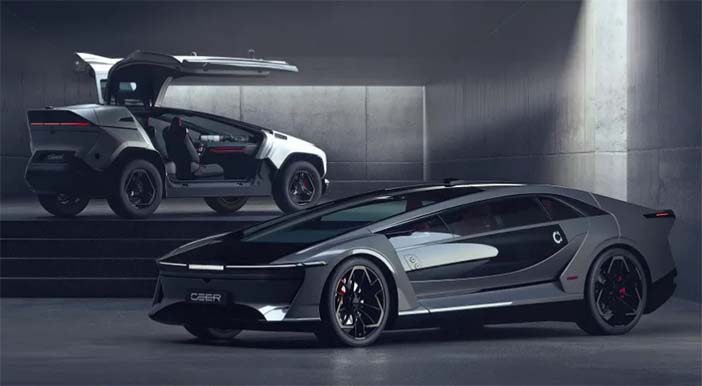
The design of the Exobot SUV and saloon was supposedly inspired by “Saudi Arabia’s landscape, rooted in its culture, and reflective of its vision”. Whatever that means … The visually dramatic cars look like they’ve escaped from the set of a new sci-fi blockbuster, especially the SUV with its high ground clearance, pronounced wheelarches, huge gullwing doors and ultra-thin lighting motifs. Meanwhile, the saloon is low and its windscreen is so sharply angled we’re not entirely sure how anyone is supposed to sit in it. We should find out soon, as more details about the Exobot SUV and saloon are due to be revealed shortly, including the first technical details. It remains to be seen if or when Ceer will export its cars to other markets outside of Saudi Arabia. But as we said, these are just the beginning. Ceer’s plans for the future include mid-size and compact models, and it’ll offer various propulsion options to serve different customer needs. All these cars will be manufactured at its complex in the Industrial Valley of Saudi Arabia’s King Abdullah Economic City, on the Red Sea coast. +++
+++ HONDA ’s hybrid models are popular right now as petrol prices rise. The automaker is already developing its next-generation hybrid system, which Honda has confirmed will launch in 2027. One of the first models with the new technology could be the CR-V. Honda will begin producing the next-generation CR-V hybrid earlier than originally planned, starting in February 2027. The CR-V hybrid is likely one of the 15 global models featuring the next-generation hybrid technology, which Honda says will begin going on sale between 2027 and March 2030. Honda has promised the new powertrain will deliver “powerful driving performance”. Honda has not provided a full breakdown of its new hybrid powertrain, but the automaker has discussed it. The new system will be slimmer and lighter than the current unit, slashing fuel consumption by 10 percent and production costs by 30 percent. The automaker is already developing new 1.5- and 2.0-liter 4-cylinder engines for its hybrid powertrain. Honda’s push for more hybrids comes after the company recorded huge losses from its EV efforts and canceled several models, including some that were not even in production yet. Honda has completely abandoned plans to go EV-only by 2040 and has doubled down on hybrids. +++
+++ The introduction of the SUV’s new architecture will pave the way for MCLAREN to chase rivals into other segments, too, with additional front-engined models that have more of a luxury focus than the current supercars. While development is ongoing and the SUV remains the only model confirmed in the strategy, a spokesman said: “The interesting thing (and I’m not saying there’s any firm plan behind this at the moment) is that once you put an engine in the front of the car, it opens up other opportunities”. He would not be drawn on which precise segments would be open to McLaren once it has introduced its new architecture, but suggested that any related models could also play a significant role in boosting volumes. A notable gap in McLaren’s line-up, compared to rivals, is in the front-engined grand tourer segment, currently populated by the likes of the Bentley Continental, Aston Martin DB12 and Ferrari Amalfi; each of which is closely related to an SUV stablemate. Woking could look to adapt the new SUV platform to replace the mid-engined, supercar-derived GT it launched in 2019, with a more traditional long-nosed tourer. Not on the cards in the immediate future, however, is a pure-electric car. The spokesman said it was important that McLaren launched an EV “at the right time, which is the most important decision to make”. Rivals including Aston, Lamborghini and Bentley have each made similar pledges when delaying their debut EVs in recent years. “It’s inevitable. It will come and we’ve got to be ready for when it does come. The amalgamation of Forseven in McLaren actually gives us an advantage over the fact, by virtue of the fact that we had a group of individuals who were developing an electric SUV. But the market reception to EVs in this space is not fantastic at the moment, so we can’t afford to make a mistake with the product, and therefore we will hold off until we’re certain that the customer demand is there”. McLaren parent L’IMAD is also a shareholder in Chinese EV firm Nio, which would seem a logical technical supplier for any forthcoming electric McLaren models. Indeed, Straughan hailed Nio as “an incredibly important partner” and said that some level of component-sharing on future products would be needed because “gone are the days where a small car maker can develop a car with their own IP entirely”. The spokesman said the McLaren line-up will effectively comprise 3 ‘swim lanes’: the core supercars, the front-engined SUV and its derivatives, and the top-rung Ultimate Series models like the W1. The new McL 6GT, a highly exclusive special edition that harks back to the 1960s M6 GT supercar, sits outside of these 3 categories, and its successful debut at Monterey Car Week last month proved that, according to the spokesman, there was “a real appetite for some really interesting concepts”, noting particularly the “incredible” reaction to its 6-speed manual gearbox, McLaren’s first since the F1. He hailed the decision to equip the McL 6GT with a manual as a “masterstroke”, but said the business case behind putting a manual option in the company’s core models was “a different question altogether”. McLaren’s landmark move to take engine development and production in-house forms part of a drive to make its cars more bespoke, and to enhance their “emotional” qualities. While Woking’s current V6 and V8 engines are developed with and supplied by Ricardo, they are exclusive to McLaren and the firm plans to double down on that exclusivity as it takes full ownership of the powertrain programme. “Not all of our customers understand that a McLaren engine is a McLaren engine. It isn’t purchased off another brand, it’s designed and developed by McLaren”, he said. “And for the first time ever, on future generations of engines, we can make the engine in-house”, the spokesman said. He stopped short of giving any details of these new powerplants, which will be used in combination with hybrid elements, as in the W1 hypercar, but said they will be developed and tuned to maximise engagement. “The engine of the car is probably the most important element in terms of creating emotion – not only from what you sense in the vibration through the car, what happens when you accelerate, the feel of power and performance, but also in the emotion of the sound that comes out the exhaust pipe. So it’s a pretty critical component”, he said. McLaren’s long-standing partnership with Ricardo continues on other engineering projects, he said, but the Sussex outfit will no longer build and ship engines to Woking as it does now. Asked about the technical make-up of these new engines, Straughan said: “Obviously it’s going to start with the current V8 products or the future generation of that, but once you start building engines there are lots of opportunities”. Confirmation of plans for two distinct engine programmes suggests McLaren will offer different cylinder counts and capacities across its line-up going forward. A new-generation V8 looks likely, and it’s possible that McLaren could follow Ferrari in developing a new V6 to replace the Ricardo six-pot in today’s Artura. +++
+++ PLUG-IN HYBRID VEHICLES (PHEVs) are typically touted as offering the best of both worlds. They possess EV-like capabilities with plug-in charging and electric-only propulsion, while still retaining a petrol engine and tank for when the battery’s usable electric range runs out. However, that complexity can cause problems, with Consumer Reports finding that PHEVs experience roughly 80% more issues on average than petrol-only vehicles. Now, Test EV, an Australian EV-battery testing specialist, is echoing those concerns and has offered explanations for why PHEVs may be more unreliable. Test EV told carsales that PHEVs are “disproportionately represented among electrified vehicles suffering battery problems”. A key point is that the batteries in PHEVs tend to be smaller than those in full electric vehicles, while still powering potent electric motors. Many PHEV batteries fall in the 15–25 kWh range, significantly smaller than the packs in EVs. The GMC Hummer EV even features a battery pack rated at over 200 kWh. As a result, PHEV batteries can undergo more frequent cycling and face greater demands relative to their capacity, potentially accelerating degradation and increasing the risk of battery-related problems. However, the report does not necessarily discourage buyers from opting for a PHEV. Instead, owners are advised to plug their vehicles in regularly to get the most from the battery and maximize the advantages of owning a PHEV. “There is plenty of feedback from years of PHEVs in the market that they need to be charged regularly to get the best out of the battery and fuel economy”, Test EV founder Nathan Gore-Brown said. Such a finding is significant in Australia, where demand for PHEVs is strong. Ford even offers a Ranger with a plug-in option there, while the Mitsubishi Outlander PHEV continues to be a top seller among non-Chinese models. BYD leads the PHEV market in the Land Down Under with the Shark 6, followed by other Chinese brands, including Geely and Chery. Nevertheless, the report can offer helpful insights to current and prospective PHEV owners in Europe, especially those considering a used one. +++
+++ Next month could see an avalanche of new PORSCHE models being previewed. Rumors of Porsche working on a reskinned Audi Nuvolari / Lamborghini Temerario may have been off the mark, and Porsche is instead working on its own platform for a new flagship halo, said to be internally named ‘S1’. This may be shown to investors on October 7, during Capital Markets Day, and the hypercar could also be joined by the 992 GT2 RS or the 992.2 GT3 RS, the petrol Macan replacement, the 718 sports cars and / or the brand’s flagship SUV. The S1 will cost start around €700.000 in The Netherlands. What’s most intriguing isn’t the stiff price, but the rumoured 8-cylinder boxer engine. Porsche is developing a standalone hypercar unrelated to its rear-engine 911, which would make fitting the boxer-8 a lot easier. Porsche has confirmed the existence of flat-8 engines in the past, with eFuels project manager Marcos Marques saying a few years ago that a 5.0-liter 8-cylinder boxer with 2 turbochargers, 750 horsepower and 1.000 Nm of torque was crammed into the chassis of a 718 Cayman. Redline was set at 9.000 rpm, and all the shunt was sent to the rear wheels through a manual transmission. It didn’t make production because Porsche felt the timing was off, but perhaps now that Porsche is trying to become even more upmarket, selling fewer cars to make more money, a low-volume hypercar may be the right call. It’s worth mentioning that while Porsche surely has made advances allowing for even more power to be produced from an evolution of the abovementioned prototype, ultra-elite buyers are looking for more engagement and theater (just ask McLaren), and a rear-drive, manual hypercar that screams to 9.000 rpm (or higher) sounds enticing. By the way, if the S1 is the flat-8 monster this report claims it is, it may soon have a direct rival in Ruf’s upcoming supercar. It’s also worth mentioning that nearly 10 years ago, Porsche revealed the Le Mans-inspired 919 Street, but while it was no more than a full-size clay model, Porsche has since refined the recipe with the 963 Le Mans Hypercar, built atop a spec chassis. It’s also converted one of these into a semi-road-legal hypercar called the 963 RSP, so it appears that building a racecar-like road car would certainly be possible. However, we suspect this option is less likely, as the noise, vibration and harshness limits of a racing car are much higher. The layout is also uncomfortable for more than one occupant, and getting in and out would not be graceful. Whatever the case, Porsche has not officially confirmed that its working on a flat-8 hypercar of any sort, a Le Mans-inspired road car, or anything else. However, with more detailed reports trickling out of Stuttgart, it’s only a matter of time before we get an announcement. +++
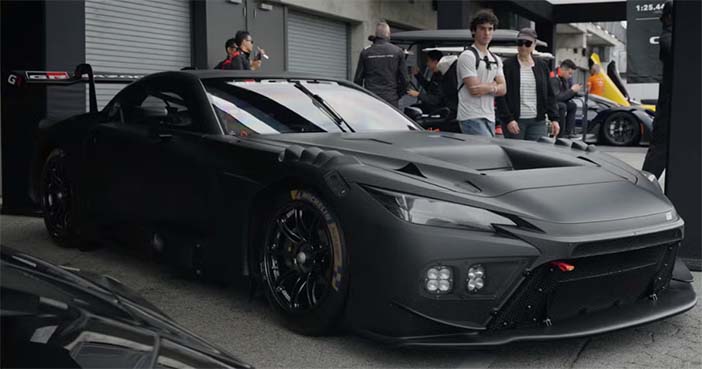
+++ TOYOTA is officially overturning the traditional motorsport development model with the Gazoo Racing GT3 program. The engineering division bypassed the standard procedure of modifying a production sports car for track duty. Instead, they built a dedicated competition chassis from the ground up to ensure absolute aerodynamic and structural superiority on the circuit. This aggressive race-first philosophy actively prevents the performance dilution that typically occurs when street cars adapt to motorsport regulations. Because the aerodynamic mapping and chassis geometry stem directly from endurance racing, the resulting production version will deliver uncompromised mechanical grip and authentic track pedigree straight from the showroom floor. At the center of this engineering effort sits a front-mid-mounted twin-turbo V8 engine utilizing a hot-V layout. Placing the turbochargers inside the cylinder banks allows the engineering team to centralize mass and package the powerplant deep against the firewall. The connection between ‘circuit’ and ‘street’ is genuinely staggering compared to standard industry practices. According to Toyota senior vice president of Automotive Operations Andrew Gilleland, this connection is entirely deliberate. “This entire vehicle was designed to be a race car first”, Gilleland explained, noting the functional styling. “So you look at the road car, you see all the aero bits and pieces. Those aren’t for show”. Gilleland confirmed the GT3 shares over 80% of its components with the road car, far exceeding the 25% commonality found in the outgoing Lexus RC F GT3 platform. With testing underway on international circuits, insiders expect the manufacturer to eventually introduce a stripped-down hardcore variant to further satisfy driving purists. Toyota’s commitment to an authentic motorsport-derived supercar feels like a massive victory for traditional driving dynamics. While the broader automotive landscape rushes toward silent electric platforms, Chairman Akio Toyoda continues to champion emotional driving experiences driven by mechanical feedback and internal combustion noise. Despite the engineering brilliance behind the project, the harsh reality of global allocation will inevitably sting local driving purists. High production costs and restrictive market regulations mean European buyers will face incredibly limited numbers if they receive the vehicle at all. It remains a spectacular machine that many dedicated fans will only experience from the grandstands. +++
+++ Not satisfied with simply producing a slew of impressive new-energy vehicles in China, XPENG wants to see foreign automakers use its advanced technologies, serving as an important new revenue stream for the company. Xpeng already works closely with Volkswagen in China, collaborating on vehicle development and a joint architecture that is already starting to bear fruit. Moving forward, unnamed sources state Xpeng is eager to see other automakers, as well as automobile suppliers and foreign software developments use its electrical and electronic architecture, in addition to its cockpit systems, advanced-driver assistance software, and Turing AI chips. While Xpeng is one of China’s most noteworthy electric vehicle startups established over the past couple of decades, the company is yet to reach profitability. Revenue from the sales of its vehicles remained relatively steady through the second quarter, while revenue from services and its other business ventures almost doubled. It’s little wonder, then, why the company is eager to offer its important new technologies to other firms. It’s not just selling technologies that could help Xpeng become profitable. The company recently commenced small-scale production of its Iron humanoid robot this month and will begin mass production before the end of the year. According to Xpeng chief executive He Xiaopeng, class-leading humanoid robots may generate higher margins than the company’s vehicles. In addition to Xpeng potentially licensing its technologies to car manufacturers and suppliers, it could also license tech to robottaxi and robotics firms. VW started production of its first vehicle co-developed alongside Xpeng in March of this year. The ID.Unyx 08 looks vastly different than any VW sold in the West and is underpinned by an 800 volt electrical architecture available with 85 kWh and 92 kWh battery packs. Rather than using VW’s own driver-assistance system, it instead uses Xpeng’s Level 2 system. +++