
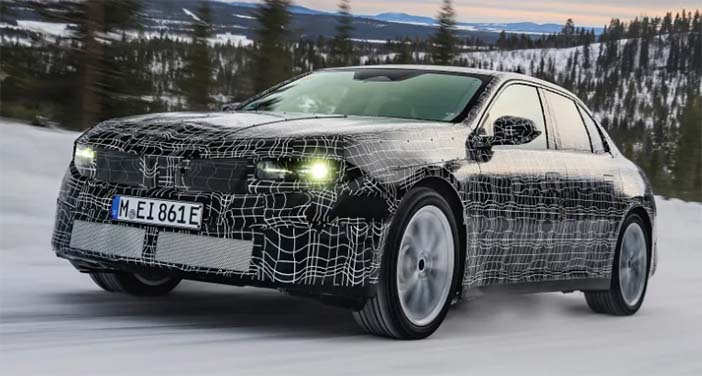
+++ The radical new electric BMW 3-SERIES is now entering the final stages of testing, as the company gears up to take on the Tesla Model 3 and the new Mercedes-Benz CLA in 2026. Expected to revive the dormant i3 moniker and launch late next year, the electric 3 Series will be the second model to use BMW’s new Gen6 modular EV platform, following the launch of the closely related iX3; a SUV which is set to be revealed later this year before launching in early 2026. It was previewed by the boldly styled Neue Klasse concept, which introduced a striking new design language that departs dramatically from the look of BMW’s current line-up while subtly nodding to some of its most important past models. The production model retains the distinctive new kidney grille, which wraps around the front of the car and houses all the radars and cameras needed to facilitate next-generation advanced driver assistance systems (ADAS). The ultra-slim slashes will be replaced, though, by more conventional led headlights, and the front of the car will be softened slightly with the introduction of a full-width lower bumper. The rear will be more substantially evolved from the concept, with the chunky lower splitter replacing by a more traditional bumper and circular brake light clusters swapped in for the substantial wrap-around led bar that adorned the concept. BMW’s trademark Hofmeister kink will be visible ahead of the C-pillar and the i3 will get a full-length panoramic roof. BMW has yet to give any glimpses of the cabin, but BMW’s two Neue Klasse concepts were both minimalist and tech-heavy affairs inside, with large, irregularly shaped central touchscreens, haptic steering-wheel controls and a full-width head-up display in place of any physical switches and buttons. BMW has yet to confirm full specifications of its crucial new electric saloon, but the Neue Klasse platform will be equipped with 800V electrical hardware to allow it to keep pace with the quickest-charging EVs on sale, while the batteries in the floorpan will be 20% more energy-dense than today’s packs. Meanwhile, a more stringent focus on aerodynamics, in combination with more efficient motors and a new software stack, will boost range by up to 30%, BMW has said. Like today’s BMW 4 Series and BMW 5 Series, the next-generation 3 Series will be sold both with pure-electric and internal-combustion power, with BMW committed to maintaining a flexible powertrain offering across its line-up in the run-up to going all-electric. The firm is working to make its current engines compliant with upcoming emissions regulations, though has not yet confirmed what the offering will be for the next 3 Series. The current, G20-generation model is available with a choice of 2.0-litre four-cylinder and 3.0-litre straight-six petrol engines or as a plug-in hybrid with an electric range of 63 miles, having dropped all diesel engines in an update earlier this year. While the Neue Klasse concept previews the saloon variant, it’s possible that the strong-selling 3 Series Touring will return, providing a rival for the upcoming electric Mercedes CLA Shooting Brake and Audi A4 e-Tron Avant. The 3 Series will also once again spawn a hot M3, which will match the standard car in offering both petrol and electric power; the latter said to offer ‘crazy’ dynamic behaviour, courtesy of an advanced torque-vectoring programme that can vary the power to each of its four motors in milliseconds. +++
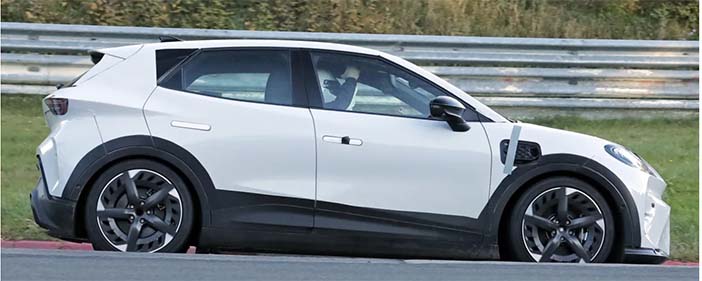
+++ The new CUPRA RAVAL , the brand’s €28.500 electric baby, will play the role of driver’s choice within its extended Volkswagen Group family. The car is set to receive the most sporting setup applied to any of its new Volkswagen Group small hatchback siblings when it hits roads in Europe next summer. Cupra head of research and development Werner Tietz said the Cupra Raval will be fitted with sports suspension across the range, as well as different steering, special software response settings and different tyres to give it the right Cupra character. “We will always offer the most sporty version on the platform”, he told. Teitz also confirmed that the Raval will get a VZ range-topper, following on from the larger Born hatchback’s hot 326 hp VZ model launched last year. “We want to have a VZ in every model”, he said, without committing to timescales. The Cupra Born VZ followed a couple of years behind the regular car’s introduction, so we may have a little longer to wait for the Raval equivalent. The Raval small hatchback, which will be built by Cupra in Spain from 2026 alongside the new VW ID.2, will be unveiled at the IAA show in Munich in September as part of the Volkswagen Group’s assault on the €27.000 electric supermini market. The model offensive will also include a baby crossover (the Volkswagen ID.2 X and Skoda’s Epiq). Meanwhile, the Cupra Formentor coupe-SUV will also be given a longer lifespan as a result of slower than expected uptake of electric vehicles, with a significant refresh in the pipeline ahead of an all-electric replacement now scheduled for beyond 2030. A decision is also looming on Cupra’s return to the US market, which is set to occur at the end of the decade. Slow take-up of electric vehicles in the States, where it’s running at around 10% of new car sales, has led to a potential rethink, with the possibility of combustion models playing a bigger role than was originally planned. “When we started to look 3 years ago we said we would go with BEVs, but if we did that today we would not be happy about it”, said Cupra CEO Wayne Griffiths. “90% of the market is combustion engines, so we can’t bet on one horse, we have to stay flexible and have all alternatives open”. He said any models built for, and likely in, the US market would also need to have European appeal, with a flagship electric SUV top of the list. Although still several years away from production, that car is likely to be the next all-new model from Cupra. +++
+++ The DACIA SANDERO recently reclaimed the title of Europe’s best-selling car, and the brand seems determined to hold onto it, because a facelifted version of the humble supermini has now been spotted testing. It sports a more robust look and potentially some changes under the metal, too. It’s worth reiterating that this is not the all-new, next-generation Sandero that’s due to be unveiled at the end of 2027 and will be available with pure-electric power. The car that was spotted, is simply the current model with a new look that’s inspired by Dacia’s latest models, the Spring, plus the Duster and Bigster. The most significant design changes are at the front and mirror those being applied to the updated version of the 7-seater Dacia Jogger that will also get a facelift. The Sandero’s front bumper looks chunkier and squarer than before, and is similar to the Spring’s, so should help the Sandero look wider. There are new headlights as well, and a slimmer front grille with what appears to be a camera underneath where the Dacia link logo will sit. Finally, the upper and lower grille both have a new cubic pattern. Changes to the rear appear to be limited to a fresh set of much slimmer LED tail-lights, while the prototype is riding on some new diamond-cut wheels. Inside, we can expect the Sandero to receive a tech boost, ideally the 10-inch touchscreen and 7-inch digital instrument panel offered in the Spring and other Dacia models. The Sandero is currently only available with a turbocharged 3-cylinder engine, producing 90 hp of 110 hp in pure-petrol TCe form or 100 hp if buyers go for the Bi-Fuel LPG version. I expect both engine options will be sticking around. However, what I’m really hoping to see is the Sandero fitted with a full-hybrid powertrain for the first time. Dacia CEO Denis Le Vot recently suggested that this could happen soon and this facelift would be perfect timing. The Hybrid 140 set-up available in the Jogger is the most likely candidate, because the 2 cars share the same CMF-B platform and the same powertrain is used by the Renault Clio E-Tech Full Hybrid. It consists of a 1.6-litre four-cylinder petrol engine assisted by a pair of electric motors, powered by a 1.2 kWh battery pack that allows for pure-electric driving around town. The addition of a Sandero Hybrid would give the brand a rival for the MG3 Hybrid+. +++
+++ The current MAZDA CX-5 has been with us since 2016 and while it’s still competitive against some tough rival midsize family SUVs, it’s due to be replaced and the new version has been caught testing on the road for the first time. Mazda revealed last year that we can expect a new CX-5 to enter the market by 2027. But judging from the spy pictures of the disguised test car, we might see the new car arrive as soon as late this year. The prototype model we spotted is wearing very thin camouflage and gives us a great look at the new CX-5’s design, even at this early stage of its development. You’d be forgiven for thinking this is a mere facelift of the current one, because the overall proportions and detailing are very familiar. At the front we can see a thinner headlight arrangement and grille that are more akin to what we’ve seen on the new 6e saloon and CX-6e concept. But while those 2 models are electric, the CX-5 will be a hybrid, so its grille is open. Like the current car, the new CX-5 will retain its wheel arch extensions and have a relatively long bonnet to give it a more sporting profile. At the rear there’s a twin-exit exhaust system – a design trait of Mazda’s internal-combustion engine cars – plus a thin, horizontal rear light cluster not too dissimilar to the CX-80. A brief glimpse of the interior tells us the CX-5 may take inspiration from the 6e electric saloon with a huge 14.6 inch touchscreen mounted on the dash, although this may be changed for the production model. Pure-electric power for Mazda’s mid-size SUV will come in the shape of the CX-6e in 2027, which will sit alongside the upcoming 6e. We already know the new CX-5 will retain a petrol engine, although it’ll be mated with a new hybrid system to keep up with the likes of the Toyota RAV4 and Hyundai Tucson. A mild-hybrid model is expected, but given that Mazda’s larger CX-60 and CX-80 SUVs offer a plug-in hybrid option, we could see a plug-in version of the CX-5 too. +++
+++ Weeks of speculation over NISSAN ’s future leadership ended overnight with the embattled Japanese automaker naming Mexican national Ivan Espinosa as its new CEO, taking over April 1 for outgoing Makoto Uchida. The selection of Espinosa, 46, injects product knowhow and international perspective into Nissan’s executive suite as it struggles with renewing its vehicle line and stoking sales and profitability in key overseas markets such as the U.S. and China. But the tough decisions that were expected to be made by Uchida have yet to be made as this automaker’s fortunes continue to fester amid global economic tensions, tariff questions in the U.S. and existential threats following failed merger talks with Honda. Today’s Nissan has deteriorated from the Nissan that announced the merger talks with Honda in December. Espinosa faces a huge fix-up job and precious little time to do it, Koji Endo, senior analyst and auto team lead at SBI Securities Co. in Tokyo, says. “The short- and long-term outlook for Nissan is substantially worse than it was just 3 months ago”, Endo said. “Espinosa has to move very quickly to find a new partner and make a more drastic restructuring program. I wouldn’t be surprised if Nissan’s profit situation worsens”. There will no doubt be arguments that Nissan needs an outsider to fix the company the same way former Boeing executive Alan Mulally reengineered Ford during his tenure as CEO from 2006 to 2014. And clearly there was sentiment by some within Nissan for an outsider with Nissan experience, such as Jun Seki, to get the job. But Nissan’s board obviously sees Espinosa as the best immediate answer to the company’s many challenges. “Given the circumstances of the company, it would be a very challenging start for Ivan”, Yasushi Kimura, chair of the board of directors, said at an evening news conference. Indeed. +++
+++ SEAT will update its Ibiza and Arona models this year to give them the legs to get to the end of the decade and allow the Spanish brand the chance to delay a decision on electrification. “At the moment, Seat is in good shape”, said CEO Wayne Griffiths. “But we don’t have the capacity to build an electric car and it would need to be profitable; a €20.000 model is very difficult to build profitably”. That means a visual refresh for the 2 petrol cars, along with tech updates, although there won’t be any changes to the powertrains outside of those needed to meet legislative requirements in the coming years. “We are planning on running the combustion cars on sale until the end of the decade and therefore the time for a decision about electric cars is in the future”, Werner Tietz, Seat’s vice president of research and development told. He said the company has reduced its development processes to 3 years, which means decisions can be taken later, but cars still arrive to the same deadline. “Our ambition is to find the technical solution which makes it viable for Seat to enter the electric market, because with the price point of the car the technology must see a step change in cost”. Tietz also confirmed that Seat had launched its last fresh combustion-engined car, with the brand’s new product future tied to making electric cars profitable. Griffiths said the uptake of electric vehicles in Europe is too far below previously predicted levels to profitably introduce a small electric Seat, with such cars running at 13 percent of new-car sales last year, rather than the expected 25 percent, while on the Spanish homemarket the figure is just 5 percent. He called for action from governments to provoke EV sales into life. “At this pace the automotive industry in Europe is at risk, but we need to see it as an opportunity to drive growth”, Griffiths said. “Electrification is inevitable, and we have been absolutely clear: it’s not a goal, it is the goal, and we need to see the same level of commitment from leaders across Europe. If we can seize the opportunity there is no reason why they can’t do the same”. +++
+++ SKODA will reveal a concept car in September that hints at the Octavia-sized electric vehicle it is currently developing. An outline of a family estate-sized car was shown in 2023 as part of Skoda’s plans for 4 new electric cars, but this model has been pushed back into at least late 2027 because the firm wants to build it on a new electric-vehicle platform from the Volkswagen Group. Known as Scalable Systems Platform (SSP), the new architecture will also underpin Volkswagen’s future electric Golf-sized car, and Skoda boss Klaus Zellmer said the step-up in abilities will make the new tech worth waiting for. “The new platform will give more performance and be more cost-efficient, and will be the platform we are going to put the Octavia on as a battery electric vehicle”, he said, although Zellmer refused to confirm if the nameplate of Skoda’s biggest-selling model would be carried over to the EV. However, Zellmer did confirm that Skoda won’t get a version of Volkswagen’s new sub-€20.000 electric small car, instead extending the life of the Fabia, Scala and Kamiq models through to the end of the decade. Skoda will introduce a sub-€20.000 mild-hybrid version of the Fabia aimed at consumers still looking for low-cost petrol cars, while sister brand Volkswagen will appeal to those looking for an electric small car. “We have decided not to be part of that segment, we will leave it to our colleagues in the Volkswagen Group”, he said. “Volkswagen will have a €20.000 electric car and Skoda will have very efficient engines in the Fabia, Scala and Kamiq. We have the freedom of choice, we leave it up to consumers to choose what fits their personal preference best”. Two new Skoda electric cars that will be revealed next year are the Epiq, a small €25.000 hatchback sister car to the forthcoming Volkswagen ID.2 and Cupra Raval, and a 7-seat electric sibling to the Kodiaq currently known by the codename 7S and likely to use the same MEB electric platform as Skoda’s existing Enyaq and Elroq models. Both new EVs will be shown in 2026 and arrive in Dutch showrooms the following year, with the Epiq likely to appear a few months ahead of Skoda’s new electric flagship. +++
+++ An electric successor to the TOYOTA YARIS is in the company’s plans, but now is not the right moment for it, bosses have told. The supermini is the Japanese brand’s second best top-seller in Europe. When asked about a Yaris Electric joining the line-up, product and marketing boss Andrea Carlucci told: “This is the idea, but now it is not something we talk about. We have deliberately decided to start our electric car sales in the fastest-growing segments (C, D and E). The right moment will arrive, but this is not quite now”. Toyota currently has a 3-strong EV line-up, comprising the new C-HR+, updated BZ4X and Suzuki-made Urban Cruiser. Not supplementing those SUVs with a smaller model “is a choice”, said Carlucci. The reception of the Renault 5 shows that there is appetite for such a car in Europe, agreed Carlucci. “There will come a time and a place”, he said. “For us, it is all about the right car, the right place at the right time, it really is. And at the moment, the expansion you’re seeing are the right segments for Europe for us right now”. A Toyota electric supermini likely to arrive in the latter part of the decade, given that the 3 new EVs the brand will launch by the end of 2026 are hinted to be a pick-up, a fastback and an SUV. When it does arrive, it’s expected to take the Yaris name, as Carlucci told that future Toyota EVs would take “familiar” names from “current cars”, like the recently revealed C-HR+. This means the fastback could be called Camry+. +++
+++ Like the rest of the global auto industry, European automakers are riding the TRUMP tariff roller coaster every day in real time. Both the Volkswagen Group and BMW today tried to grapple with the long-term implications while keeping up with the latest developments. Cupra, Volkswagen’s sporty Spanish brand, still plans to enter the U.S. by 2030 despite the Trump administration’s threat to impose additional tariffs on European cars, CEO Wayne Griffiths said. “Our decision to bring Cupra to the U.S. by the end of the decade remains unchanged”, Griffiths said at a news conference March 13. “This is a long-term decision that cannot be determined on the basis of short-term fluctuations”. President Donald Trump has said European passenger cars will face 25 percent tariffs, up from 2.5 percent now. Cupra models are built in Europe and China. Meanwhile, BMW’s brass expect newly imposed U.S tariffs will not last long, although the carmaker warned of a $1.1 billion hit this year from the escalating trade war. CEO Oliver Zipse told Bloomberg Television: “We don’t think that all these tariffs will last very long, though some of them might last longer”. +++
+++ New generation battery tech (with good energy density and lighter weight) will enable VOLKSWAGEN to make EVs more affordable for European buyers. The Polo-sized ID.2, due in 2026, should have an entry price close to €25.000, and the ID.1 production version of the ID.Every1 concept, which arrives a year later, could come in around €20.000. Today’s cheapest electric Volkswagen in the Netherlands is the €25.000 ID.3 Pure. Volkswagen ’s baby BEVs are switching to lithium iron phosphate (LFP) batteries, which use raw materials that are typically cheaper than the Nickel Manganese Cobalt (NMC) cathode design powering the current ID range. LFP isn’t as energy dense as NMC but Volkswagen will overcome that by cramming more cells into its cars using a new ‘cell-to-pack’ system. The thinking is similar to the Blade battery of Chinese car maker BYD, which layers long cells across its battery pack to boost energy density. The MEB31 battery module in today’s VW EVs needs a series of metal ribs to hold the rectangular modules in place, unnecessary structure the new design can jettison. “The usable space is much better, we can pack in more energy density and it’s lighter,” says VW engineer Malte Schulz. As a result, Volkswagen can get sufficient battery cells into the ID.1’s short wheelbase, while trimming some weight given that the Up! replacement has only a 95 hp motor. The new cell-to-pack design is scalable to boost cost competitiveness: the same layout can also accommodate higher performance NMC cells for Porsche and Audi models. In the initial stages they won’t be a ‘cell-to-body’ design (where the battery pack forms a structural part of the car, as in BYD’s Seal) though Volkswagen says this will come in the next stage. The batteries will be built in Europe, with pilot production underway at the Salzgitter gigafactory in Lower Saxony owned by VW spin-off PowerCo. “The battery cell is the combustion chamber of tomorrow”, says Volkswagen Group CEO Oliver Blume. “It’s a core competency for VW Group, so we need the engineering knowledge and to own production. Salzgitter will ramp up this year”. The plant will have a capacity of around 40 gWh and cell production could be split between LFP and NMC chemistries. Another 60 gWh will come on stream at PowerCo’s second European plant in Valencia, Spain, in 2026. A third factory is underway in Ontario, Canada, with up to 90 gWh, which is due to open in 2027. That gives PowerCo and Volkswagen a capacity of around 200gWh. +++