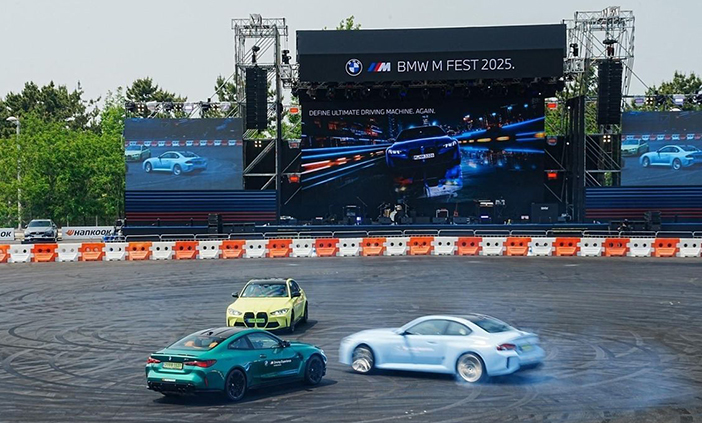
+++ BMW KOREA is maintaining its top position in the country’s high-performance car market, selling nearly 2.700 BMW M vehicles in the first half of this year, outpacing rivals. According to BMW Korea, it delivered 2.668 BMW M vehicles from January to June this year; up 20 percent from a year earlier. The growth was driven by a balanced performance across a wide range of M models rather than concentrated on a single model. The importer attributed the stable sales to BMW Group’s “power of choice” strategy, which offers a broad range of selections to customers seeking driving performance and a premium lifestyle at the same time. BMW Korea currently offers a total of 34 high-performance models ranging from sedans to SUVs and compacts to large vehicles. It also includes internal combustion engines, plug-in hybrids and full electric vehicles. In the first half of the year, the top selling models in the M high-performance segment were the M2 with 170 units, the XM with 157 and the M5 with 137. In the M performance segment, the M340i led with 271 units, followed closely by the M850i with 270 and the X7 M60i with 176. In the latter half of the year, BMW Korea will roll out the full-electric iX M70 and the M5 Touring to strengthen its customer appeal. Along with its extensive high-performance line-up, BMW Korea’s efforts to offer a distinctive brand experience also contributed to its strong sales. In May, the company hosted the BMW M FEST 2025, an event designed to let visitors experience the heritage and spirit of the M brand first hand. The festival attracted more than 5.500 participants and featured more than 30 high-performance models on display and available for test drives, delivering the thrill of driving to a wide audience. “Based on its deep commitment to the Korean market, BMW Korea plans to strengthen customer brand loyalty and solidify its leadership in the premium high-performance car segment”, a BMW Korea official said. +++
+++ Life at the top is proving complex for China’s leading automaker, and there are fresh challenges on the horizon. BYD ’s monthly sales have stagnated of late and with the summer months being a traditionally slower time for consumer purchases, that trajectory isn’t expected to reverse any time soon. Discounting is also now being looked sternly upon by Beijing, with China last week pledging to rein in “irrational competition” in the electric vehicle sector, reflecting authorities’ wish to tackle the deflationary price wars that are threatening economic and industrial growth. Some of BYD’s international forays are also proving more challenging than expected, raising the question: is China’s No. 1 automaker on shaky ground? The Shenzhen-based behemoth currently looks like it will undershoot its annual sales target for 2025, in what would be a rare miss after a multi-year bull run. The number of electric and hybrid vehicles BYD needs to sell each month through December has hit 560.000 units, in excess of levels it could hope to achieve typically in a single month. The most vehicles BYD has ever sold in a month was just shy of 515.000, in December last year. Analysts are now doubting whether BYD can hit 5.5 million units in 2025. Consensus estimates continue to be downgraded. Morgan Stanley last month lowered its projection to 5.3 million, pointing to a smaller number of new models, while Bloomberg Intelligence’s Joanne Chen says BYD will need to sacrifice some profit and maintain its hefty discounting in the second half if it wants to stay on track. “Regulatory scrutiny will temper direct cuts to vehicle sticker prices but competition isn’t going away and retail promotions are still needed to sustain sales momentum”, she said. “New model roll outs and steady tech upgrade are also crucial”. Bing Yuan, a fund manager at Edmond de Rothschild Asset Management, said many market watchers now realistically expect sales of around 5 million. “My sense is that is the consensus”, she said. Stripping out overseas and commercial sales, BYD’s core car deliveries in China are shrinking. In June, they slipped 8% year-on-year as vehicles from brands like Geely, Xpeng and Xiaomi won over buyers. HSBC data shows that Geely was the largest gainer of market share in the first half, while BYD was among the biggest losers. Overseas sales are faring better and those are looking on target to reach BYD’s forecast of 800.000. Indeed, BYD is already almost 60% of the way there. But while higher margin international sales will help BYD offset aggressive domestic discounting, some foreign markets are presenting new difficulties. BYD has grand plans for Saudi Arabia, for example, hoping to triple its footprint after Tesla entered the country. But EVs account for just over 1% of total car sales in the kingdom, with high costs, sparse charging infrastructure and extreme temperatures challenging EV adoption. India, a potentially huge market, has meanwhile consistently blocked BYD’s efforts to expand and despite rapid growth from a low base in Europe, there are substantial tariff headwinds and increasing competition from legacy automakers that already have consumers’ trust, not to mention more extensive after-sales networks. At home, regulatory scrutiny has also intensified around BYD as it continues to be at the fore of an EV price war. In late May, it slashed prices by as much as 34%, triggering renewed sector-wide discounts. Its moves were later discouraged in a veiled warning by the Chinese Communist Party’s mouthpiece the People’s Daily, which slammed the “rat-race competition”. Whether Beijing can actually stop price discounting by a privately held company is a point of debate. Tianlei Huang, a China program coordinator at the Peterson Institute for International Economics, said authorities may resort to administrative tools such as price reviews or cost investigations to establish a de facto price floor, or coordinate a concerted capacity reduction among leading EV makers, although he acknowledged those measures won’t be easy. Regardless, BYD must be careful. As the company gears up to release first-half results next month and July sales data within weeks, analysts will have their spreadsheets ready, waiting to see whether those 2025 targets look even further in the distance. +++
+++ KIA said Friday that its operating profit declined 24.1 percent on-year to 2.8 trillion won ($2 billion) in the second quarter, largely due to the 25 percent automobile tariffs imposed by the US. According to Kia’s conference call on earnings from April to June, its operating profit margin declined to 9.4 percent, marking a single-digit figure for the first time in 10 quarters. Its sales revenue reached a record high of 29.3 trillion won, with a 6.5 percent increase from the previous year. “The US tariffs, which have taken effect since April, have (negatively) affected the company’s profits by 786 billion won”, said Yoon Byung-yeol, head of the investor relations division at Kia. “Despite our efforts to mitigate this impact through incentive cuts in the US, overall incentives increased due to fierce competition in the European market, resulting in a further drop in profit reduction of 341 billion won”. In the second quarter, Kia’s global sales volume soared by 2.5 percent year-on-year to 814.888 units. This includes a 3.2 percent increase in the domestic market with 142.535 units and a 4.1 percent jump for the North American market, totalling 289.000 units. Sales in Europe declined 4.5 percent to 140.000 units, while India saw a surge in sales by 9.5 percent to 67.000 units. Kia’s eco-friendly vehicle sales, ranging from all-electric vehicles to hybrids, rose by 14.0 percent to 185.000 units in the same period, with a strong demand for hybrids in the US and EVs in Western Europe. The share of eco-friendly cars in total sales also increased by 2.0 percentage points from the previous year, reaching 23.4 percent. Addressing the hostile business environment, Kim Seung-jun, chief financial officer of Kia, noted that the second half of this year would be more challenging than the January–June period as the full impact of the US tariffs hits. To mitigate this, Kia plans to redirect approximately 25.000 vehicles produced at its Georgia plant (originally intended for export to Canada, the Middle East and Africa) toward the US market. By combining this strategy with receiving car parts tax credits from the US government and maintaining low consumer incentives, Kia aims to reduce the tariff impact by 30 percent for the remaining year. In addition to this multi-pronged strategy, Kia looks to drive sales of its hybrids, including the Carnival MPV and Sorento, Sportage and Telluride SUVs, along with its gasoline-powered cars, increasing its US market share from 5.1 percent in the first half of the year to 6 percent in the latter half. This goal comes despite industry projections of a 10 percent decline in demand for EVs in the US during the same period. In its push to bolster sluggish European sales, which have been hit by intensified competition from Chinese automakers, Kia will launch the EV4 and EV5, as well as the new Sportage PE model. Due to the global market uncertainties, Kia has not updated its annual guidance for this year, which aims for a 4.1 percent on-year increase in sales to 3.2 million units and revenue surpassing 112 trillion won with an 11 percent operating profit margin. +++
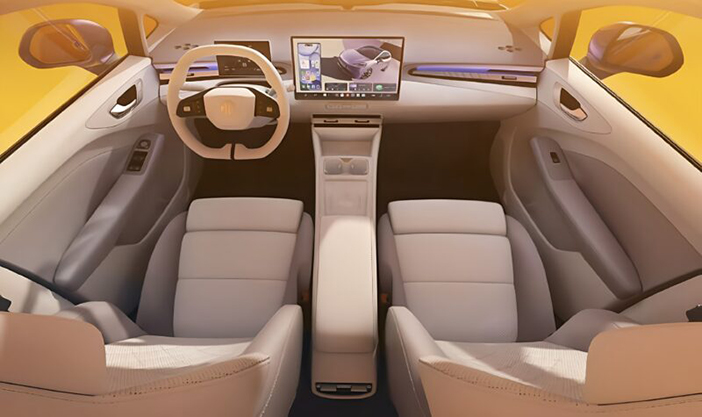
+++ SAIC Motor has officially revealed the interior of the new MG 4 ahead of its debut in China on August 5. The update introduces a new dashboard, an intelligent infotainment system co-developed with Oppo, and upgraded seat designs designed to enhance occupant comfort. A 15.6-inch floating central screen anchors the new dashboard layout, replacing the earlier integrated display. Most physical controls have been eliminated, with just five core function buttons remaining below the screen. Air vents are now hidden within the dashboard surface to preserve the minimalist aesthetic. The new infotainment system is the first collaboration between MG and Oppo. Powered by the Qualcomm Snapdragon 8155 chip, it supports cross-platform connectivity, smartphone-based vehicle control and gesture-based navigation. Additional features include AI-powered interaction, app mirroring and wireless integration with Apple CarPlay and Android Auto. A 50-watt wireless charging pad with active ventilation is positioned within the centre console. The front seating has been revised to enhance ergonomics. Each seat features a 503-millimetre-long cushion and includes both ventilation and heating. The driver’s footwell adopts a 46.4-degree flat pedal angle designed to reduce leg strain on longer trips. Seat backs now use a one-piece construction for greater support. In the rear cabin, MG has extended the seat cushion to 522 millimetres and set the backrest at a 27-degree recline angle. The floor is fully flat to enhance rear legroom, and the seatbacks fold 60/40 to increase cargo flexibility. A panoramic sunroof with an integrated sunshade is available on higher trim levels. The new MG4 is based on SAIC’s Nebula EV platform. It measures 4.395 mm in length, 1.842 mm in width and 1.551 mm in height, with a wheelbase of 2.750 mm; up 45 mm from the previous model. These changes support the interior’s expanded proportions and improved passenger space. The MG4 EV competes with models like the Volkswagen ID.3 in China’s compact electric vehicle segment. The interior changes are part of a mid-cycle update that also includes revisions to the exterior and drivetrain. Deliveries are expected to begin in September, following the official launch. +++
+++ MITSUBISHI announced the termination of its joint venture agreement with Shenyang Aerospace (Shenyang Aerospace Mitsubishi), marking the Japanese automaker’s complete withdrawal from China’s automotive manufacturing sector. This decision follows the cessation of its local car production in 2023 and underscores Mitsubishi’s strategic retreat amid China’s rapid shift toward new energy vehicles. Established in August 1997, Shenyang Aerospace Mitsubishi had been a cornerstone of Mitsubishi’s China strategy, producing engines for both Mitsubishi-branded vehicles and numerous Chinese automakers. The joint venture, which began operations in 1998, supplied critical powertrain components to support Mitsubishi’s local assembly lines and third-party manufacturers. However, on July 2, 2025, the company was officially renamed Shenyang Guoqing Power Technology, with Mitsubishi exiting as a shareholder. In a statement, Mitsubishi cited “the rapid transformation of China’s automotive industry” as the primary reason for its exit, emphasising a strategic reassessment of its regional priorities. Mitsubishi’s China journey began in 1973 with exports of medium-duty trucks. By the early 2000s, its 2-engine joint ventures supplied powertrains for approximately 30% of domestically produced vehicles. However, the rise of China’s new energy sector, coupled with weakening demand for internal combustion engines, eroded its market position. The formation of GAC Mitsubishi in 2012 (a 50:30:20 joint venture with Guangzhou Automobile Group (GAC) and Mitsubishi) initially showed promise. Sales peaked at 144.000 units in 2018, driven by the Outlander SUV’s 105,600-unit sales. However, annual deliveries plummeted to 33.600 units by 2022 amid intensifying competition from domestic EV brands. By March 31, 2023, GAC Mitsubishi reported total assets of 4.198 billion yuan ($582 million) and liabilities of 5.613 billion yuan ($778 million), leaving a net worth of -1.414 billion yuan (-$196 million), according to GAC disclosures. In October 2023, Mitsubishi announced plans to halt local production and restructure its China operations. GAC subsequently took full ownership of the joint venture, with plans to repurpose the plant for its EV brand, Aion, aiming for mass production by June 2024. Mitsubishi’s exit reflects broader challenges faced by foreign automakers in China’s electrified market. Domestic brands like BYD and Tesla’s localised operations now dominate, while other joint ventures, such as GAC-FCA, have collapsed entirely. “China’s automotive landscape has become a battlefield for EV innovation, where legacy automakers struggle to compete”, said industry analyst Chen Liwei quoted by Chinese media Jiemian news. “Mitsubishi’s retreat highlights the irreversible shift toward homegrown solutions”. +++
+++ Interior spy photos of what appears to be a simplified TESLA MODEL Y have surfaced online. The images suggest Tesla is preparing to launch the more affordable variant of its popular electric SUV with several cost-cutting modifications. During Tesla’s Q2 earnings call, CEO Elon Musk clarified that the long-rumoured affordable Tesla isn’t an entirely new model but rather a simplified version of the Model Y. The new variant is already in production and expected to hit the market in the fourth quarter of 2025. The interior design shows changes aimed at reducing costs. The panoramic glass roof and rear entertainment screens have been eliminated. The front centre armrest area has been redesigned with a pass-through layout, creating a more spacious and practical cabin. Despite these simplifications, the steering column stalks have been retained, and the vehicle will likely continue to use the current model’s screen-based gear selection system. Exterior modifications are also evident in the leaked images. Most notably, the continuous light strip across the front fascia has been removed, with headlights repositioned higher, giving the vehicle a look more reminiscent of the Model 3. The taillight design is expected to lose its central reflective light strip, further simplifying the design and reducing production costs. In the first half of 2025, Tesla’s Model Y sold 171.491 units, remaining the sales champion among vehicles priced above 250.000 yuan ($34.750) in China. However, its advantage over other models has become increasingly narrow. In the same price range, Xiaomi’s SU7 sold 155.692 units. Moreover, Xiaomi’s YU7, which sold 200.000 units in an extremely short time, only launched on June 26. For the Model Y, XPeng, Li Auto and Nio (Onvo) will all release highly competitive models in the second half of the year. Today’s Model Y no longer offers particularly high cost-performance in the Chinese market, making it imperative for Tesla to introduce a more affordable version. +++
+++ Inside TOYOTA , a group of employees are worried about the company’s future in an era when a car’s software matters just as much as its sheet metal. The world’s biggest automaker is known for churning out reliable cars like clockwork, but it’s been struggling to keep up with Elon Musk’s Tesla, China’s BYD and other front-runners in the industry’s shift toward electric vehicles (EVs) with sophisticated software. A somewhat obscure Toyota business unit called the Digital Transformation Promotion Department aims to change that. Established 4 years ago at the behest of then-chief executive officer and now chairman Akio Toyoda, the little known group’s mandate is to bring the carmaker up to speed by modernizing it from within. The division’s rank-and-file members are drawn from a wide cross-section of the corporate flow chart; everyone from R&D technicians to blue collar mechanics on factory floors. They all share a broad vision to introduce a more digitized future to a company with a stubbornly analog culture. While they’ve managed to foster some changes, Toyota’s core competency remains very much in hardware, with one foot in the world of EVs and its other planted in petrol-powered cars. That cautious approach has been key to the Japanese automaker’s success so far. Yet it’s also a source of frustration for some inside and outside the company who are pushing for quicker progress. “Toyota sees the importance of software, but it’s still slow,” said Kani Munidasa, chief executive officer of Code Crysalis, a Tokyo-based startup that’s working with Toyota to put workers through Silicon Valley-style coding boot camps. Some advocates for a software-led rethink at Toyota have grown disillusioned by what they see as a lukewarm commitment to reform from within, according to people familiar with the matter. They point to a recent decision to fold the Digital Transformation Promotion Department into a larger business unit, threatening to short-circuit its mission as a change agent. The division, which previously reported directly to Chief Executive Officer Koji Sato, was absorbed by the Digital Information and Communication Group “to accelerate the internal promotion of digital transformation”, Toyota said in a statement. “We aim to create new value and transform business by accelerating collaboration among the various infrastructures and the use of AI”, it said. In some ways a similar fate befell Toyota’s effort to create a digitally focused, quasi-independent subsidiary called Woven. Despite bold ambitions to usher in a “software-first” approach to car manufacturing, in the end Woven was quietly folded back into the corporate mothership in September 2023 after its American executive departed and its portfolio was downsized. While Toyota’s software team isn’t directly involved in the development of the cars it sells, they’ve undertaken a number of projects focused on the company itself. That includes creating a database to keep track of the company’s fleet of test cars, overhauling a system employees use to apply for time off, replacing white boards with touch screens on factory floors and deploying robots to deliver medicine inside Toyota’s 527-bed company hospital in Aichi Prefecture, according to people familiar with the matter. Another project involved extending access for remote workers to computer assisted design software using a virtual desktop infrastructure in partnership with Nvidia. “Moving forward, our plan is to roll out similar systems not only to Toyota Motor but also to Toyota group companies”, Masanobu Takahisa, a Digital Transformation project general manager, was quoted as saying in a 2021 press release about the campaign. Those efforts might not be transformative, but they’re notable in a company where scissors are banned in the office out of an abundance of safety-minded precaution, and erasable billboards are still used to keep employees informed at factories. Toyota isn’t unique among Japanese companies. While the country dominates in some high-tech fields such as industrial robots, its business culture is known for clinging to fax machines and other bygone technologies. The government in Tokyo has warned about failing to surmount what it terms a “digital cliff” separating Japan from other advanced economies. In March 2021, sitting across from union members during the final round of annual wage negotiations, Toyoda, scion of the founding family and then CEO, said he wanted to break down internal information silos and put the automaker’s digital innovation on par with top global companies within three years. “Inside Toyota, it’s still the case that only people ‘in the know’ are considered valuable, and that knowledge only belongs to a small group”, he said. “By moving forward with our digital transformation, we can rid ourselves of that inequity and build an environment where it’s easier for everyone to focus on their work”. The carmaker based in Toyota, Aichi Prefecture, hatched the Digital Transformation division to heed that call with a team of innovative minds looking to break down antiquated systems and practices. The idea was that, if all went well, that reform agenda would rub off on other parts of the company, boosting resiliency and productivity. But the progress has been piecemeal and the division is far from achieving its long-term goals, the people familiar with the matter said. Former employees who spoke anonymously described a workplace bound by conformity, with a paternalistic bureaucracy that values harmony over new ideas. One ex-employee joined Toyota because they were interested in autonomous driving, but instead felt trapped for several years doing quality control on mundane electronic parts. Toyota’s global success (its record as the world’s biggest automaker for 5 consecutive years and its status as Japan’s biggest and most important company) has arguably created a self-enforcing inertia. Talk among employees of transferring or quitting usually triggered the same reaction: Why would anyone want to leave? It’s not the only legacy carmaker struggling to adapt to modern technology. Volkswagen’s Cariad software unit has been downsized following glitches and delays, while Ford recently downgraded its next-generation advanced software project known as FNV4 by merging it with an existing architecture platform. That speaks to a larger issue involving the industry’s ability to innovate fast enough to compete with the likes of Tesla and China’s Xiaomi as well as Big Tech, which has moved aggressively into automotive dashboards with popular features such as Apple’s CarPlay and Alphabet’s Google Android operating system. Reinvention won’t come easy for established automakers, said John Murphy, a senior automotive analyst at Bank of America. “It goes into structures, platforms, technology, sort of the whole integrated operating system of a vehicle, I think, needs to be done differently”, he said. “It’s an uphill battle”. +++
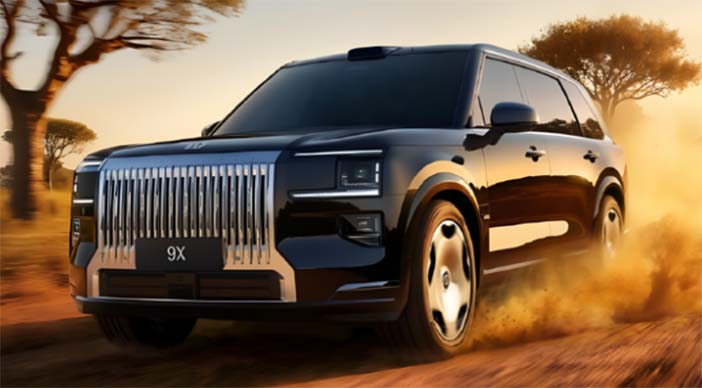
+++ Geely‘s ZEEKR has announced that its first hybrid model, the 9X, will go on sale for pre-order at the Chengdu Auto Show in August. The information was confirmed in the company’s official Q&A session titled “You Ask, I Answer”. The Q&A addressed the 9X’s product positioning, launch timeline, and future planning. According to the company, the Zeekr 9X’s pricing has not yet been finalized and will be communicated once confirmed. Zeekr stated that while its mid- to large-sized vehicle line-up remains focused on pure electric platforms, large-sized models like the 9X will adopt its new “super electric hybrid” strategy. Currently, there are no plans for a fully electric version of the 9X. The Zeekr 9X is built on the brand-new SEA-S modular platform, known in Chinese as Haohan-S, which utilises the SEA Hybrid (Haohan Hybrid) technology. Power is delivered by a system combining a 2.0-litre turbocharged engine with 3 silicon carbide electric motors, producing a total output of 1.381 hp. The SUV accelerates from 0 to 100 km/h in 3.1 seconds and reaches a top speed of 240 km/h. Zeekr states that acceleration remains consistent regardless of battery level, with only a 0.2-second difference in acceleration. The hybrid setup includes a 70 kWh CATL Freevoy battery, one of the largest in any PHEV passenger vehicle. With 6C charging capability on a 900V system, the 9X can recharge from 20% to 80% in around 9 minutes. The electric-only range is rated at 285 km, while the total driving range exceeds 1,000 km. Zeekr reports that the 2.0T engine achieves a thermal efficiency of above 46%, with fuel consumption 5–10% lower than that of typical 1.5T hybrid engines. Zeekr reiterated that although there are no current plans for a BEV version, the company is technically prepared to offer one if future demand justifies it. The 9X will enter the Chinese market in the third quarter of 2025, following its pre-sale debut at the Chengdu Auto Show in August. +++