
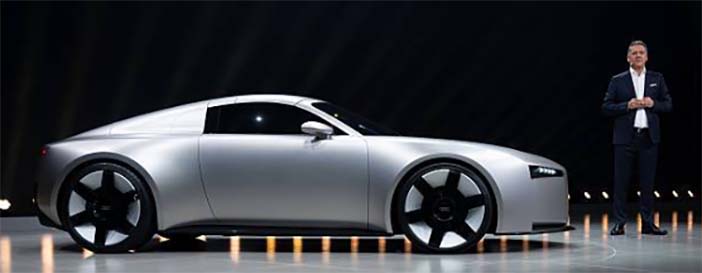
+++ AUDI is undergoing a complete aesthetic transformation, but with that will come a stark reduction in complexity across all model ranges, including the options available within them. Judging from our chat with Audi CEO, Gernot Döllner (photo), and the brand’s new chief creative officer, Massimo Frascella, in Milan, Audi looks set for a revolution that will completely change how you order and spec a ‘premium’ car. The news comes on the back of the brand’s visual reinvention signalled by the new Concept C sports car. More than just a concept, it will spawn a new electric roadster and a new design language underpinned by a stronger vision that allows less opportunity for customers to personalise their cars. I asked whether the huge level of variation in today’s Audi models will still be available on future products, including Audi’s popular S-Line package. Massimo Frascella replied: “We’re looking at how to structure that differentiation. The key is being able to offer added value, not just offer it for the sake of it”. Gernard Döllner added: “We also need to keep a level of complexity that is sustainable from the business side. This is one of the advantages of reducing complexity. But also from a brand point of view, the more consistent we are with the main touchpoints like the steering wheel, the more recognisable it will be as Audi. “For example, we believe that we only need 3, maybe 4 different versions of a steering wheel. At the moment, we have over 100!” This suggests Audi might be looking at trimming down the variations within its model lines. Premium brands started with trim lines like BMW’s M Sport and Audi’s S-Line but the level of choice for consumers has since ballooned into hundreds of different options across all elements of the car’s exterior and interior design. Audi plans to use the resource that goes into this to offer fewer options of far higher quality. Massimo told me: “we can build better quality elements because we’ve reduced”, However, for many customers a key part of the ‘premium’ car buying experience is choosing from all the options or, more often the case in the Dutch market, selecting various option packages. These tailor the car to the customer’s preferences. But this isn’t always a profitable thing for a manufacturer to offer, as Döllner suggested, especially when multiple versions of the same part have to be developed individually throughout the car’s overall development. Audi plans to lead the way in changing the way we spec our cars. +++
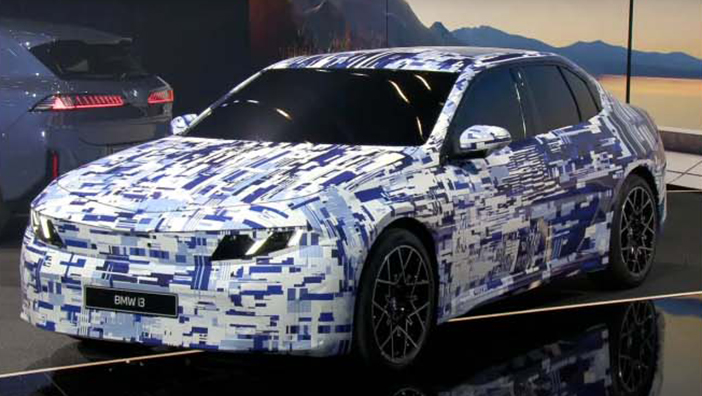
+++ BMW has shown the new electric 3 Series for the first time and confirmed it will arrive next year badged i3. Revealed in camouflaged form at the launch of the new iX3 on Friday, the car has evolved from the striking Vision Neue Klasse concept that was revealed in 2023. The saloon will become the second model in the company’s Neue Klasse range. This will be the first time BMW offers a 3 Series-sized model with an electric powertrain in Europe. When it arrives next year, it will be the smallest EV the brand offers. It inherits its name from the seminal BMW i3 electric hatchback, which went out of production in 2022. Speaking at the iX3 launch, BMW chairman Oliver Zipse said: “This is the new i3 that will arrive next year and be all electric. It’s the first model variant of the new 3 Series generation. You will recognise classic proportions of a typical sporty BMW. For the past 50 years across multiple model generations, no other model has been as tied to the BMW brand as the 3 Series. It represents sheer driving pleasure at its finest. The iX3 and i3 are powerful symbols of the broad spectrum the Neue Klasse models will cover”. When the new iX3 and i3 arrive next year, they will spearhead a huge product offensive from BMW. Zipse said that, starting next year, the brand will launch a new version of each model, adding: “We will launch 40 new and updated models by 2027”. While arriving first in electric i3 form, the 8th-generation 3 Series will continue to be offered with ICE power as it moves onto BMW’s completely new, EV-first architecture. This 800 Volt Gen6 platform is the same as what underpins the larger iX3. While the iX3 is being launched as the longest-ranged EV on the market, with a range of 800 km, expect the i3’s lower and sleeker shape to push this further. Power will likely match the iX3, which at launch is offered with 470 hp and 650 Nm from a dual-motor set up. This enables the SUV to cover 0-100 kph in a claimed 4.9 seconds. Other power configurations are planned. BMW has already teased an electric M3 with the M HP BEV test mule. Due in 2028, BMW has promised that the crucial sports saloon will “set new standards” for electric performance. The car is also set to get a Touring estate version, BMW Group design boss Adrian van Hooydonk previously told. +++
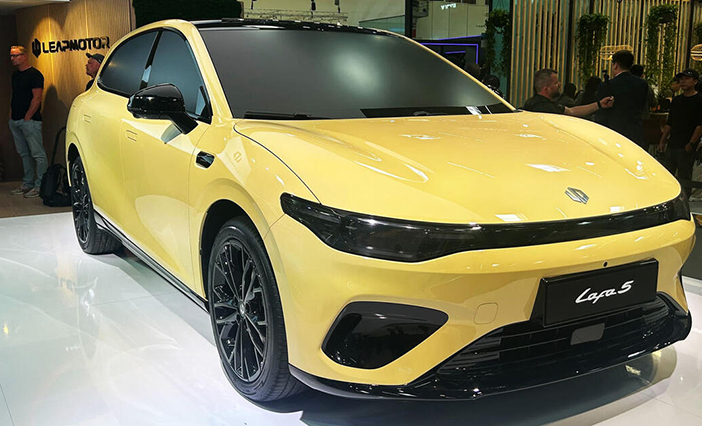
+++ LEAPMOTOR has revealed the B05, an electric hatch that will arrive early next year as a rival to the Volkswagen ID.3. Revealed at the Munich motor show by the Stellantis-backed Chinese brand, the new B05 sits between the T03 city car and the recently revealed B10 crossover; the latter of which is due here in the coming months. The B05 is effectively a lower-slung and more affordable version of the B10. It measures 4.430 mm long, 1.520 mm tall and 1.880 mm wide, which Leapmotor claims makes it the broadest in its segment. Leapmotor describes the B05 as a “sporty-looking hatch” that has been designed “for the new generation of urban trendsetters”. This “futuristic but grounded” design language is showcased by the car’s frameless doors and 19in ‘Swift-Wing’ alloys, said Leapmotor. Speaking previously, Leapmotor vice-president Cao Li said the B05 is a “gift” for young people worldwide. “We want to build a dream car for young people who refuse to settle, conform or be ordinary”, he added. Leapmotor has yet to confirm any technical specifications for the B05, but it is likely to mirror what is offered by the technically identical B10. The crossover, which sits on the new Leap 3.5 platform, draws power from either a 56.2 kWh or 67.1 kWh battery pack and offers up to 420 km of range. It is powered by a 218 hp single motor on the front axle. For the B05, these figures line it up neatly as a rival to versions of the popular Volkswagen ID.3, MG 4, BYD Dolphin and Renault Megane. Inside, it is likely to look all but identical to the B10, having a minimalist cockpit that majors on digital functionality with a 14.6 inch touchscreen and a 8.8 inch instrument display handling all the main infotainment and control functions. Pricing has yet to be announced, but Autointernationaal.nl expects the B5 to start from 25.000 euro. The B05 will be the 4th of 6 Leapmotor cars that are planned to be on sale in Europe by 2027. It will be followed next year by the A10, a small crossover conceived as a rival for the Volkswagen ID.Cross, and the A05, a circa 23.000-euro hatchback. +++
+++ LOTUS has confirmed it will reveal its long-awaited challenger to the Porsche Macan before the end of the year, and it will be the first model to feature the British firm’s critical new ‘Hyper Hybrid’ technology. Lotus CEO Feng Qingfeng shared the news during the company’s Q2 financial results call, confirming that the as-yet-unnamed model being revealed soon is an SUV. He added that it will be launched in China first in early 2026 before reaching Europe and other markets shortly after. Lotus announced its intention to launch a mid-size SUV, known internally as the ‘Type 134’, back in 2021. At that point it was going to be pure-electric, like the latest Macan, but since then the plan for Lotus to go EV only by 2028 has been scrapped and the company is now working quickly to add hybrid power to its cars to try and boost customer appeal. Lotus is having a rough year, to put it mildly. The British sports car maker just recorded a net loss of over €260 million in the first half of 2025, sales are about half what they were at this point last year and it will soon be cutting 550 people from its workforce. The huge, ever-growing popularity of mid-size SUVs should give Lotus some hope for the future because it means this new offering has the potential to significantly boost its sales figures. For context, the brand has delivered just 2.813 new cars so far in 2025, down from 4.904 in the same period last year. It’s also worth remembering that Lotus’ factory in Wuhan, China, where it produces the all-electric Emeya four-door GT and Eletre flagship SUV has a 150,000-unit capacity. In 2024, Lotus sold less than 7.000 examples of its 2 ‘lifestyle EVs’. The British brand’s Porsche Macan and BMW X3 rival was supposed to be revealed last year, and last we heard the brand was targeting a starting price of around €65.000. That would put it within a few thousand pounds of the BMW, and significantly undercut the Macan Electric. Whether or not this is still the goal remains to be seen. By 2028, every model in the Lotus range will feature hybrid technology. That includes the Emira mid-engined sports car, which we’ve just learned will be available with plug-in hybrid power from 2027. As I mentioned, this SUV will be the first model to use Lotus’s Hyper Hybrid technology. It should make its way into the existing Eletre and Emeya next year too, and will be used by another mysterious model codenamed ‘Vision X’, which Lotus says it will also unveil in 2027. While key technical details remain under wraps for now, bosses at Lotus have previously told the ‘Hyper Hybrid’ set-up will offer an “EV-centric driving experience”, more than 160 km of zero-emissions range and a combined range of more than 1.000 km with the help of a petrol engine. As I understand it, the Hyper Hybrid system is a range-extender rather than a typical plug-in hybrid set-up. That means the petrol engine won’t drive the wheels at all, instead its sole purpose will be to generate energy to power the e-motors. The company has said that the Hyper Hybrid powertrain will deliver industry-leading ultra-rapid charging speeds thanks to a 900 Volt electrical architecture, while on-the-move charging abilities will ensure “uninterrupted electric performance in any situation, including acceleration at high speeds and in extreme cold weather”. The Type 134 will sit on a shortened version of the flagship Lotus Eletre’s platform called the ‘Electric Premium Architecture’, which as the name suggests was designed exclusively for EVs. It can accommodate wheelbases ranging from 2998 mm to 3.100 mm, as well as various battery sizes. The Eletre and Emeya are powered by 112 kWh and 102 kWh batteries respectively, however the Type 134 could use a smaller unit, potentially around 92 kWh in capacity, which is the smallest size the platform was designed for. We also expect the Type 134 to use a dual-motor set-up for all-wheel drive, just like its big brother and sister, the quickest of which produces 900 hp and 1.350 Nm. Despite its importance to the company, Lotus has released just one shadowy teaser image of the Type 134 SUV, and it doesn’t give much away except for the car’s headlight design. +++
+++ MERCEDES-BENZ will launch the third-generation GLA crossover late next year, chairman Ola Källenius has confirmed. The smallest member of the brand’s MMA-based compact car family will be sold in both electric and hybrid forms, replacing the first-generation EQA Electric and the second-generation GLA Petrol/Diesel. The entry-level EV is seen as a key model for the German firm to compete with some of the best selling compact electric cars on the market, such as the Volkswagen ID.3 and Skoda Elroq. The petrol model will take on the BMW 2-series Active Tourer. Speaking at the launch of the new Mercedes GLC EQ ahead of the Munich motor show, Källenius said the GLA “will be coming by the end of next year. We will continue to offer it as an entry point into Mercedes’s brand”, he added. Pictures of the new GLA testing reveal that it will have a sportier, more coupé-like silhouette than today’s model, with a distinctive front end featuring Mercedes’ new ‘Iconic Grille’ which was debuted by the GLC. The car is expected to grow in size to just over 4.500 mm in length, allowing for a more spacious interior. For comparison, the current GLA is 4.410 mm and EQA is 4.463 mm. Although pictures have yet to be taken of the new GLA’s cabin, it is expected to mirror the designs of the recently revealed CLA saloon and incoming GLB. They feature a free-standing full width display, AI-supported infotainment functions and more upmarket materials than today’s model; all of which aims to outclass rivals in the segment. The electric version will also receive a frunk, something not present on today’s EQA. Underneath, the electric GLA will use the same 800 Volt electrical architecture as the new CLA. That car is offered with either a 58.5 kWh LFP or 85 kWh NMC battery and a top-end range of 770 km. Drive comes from either a single-motor or dual-motor powertrain, which deliver 272 hp and 354 hp respectively. As with its MMA siblings, the GLA is planned to receive at least 2 AMG performance models featuring axial flux motors from British firm Yasa in 2027. ICE versions of the GLA will also draw directly from the new CLA, using a hybridised 1.5-litre 4-cylinder turbo petrol engine with 136 hp, 163 hp or 192 hp, mated to an 8-speed dual-clutch automatic gearbox. Production will take place alongside the CLA saloon at Mercedes’ recently refitted Rastatt plant in Germany. +++
+++ The SEAT Ibiza and Arona will finally receive a major update next year, as part of ongoing investment in the brand, according to interim boss Markus Haupt. While the focus has been on the Cupra sibling brand in recent years, company chiefs have long insisted there are future plans for Seat. In late 2024 former boss Wayne Griffiths previewed an updated Ibiza and Arona that were due to arrive this year, and Haupt says a launch has now been confirmed for the 2 models early in 2026. “Seat is the perfect complement to Cupra at the moment”, said Haupt at the Munich motor show. “We are present in different markets and addressing completely different customers. We are still investing in Seat, and we will launch a new Ibiza and Arona next year. That’s something I want to be clear on: we are still investing in Seat, because having the flexibility of addressing so many different markets given all the different regulations, is so important right now. So we have the perfect match between these 2 brands”. Haupt declined to comment on specifics of the update, but the teasers shown in late 2024 suggested that the styling would only receive a minor makeover. While the role of Seat has long been questioned following the emergence of Cupra as a standalone brand 6 years ago, these significant investments in its two entry-level models now suggest a role for the Spanish brand into the 2030s: as a specialist in smaller and more affordable models in conventional segments. That will allow Cupra to play further upmarket, with a focus on plug-in hybrid and electric cars. Before leaving the company recently, Griffiths told that the Ibiza would follow the lead of the closely related Volkswagen Polo in being updated ahead of EU7 emissions regulations kicking in. This will mean mild-hybrid petrol engines will be offered; a significant investment for smaller and less profitable cars but an important and necessary step for car makers to continue to be able to sell affordable new cars in the mass market where demand for EVs has yet to take off. The larger Ateca and Leon are the other models in the brand’s range after the demise of the Tarraco, and both of these are also offered as Cupra models. It’s possible that Seat versions of the Leon and Ateca may ultimately be dropped when they’re given updates of their own, should Seat’s role as a small, affordable hybrid car specialist be solidified off the back of the Ibiza and Arona updates. Griffiths confirmed the Cupra Leon would be updated in its present form, which includes petrol and PHEV versions, to allow for production to be extended “well into the next decade”, alongside the closely related Cupra Formentor. “The Cupra Leon and Cupra Formentor are both based on the same platform”, said Griffiths. “We will extend those well into the next decade. If we want to go into the next decade, then we’re always going to have to take care of those cars and revitalise them. “We could expect facelifts or product improvements on both to keep them going as long as we need to. But after that, the next generation of Leon will definitely be electric”. Griffiths said the investments in the Ibiza and Arona shouldn’t be seen as the Seat group backing away from EVs but representing the reality of a “need to respond to the 90% of the market that is asking for other types of drivetrains: efficient petrol ones, hybrids and plug-in hybrids”. He added: “We’re not going to deviate from electrification as a direction. We don’t question the objective of getting to zero emissions as fast as possible. We have to be flexible on the way and we can’t be dogmatic. We can’t force consumers to drive electric cars”. +++
+++ VOLKSWAGEN design chief Andreas Mindt has hinted that a dramatic make-over next year for the ID.4 will take a significant number of styling cues from the new ID.Cross concept. While Mindt wouldn’t give specific details, he said the ID.4 will be “the big brother” of the new ID.Cross, which is due to go on sale next year. The ID 3 will also receive a similarly dramatic overhaul, although Mindt refused to elaborate. However, he did hint that Volkswagen would move away from the extremely short front ends on its early bespoke electric efforts, most notably the ID.3, although it is unclear if that can be addressed in a heavy update. “With electric cars you don’t have engines so the bonnet can be really short, so companies including us did this”, he added. “But the pedal box stays in the same place, and when that stays it’s wrong, because all you create is a very deep dashboard and long glass window, and that is like an oven and you don’t have energy to cool it down, so it’s a mistake”. As previously reported by Autointernationaal.nl , the ID 4’s mid-life update will be so extensive that it will be more like a new generation than a facelift, as part of a drive to sustain its strong sales figures and make it a more obvious electric equivalent to the Tiguan. The ID.4, Volkswagen’s second bespoke electric car after the closely related ID.3, is approaching its fifth birthday, having launched in 2020 as a crucial component of the firm’s drive to become a global leader in EV sales. It quickly became one of the world’s most popular EVs, and remains an important part of Volkswagen’s electric portfolio: in the first half of 2025 it was Europe’s second best-selling electric car, behind the Tesla Model Y, according to figures from Jato Dynamics. Volkswagen CEO Thomas Schäfer told the new ID.4 is “really beautiful” and hinted at just how extensively it has been overhauled: “We’ll re-do the ID.4 completely inside and out. It will be a completely different car – a huge step up”. A major priority for the design overhaul is to ensure the ID 4 is visually related to Volkswagen’s new-generation electric cars. “We felt it needed to fit in with the new design language going forward, since it is still our most important electric vehicle in numbers”, said Schäfer. “It’s also to stay competitive for a while: let’s bring a completely new one”. The new ID.4 is known internally as the ‘electric Tiguan’, hinting at a push to present the 2 similarly sized SUV models more overtly as siblings. The company has not confirmed plans to go as far as changing the ID.4’s name, but Schäfer previously suggested that the Tiguan moniker would always have a place in Volkswagen’s portfolio, even as the line-up goes all-electric. He said: “We’ve decided we’re not going to throw away the traditional, successful names that have carried us for so long, that we’ve invested in for so long, like Golf and Tiguan. Why would you let them go?” An electric Tiguan equivalent has long been understood to be part of Volkswagen’s product roadmap, the combustion-powered car being Volkswagen’s most popular car globally, and was earmarked for a launch in 2025 or 2026, which would coincide with the planned rollout for the upgraded ID.4. Volkswagen also intends to differentiate its EV designs by region, with European and US models sharing a common design theme while Chinese-market cars receive their own styling direction. This strategy was hinted at by the unveiling of the ID Aura, Era and Evo at the Shanghai motor show in April. +++