
+++ New spy images of the 2027-modelyear BMW iX1 have been uncovered, revealing the compact electric SUV will be totally overhauled in the mould of the impressive ‘Neue Klasse’ iX3. News about BMW’s plans for the iX1 came in October last year, and now, as the company braces itself for a 40-car onslaught over the next 24 months, there’s greater clarity as to what’s in store for the new model. The current iX1 was introduced in 2022 as an all-electric version of BMW’s smallest SUV, the X1. However, while it’s only 4 years old, BMW plans to introduce an all-new iX1 some time in 2027. This will feature all-new styling and a brand new interior, plus the latest Neue Klasse tech. It’s only the electric model that will be reimagined entirely, though. as the petrol and diesel-powered X1 will retain its existing body, albeit with a few styling tweaks. The X1 will probably pick up a new interior design and some of the Neue Klasse cabin features, but its fundamental form will not change dramatically. This plan of action aligns with comments made by BMW’s head of Neue Klasse, Mike Reichelt, who previously mentioned that the brand aims to roll out Neue Klasse tech “to the entire BMW portfolio by the end of 2027, regardless of the drive type”. The most obvious synchronization between the next-generation iX1 and the rest of the BMW range will be with its design, taking direct inspiration from the iX3. We can expect a smoother bodywork and more aerodynamic shape. The upright kidney grilles is blanked off for aerodynamic efficiency, and a distinctive headlight cluster that mimics classic BMW noses like those found on the 2002 and the E30-generation 3 Series. The roofline will stay broadly similar to the current model’s, potentially leaving space for a sleeker iX2 coupé-SUV variant later down the line. To further help aerodynamic efficiency and boost electric range, the iX1 will get flush-fitting door handles and a swept-back windscreen, plus aero-optimised wheel covers on some models. We should also see wide rear lights similar to those found on the iX3, a roof spoiler and various bumper designs front and rear for the standard and M Sport trims. One area where the Neue Klasse iX1 should really stand out is in terms of efficiency. The latest iX3 boasts a 800 km range courtesy of its massive new 108.7 kWh battery, with a rear-wheel-drive model that could build on this even further. Given its shorter wheelbase, however, the iX1 will have a smaller battery, although BMW has clearly made efficiency gains with the Neue Klasse platform and we should see the same cylindrical layout of cells found in the iX3 for better packaging. Expect a significant improvement on the maximum of 470 km between top-ups that the current iX1 offers. That should apply to both single-motor and dual-motor versions, because as with the current iX1, we expect the new car to come with a variety of powertrain layouts. BMW traditionalists will be happy, though, because unlike the model on sale now, the cheapest iX1s will have a motor mounted on the rear axle; the Neue Klasse platform doesn’t cater to front-driven layouts. The 6th generation eDrive electric motors available on Neue Klasse models enable the rear-mounted unit to provide as much as 408 hp, with dual-motor cars adding power at the front. I don’t expect the iX1 to top out anywhere close to the 469 hp seen in the new iX3 xDrive50, although a healthy increase over the current iX1’s 313 hp maximum seems likely. The latest eDrive motors on Neue Klasse BMWs also reduce energy losses by 40 percent compared with previous-generation BMW EVs, as well as reducing weight by 10 percent, all of which helps to provide improved efficiency. The Neue Klasse platform uses an 800V electrical architecture, proofing it with a maximum charge rate of up to 400 kW. I’ve witnessed the iX3 replenish more than 400 km of range in just 10 minutes; even if the iX1 doesn’t get the same ultra-rapid top-up times as its bigger sibling, it should easily beat the current car’s 130 kW charge rate. BMW has previously said all Neue Klasse models will get a new panoramic iDrive system, even in entry-level cars such as the iX1. The new iDrive layout is the most significant change to BMW interiors for years, providing a full-width display for key information, supplemented by a large touchscreen in the centre of the dash. The new iX3 comes with an optional head-up display and we expect top versions of the iX1 to get this option too. The iX1’s infotainment will be based on BMW’s ‘Operating System X’ (the 10th iteration of iDrive), which was introduced this year with the iX3. Neue Klasse models, like the new iX1, will be designed to use the brand’s ‘HypersonX’ audio system, too, which augments driving sound to help create an “emotional interaction between the driver and their BMW”. Other changes coming to the interior could include a 2-spoke steering wheel with haptic feedback controls. With the Neue Klasse platform, which has been designed for electric power from the outset, the iX1 should be able to package its battery and powertrain more efficiently, which should in turn create more space inside. That’s certainly the case in the back seats of the latest iX3, although on paper, the boot shrinks from 550 litres to 520 litres in the latest Neue Klasse car. The next iX1 is still more than a year away, with a launch date expected in 2027. That makes it difficult to predict pricing, although given the hotly fought area of the market in which it’ll sit, we could see it creep in under the €45.000-mark. Range-topping dual-motor versions in more lavishly equipped M Sport trim will likely nudge €60.000. I expect BMW’s plan for the petrol-powered X1 will fit in with the manufacturer’s next-generation internal combustion-engined 3 Series and 5 Series, which will share their Neue Klasse design language with the all-electric i3 and i5, despite sitting on different platforms. +++
+++ DACIA will launch 4 new full-electric vehicles between now and 2030 as part of a major growth push, including a sub-€18.000 city car based on the Renault Twingo and a next-generation Sandero with multiple powertrain options. The new models will arrive alongside the new Striker as part of the Renault Group’s next wave of launches, which are intended to reinforce Dacia’s “distinctive positioning as the benchmark for affordable, essential and robust mobility”. Dacia currently offers just one electric vehicle, the Chinese-built Spring. But that will be joined later this year by a new city car, which has been developed in just 16 months, is closely based on the Twingo and uses the Renault Group’s AmpR Small platform. While Dacia has yet to give firm technical details of that car, it is likely to closely match the Twingo, with a 27.5 kWh battery giving a range of just over 250 km. Notably, Dacia has confirmed the model will be priced less than €18.000, undercutting the €20.995 Twingo and making it one of the cheapest EVs on sale. Dacia has committed to launch 3 other electric vehicles in the next 4 years, although it has not yet given full details of them. One, however, will be the electric version of the next-generation Sandero, which will adopt a “multi-energy powertrain range”. It will use the CMF-B platform from Renault, which allows for pure-combustion, hybrid and electric powertrains. The Sandero will “remain the value-for-money benchmark in its segment”, said Dacia. As well as increasing its EV line-up, Dacia will continue to expand its hybrid offerings. While around a quarter of Dacias currently sold feature a hybrid powertrain, the goal is for that to reach two-thirds in the future. The Striker and Bigster will be key to growing sales in the larger and more profitable C-segment. That market currently accounts for around a fifth of the brand’s sales but the aim is for the combination of the two vehicles to increase that share to a third in the coming years. More broadly, Dacia will continue to lean on what it calls a “unique business model”, drawing on a “disciplined” design-to-cost strategy that, helped by the use of shared group platforms and a lean distribution system, gives it a cost advantage of 15% compared with rivals, it claims. Dacia is also aiming to further strengthen its customer loyalty. It claims that more than 70% of owners stick with the brand when buying a new vehicle, with a further 10% switching to Renault. +++
+++ The rise in popularity of SUVs over the past couple of decades has been bad news for estates, hatchbacks and even saloons, but the biggest casualties have been MPVs and now the MERCEDES-BENZ B-CLASS is almost ready for the chopping block. Robert Lesnik, Exterior Design Director at Mercedes, said the “B-Class is definitely not having a future” in response to the company expanding its EV market coverage with the likes of the new Electric A-Class. The brand had originally planned for 4 new models to sit on its all-new Mercedes-Benz Modular Architecture (MMA) platform: the CLA 4-door Coupe and Shooting Brake, plus the new GLB and the upcoming GLA. The forthcoming Electric A-Class will now take this figure to 5 in a couple of years’ time, but Mercedes has no plans to squeeze in an all-electric B-Class as well. “These days people have switched to SUVs. SUVs have killed the MPV market”, explained Lesnik. He also pointed towards the new GLB, which will come with 7 seats as standard, as a natural successor to the B-Class. The GLB, like the CLA, will also come with a hybrid powertrain. The first B-Class arrived in 2004 with a traditional MPV bodystyle, looking to expand on the practicality of the A-Class, on which it was based. While the second-generation B-Class, which launched in 2011, used the same MFA platform as the A-Class (which had transformed into a family hatchback), the B-Class retained an MPV bodystyle. This shape continued on to the current B-Class, which has been around since 2018 with petrol, diesel and plug-in hybrid powertrains. +++
+++ MG will add the new S9 PHEV, its largest model to date, to its European line-up. The 7-seat SUV will be priced from about 44.000 euro in the Netherlands and offer 100 km of electric-only range. That means it is significantly cheaper than alternatives such as the Peugeot 5008 Plug-in Hybrid. It’s powered by the same plug-in-hybrid system as in the smaller MG HS, comprising a turbocharged 1.5-litre petrol engine, an electric motor and a 24.7 kWh battery. In the HS PHEV, the battery can be charged at only 7kW, as it doesn’t support DC charging. The S9’s boot space is rated at 332 litres with all 7 seats in the upright position or more than 1.000 litres with the 2 rear rows folded flat. MG has yet to show the S9’s interior, but in Australia, where the model is sold as the QS, it bears a strong resemblance to the HS, with 2 large displays for the instruments and infotainment. Unlike that car, however, it has a row of physical switches for important functions such as climate controls and infotainment touchscreen shortcuts. Full technical details of the S9 will be revealed in the coming weeks, when the first examples arrive in British showrooms. +++
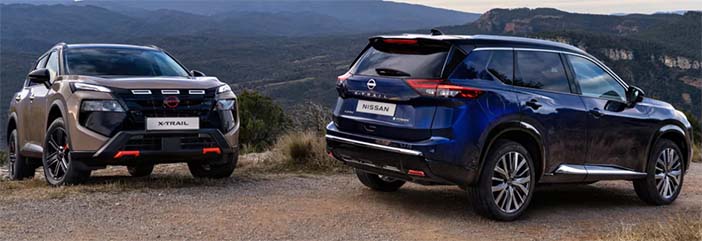
+++ The NISSAN X-TRAIL has been updated for 2026 with revised exterior styling, upgraded infotainment (from Google_ and a rugged new N-Trek model. Available to order soon, the revised Nissan X-Trail will only be offered with the brand’s e-Power hybrid system in either 2- or 4-wheel drive guises, producing 204 hp and 214 respectively. Headlining the changes is undoubtedly the revival of the N-Trek trim level which adds several off-road-inspired design upgrades, along similar lines to something like an BMW X1 xLine or Ford Kuga Active. While other refreshed X-Trail variants (Acenta, N-Connecta and Tekna) get a slightly wider version of Nissan’s trademark V-Motion grille, N-Trek models get their own rendition, complete with red badging. This sits above a more robust-looking bumper, also complete with red tow hook-like accents. If you’re sitting behind an X-Trail in traffic and you’re not sure whether it’s the new one or not, the 2026 versions can also be identified by new hook-shaped led taillights. The rear bumpers have seen a subtle nip-and-tuck, plus there’s now two new colours to choose from Sukomo Blue and Coastal Dune, as well as fresh alloy wheel designs. Equally as subtle as the exterior updates are those on the inside of the 2026 Nissan X-Trail. The standard infotainment system (with a 12.3 inch touchscreen) now has built-in Google connectivity, which includes Google Maps and Google Assistant. Other interior changes include an upgraded 360-degree camera which can help you peek around T-junctions, as well as the option of quilted chestnut brown leather. Nissan says it’s tweaked and refined its ProPilot Assist driving assistance features, too. As before, the Nissan X-Trail will continue to be offered in both 5 and 7-seat configurations, with a sliding second row to aid flexibility in the 5-seaters or access to the third row seats when they’re fitted. Boosting practicality further, the N-Trek model also gets CellCloth waterproof upholstery, as well as rubber waterproof mats in the boot and footwells. +++
++ RENAULT ’s next-generation Megane and Scenic are set to pack more than 700 km of range and 10-minute recharging, the company has confirmed. They are also set to embrace range-extender hybrid technology as well as pure electric power, with both drivetrains outlined in Renault’s next-generation technology blueprint revealed today. The big news is the confirmation of an all-new electric car platform, which will underpin mid-sized cars such as the next-generation Scenic and Espace. “Bigger cars are one of our priorities”, CEO Francois Provost told. “In the next mid-term plan we propose a new platform and solutions to continue our ambition to grow in the C-segment in the heart of Europe”. The new, hi-tech chassis is called RGEV Medium 2.0 and is expected in service around 2028. Highlights include an 800 volt electric architecture (twice the power of the current Tesla Model 3 and Y), which enables faster charging and reduced wiring to save cost and weight. Another breakthrough is a ‘cell-to-body’ construction, where the battery pack is a section of the car’s floor, as in current BYD and Tesla cars. Again this eliminates structure and reduces mass. The battery compartment will be highly modular, able to accommodate different-shaped pouch, prismatic and blade cells with 2 different chemistries. Renault is labelling them as ‘high-energy density’ and ‘affordable’, equivalent to today’s nickel manganese cobalt oxide (NMC) and lithium iron phosphate compositions, although the introduction of solid-state batteries could further extend choice over time. High-energy density vehicles will unlock high performance and that tantalising long range of up to 750 km, much like NMC does in premium EVs today. Renault also promises that 10-minute charging target will be offered with the ‘affordable’ batteries, too, with 800-volt electric architecture common to all ‘C’ and ‘D-segment’ cars. And those models will be a mix of SUV, saloon and MPVs, with RGEV medium 2.0 sufficiently flexible to underpin high-riding SUVs and low-slung hatchbacks and saloons. It’s also flexible enough to enable one-box ‘monospace’ vehicles with short noses and a front bulkhead that’s pushed forward, to maximise space in the cabin. That’s the silhouette that underpinned classic MPVs such as the original 1984 Espace and the 1996 Scenic. And with Chinese car makers set to bring MPVs to Europe, the French are getting ready to respond. Renault’s 2026 Strategy Day also formally announced the group’s embrace of range-extender hybrids (REx), or EV Range Extenders in Renault-speak. These feature an efficient combustion engine which acts as a generator to charge the battery, feeding an electric motor to provide propulsion. Nissan offers a REx in the ePower versions of the Qashqai and X-Trail (though it isn’t a plug-in and has a small battery onboard). Renault says its plug-in EV Range Extenders are targeting 1.400 km of range. That figure likely includes the vehicle setting off with its battery fully-charged from a wallbox. “Do we want serial drive or direct drive?” Renault brand CEO Fabrice Cambolive has said, musing on whether the engine would directly spin the wheels or act in a ‘series’ along with a battery and motor. “I think the logic is to go to serial drive, which means electric traction”. Offering a hybrid driving experience that feels close to an EV’s would dovetail nicely with Renault’s role as one of the electric pioneers in Europe. The group will tap its Horse powertrain joint venture with Geely for the REx drivetrain. Horse last year revealed a compact range extender which packages a 1.5-litre 4-cylinder engine, generator and inverter into the space of a briefcase. Developing 95 hp or 163 hp with a turbocharger and meeting upcoming Euro 7 emissions standards, Horse says the powertrain can be used to hybridise existing EVs, integrating with a vehicle’s existing electric motors. Renault is working on a new electric motor with 275 hp; a circa 25 per cent power bump over the 220 hp maximum in today’s Scenic. It can be deployed on the front or rear axles, and potentially paired together for all-wheel drive. The group will introduce the third-generation of its Electrically Excited Synchronous Motor with copper wiring, a design known for its efficiency and devoid of rare-Earth materials. Renault says the new motor is targeting 93 percent motorway efficiency. The new tech package will drive down costs: Renault claims the new motor will be 20 percent cheaper, while the RGEV Medium 2.0 is 40 per cent more cost efficient than today’s EV underpinnings. The new cars utilising this technology will be Software Defined Vehicles (SDV), Renault’s first passenger cars with this capability. The Trafic will introduce the Renault SDV concept, with superfast core computing systems delivering stepchanges in the user experience, over-the-air upgrades and connected features, plus advanced safety and driver-assistance systems. Provost has told that he will continue to invest in the RGMP small platform (standing for modular platform B- and C-segments), which underpins petrol/electric cars such as the Clio, Captur, Symbioz and Austral. These smaller cars are not tipped to be SDVs, continuing with their ‘domain control’ electronic architectures with segmented systems for cockpit features, driver assistance and so on, rather than them being united by a sophisticated SDV central nervous system. Renault plans to launch 22 cars in Europe in the next five years, with 16 of them being pure EV. And by 2030, Renault plans to phase out solely combustion engines in Europe, although hybrid engines will continue into the 2030s. +++
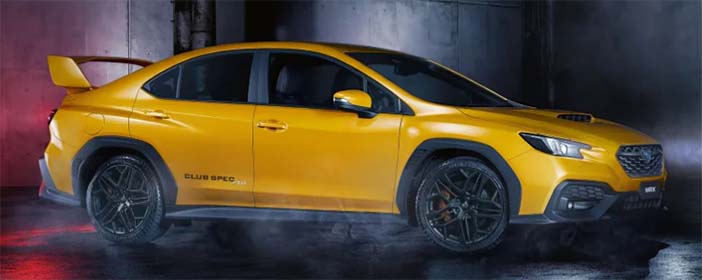
+++ The SUBARU WRX STI might seem like a distant memory for us here in Europe, but something very close to the iconic rally-inspired saloon is now available Down Under. Called the WRX AWD Club Spec Evo, this special edition takes the existing WRX not sold in Europe and gives it a proper STI-style makeover. The only things missing are the gold wheels. New for the Club Spec Evo model is a unique Sunrise Yellow paint finish that mimics iconic models like the STI Spec C from the early 2000s, complemented by matt-finish 19-inch alloy wheels, a high-mounted rear wing and contrast stitching inside. Under the bonnet, which still features a prominent scoop, sits Subaru’s turbocharged 2.4-litre flat-4 petrol engine matched to a 6-speed manual transmission. This produces 270 hp and 350 Nm of torque, giving a 0-100 kph time of around 6.5 seconds. The Club Spec Evo also takes many of its chassis upgrades from the Australian-market WRX Ts Spec B model, which adds in a few choice components familiar to the STI models of old. These include a locking differential on the rear axle, plus Brembo brakes, Recaro seats and even adaptive suspension. This generation of WRX has never made it to Europe, with tough emissions regulations and ever-faster hot hatchback rivals leaving the Subaru (and its historical Mitsubishi Lancer Evolution rival) out of favour. However, the flame has never gone out in Subaru-loving markets such as Australia and the US, where models like this still have their fans thanks to buckets of old-school charm, even though they’re not considered to be cutting-edge. Only 75 versions of the WRX Club Spec Evo will be produced, all of which will only be available in Australia. +++
+++ VOLKSWAGEN is preparing for Chinese brands to increase their level of threat to manufacturers in Europe, despite claiming minimal impact so far from the influx of newcomers. “It’s been abundantly clear for a while now that the Chinese manufacturers have identified Europe as a market for their products, they’re hardly making any money anymore in China because of the fierce competition there and the pricing pressure”, Volkswagen Group chief executive Oliver Blume told the brand’s annual results media conference this week. “In Europe, they can make good money with their vehicles, and the Chinese currently cannot export their products to the United States, so in that sense, that’s their main focus”. Blume said Volkswagen’s strong brand position across the various manufacturers within the VW Group puts it in a good place against new entrants, but while the impact to date has been low, with no “noticeable adverse effect” so far, he’s aware that the situation is likely to change. “European customers appreciate our brands, not only the brands, but the design, the quality of our service offerings that we have been building here for many years, but we have to be prepared for pricing pressure on us as well”, he declared. VW has been working on bringing down production costs across its brands, in order to negate the price pressure inflicted by Chinese manufacturers. The German giant delivered more than 8.8m cars in 2025, a 1.0 per cent drop on the previous year, and with five of Europe’s biggest-selling electric cars, Blume declared the brand to be the “clear leader” in EVs. VW Group’s electric car sales were up 66 percent in Europe last year, while in the US they were down 10 percent and in China down 8 percent, which the group’s chief executive said was “in line with expectations”. EV sales in South America, Asia (excluding China), and Africa and the Middle East were all up between 9 and 12 percent year-on-year. Blume also said the direct and indirect cost of tariffs to the group hit five billion euros last year. +++