
+++ An Italian coachbuilder wants to transform the ALFA ROMEO GIULIA QUADRIFOGLIO into a 2-seat convertible, complete with carbon-fiber bodywork and a very French-looking front end. The donor car is already one of the most distinctive sports sedans on the market, but Castagna Milano believes it can be even more special. The Italian coachbuilder has unveiled plans for a one-off, open-top version of the performance sedan, reimagining it as a two-seat grand tourer with radically redesigned bodywork. There’s just one catch: The proposed front end looks suspiciously like something Peugeot might have designed. Those fang-like daytime running lights are hard to ignore, and once you spot the resemblance to the French brand’s styling, it’s difficult to unsee it. Of course, the rest of the car goes well beyond a simple styling exercise. Castagna Milano envisions a bespoke creation with extensive carbon-fiber bodywork, a dramatically elongated hood, and proportions that bear little resemblance to the aging-but-still-excellent sedan underneath.
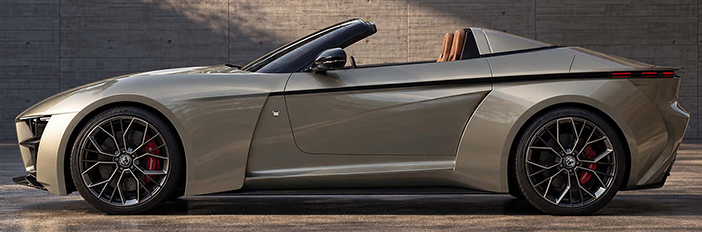
The transformation would involve moving the front seats 330 millimeters farther back to make room for a much longer hood. The redesigned hood would sit 40 mm lower than the standard item and feature a large exposed carbon-fiber section. At the front, angular, Y-shaped elements would create brake-cooling ducts while partially concealing the headlights. Castagna Milano would also widen both tracks to match those of the hardcore Giulia GTAm and add pronounced fender extensions. At the rear, a cutout beltline would sweep around the body and incorporate the taillights. A diffuser and active rear spoiler would complete the look, giving the bespoke convertible a more aggressive stance than the standard Quadrifoglio. As you’d expect from a coachbuilt special, the cabin would receive its own treatment. Castagna Milano proposes wood trim, 2 types of leather and new glass all around. Despite losing its fixed roof and rear seats, the car would reportedly offer 623 liters of luggage space with the fabric top folded away.
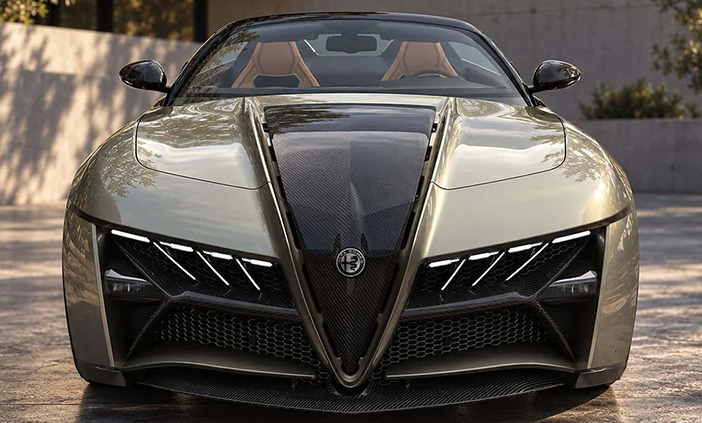
The coachbuilder is also targeting a surprisingly low weight of just 1.420 kilograms. That would make the proposed convertible lighter than many conventional sports cars, although we’ll have to wait for a real car to see whether it meets that target. Under the long hood, the Giulia would retain Alfa Romeo’s familiar 2.9-liter twin-turbo V6. Castagna Milano hasn’t announced any changes to the engine’s output, but it promises a longer final-drive ratio to make cruising more efficient. In other words, this would be a grand tourer rather than an all-out track special. For now, Castagna Milano’s Giulia Quadrifoglio cabriolet exists only as a digital design proposal. The coachbuilder needs to find a customer with deep pockets and a genuine appreciation for Alfa Romeo to commission the one-off project.
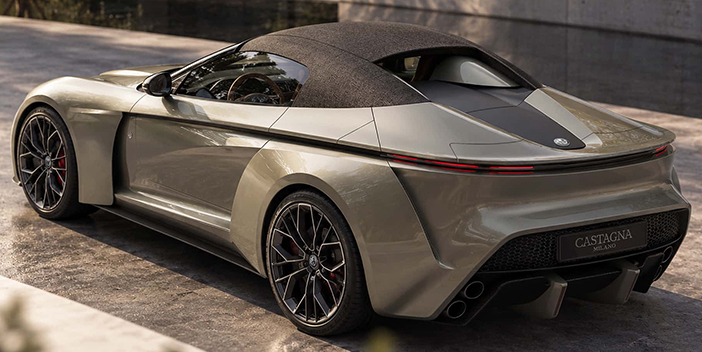
The company also sees the car as a statement about independent coachbuilders at a time when automakers increasingly handle personalization and design in-house. Whether this proposal becomes reality remains to be seen. Still, the idea of a lightweight, carbon-bodied Giulia convertible with a twin-turbo V6 sounds appealing on paper. I’m just not entirely convinced by the Peugeot-inspired face. If the project goes ahead, let’s hope the final car looks more unmistakably Italian than French. It also makes us wonder why Alfa Romeo didn’t expand the Giulia family with a coupe, a convertible, or even a wagon to take advantage of economies of scale. It’s too late for that to happen with the current generation, but coachbuilders are happy to fill the void for the right price. Case in point, Castagna Milano isn’t the first company to see an opportunity to make the Giulia far more exclusive. Back in 2022, Zagato unveiled the Giulia SWB Zagato, a striking 2-door coupe developed to celebrate the design house’s long relationship with the Italian automaker. Unlike Castagna Milano’s proposed convertible, the Zagato was a shortened, fixed-roof coupe with bespoke bodywork and a more traditional grand touring silhouette. It was based on the Quadrifoglio platform and featured the same twin-turbo V6, while also drawing inspiration from the high-performance Giulia GTAm. The 2 projects take very different approaches to the same idea: using Alfa Romeo’s sports sedan as the foundation for a low-volume, coachbuilt special. Zagato went for a dramatic coupe, while Castagna Milano wants to cut off the roof and create a 2-seater with a much longer hood. You won’t find either in an Alfa Romeo configurator, and that’s precisely the point. These bespoke creations target customers willing to pay for something far rarer than a standard production car. +++
++ BMW ’s electric 3 Series Touring is getting closer to reality, with a new spy video capturing the i3 Touring testing ahead of its expected debut next year. As the first electric 3 Series Touring, it will bring a completely fresh design language to a long-roof body style, giving buyers a practical alternative to the seemingly unstoppable SUV invasion. The prototype was spotted testing near the Nürburgring, wearing camouflage at both ends. However, the disguise hides little now, suggesting BMW is getting closer to the final design. Logic tells us the front end should look virtually identical to the i3 Sedan, as BMW will likely carry it over to keep costs down. The changes occur from the B-pillar rearward to accommodate the longer roof and redesigned tailgate, giving the wagon its own identity. But before the wraps come off, our rendering imagines what BMW is hiding beneath its typical black-and-white swirly camouflage. Judging by the spy video, the rear window no longer appears to open independently of the tailgate. That’s hardly a surprise, since the bigger 5 Series Touring has also lost this feature. When that happened, the company told us it wasn’t a cost-cutting measure, but a decision made for aerodynamics. When the i3 Touring arrives next year, it’ll borrow nearly everything from the i3 Sedan, including a 17.9-inch central touchscreen and the pillar-to-pillar projection at the base of the windshield. The so-called Panoramic Vision replaces the traditional instrument cluster with 3 fixed tiles in the driver’s line of sight, joined by six customizable widgets to the right. There’s also a new optional 3D head-up display, but the traditional iDrive knob is dying with every new model BMW launches. Range will be another major selling point, especially since wagon owners tend to take longer trips. The i3 Sedan can travel up to 912 kilometers on a full charge under the WLTP cycle. However, the Touring will likely fall short because of its slightly higher weight and marginally less aerodynamic body. Nevertheless, the quoted range should help put any lingering range anxiety to rest. The sedan’s rapid-charging capability of up to 400 kW should carry over, making the i3 Touring a compelling option for buyers who want an electric car without sacrificing the practicality of a traditional estate. Under ideal conditions, the sedan can replenish its battery in just 10 minutes with enough energy to cover 400 kilometers under the WLTP cycle. The electric Touring isn’t the only reason for traditional BMW fans to pay attention. Munich is also considering a combustion-powered successor to the current 3 Series Touring, which would share much of the i3 Touring’s styling while using a different platform. Internally known as the G51, the conventional wagon hasn’t been greenlit yet. Well, at least we don’t know of it. If approved, it would use BMW’s CLAR architecture and offer gasoline and hybrid powertrains. Diesel is on its way out of the 3 Series lineup, especially since BMW dropped oil-burners from the new sedan, and it wouldn’t make much sense to bring it back just for the Touring. As automakers increasingly steer buyers toward crossovers, it’s refreshing to see BMW invest in another wagon. The i3 Touring won’t need an X in its name to offer the space families want, and it could prove that going electric doesn’t mean giving up on the traditional BMW estate. Hopefully, ICE loyalists will get one more 3 Series generation with combustion engines, ideally including the inline-sixes for long-roof versions of the M350 and M3. BMW’s Touring line-up will get another refresh in 2027, when the 5 Series/M5 Touring and electric i5 Touring receive mid-cycle facelifts. It’s safe to say that Munich is doubling down on long-roof models at a time when SUVs dominate the market. It’s a welcome move for those who still prefer a traditional wagon over a high-riding crossover. +++
+++ The CHERY TIGGO X7 has arrived as a tougher, more adventurous alternative to the standard Tiggo 7. The first in a new line of ‘Tiggo X’-branded soft roaders, the Tiggo X7 is much boxier than its sibling. Dominating the car’s front is a unique grille with a body-coloured panel, plus a pair of rather angry-looking headlights and recovery hook-inspired trim pieces.
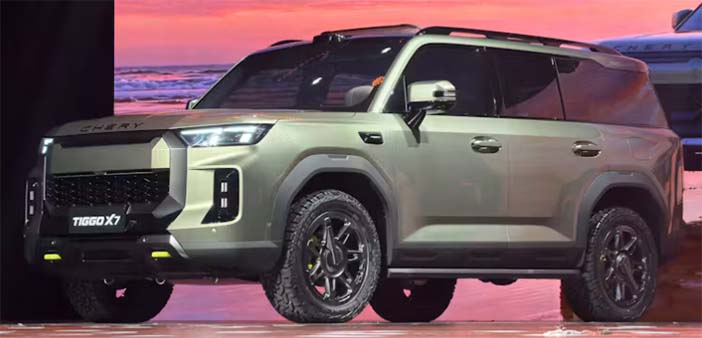
Plastic body cladding surrounds the bumpers and wheelarches, while the X7 swaps the standard Tiggo 7’s rear light bar for more traditional C-shaped LED tail-lamps. Inside, the X7 gets the same landscape touchscreen and digital instruments as the facelifted Tiggo 7. The electric seat controls are on the doors, as well as a rectangular ambient lighting element. Just like the Tiggo 7, the X7 only offers seating for five people, slotting below the seven-seat Tiggo 8 in the line-up. What will power the Tiggo X7 hasn’t been revealed, however, it’s safe to assume it’ll get the same petrol and plug-in hybrid powertrains as the standard Tiggo 7. But we do know the Tiggo X7 will be much more capable; Chery says its so-called “family comfort exploration SUV” will have 6 off-road-specific drive modes: Snow, Mud, Sand, Rocks and Water Wading. The Tiggo X7 also gets a raised ride height, plus chunky off-road tyres. A maximum towing capacity of 1.500 kg is 200 kg less than the Tiggo X7’s sister car, the new Omoda X, which is claimed to boast a maximum wading depth of 700 mm. Pricing for the Chery Tiggo X7 has yet to be finalised, nor has it been confirmed when it might come to The Netherlands. +++
+++ EUROPE ’s combustion-engine reprieve is taking shape, but the latest proposal goes further than the European Commission’s original plan. A new agreement between lawmakers would give automakers more flexibility to keep selling ICE-powered vehicles after 2035, marking another retreat from the bloc’s original, and rather unrealistic, zero-emissions target. The compromise, reached by representatives of the European People’s Party (EPP), the Socialists and Democrats (S&D) and Renew Europe, would require automakers to reduce average CO₂ emissions from new cars by 87.5 percent compared with 2021 levels by 2035. That’s less stringent than the European Commission’s proposal from last December, which called for a 90 percent reduction. The new arrangement would allow manufacturers to use credits for low-carbon steel produced in the EU to offset part of their emissions obligations. This would effectively preserve room for combustion-engine and hybrid vehicles beyond 2035. However, the final rules would determine exactly how many and what types of vehicles could remain on sale. It’s an important distinction from last year’s announcement. While the Commission’s December 2025 proposal already backed away from the original 100 percent emissions-reduction target, the latest parliamentary compromise would loosen the proposed requirements further. Under the rules adopted in 2023, the EU set a highly controversial 100 percent reduction target for CO2 emissions from new cars and vans by 2035, effectively ending the sale of new tailpipe-emitting vehicles from that point onward. Existing gasoline and diesel cars would not have to be taken off the road. After sustained pressure from automakers and governments, particularly Germany and Italy, the European Commission proposed a softer approach in December 2025. Instead of requiring a complete reduction in average fleet emissions, it proposed a 90 percent cut from 2021 levels, with the remaining 10 percent offset through measures involving low-carbon steel and renewable fuels. That proposal would have allowed some plug-in hybrids, range-extender vehicles, and other combustion-engine models to remain on sale, provided manufacturers met the applicable emissions requirements and compensation rules. The latest compromise takes a different route. Instead of retaining the proposed 90 percent reduction, lawmakers have agreed on an 87.5 percent target for cars, with credits for EU-produced low-carbon steel accounting for up to 7.5 percentage points. In other words, the deal would give carmakers more room to comply with the rules while supporting Europe’s domestic steel industry. The framework seeks to balance the automotive sector’s calls for greater flexibility with efforts to maintain European manufacturing and reduce industrial emissions. The distinction matters because the December 2025 announcement was a European Commission proposal, not a finalized replacement for the existing legislation. The October 2026 agreement is another step in the legislative process, with lawmakers seeking to further loosen the proposed requirements. Although the latest compromise would weaken the effective phase-out, it wouldn’t give automakers unrestricted permission to sell gasoline and diesel cars indefinitely. The emissions targets apply to a manufacturer’s new-vehicle fleet average rather than setting a universal emissions limit for every individual model. Automakers would therefore have to balance higher-emitting vehicles with lower-emission alternatives and comply with the final calculation and credit rules. That could give plug-in hybrids, range-extender EVs, and other combustion-engine vehicles a longer future in Europe. However, the extent of that opportunity would depend on the final regulation, the credits available, and each manufacturer’s fleet emissions. EVs would remain central to automakers’ efforts to meet the requirements. The compromise would leave more room for other powertrains than the original 100 percent reduction target allowed. The agreement also proposes a 55 percent reduction in average car emissions by 2030, while the target for vans would fall to 35 percent. The Commission’s earlier proposal had set a 40 percent reduction target for vans. The compromise would also allow additional flexibility through multi-year compliance arrangements and credits for certain efficient or smaller electric cars. The latest agreement is not the end of the legislative process. The participating parliamentary groups must formalize their position, after which the European Parliament and EU member states will need to negotiate the final legislation. Until that process is complete, the existing 2035 emissions target remains the legal baseline. Automakers can prepare for a more flexible framework. Still, they cannot yet treat the compromise as a guarantee that every type of combustion-engine vehicle will remain on sale after the deadline. For Europe’s automotive industry, the direction is becoming clearer. The EU is moving away from a strict zero-emissions requirement toward a framework that allows continued sales of some combustion-engine vehicles while maintaining pressure to reduce fleet emissions. The difference between December 2025 and October 2026 is more than a change in wording. The Commission first proposed a 90 percent reduction target with compensation mechanisms. Lawmakers have now backed a lower 87.5 percent reduction requirement for cars, with credits tied to low-carbon steel produced in the EU. That doesn’t mean Europe’s transition to electric vehicles is over. It means the rules governing how quickly combustion engines disappear from new-car showrooms are still being renegotiated. +++
+++ As the entire American market for electric cars recalibrates in dramatic fashion, GENERAL MOTORS wants you to know it still sees electric cars as the future. During GM’s Forward event in New York, GM President Mark Reuss reiterated that the company is not giving up on EVs. Rather, it’s coming back stronger with cars that are better tailored for the realities of our EV market. “We’re a global company. 1 of every 4 vehicles sold around the world is an EV and that number is only rising”, Reuss said. “We’re not walking away from that. We’re embracing it. We continue to develop our future EVs and work to reduce battery costs. And when the U.S. market is ready for EVs in large numbers, we will be there for them. The investments we’re making in battery technology, EV platforms, software, energy management and advanced manufacturing are investments in an electric future”, he said. “They demonstrate that GM is committed to EVs for the long term, even as we give customers choice today”. At the event, GM laid out a vision that includes heavily updated EVs and more high-tech combustion vehicles too. The company touted shorter development times, software-defined vehicles with more powerful compute architectures and a 4th generation EV platform that will underpin a range of crossovers down the line. Details about the platform are still scant, but GM says it is designed for mainstream adoption and uses its lower-cost lithium manganese-rich (LMR) cells. GM has positioned LMR cells as key to reducing costs for both manufacturing and buyers. It says the cells can cost about the same as lithium-iron phosphate (LFP) batteries, while offering energy density that rivals high-nickel batteries. The new vehicles, GM says, will need 20% less battery than its previous ones and will weigh less too. The new platform will also use a centralized computing platform. In the U.S., EV sales have faltered over the last year after the EV tax credit disappeared and pro-EV regulations were axed. General Motors spent years building out a broad line-up of EVs and it hasn’t been spared in the new more difficult environment. Chevrolet EV sales have been roughly cut in half so far this year, while electric Cadillac sales are down about 10%. The results are clear. Petrol pick-up trucks and big SUVs are back in focus for GM, the Bolt is ending production with fewer than expected units produced, and Honda’s variants of GM’s Ultium cars are dead. But the powertrain is only gaining ground globally. EVs made up around 30% of car sales in Europe in September. In some European countries, new EV sales are already outpacing combustion vehicles. GM knows this well from operating in China, where electrified vehicles are vastly more popular than petrol-powered ones. It sees the writing on the wall: EVs will only become more significant over time, despite the choppy waters in the U.S. right now. GM didn’t announce a timeline for its 4th-generation EVs at GM Forward, but Reuss said they should launch “very shortly”. +++
+++ MERCEDES-BENZ has drawn a line around its smaller G-Class, and it is a wide one. Mercedes-AMG CEO Stefan Weckbach said this week that the compact off-roader will not be chasing the same buyer as the original. “We will make sure that the little G-Class will target a different segment”, Weckbach said. Mercedes-Benz CEO Ola Källenius said in an interview published in October 2024 that the smaller truck should arrive in less than 24 months and he repeated that 24-month timing again in a new interview 6 days ago. That points to an expected debut around 2028. Weckbach was blunt about who the Little G is for. It will not target “the real G customer”, he said, separating the smaller model from the buyer who walks into a Mercedes showroom wanting the full-size G-Class and nothing smaller. Analysts see the Little G as Mercedes’ answer to compact luxury off-roaders, and a smaller G-badged SUV gives the brand a lower entry point while the larger G-Class stays at the top of the range. Källenius has been equally clear that the 2 SUVs are not meant to compete with each other. He has spoken with evident pride about the G-Class’s off-road pedigree, name-checking the Schöckl test mountain in Austria where the brand puts every G through its paces. “There is only one car in the world that can do that, and that is the G”, Källenius said, describing descents of 60 to 70 kilometers per hour on that mountain. The Little G isn’t being built to match that benchmark. Even with a different target buyer, Mercedes wants the family resemblance intact. Weckbach described a vehicle that borrows “some of the larger vehicle’s G-Class genes” rather than functioning as a shrunken copy of the original body-on-frame truck. Källenius promised “very good off-road capability” for the smaller model. Reported development work centers on suspension geometry, wheel dimensions, and axle articulation. Those are the pieces that actually determine how a vehicle handles broken terrain. The powertrain story has shifted too. Weckbach’s predecessor, Michael Schiebe, confirmed the Little G will offer both combustion and electric versions after North American dealers pushed hard for a petrol option on top of an electric version. Several test mules have already been spotted wearing camouflage, and Mercedes is reportedly pursuing production in Hungary rather than at the German plant that builds the full-size G-Class. Mercedes and AMG executives have outlined a lineup with combustion and electric powertrains, hinting at a turbocharged four-cylinder gas engine and a dual-motor all-wheel-drive EV. They have not detailed specific engines or confirmed any direct carryover from the GLA’s engine line-up. +++
+++ MG will go after the Renault 5 next year with a production version of its funky Go electric supermini concept, which will be built at its new Spanish factory from 2028. In June, MG parent company SAIC Motors announced plans to build its first European factory, and sources have revealed that the site will begin assembling the Chinese firm’s new electric supermini in the next 2 years. MG’s first European-built model since assembly finished at Longbridge in 2016 has been referred to widely as the MG 2, but sources suggest the Go name is set to remain for production.

Due on sale around September next year, it will share its E+ platform with the new front-wheel-drive 4 EV Urban and remain close in appearance to the concept, which was designed at MG’s London studio. The small MG takes a similar retro-futuristic design approach to its Mini and Renault rivals and is set to match them closely on specification too. At around 4.0 meter long, it’s set to use the 4 EV Urban’s 152 hp motor and 43 kWh lithium-iron-phosphate battery. Pricing is expected to start at around €22.500 in The Netherlands, compared with a €25.495 starting price for the 4 EV Urban. MG will no doubt look to match the aggressive pricing of the Geely EX2 and the forthcoming Leapmotor B03, which will also be built in Spain from 2028. During the initial phase, SAIC plans to build 70.000 vehicles per year at Ferrol from late 2028. Given the factory’s stated maximum capacity of 120.000 cars a year, a second model is likely to join the assembly line later. MG is one of several Chinese car makers moving to build European-market models within the region, to get around the EU’s import tariffs on Chinese-built EVs. Spain has become their preferred destination, thanks to competitive labour costs and government incentives. Geely has chosen Ford’s Valencia plant, Leapmotor is using Stellantis factories in Madrid and Zaragoza, while Chery operates the former Nissan site in Barcelona. SAIC has selected the port of Ferrol in the north-west, which already serves as the European entry point for MG models shipped from China. The firm’s Spanish investment is strategically important, as SAIC faces the highest tariff imposed on any Chinese manufacturer : 35.3%, on top of the standard 10% import duty. As a result, SAIC’s European EV sales have declined, while its hybrid and plug-in hybrid models have gained ground. In response to the expected fresh influx of Chinese-made vehicles, the EU recently raised the prospect of tariffs on Chinese hybrids unless Beijing limits annual exports to 15% of the market. “The plan is to begin construction of the Ferrol site in 2027 and have the factory operational before the end of 2028”, MG regional president Alfonso Rueda said in June. The 100.000 m2 factory is expected to create 2.000 jobs, including 1.000 direct roles. It made headlines in August when the Spanish Navy, whose warships are based in Ferrol harbour, raised concerns over potential Chinese espionage risks. While construction of the factory will begin in 2027, SAIC has already started work in As Pontes de García Rodríguez, some 40 km from Ferrol, to establish its parts-supply logistics. To speed up the launch, the first cars will be assembled from late 2028 using completely knocked-down kits, rather than semi-knocked-down kits, shipped from China. Initially the Ferrol site won’t include stamping, body-in-white or paint operations. +++