
+++ This year marked the beginning of a new era for ALPINA as it became an official part of the BMW Group, and its first product under the new regime has now been spotted for the first time. As promised, it’s based on a 7 Series, though whether it will be called B7 like previous Alpina-fettled 7ers remains to be seen. What is clear is that the Alpina 7 will have several distinctive styling features that set it apart from what is already an incredibly luxurious car in the 7 Series, and as confirmed by BMW, it will have a V8 engine, likely with more power than the M760 xDrive. The rear of the BMW Alpina 7 Series/B7 looks almost identical to the regular 7 Series, but it features Alpina’s trademark oval tailpipes, and the bumper may be changed for something a little different. Meanwhile, the taillights have a clear smoked effect that appears to be a little sportier than standard. In profile, there’s also little to talk about (we see a complex wheel design, but a modernized version of Alpina’s traditional 20-spoke design is expected to appear for production), but up front, a few key changes are worth mentioning. While Bimmers enhanced with M Performance now gain access to M Yellow Lights, the Alpina 7 Series has amber daytime running lights, which were also seen on the Vision BMW Alpina concept shown off a few months ago. This suggests that amber lighting highlights are likely to become a signature styling element of all Alpina products going forward. Another notable change can be seen in the front grille, which now has only 3 horizontal vanes compared to the 7 slats seen on the regular 7 Series. The lower intake has also been redesigned, with a more upright opening creating a slightly more aggressive aesthetic. BMW knows it can only sell a more luxurious version of the 7 Series with a V8, and a downgrade from what’s come before is unlikely to be well received. Thus, it’s expected that the twin-turbocharged 4.4-liter V8 engine in the M760 will be boosted beyond its current 563 hp rating, likely nearing the 600 hp figure of the last 7 Series-based B7 (2016-2022). Inside, we can expect only the finest materials and likely unique graphics for the digital interfaces, but a full reveal is only likely to happen early in 2027. Later next year, the X7 will also get the Alpina treatment to become the XB7. +++
+++ The ultimate driving machine no longer needs you to be the ultimate driver. BMW says that its cars will be able to handle intersections, roundabouts and anything a city can throw at them, all without your help, starting in 2027. BMW’s existing Highway Assistant driver assist technology can steer, brake and accelerate the car by itself, as well as change lanes on highways while allowing drivers to take their hands off the wheel.
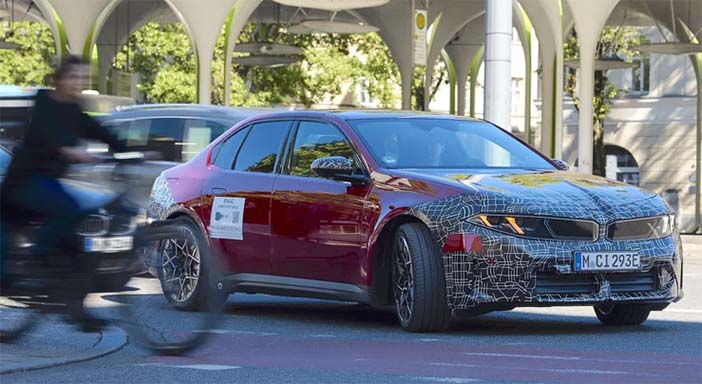
It can also stop at red lights and pull away when the lights turn green. But starting in 2027, the system gets even smarter with BMW Symbiotic Drive. New skills available when BMW Maps is active include urban lane changes, yielding to traffic that has the right of way, and tackling roundabouts. BMW says that these new capabilities work together with the existing system to allow for traveling from a freeway network through country roads and into a city, all without touching the wheel. Germany is first to get the new system, but other countries are slated to follow. The hardware required to make Symbiotic Drive work is already built into the latest BMWs, including the iX3 and iX4, the new X5, new 3 Series and the facelifted 7 Series. Each of those vehicles has BMW’s Panoramic Vision display at the base of the windshield, which will give drivers information about the status of the assistance and the upcoming automated maneuver on the touchscreen. Although the hardware needed to make the system work will be fitted as standard, it will require an OTA software update to activate. That could cost extra and may take the form of a monthly subscription, though BMW hasn’t explicitly said so. BMW’s new driver assist software could help relieve the tedium of city driving, while still leaving you free to enjoy country roads. But don’t go thinking you’ll be able to doomscroll while commuting to work, or finish that presentation you forgot to finish. You still need to keep your eyes on the road (a camera will make sure you do) even if your hands aren’t on the wheel. Get distracted and the car reverts fully to your control. That’s because the system is only rated at Level 2 (L2) under the framework established by the Society of Automotive Engineers, with Level 0 being no assistance and 5 being fully self-driving. Ford’s BlueCruise and GM’s Super Cruise are also ranked as L2 systems, although GM is gearing up to deliver something more advanced on the Cadillac Escalade IQ due in 2028. BMW has previously offered a Level 3 system, as did Mercedes. Cars like the 7 Series and S Class, when optioned with the right equipment, would let you hand-off driving duties to the car on select routes. Emails, Netflix, and video games while traveling at 60 mph were all possible. But both automakers have temporarily pulled back from L3 tech due to the cost of the lidar equipment needed to make it work, and poor customer uptake. BMW thinks this new L2 tech will be more useful to drivers, while costing less money. +++
+++ The automotive industry has faced significant challenges this year, including growing competition from China, U.S. tariffs, and volatile fuel prices. Against this backdrop, it’s perhaps no surprise that most automotive brands saw their estimated BRAND VALUE decline in Interbrand’s 2026 Best Global Brands report. Ferrari, however, was a notable exception. Ferrari’s estimated brand value rose 14.7% to $17.7 billion, allowing the Italian marque to climb three places to 51st among the top 100 global brands. That’s enough to earn recognition as one of the report’s Top Risers and bragging rights over its rivals in the automotive sector. Aside from Ferrari, only Hyundai (+1.6%), Kia (+2.7%) and BYD (+4.5%) posted increases among the auto brands in the top-100, while 9 others, including Toyota (-19.9%) and Tesla (-37.8%), recorded declines. According to Ferrari, the gain reflects the effectiveness of its overall strategy across its “three souls”: racing, sports cars and lifestyle. The racing part could partly be attributed to Formula 1, which has grown in popularity, even in the U.S., where the open-wheel racing series holds 3 Grand Prix weekends each season. Ferrari has also diversified its road-going vehicle offerings, which now include the electric Luce, unveiled earlier this year to a polarizing reception, largely due to its design. Still, the mixed reaction comes as the brand continues to enjoy strong growth in its estimated value. The automaker also offers an SUV with the Purosangue while retaining a traditional naturally aspirated V12 in the 12Cilindri, even as the industry increasingly embraces engine downsizing and hybridization. Next year is also looking bright for the Prancing Horse brand, as its order book already covers all of 2027. At 51st overall, Ferrari ranks 7th among automakers in Interbrand’s report, one of the world’s most established brand valuation rankings. Toyota (9th overall) remains the top-ranked automaker with an estimated brand value of $59.5 billion, followed by Mercedes-Benz (20th overall) and BMW (22nd overall), with $40.8 billion and $38.4 billion, respectively. Apple is the overall leader with an estimated brand value of $514.6 billion, representing 9.3% growth. Microsoft ($443.7 billion) and Google ($389.3 billion) complete the podium, ahead of Amazon ($351.8 billion) and Samsung ($105.2 billion). Nvidia ranks 6th with an estimated brand value of $74 billion. The American technology company also has a growing presence in the automotive industry through partnerships with automakers like General Motors to develop advanced vehicle software and driver-assistance systems. +++
+++ You don’t always need an overtly sporty car to enjoy great driving dynamics. Even regular cars can be fun behind the wheel, bringing some joy to one’s everyday commute. Some shining examples include the Mazda3 and Honda Civic, while moving up the price bracket, you have compact executive sedans like the Alfa Romeo Giulia and BMW 3 Series. Still, the list isn’t long enough, reckons KIA , as its chief ride and handling engineer for Australia, Graeme Gambold, said driving enthusiasts are being overlooked. He also mentioned that technology, while good, has been taking away the fun element in cars. Gambold expressed his frustration towards some driver assist technologies. “It’s really hard to find a car that drives nicely. It’s really hard to find a car that has all the features but none of the safety intervention, as I don’t need it”, he said. Now, that’s a pretty bold statement from a company chief, especially since automakers are committed to advanced driver assist technologies. He’s not saying that those should be banned altogether, as there have been instances wherein these were genuine lifesavers. Instead, it’s the intrusiveness of these systems that annoys instead of giving joy. Gambold was also asked if fun cars are a dying art. While he said it wasn’t necessarily the case, he stated that current market priorities have put enthusiasts aside. It’s one of the reasons why Kia (along with Hyundai) still has ride and handling tuning divisions in its major markets. In an age where everyone is trying to shave chunks of cost, the South Korean automaker is more than willing to spend on catering its chassis to specific markets. Right now, the main priority seems to be pushing out new models at lightning speed. It’s something that the Chinese market has effectively pressured legacy automakers to do, particularly in the fields of technology and electrification. But while higher-end models come with tricky suspension arrangements, one has to wonder how these cars would actually fare without these. It’s possible that electronics could be masking what are, otherwise, shortcomings in basic chassis tuning. That’s the rub of the more widespread availability of active and adaptive suspension systems. While it’s good that the trickle-down effect has made these reasonably-priced options, it does make chassis engineering more tech-dependent, which also adds a layer of complexity to any vehicle. As China has effectively pressured the world into developing cars faster, and a majority of car buyers simply want point A to B transport, it doesn’t really encourage automakers to add a little zing to their mass-market models. Of course, there may come a time when cars can be completely software-defined. Many automakers aren’t exactly shy about going in that direction. Still, at least we know some brands still see value in proper chassis tuning and calibration rather than just letting active systems and software development do a good chunk of the work. +++
+++ Generally, a car’s bodywork is made from steel, aluminium, carbon fibre or plastic, or a mix of those. Copper, though, is a new one on us. The car to have such a construction is the one-off GFG Style PERALTA D . You might not have heard of the brand, but you will probably recognise the surname of the chap who styled it: Fabrizio Giugiaro. He’s the son of Italdesign founder Giorgetto Giugiaro, whose CV includes another car made from an unusual material: the stainless steel DMC DeLorean.
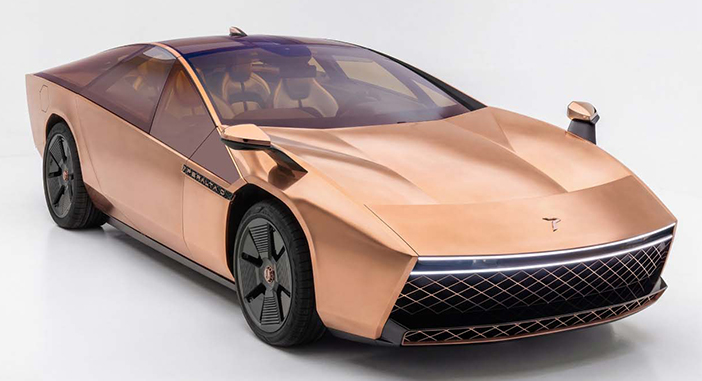
The Peralta D follows up another one-off, the Maserati MC20-based Peralta S, with both cars taking their names from the entrepreneur and collector who commissioned them, Carlos Peralta. The ‘S’ designation from the first creation was in dedication to Peralta’s sons, with the D in the newer car standing for ‘donne’, the Italian word for women, in tribute to his daughters. Once again, a Maserati is used as a base, but this time it’s the front-engined GranTurismo. No specifications are given, but the presence of an exhaust system suggests it’s the petrol-powered version of the car, rather than the all-electric Folgore. That means it’ll have up to 550 hp available from a twin-turbo V6. With copper not being an especially light material, it’ll likely be a fair bit slower than the car it’s based on. On top of the Gran Turismo’s aluminium chassis is a carbon fibre structure that supports a series of hand-hammered copper panels and mirrored glass. There’s a definite seventies vibe to the whole affair, and GFG cites the decade as inspiration for the geometric pattern on the wheels.
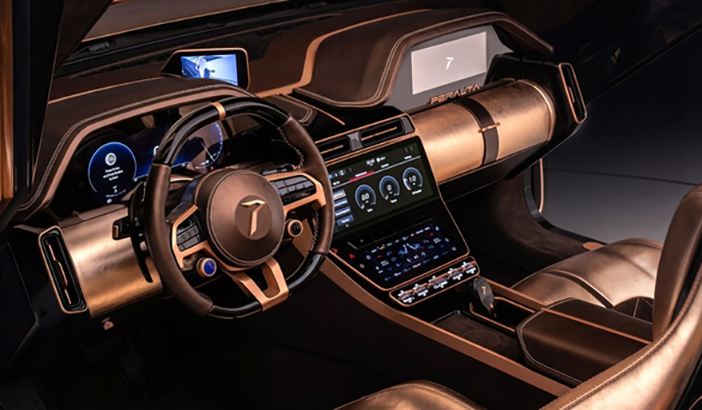
The cabin can’t fully hide its Maserati origins, but GFG has certainly had a go, with a lurid mix of copper and brown upholstery. There’s even an illuminated vanity mirror for the passenger, and a champagne holder. Fabrizio Giugiaro, who previously had a stint as Italdesign’s director, said this of the new creation: “The Peralta D was born from the positive energy and creative synergy established with Carlos Peralta during the development of the Peralta S. We wanted to build on that stylistic journey by exploring the expressiveness of a fascinating and complex material like copper. “The challenge was to combine a minimalist aesthetic (characterised by clean lines and elegant details) with cutting-edge functional solutions to create a true 2+2 Gran Turismo coupé”. Inevitably, there’s no mention of how much Mr Peralta paid for all this. Our guess is that it’s a figure best described as ‘a lot’. +++
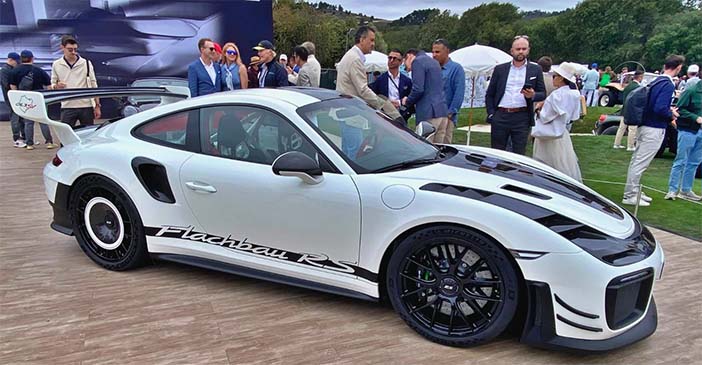
+++ PORSCHE is leaning into high-end, expensive, and exclusive models to drive its future profits, with plans that go far beyond the new Mission S supercar. The German automaker has confirmed it will aim to raise the average sales prices of its vehicles, with a particular focus on the 911 and bespoke, one-off projects akin to the new Flachbau RS. This approach is expected to be an important profit driver. According to Porsche’s vice president for product and individualization Alexander Fabig, Porsche already has 15 of these projects on the cards, with prices that start at $1.8 million and stretch to an eye-watering $15 million. “Additional few-off offerings will play a key role”, Fabig said. “It is the next step in Porsche’s proven strategy of turning exclusive niches into highly profitable businesses”. The one-off Flachbau RS gives us with an idea of what Porsche is planning. This car is based on a 2018 911 GT2 RS with the Weissach Package and has been transformed into a machine inspired by the iconic 1978 Moby Dick race car. There’s no word on how much this car cost, though it would obviously have been extraordinarily expensive.
In mid-2025, Porsche presented the 963 RSP, perhaps its most remarkable one-off built to date. This car was built for motorsport legend Roger Penske, is based on the 963 Le Mans prototype, and takes inspiration from the legendary Porsche 917. Porsche’s vice president for product and individualization, Alexander Fabig, used the new 911 GT3 S/C as an example of what the brand can do with the beloved 911. In that case, it costs roughly 95% more than a standard Carrera, and that’s just the start. “We are not done yet”, Fabig said. “Future projects could exceed a 200 percent price premium over the base model”. Porsche also has a factory recommissioning and restoration program that should further bolster its profits. The automaker has updated and restored 11 examples of the iconic Carrera GT, charging up to $784,000 for the modernizations. Fabig says Porsche is already working on 16 others and has 21 units in the pipeline. +++
+++ Think you know mid-size RENAULT cars? Think again. The French brand is set to transform models such as the Megane, Scenic and Rafale with a cutting-edge new architecture featuring sporty dynamics and long-distance ranges, at affordable prices. Engineers at Renault’s Paris Technocentre are hard at work on the new RG EV Medium 2.0 platform, to hit the deadline of launching the first car in 2028. It’s a flexible platform that can underpin vehicles from 4.3 to 4.8 metres in length. That puts it bang in the heart of the family car ‘C-segment’ for the Megane and Scenic, as well as ripe for replacing bigger flagship vehicles such as the Rafale and Espace. The wheelbase measures 2.85 metres long to ensure plenty of cabin space. Power will come from pure electric and range-extender (REx) engines, with an efficient combustion motor acting as a generator to power an electrified drivetrain. Renault promises a minimum 750 km range for the EVs and a whopping 1.400 km capability for REx models, to ensure buyers migrating from diesel cars aren’t disappointed. More headline news comes with the switch to rear-wheel drive, to cope with a big bump in power. A single motor will produce 275 hp and 350 Nm of torque, and there will be all-wheel drive versions. Expect more exciting and dynamically sharper Renaults as a result. “Front-wheel drive is a problem for driveability, ride and handling; it was very difficult to tune the current Scenic and Megane”, Renault’s technology boss Philippe Brunet told me. Rear-wheel drive also helps with packaging: the power electronics can be housed under the rear seats, with the reduced amount of wiring helping to cut costs. Renault has confirmed the RG EV Medium 2.0 will underpin the next Scenic and Rafale, and the company is thinking deeply about how to replace the famous Megane. Insiders admit the current E-Tech has underachieved due to its compact, 4.2 metre-length, initially modest electric range and unusual, high-riding hatchback look, oversold as seriously sporty back in 2021. The new platform, capable of supporting both high-riding SUVs and low-riding ‘sedans’, will be able to deliver a very different-looking Megane. Renault Group’s head of design, Laurens van den Acker, told “future EV-driven platforms will give different silhouettes from the get-go. Longer wheelbases, bigger wheels, shorter overhangs; cars that are not as tall as an SUV but not as low as a sedan”. This type of thinking isn’t new for the C-segment. Other manufacturers in this class are now experimenting with form in all sorts of ways to suit the technology. Nissan is a prime example, transforming its traditionally shaped Leaf into a new type of fastback crossover. What we do know is that the Megane won’t bear much resemblance to previous Renault models, because its contemporary aesthetic will move the brand’s core design language, and remain distinct from the retro designs of the Renault 4, 5 and Twingo. Van den Acker told me: “Our challenge is not the small car segment because traditionally we are very strong in these markets and we feel very confident. Our challenges are more C+ and D segments”. Van den Acker did give some hints, however, saying “The form language is going to be a little bit more restrained. As you can already see in the E-Space Concept, it’s very modern, but also more controlled. When you move up in price, the cars have to become more timeless”. He added: “We need to make the cars feel a little more serious, so you might find a little less surface entertainment. But at the same time we’re a latin brand. We’re not cold like the Germans or hot like the Italians. So we need to find our own way”. The main source of inspiration for Renault’s next generation of timeless design is based on the Clio, but with a more sophisticated use of lines and volumes. Typical styling elements of Renault’s modern BEV models also apply, such as narrow headlights, small grille openings and the use of clever LED technology. Its aerodynamic look (including a low frontal area and shorn-off rear end) will largely be driven by a need to deliver that 750-km target, beating just about every current rival in the C-segment. Such a mighty range would put it in the mix with the Tesla Model Y, as well as rivals like the Hyundai Ioniq 5 and Skoda Enyaq. In order to reach this number, Renault is developing a new software-defined electrical architecture, like BMW’s new electric cars with their highly sophisticated dynamics and hi-tech cabins. Renault Group CEO Francois Provost told me: “The Software-Defined Vehicle will be largely used in the C-segment, based on the Medium 2.0 platform. This is where we see the potential of scaling SDV. It’s a huge initial investment but after you can reuse it quite easily”. Philippe Brunet, Renault Group’s chief technology officer, then added more technical detail to the project, saying: “When we started the study of this new platform, the idea was to bring something the Chinese don’t have. A C-segment car able to achieve 750 km WLTP with an LFP battery, maximum 2 tonnes: you will not find it on the market”. While BMW EV batteries comfortably eclipse 100 kWh, Brunet says that’s much harder in C-segment cars with smaller wheelbases, and at affordable prices. “This is why we believe we need to have a reasonable battery energy level, below 90 kWh”. The battery will be installed ‘cell-to-body’ as a structural component, acting as the car’s floor. By running on this cutting-edge new platform, Renault will futureproof its models to include autonomous driving and steer-by-wire. Brunet added: “We are not a premium OEM, so we have to take care of our customers in terms of price. If you ask me, do you see a real advantage with technologies like the steering-by-wire, I will say yes, for different reasons. “But if you ask me if, one day, would you have to put L4 level on the market, which is the upper level in terms of autonomous driving, I will tell that the by-wire tech is mandatory”. With many Chinese firms on the cusp of offering Level 2++ hands-off driving in European mainstream segments as early as 2028, Renault is aware that it needs to keep up. All this new technology will be packaged into a cabin that looks to the E-Space concept for inspiration. Van den Acker explained: “What you see on the E-Space is kind of what we’re aiming for, with a pillar-to-pillar screen where you really have the main information on the screen, close to the windscreen, because we feel this is, in the end, the least tiring for your eyes”. This will then be joined by a secondary control touchscreen: “the main action still remains on the central screen. And what we want to do is to move the actions there, and also use voice a lot more to interact with the vehicle, because vehicles will become more intelligent”. Put all of the pieces together and it’s clear that Renault isn’t just thinking about retaining its current customers, but attracting new, tech-savvy buyers to a model that sounds more like a Tesla Model Y than it does a Renault Megane. The key, however, is that it will be designed with a certain French flair that the company knows is authentic to its values. +++
+++ One of the best perks of EVs? Automakers can play Tetris with all the hardware underneath. Forget the old days of squeezing in a bulky engine and transmission: electric cars let you shuffle things around and make the most of every inch. This flexibility is important for electric sports cars. Many people like the look of a low hood, but fitting motors, electronics and cooling parts into a small front end can make it difficult to keep that classic shape. TOYOTA thinks it has a fix.
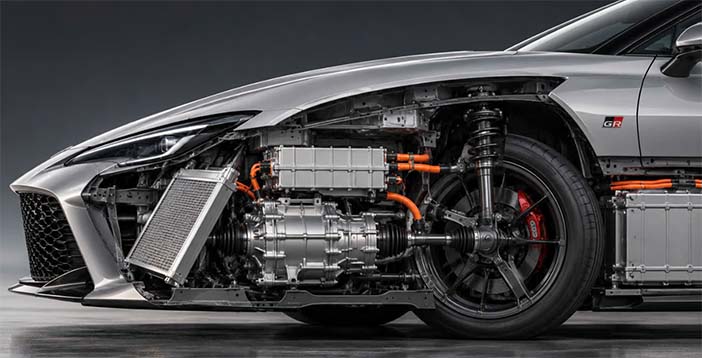
A recent Japanese patent application shows off a clever way to squeeze everything in and drop the nose for those sportier proportions. Patent JP 2026-171370 A isn’t about reinventing the electric powertrain. Instead, it’s all about where you stick the front drive units, electrical gear, and the airconditioning condenser. According to the patent, Toyota’s trick is to line up the electric motor, reduction gearbox, and driveshaft along a single axis. This makes the whole drive unit shorter and squatter, though it does get a bit wider. But here’s the payoff: a lower drive unit means more space to drop the front end. Toyota doesn’t stop there. They tilt the airconditioning condenser forward, making use of the space in front of the drive unit. Normally, this part chills the refrigerant and hangs out behind the grille, catching fresh air. Instead of standing the condenser straight up, Toyota angles it so the top juts forward. That way, the condenser’s top edge can sit lower than the stack of electrical gear above the drive unit. The patent mentions things like a DC-DC converter and onboard charger, but there are other possible setups too. Put it all together, and you get a front end that doesn’t need as much vertical space for hardware, but still lets the condenser breathe. The upshot? Designers get more room to sculpt a lower hood and give future electric coupes or performance cars the kind of sleek silhouette that turns heads. Of course, the patent doesn’t name any specific model, and there’s no sign Toyota is actually building this into a real car yet. It’s just an engineering idea for now, but maybe something we can look forward to after the electric Lexus LFA arrives to the market. Like most patents, this one might never see the light of day. Automakers love to lock down clever ideas just in case, even if they never make it to the showroom. So don’t hold your breath – but it’s fun to imagine what could be coming. +++