
+++ All GENESIS vehicles will be purely electric starting in 2025, Hyundai Motor’s luxury brand announced. This is part of the company’s efforts to achieve carbon neutrality by 2035. The announcement was made through a film called “Futuring Genesis”, which was released to the public via the company’s YouTube channel. “Genesis has been on an intensive, bold and successful journey, successfully establishing itself as a truly global luxury brand”, said Hyundai Motor Group chairman Euisun Chung. “Genesis is once again at the starting point of another audacious journey: the journey towards a sustainable future”. Genesis will use a dual electrification strategy involving fuel cell and battery-driven electric vehicles (EVs). Genesis will continue to work on electric technologies such as new hydrogen fuel cell systems with higher power outputs, and electric systems that help improve efficiency. A total of 8 new battery powered and fuel-cell EVs will be introduced by 2030, with a global sales target of 400.000 units per year. Genesis plans to achieve carbon neutrality throughout its supply chain, starting from raw materials and parts and at all work sites and factories. It also said it will devote itself to building next-generation technology that gets better performance and efficiency from lithium-ion batteries. “I am extremely excited to announce the new vision of Genesis for a sustainable future”, said Chang Jae-hoon, global head of Genesis. “As we continue to design a new dimension of customer experience and build an authentic relationship with our customers, Genesis will take audacious steps to lead the age of electrification into the sustainable future”. Genesis has introduced the GV60, the brand’s first product to be manufactured using the E-GMP architecture. This is a standardized EV design and production process that incorporates the battery, the base frame, motors, axles, wheels and suspension. Previous EVs were made along the lines of internal combustion engine vehicle design. The model is expected to be available in the second half of the year. Genesis also presented various concepts for vehicles in the future in the video including Stage Doors, which refer to doors that open outwards without a B-pillar, and a 360-degree rotating car seat. “Our new electric lineup is the perfect platform to increase our interface with our customers”, said Luc Donckerwolke, chief creative officer of Genesis. “We aim to interact with all their senses. Our new architecture will integrate audacious technologies with breathtaking designs while providing sincere detail-oriented experiences. Warm and exquisite care will be our differentiator”. Genesis itself does not yet market a hydrogen fuel cell vehicle, but parent company Hyundai currently sells the Nexo crossover and has promised that hydrogen will continue to play a central role in its electrification strategy in the coming years, so naturally Genesis will follow suit. In future, Genesis says it will “put an effort on developing pure electric technologies such as new fuel cell systems with higher power output, and electric systems that help improve efficiency”. It will also develop ways of extracting better performance and efficiency from lithium ion batteries. +++
+++ HYUNDAI has been spotted testing what looks like a high performance version of the new Ioniq 5, which could be launched under the brand’s ‘N’ division umbrella as the company’s first hot EV. The spy shots show a mysterious Ioniq 5 prototype with little to separate it from regular versions of the car. The only giveaway is the fitment of lightweight alloy wheels shod with high performance Pirelli P Zero tyres. Autointernationaal has known of the Hyundai N division’s plans to develop a high performance electric car based on a model from the new Ioniq sub-brand for a while. I broke the news based on quotes from the Korean manufacturer’s head of technical development and Hyundai management’s suggestion that N’s focus will shift towards more sustainable, environmentally friendly models. Hyundai’s vice-president for product and strategy, Thomas Schemera, told me early in 2021: “We never stop thinking about expanding our product portfolio. Strategically we are moving full speed ahead with eco-friendly offerings. We have a crystal clear plan. One thing is for sure: eco-friendly vehicles are on our priority list, at the top”. When asked specifically if N would look to develop cars based on the Ioniq models, which use Hyundai’s e-GMP modular electric platform, Schemera said, “Everybody knows that Hyundai’s electric architecture has a lot of potential and shows a lot of flexibility. So this is an interesting question. I guess if you have a look at our strategy of the future, to offer more eco-friendly vehicles and moving ahead with our battery-electric concept and our fuel cell-electric concept, it seems to be realistic”. Albert Biermann, Hyundai’s board member for technical development, added, “Let me ask one question in return. Could you imagine we were not working on it already?” We know that the E-GMP platform can have high-performance applications. For instance, the new Kia EV6 GT uses the same architecture as the Ioniq 5, and its all-wheel-drive electric drivetrain produces 578 hp. Biermann suggested that the American-market Elantra could give the N division a further model in Europe, if customer demand were sufficient. “We are developing an Elantra N”, he said. “It participated already in the launch event of the Elantra in the United States. At this point it’s not planned for Europe. But if you can create enough demand I would not rule out that it could be reconsidered. It could be an interesting next N vehicle for Europe and other markets”. Customer feedback could yet persuade Hyundai to offer the Kona N with a manual gearbox, Biermann also admitted. The car has been launched with an eight-speed dual-clutch automatic only, but the former BMW M division chief said, “The feedback we get back on the 8-speed dual-clutch is so fantastic. Recently I saw some comments saying that this Hyundai 8-speed DCT is better than the Hyundai manual transmission. That gave us the confidence to say on Kona N, we can try without the manual. If customer demand is higher than we are expecting then we can change this I guess; it’s not such a big challenge from an engineering point of view”. +++
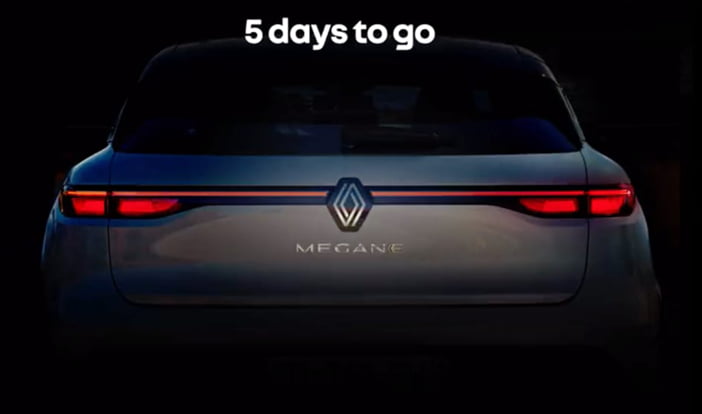
+++ The new electric RENAULT Megane E-Tech Electric SUV has been teased ahead of its unveiling at the 2021 Munich Motor Show. We’ve already seen official images from Renault of the new Megane E-Tech in prototype form and this preview certainly conforms to the design of the camouflaged development car. The rear light bar broken up by the Renault badge seen on the current fourth-generation model makes a return and if the prototype design is to be believed, the ‘C-shape’ headlight design seen on the Captur and Clio will also feature on the new Megane. The new Renault Megane will open a new chapter for the French brand with former Seat boss Luca De Meo now in charge. The firm’s plan, dubbed “Renaulution”, will see Renault launch seven new all-electric vehicles by 2025, with this Megane EV the first of the bunch. Renault’s new Megane E-Tech Electric is based on the Renault-Nissan Group’s CMF-EV platform, which is shared with the Nissan Ariya SUV. Like its chassis sibling and Renault’s recently unveiled Mobilize Limo, the Megane E-Tech will have a 60 kWh battery pack and a 218 hp electric motor to provide a maximum range of up to 450 km. The motor will also provide a healthy 300 Nm of torque, while De Meo has previously promised a 0-100 kph time of less than 8 seconds. He also said that Renault could look to develop a longer-range version of the car in the future. Renault previewed its new EV last year with the Megane E-Vision concept, and while the suspension has been raised, the rear light bar has been tweaked and the enormous alloy wheels have been swapped for smaller production-friendly alternatives, the rest of this early car’s styling remains faithful to the concept. Given the design similarities, the finished Megane E-Tech Electric’s dimensions should be very close to the concept’s, at 4.210 mm long, 1.800 mm wide and 1.505 mm tall. That’ll give it a comparable footprint to the Captur crossover, but with a lower roofline. De Meo hailed the concept as “a masterpiece of packaging”. The car’s wheels are pushed out to the corners of the body to maximise interior space, offering a similar level of room to larger family hatchbacks with exterior dimensions similar to that of the current Megane. The floor appears to be very shallow for an EV, too; no surprise, given that Renault promises that the Megane EV will use the slimmest battery pack on the market, at just 110mm deep. Renault also previously teased the new car’s interior, which will feature a brand-new L-shaped infotainment system. The set-up comprises a large portrait infotainment system, which links into a wide digital instrument cluster, and thanks to the lack of a transmission tunnel, there’s space beneath the screen for a little extra storage. Elsewhere on the technology front, an on-board charger will allow 7 kW charging from a wallbox, with more advanced AC three-phase compatibility, too. However, the only charge time Renault has revealed so far is that the electric Megane will be able to reclaim 200 km of range in 30 minutes when rapid charging at its maximum of 130 kW DC. There’ll be several Renault-badged EVs following on from the Megane E-Tech Electric, too. De Meo said: “Like with the first generation of Megane, this Megane with an E is just the beginning. A whole family of vehicles will be based on our CMF-EV platform”. However, Renault is more likely to make a range of separate models, rather than a cluster of EVs all under the Megane banner. +++
+++ RENAULT SAMSUNG MOTORS said its sales rose 17 % last month from a year earlier on strong exports of its SUV models. The South Korean unit of Renault sold 8.846 vehicles in August, up from 7.570 units a year earlier, the company said in a statement. Domestic sales fell 25 % to 4.604 units from 6.104 during the same period, while exports jumped to 4.242 units from 1.466 on strong demand for the XM3 (Arkana) and QM6 (Koleos) SUV models, it said. From January to August, its sales declined 9.9 % to 75.805 autos from 84.158 units during the same period of last year. French automaker Renault holds an 81 % stake in Renault Samsung. +++
+++ Some car manufacturers are building vehicles with fewer SEMI CONDUCTORS chips in response to the worldwide shortage that has crippled the industry in recent months. 2 trim lines on Ford’s Puma, for example (Titanium and ST-Line) are now being offered alongside a cheaper ‘Design’ spec that uses fewer chips, but loses certain features as a result. According to the latest price list, Design versions of the ST-Line go without high beam assistance, rear parking sensors, lane-keeping assistance, lane departure warning, pre-collision assistance with automatic emergency braking (AEB), pedestrian and cyclist detection, and post-collision braking. There’s also a Design edition of the EcoSport ST-Line that economises with several of those features. Puma Design models are €1.000 and €1.700 cheaper than the ST-Line and Titanium forms respectively, and a spokesperson for Ford has told that their reduced reliance on chips means customers can choose to receive their cars in a month or 2, or wait longer for a fully equipped vehicle. “The global semiconductor chip shortage has affected almost all vehicle manufacturers around the world, including Ford”, said the spokesperson. “In order to meet the needs of our customers for Puma and EcoSport, Ford is realigning the content of a small volume of vehicles to mitigate the impact of the chip shortage”. The decision to reduce the number of chips in a popular model contrasts with other manufacturers that have opted to temporarily pause production altogether in certain cases. Meanwhile, the absence of AEB and lane-keeping assistance means that the Puma’s 5-star Euro NCAP (awarded in 2019) doesn’t apply to Design-designated cars. “We’re aware of the situation”, said Matthew Avery, director of insurance research at Thatcham Research. “Ford, to give them their due, have been very responsible and contacted us because they recognise that they would be infringing the requirements for Euro NCAP without that equipment. We understand manufacturers are trying to shift metal and buyers are anxious for cars, but we wouldn’t want them to specify those vehicles. We would ask consumers to wait: when it comes to safety equipment, we think you should hold back because this technology may save your life”. The Ford Puma retains its 5-star Euro NCAP rating, but the car’s online listing makes it clear that “Pumas of ‘Design’ grade do not have all the safety features needed” to fulfil the car’s 5-star status. AEB and lane departure warning systems are set to become mandatory on new type approvals from May 2022: even if the shortage lasts beyond that date, Ford won’t be breaking these rules as the Puma (which is already type approved) won’t have to comply until May 2024. Elsewhere, Volvo has confirmed that the shortage of semiconductors has forced it to scale back the features of its Driver Awareness pack on the XC60. “This package contains BLIS (Blindspot Information System) with Steer Assist, CTA (Cross Traffic Alert) with Autobrake, and RCWM (Rear Collision Warning and Mitigation)”, said a Volvo spokesperson. “The XC60’s high basic safety standard is not affected. These features do not have an impact on the safety rating (for example, the Euro NCAP rating) of our cars. The safety level of our cars is fully sufficient with the standard safety features”. Volvo is contacting customers who have specified the package to ask if they want to continue with their orders without the equipment, or wait until the kit becomes available once more. The spokesperson added: “The semiconductor situation is very volatile, so we cannot provide a timing today for when these features will become available again, although we will keep our customers informed. We are working closely with our suppliers to minimise the impact on our customers”. +++
+++ Carmakers in SOUTH KOREA saw sales fell 4.5 percent last month from a year earlier as an extended global chip shortage and the Covid-19 pandemic continued to weigh on vehicle production and sales, industry data showed. The country’s 5 carmakers (Hyundai, Kia, GM Korea, Renault Samsung Motors and SsangYong) sold a combined 544.992 vehicles in August, down from 570.601 units a year ago, according to data from the companies. Their domestic sales declined 4.1 % to 106.247 units from 110.835, while overseas sales dropped 4.6 % to 438.745 from 459.766 during the same period, the data showed. In August, Hyundai’s sales fell 7.6 % to 294.591 units from 318.700 a year ago, and its overseas sales also declined 7.8 % to 243.557 from 264.110 during the same period. Kia’s rose a mere 0.1 % to 217.204 units from 217.089 as its overseas sales fell 1.4 % on-year to 176.201. Steady sales of Hyundai’s Palisade and Tucson SUVs, and Kia’s Sportage and Seltos SUVs allowed the carmakers to report the monthly results. Hyundai suspended the Asan plant from July 13 until August 6, which affected the production of the Santa Fe and the Sonata. This year, Hyundai and Kia said they will continue to focus on promoting their new models, including Hyundai’s all-electric Ioniq 5 crossover utility vehicle and Kia’s K8 sedan and all-electric EV6 model, to ride out the pandemic. They aim to sell a combined 7.08 million vehicles this year, 1.7 % lower than the 7.2 million units they sold last year. 3 other carmakers also suffered a decline in domestic sales last month due to lack of new models and tougher competition with their bigger rivals. Increased exports at SsangYong and Renault Samsung did not help drive up their overall results last month. GM Korea was the worst performer in domestic sales and exports. SsangYong’s domestic sales fell 28 % on-year to 4.861 autos last month from 6.792, while exports more than doubled to 2.874 from 1.235 during the cited period. Renault Samsung’s local sales declined 25 % to 4.604 from 6.104, while exports nearly tripled to 4.242 from 1.466. But GM Korea’s local sales dropped 20 % to 4.745 from 5.898, and exports plunged 46 % to 11.871 from 21.849. From January to August, the 5 automakers’ combined sales rose 15 % to 4.87 million units from 4.22 million in the year-ago period. Their domestic sales fell 7 % to 982.863 autos in the first 8 months from 1.06 million units in the year-ago period, while overseas sales jumped 23 % to 3.88 million from 3.17 million. +++
+++ Early last month at a sprawling factory on the highway connecting Hanoi to the port city of Haiphong, a single worker tested positive for Covid-19. The delta variant was spreading swiftly through the Southeast Asian nation at the time, and on August 4 provincial officials suspended work at the auto-parts manufacturer. An ocean away, TOYOTA chief purchasing group officer Kazunari Kumakura was watching intently. The plant is operated by a key Toyota supplier and is one of Vietnam’s biggest assemblers of wire harnesses — a basic but essential yoke for cables that holds the inner workings of an automobile together. As the infection at the facility disrupted operations, Toyota’s inventories grew thin. From July, the Japanese automaker had been examining its suppliers in the region, which has become a COVID-19 hotspot, on a daily basis to assess how dire things were getting. Eventually, unable to secure a number of parts, including the wire harnesses from Vietnam and chips from Malaysia, Toyota succumbed. The world’s No. 1 automaker shocked the market by announcing it would slash its output of cars in September by 40% compared with previous production plans. “The big thing was whether operations could continue in Southeast Asia”, Kumakura said in a late afternoon address to reporters on August 19. But lockdowns, growing Covid-19 clusters and government-imposed restrictions on production made it clear that auto suppliers, particularly in Malaysia and Vietnam, wouldn’t be able to continue operations, he said. It “tangled up our parts” and “happened rapidly”. Toyota is now faced with the challenge of securing substitute parts and recovering lost output in time to meet an inventory-depleting level of global demand for cars. But more broadly, the snarls that finally toppled one of the world’s best-maintained supply chains have sparked deeper questions about whether the auto industry’s strategy of prioritizing efficiency and maintaining minimal inventory will endure in the post-pandemic world. Carmakers globally have lost revenue because shortages have slammed output. India’s largest automaker by deliveries, Maruti Suzuki, said volume would likely drop to about 40 % of normal this month, and Tata Motors blamed “the recent lockdowns in east Asia” for worsening the supply situation. China’s Nio has struggled with partners in Malaysia. Also in Japan, Suzuki will cut vehicle production by 20 % in September, while in Europe, Renault plans to halt assembly plants in Spain for as long as 61 days before the end of the year. The car sector is accustomed to much thinner profit margins than those enjoyed by big technology companies, even after decades of trying to drive down costs, said Howard Yu, a professor of management at the Switzerland-based Institute for Management Development. Carmakers strive to be lean, reducing redundancies and working out of regional hubs because it’s more efficient, he said. “But to be resilient, you need a bit of redundancy. The delta outbreak is exposing that this system is really vulnerable to external shocks”. Over the past decade, Japanese automakers have invested heavily in Southeast Asia, looking to the region as a source of cheap labor and to supplement their China operations amid trade tensions with the U.S. Thailand is a major production hub for Toyota, Mitsubishi, Honda and Nissan Motor Co. Those automakers make up about half of Thailand’s vehicle production capacity and source a number of parts from neighboring countries. Toyota alone works with suppliers that have more than 400 plants located in Malaysia and Vietnam, data compiled by Bloomberg shows. That concentrated approach worked, until it didn’t. Midway through this year, Southeast Asia began to grapple with one of the world’s deadliest Covid-19 resurgences. Governments declared lockdowns and restricted business activities, at times halting entire plant operations upon the discovery of just a handful of confirmed cases. Vietnam is Japan’s biggest source of wire harnesses. Several Japanese parts makers operate plants in the country. The Hai Duong factory that shut in early August belongs to Sumitomo Electric Industries, which declined to comment on individual site operations. Another major wire harness-maker and Toyota supplier in the region, Furukawa Electric, has been forced to limit operations due to Covid-19 restrictions, according to a company spokesperson. Similarly, Malaysia has emerged in recent years as a major center for end-stage chip packaging; the smallest and least-profitable component of the semiconductor manufacturing process. Rising Covid-19 cases have forced key auto suppliers STMicroelectronics NV and Infineon Technologies AG to close facilities, worsening a shortage of chips that’s been hammering automakers for months. Bloomberg’s supply chain analysis data shows that Toyota sources from both of those companies. For now, automotive suppliers in the nations are showing signs of getting on a path to recovery. Most staff at Sumitomo Electric’s Hai Duong wire harness plant had returned to work by around the second week of August, according to the province’s official television station. As of last week, Malaysia’s chipmakers were essentially back to normal levels of operation, and Toyota has said it expects to begin to recover lost production in October. The question remaining is whether this supply chain disruption will spark a long-term shift at Toyota and other manufacturers’ operations. If the delta outbreak in Southeast Asia proves to be relatively short-lived, it may not make much sense to uproot supply chains, Bloomberg Intelligence analyst Tatsuo Yoshida said. Greater economies of scale are possible with single sourcing, and diversifying supply chains requires significant time and money. Hubs have formed in Southeast Asia for a reason: labor-intensive processes can be performed cheaply there, he said. At the same time, if Toyota’s relatively strong performance amid the pandemic and supply chain mess thus far says anything, it’s that the automaker is willing to take action after breakdowns. The company’s methods of maintaining high visibility in its supply chain and its strategy of keeping stock of riskier parts such as semiconductors are legacies of 2011, when the Great East Japan Earthquake and resulting tsunami knocked its suppliers’ plants offline, disrupting Toyota’s operations for a full half year. Kumakura acknowledged last month that because production of certain widely used parts is concentrated in Southeast Asia, a disturbance in the region has the potential to ripple across a much wider area. In the future, Toyota “will look at how to allocate production and diversify risks so as to not concentrate on one specific area,” he said. “We’ll reflect and draw on this knowledge to further strengthen ourselves”. In the end, it comes down to striking a balance between efficiency and resilience, said Yu, the management professor. Certain parts don’t seem critical until they “blow up production systems” because there are limited suppliers concentrated in a particular region. In a good quarter, dipping into profit to invest in rainy-day resilience is “what long-term perspective is about”. he said. “And this isn’t just a story of Toyota”. +++
+++ Chinese tech heavyweight XIAOMI is hitting the accelerator of its car business: the company said it has registered its electric vehicle or EV business with a registered capital of 10 billion yuan ($1.55 billion). Xiaomi’s EV division, which employs about 300 employees, has thus entered a “substantial development phase”, the Beijing-based company said. In late August, Xiaomi said it had acquired autonomous driving firm Deepmotion for around $77.37 million to enhance the technological competitiveness of its EV business. Xiaomi announced its foray into the electric car business in late March when several tech giants like Baidu and Huawei Technologies were already looking at the vehicle industry as the next big-ticket sector, on hopes that in the future cars will become increasingly autonomous and connected. Lei Jun, CEO of Xiaomi and CEO of its new smart electric car unit, said earlier that the company’s cash reserves totaled 108 billion yuan by the end of 2020, which allows the company to afford the risks involved in the car business. Xiaomi said its EV team has undertaken a massive amount of user research in the last 5 months, and also visited industry partners while pressing ahead with the EV product definition and team formation. Xiaomi currently has 16.000 engineers, and its research and development spending hit 10 billion yuan last year. The company said it has sufficient confidence in talent reserves and its technological advantages in artificial intelligence, new materials and other fields, which will form a strong support for the automotive business. Roy Lu, director of the Gasgoo Auto Research Institute, said Lei has for long been seeing automobiles as part of Xiaomi’s AI-enabled internet of things ecosystem, and invested in Chinese electric car startups such as Nio and Xpeng Motors via Shunwei Capital, a venture capital firm. But Lu also warned that the change in Lei’s role from an investor to a competitor will push Nio and Xpeng Motors to prepare harder for the possible impact of Xiaomi’s entry into cars on their business. Experts also said it remains to be seen whether Xiaomi can really afford the capital and time needed for the cash-intensive smart car business, given that a string of Chinese companies that had entered the segment faced severe financial difficulties, with some even going bankrupt. Matthew Kanterman and Nathan Naidu, analysts at Bloomberg Intelligence, said Xiaomi’s entry into China’s EV market opens a big new growth area for the company beyond smartphones and other consumer electronics. In the second quarter of this year, Xiaomi posted record revenue of 87.8 billion yuan; up 64 % year-on-year and beating analyst expectations, as it benefited from rapid growth in overseas markets. The strong performance came as Xiaomi earned its new tag of the world’s No 2 smartphone maker by shipments from April to June, a period during which Xiaomi shipped 52.8 million units of smartphones, marking a year-on-year growth of 83 %, according to data from market research company Canalys. +++