
+++ The BMW iX3 has earned the only ‘very good’ ranking out of 7 cars assessed by Thatcham Research for assisted-driving features such as speed assistance, steering assistance and adaptive cruise control systems. The BMW joins the Audi A8, BMW 3 Series and Mercedes GLE, which received similar ‘very good’ ratings in 2020, while the Cupra Formentor and Ford Mustang Mach-E assistance systems have been judged as ‘good’ in 2021. In the latest assessments, the Hyundai Ioniq 5 and Polestar 2 earned only ‘moderate’ ratings, while the Toyota Yaris and Opel Mokka-e assistance technologies are assessed as ‘entry’ level. Thatcham Research says the results are encouraging, with all seven cars tested this year showing pleasing levels of assisted driving system support. Of the cars tested in 2021, 5 are pure electric models. The Thatcham assessments evaluate and rate the level of driving assistance, driver engagement, and safety back-up of their onboard systems. Matthew Avery, Thatcham chief strategic research officer, said: “Assisted-driving technology must strike the right balance between offering a meaningful level of support and ensuring that motorists don’t sit back and let the system do the driving. We’ve seen the dangerous outcomes on roads around the world when drivers become convinced that their role is secondary”. When Thatcham first started looking at driver-assistance systems, it raised concerns that car makers could be overselling the technology in a way that could be confusing and dangerous to consumers, and it downgraded the Tesla Model 3 to ‘moderate’ as a result. The organisation says it’s reassured that’s not the case with any of the cars tested this year, with all of the systems being described correctly. “All 7 cars we’ve just tested are clearly marketed as having ‘driver assistance’ functions, not ‘automated’,” said Avery. “These systems are engineered to involve and support the driver in a very cooperative manner. They’re certainly not trying to offer automation, where the driving task can be relinquished to the vehicle, and we strongly believe that’s the right thing to do”. Thatcham’s chief research officer Matthew Avery has provided comments on each of the cars in this year’s test: BMW iX3: “Our top-performing vehicle is the BMW iX3 which is a premium, battery-electric SUV. It’s the only vehicle to get our ‘very good’ grading. It responded well in our collision-avoidance scenarios and at 85 %, it has one of the highest scores for Driver Engagement, in part because the iX3 features good in-vehicle video to show the driver how to use the system”. Ford Mustang Mach-E: “Ford’s battery electric Mustang Mach-E achieved a ‘good’ grading. It’s got a very good Safety Backup system which scored 83 %, and it has generally well-balanced Assisted-Driving functionality. However, we do think the name of ‘Co-Pilot 360′ is a little ambiguous and doesn’t adequately describe the fact it’s an Assisted Driving system that always requires the driver to be in control”. Cupra Formentor: “The Cupra Formentor is a petrol-powered vehicle with a plug-in option and receives a ‘good’ grading. The ‘Travel Assist’ name accurately portrays the role of the system, which has well-balanced Driver Engagement, Vehicle Assistance and Safety Backup features. A good option in the market”. Polestar 2: “The Polestar 2 is another full battery-electric vehicle and it gets a ‘moderate’ grading. It has an incredibly good score of 85 % for its Safety Backup, something you’d expect from a Volvo-derived vehicle. But it’s let down by its Vehicle Assistance score, which is just 50 %, because the system cannot adapt its speed for curves and junctions. This vehicle is capable of over-the-air updates, and Polestar has already confirmed that it will improve that functionality for all its drivers soon”. Hyundai Ioniq 5: “The Hyundai Ioniq 5 is a brand-new, fully electric car and it achieves a ‘moderate’ score. It has good Vehicle Assistance and good Driver Engagement. But it’s let down by its Safety Backup score of 50 %. This means the car is less capable at supporting the driver in an emergency”. Toyota Yaris: “Toyota’s Yaris gets an ‘entry’ rating, but it’s impressive to see Assisted Driving functionality on a low-cost supermini such as this. However, it’s let down by its comparatively poor performing Vehicle Assistance and Safety Backup functions”. Opel Mokka-e: “The Mokka-e is the fifth battery-electric vehicle in this year’s assessments, but it’s also a low-cost one. It receives an ‘entry’ grading because its Speed Assistance system only uses a camera. This means the information the driver is receiving from the system may not always be reliable”. The 2021 Assisted Driving Grading results for Driver Engagement / Vehicle Assistance Safety / Back-up and the resulting Rating were: BMW iX3 85% 83% 86% Very good; Ford Mustang Mach-E 69% 71% 83% Good; Cupra Formentor 70% 79% 74% Good;
Polestar 2 70% 50% 85% Moderate; Hyundai Ioniq 5 80% 77% 50% Moderate; Toyota Yaris 79% 56% 53% Entry; Opel Mokka-e 67% 57% 44% Entry. +++
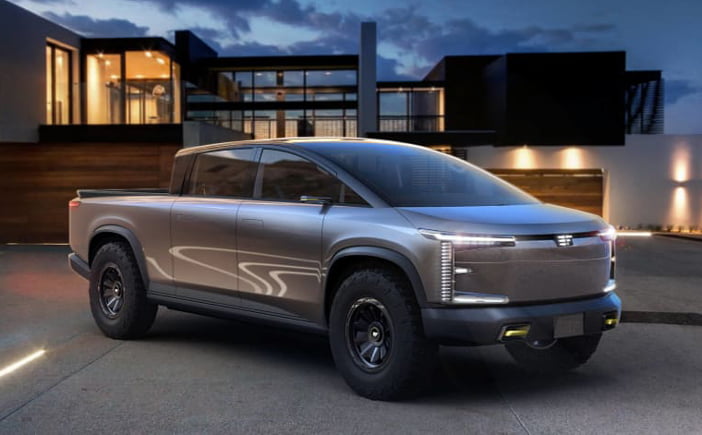
+++ At the Los Angeles Auto Show, electric vehicle manufacturing hopeful EDISON FUTURE debuted its first 2 offerings in conceptual sheetmetal, the EF1-T pickup and EF1-V commercial van. This week, I learned that the startup hopes to begin delivering vehicles in 2025. I’m not sure if these came from the pens of Icona; EdisonFuture didn’t mention involvement by the design house with which it is ostensibly partnered. Whoever’s responsible likes long, unadorned, straight lines. The pickup is 6,17 meter long. I’m not sure if that’s with the standard 2,2 meter foot bed or the optional 2,7 meter bed, but with the standard bed the EF1-T would be about 30 centimeter longer than the most recent version of the Tesla Cybertruck and 10 centimeter longer than a short-wheelbase Ford F-350 Super Cab with a 2,2 meter food bed. The smooth gray exterior gets its only decoration from the angular headlights and taillights; even the door handles are flush. The fancy rims and chunky wheels on the concept truck keep it from looking like an appliance, whereas the steelies on the van make it look like the appliance it’s intended to be. EdisonFuture plans to offer the truck in 3 trims. Standard will come with a 120 kWh battery powering a single motor good for 440 horsepower, an estimated 480 km of range, and a 3.300 kilo towing capacity. This one is intended to get from standstill to 100 km/h in 6.7 seconds. A Premium EF1-T gets a 150-kWh battery, adds a second motor for 690 total horses, ups the range to 600 km and towing capacity to 4.000 kilo, and lowers the stoplight dash to 4.7 seconds. Top-dog Super uses a 180 kWh battery, adds a third motor for 816 total horsepower, ups the range to 720 km and towing capacity to 5.000 kilo, while getting to 60 mph in 4.1 seconds. Payload capacity for all three is 1.350 kilo. When there’s no payload, drivers can extend an optional bed cover that can be fitted with solar panels. Instead of a rollout tonneau, a series of concentric bows slide out from behind the cab, creating a turtle-like profile for the greenhouse from cowl to tailgate. It’s neat to look at, but it seems the bows eat a hefty chunk of vertical bed space when stowed. The company touts its solar panel options for the pickup and van, with photovoltaics lining the roof, bed cover, and even the instrument panel on the pickup. In ideal conditions, the panels are said to be able to add from 40 to 60 km of range, which sounds, let’s say, optimistic. The van comes in cargo capacities ranging from 7.300 to 11.000 liter, but EdisonFuture doesn’t explain whether the difference is due to wheelbase or something else. There are only 2 powertrain options here, either a Standard single-motor trim a Long Range dual-motor trim. The company has rendered the interiors with a 17.5-inch touchscreen for infotainment, and dual seven-inch screens to pick up the feeds from the side cameras. I’m told the production versions, targeted for 2025, will change based on customer feedback, though. Refreshingly, EdisonFuture doesn’t talk up huge production goals, at least not yet. Seems the company just wants to add more options to the products it already makes with Phoenix Motorcars. Said chief marketing officer Jose Paul Plackal, “The EV space is growing at such a rapid pace, so there is opportunity for numerous OEMs to address the demand. Because our main goal is electric vehicle adoption, we simply provide additional choices that are unique, stylish, and complete with features and spec that create a unique value proposition for drivers”. In 2019, SPI (a Chinese renewable energy company founded in 2016, based in Hong Kong with a North American headquarters in California) announced it would sell “advanced” pickup trucks and last-mile delivery vans under the Phoenix Motorcars label (a California subsidiary which produces electric Class 4 buses and trucks) and a new consumer venture called EdisonFuture, not to be confused with the here-then-gone French company Edison Destiny from 2016. +++
+++ Vehicles powered by e-fuels complement rather than compete with electric vehicles and should be considered as a viable alternative on the path to carbon-neutrality, according to guests on an autobusiness seminar. MAZDA European research director Christian Schultze said: “We believe that e-fuels aren’t in competition with the electrification route but complement it. E-fuels can be used already on existing cars – and future cars. Having two pathways to follow can get us to climate-neutrality faster and better. There are pros and cons of both. Combustion engines are hard to make as quiet as an EV, while long-distance journeys are harder to make with an EV. Let’s use the good points of both technologies to drive forward carbon-neutrality rather than betting on one technology”. Steve Sapsford of automotive consultancy SCE added: “It’s not trying to replace our journey to electrification. Banning internal combustion engines might be picking a fight with the wrong enemy. Stopping our dependence on fossil fuels is where we should be focused”. Sapsford said that the immediate focus should be using e-fuels as ‘drop-in’ fuels, which can be mixed with existing gasoline: “Drop-in fuel meets the current specification – and the engines, consumer and infrastructure shouldn’t notice any difference. It’s perfectly feasible to use e-fuels as drop-in fuel”. Schultze predicted that e-fuels pricing would be on a par with petrol by 2030 in Europe. He said: ”By 2030, it can be around 1 euro per litre. When you factor in CO2 taxation on fossil fuels, I think gasoline prices will become even higher. E-fuels are very very close to being on a par with gasoline prices”. Shultze, Sapsford and Paddy Lowe (the founder of Zero Petroleum and an ex-Formula 1 engineer) all called on legislators to consider well-to-wheel emissions rather than just tailpipe emissions as a means to achieve carbon-neutrality. Schultze also said e-fuels should be considered for similar subsidies to EVs: “We need to find solutions that lead us to the CO2-neutral target. What’s the reason for ruling out for technologies?” Speaking on motorsport and e-fuels, Lowe commented: “Motorsport is generally a great platform for pioneering new approaches and new technology and giving them publicity. We’ve had Formula E, I think we will see hydrogen competitions and we will definitely see synthetics”. +++
+++ Chinese electric car maker NIO has entered into a strategic cooperation agreement with Shell, which among other things, will see EV battery swapping stations installed in Europe. The agreement states that NIO and the energy giant will “jointly construct and operate battery charging and swapping facilities”. The plan is to install 100 battery swapping stations in China by 2025, and “start to construct and operate” pilot stations in Europe. NIO has already installed over 300 battery swapping stations across China. Currently only available to owners of the brand’s cars, the facilities can remove a flat battery and exchange it for a fully charged 1 in 3 minutes; significantly faster than even the quickest chargers and in a similar ball park to filling up with fuel. Shell will also make its charging network in Europe available to NIO users and allow NIO to install swapping stations at its locations. NIO will install Shell Recharge rapid charging points at its locations in return. The two brands will “continue to explore more collaboration opportunities in battery asset management, fleet management, membership systems, home charging services, advanced battery charging and swapping technology development”. Shell, the world’s largest petrol retailer, claims it is “committed to becoming one of the leading charging service providers worldwide”. NIO has taken its first steps in the European market, selling its ES8 (a SUV) and ET7 (a saloon) in Norway. Further European expansion is due. +++
+++ I was really hoping this one wasn’t going to need writing, but there seems to be no end in sight for the scourge that is “ PIANO BLACK TRIM ”. I’m talking about the glossy black trim that has somehow become a luxurious trim used to class up interiors that might otherwise be lacking in class. Last week’s L.A. Auto Show reveals showcased plenty of it. Both the new Subaru Solterra and Toyota BZ4X are featuring piano black plastic in exactly the wrong places. Same goes for the new Kia Sportage, but these few examples are just a blip in what is a whole industry-wide obsession with glossy black. This shiny trim looks good in fancy press photos of new car interiors, but it stops looking good soon after the photoshoot is finished. Anyone who owns a car with piano black trim already knows what happens to it over time. First, it gets coated in dust and particles; this only takes a day or two. Next, and this part takes a few months to a year, it gets terribly scratched up and generally looks horrible. It may just be the least durable interior trim material ever invented, and now it’s used on untold numbers of new cars. Anecdotally speaking, the use of piano black trim has grown recently, and it continues to grow. In most cases, it’s replacing plastic that might otherwise have a flat black or gray finish. Those flat, non-flashy trim pieces hold up to years of abuse and don’t get dirty anywhere near as easily as piano black does. That begs the question, why have automakers decided to flock to the new piano-black-everything style? Perhaps, piano black interior trim is more effective at selling cars. We humans have a tendency to be drawn to shiny things like diamond rings and expensive watches. If one interior wows us with its sparkling flare where another is dull, it stands to reason that we could end up choosing the one that hit us with that initial “wow” factor. Even as the trend runs full steam ahead, some are making a point about fighting back against piano black trim. Honda designed the new Civic’s center console without any piano black trim on purpose, instead opting for a lined, gray plastic. It’s not going to scratch or become dirty like piano black does, but it’s still a visually interesting piece of trim that is superior to no design at all. This kind of intentional design is exactly what I’d love to see happen, too. Let’s get rid of any piano black trim that sits flat in the interior or is going to be subject to our frequent touch. If it’s flat, it’s going to collect dust instantly. If we touch it often or set things on it, the trim will scratch and quickly lose its luster. The only areas where piano black trim is acceptable are in spots that are vertical and in places where our fingerprints won’t frequently smudge it. Our long-term Hyundai Palisade mostly executes on this rule by limiting the piano black trim to certain areas like the infotainment surround, while utilizing a metal-like silver trim in high-impact spots. And while we’re on this trim rant, let me also call out carbon fiber interior trim as another played-out trend. Any car with an inkling of performance seems to either be fitted with as standard (or offer as an option) carbon interior trim. I was once enamored with the idea of seeing carbon fiber in as many places as I can, but those days are long gone. Now, it just looks tired and cheap. I still appreciate the use of carbon fiber for any exterior parts like the rear spoiler or side sills (full-carbon cars have their place, too) but its purpose is largely wasted on the interior. If the carbon trim were legitimately cutting real pounds off, then I’d be all for it. But for such limited use on the interior (strips on the dash, door or center console surround) it’s not cutting any tangible weight, and a beautiful wood or patterned metal trim would look significantly more luxurious. Not to mention, the cost of adding carbon fiber trim is typically higher or similar to that of a far more lavish alternative. I’d much rather stare at an open pore walnut dash than one spackled with carbon fiber. And don’t even get me started on carbon fiber-trimmed steering wheels. The carbon behaves like all the metal in the car on hot days, becoming impossible to touch for the first several minutes of driving; that’s not a good quality to have in a steering device. So, let’s say goodbye to both piano black and carbon fiber interior trim. The former is simply a poor idea for your interior’s longevity, and the latter has numerous, more attractive alternatives. +++
+++ For many people, the absolute worst thing they could experience with a car is for it to break or have a problem. The good news is there are cars that will ease the anxiety of their owners with infrequent trips to the shop. According to Consumer Reports (CR), using data from its annual survey of subscribers, the following 7 vehicles are the most RELIABLE in the country, and are ordered from most to least reliable. Any of these vehicles should be a solid choice if the most important consideration in your car-buying decision is predicted reliability. That said, they aren’t all vehicles that Autointernationaal would recommend as fun to drive. 1) Subaru XV: It has class-leading ground clearance, tall seating position and good visibility, a surprisingly spacious cargo area, and multiple driving modes geared toward inclement weather and dirt roads. According to CR, it also sees fewer trips to the shop. 2) Toyota Highlander: It wouldn’t be a reliability list without at least one Toyota on it, and indeed the Highlander isn’t the sole Toyota here. Also, the Hybrid has excellent fuel economy. 3) Mazda MX-5: Any car journalist will happily profess their love for this Mazda MX-5. It’s an incredibly engaging roadster (at least when equipped with a manual transmission) that behaves a lot like the classic British and Italian roadsters of yesteryear. Thankfully, it doesn’t share its European forebears’ penchant for breaking. 4) 5. Cadillac XT5: One of the newer nameplates on this list, the Cadillac XT5 is also a hot seller for the American luxury brand. It’s also Cadillac’s most reliable vehicle. 5) Toyota Prius: The Prius has been the face of Toyota efficiency for years now. This popular hybrid won’t just save you trips to the pump, it’ll also save you trips to the mechanic. 6) Toyota Prius Plug-in: It’s like the standard Prius, including in terms of reliability, but with a bigger battery and a plug. 7) Kia e-Niro: This all-electric member of the Kia Niro family is funky and fun to drive. If you buy it, you’ll not just get a sporty and economical EV, but also a reliable one. +++
+++ TESLA is planning to spend more than $1 billion on its new vehicle factory in Austin, Texas, and plans to complete construction by the end of this year, public filings with a Texas state agency showed. Filings submitted to the Texas Department of Licensing and Regulation (TDLR) outlined Tesla’s spending on various manufacturing capabilities at its Austin factory. The company said it plans to complete construction of its general assembly, paint, casting, stamping and body shop facilities by December 31. The 5 facilities would have a combined square footage of nearly 4.3 million (0.4 square kilometer), and cost a combined $1.06 billion, according to the filings. The TDLR regulates and licenses a broad range of businesses, facilities and equipment. The Tesla filings were made under the agency’s architectural barriers project, which reviews and inspects projects to ensure they comply with Texas’ accessibility regulations. Tesla chief executive Elon Musk has previously said the company plans to start limited production of its Model Y this year and high-volume production next year. Construction for Tesla’s new factory, located close to the airport on the eastern outskirts of Austin and projected to cost $1.1 billion, began during the summer of 2020. The company is expected to receive nearly $65 million in local tax rebates for the factory, which Tesla said will create some 10.000 jobs, most of them low skilled. Construction groups can be seen working on the massive plant day and night, and the factory building is expected to be at least 1.2 km) long once completed. Tesla has also said it would move its headquarters to Austin, Texas from California. +++