
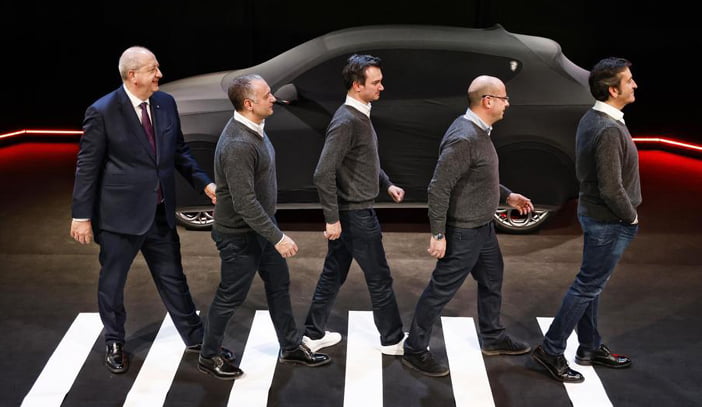
+++ ALFA ROMEO has confirmed the long-awaited Tonale small SUV will be officially revealed in February, with company boss Jean-Philippe Imparato giving an early look at its silhouette in a preview photo on twitter. Shown behind the executive team responsible for its design, marketing, manufacturing and specification, the Tonale already looks to bear a close resemblance, silhouette-wise, to its larger Stelvio sibling. The Italian firm’s new hope for sales success will be unveiled as part of an online, rather than in-person, event. According to the firm, “La Metamorfosi (the metamorphosis) is going to begin” on the 8th of February. The SUV, which will sit below the Stelvio in the Alfa Romeo range, and which takes its name from another famous Italian mountain pass (this one lower and in the Rhaetian Alps), will be the brand’s first car to offer plug-in hybrid technology. The Tonale has been spotted testing in final, production-spec bodywork multiple times ahead of its official reveal, showing a resemblance to the original Geneva motor show concept, but with a number of changes. At the front, the split between the bonnet and front bumper has grown, accomodating more conventional headlights. The rear window has grown in size, too, while the tail-lights are thicker. The overall proportions remain the same, however. +++
+++ ALPINE is preparing a more potent version of Renault’s reborn 5 hatchback, featuring a front-mounted 218 hp electric motor borrowed from the new Megane E-Tech Electric, the company’s engineering boss has confirmed. The French sports car brand is due to switch to pure-electric vehicles by the middle of this decade, and has already issued teasers for what it calls its ‘dream garage’ range of cars: a large SUV with a coupe roofline, a sports car developed with Lotus, and the muscular-looking R5 hot hatch. The company’s executive vice-president for engineering, Gilles le Borgne, has confirmed that not only will the Alpine be a warmed-up version of the Renault 5, but also that it will use a front-mounted motor producing 218 hp. Depending on weight and gearing, this means the car could deliver a 0-100 kph time of around 6 seconds. “One of the dream garage will be a derivative of the R5”, le Borgne said. When asked if the more powerful e-motor from Renault’s forthcoming Mégane E-Tech Electric could fit into the more compact CMF-B EV architecture that will underpin the new R5, he revealed that: “The final answer is yes, because we want to do Alpine cars. By shortening the engine for the regular R5, it has the global installation. We’ll adjust the track because it’ll be a more sporty look on the R5 Alpine”. Le Borgne also revealed that Alpine is developing a 4-wheeldrive multi-electric motor setup for its sporty SUV, with torque vectoring rear motors, but the R5 hot hatch will be exclusively front driven – there are “no current plans” to offer such a layout for the hot hatchback. It’s likely that the R5 Alpine would have the larger 52 kWh battery offered in the CMF-B EV platform, to deliver a range north of 320 km. The chassis should lend itself to higher performance, with MacPherson struts expected at the front (CMF-BEV shares many components with the CMF-B platform that underpins the current Clio) and a multi-link layout at the rear. +++
+++ AUTOMATIC EMERGENCY BRAKING (AEB) has been around for a while now, and it has quietly become more advanced with systems adding pedestrian detection. In fact, according to IIHS, which conducted the study we’re about to discuss, from 2019 to the 2021 model year, availability of pedestrian AEB has increased from 3 out of every 5 vehicle models sold to 9 in 10. Not only that, the organization has discovered that many systems work well, and they’ve made major reductions in the number of pedestrian collisions. But it turns out they have a couple of blind spots, primarily dark conditions. First the good news. AEB with pedestrian detection works really well. The IIHS study discovered that overall, cars with such systems had 27% fewer pedestrian collisions than cars without them. Additionally, the systems work well during the day and in areas with streetlights, with the odds of a collision being lower by 32% and 33% respectively. And when there are pedestrian collisions, 30% fewer of them caused injury. Now for the bad news. IIHS discovered the systems didn’t make a difference in reducing pedestrian collisions at night in poorly lit or unlit conditions. That’s not good, since the organization also notes that 75% of fatal pedestrian crashes happen in those exact situations. The IIHS also tested out eight small SUVs in daylight, artificially-lit and dark situations. Most of the vehicles had much worse performance in the dark, not reducing speed as much as they would with good visibility. There are other weak points, too. While the IIHS found that pedestrian AEB works well on roads with speed limits of 50 kph or less, it didn’t make much of a difference on roads with speeds above 80 kph. These systems also didn’t make any real difference in collisions that happen when a car is turning. But now we come back to some good news. There were a couple of SUVs that IIHS tested in this small group that still performed decently in the dark. The Toyota C-HR for instance, which uses a combination of cameras and radar, and the organization noted that automakers may already be improving in these areas. The IIHS will also begin testing these systems in the dark for all cars both to inform consumers and also to encourage automakers to improve in these areas. Automakers are also upgrading automatic emergency braking systems to check corners during turns so that they’re more effective in those situations. Summing up, automatic emergency braking systems with pedestrian detection really are helpful in reducing pedestrian crashes and making them less harmful when they do happen. And although they have weaknesses, both independent testing agencies and automakers seem to be aware of them and are trying to improve. +++
+++ The new FERRARI Purosangue SUV will make its debut later this year, with its arrival confirmed as part of the Italian brand’s 2021 financial report. It’ll be the Ferrari’s first ever off-roader and has been designed to rival luxury models such as the Aston Martin DBX, the Lamborghini Urus and the Bentley Bentayga. Ferrari also confirmed that first deliveries of its SUV will commence in 2023. The company’s marketeers describe the Purosangue as a “Ferrari Utility Vehicle”. Recent spy shots (which show the car in its production bodywork) suggest it’ll be anything but utilitarian, though, as it has a relatively low ride-height and a low-slung silhouette. Whereas the DBX and the Urus sit tall and upright with relatively short overhangs, the Purosangue has a long bonnet, a steeply raked windscreen and a fairly long wheelbase. The rear overhang is also extensive, while the rear wheels appear to be a little larger in diameter than the fronts; just like a supercar. However, that could just be a quirk of the way the prototype has been set up. Because it rides so low, we expect Ferrari will fit the Purosangue with ride height-adjustable air suspension. Quad-exit exhausts are also visible on this prototype, as are a set of enormous cross-drilled brake discs and huge calipers. While the Purosangue’s styling doesn’t point towards it being particularly practical (in the SUV world, at least), it’ll be the most spacious model in Ferrari’s line-up. There’s a 4-door, 4-seat layout and a hatchback tailgate. I expect there will be design similarities with the Roma. In essence, then, the SUV will become an indirect replacement for the GTC4 Lusso four-seat coupe, which Ferrari pulled from its price list at the end of 2020. Ferrari has already confirmed that the Purosangue will be based on the same platform as the Roma GT. Former Chief Technology Officer Michael Leiters told us: “In general, we will have 2 families of architecture: front and rear-engine families. The modularity is there and, especially on the front-engined architecture, we have to foresee many more models. We have a 2+2, we have a 4+, we are thinking about Purosangue, and so on”. Leiters also mentioned that the SUV’s platform is capable of accepting either V6, V8 or V12 engines, which suggests the Purosangue could be available with a plug-in hybrid powertrain, similar in design to the unit found in the SF-90 Stradale. However, we expect the former two units are the most likely candidates for electrical assistance. Ferrari will continue to develop its 6.5-litre V12 engine independently of hybrid drive, as combining such a heavy combustion engine with an even heavier electric motor and battery pack is not favoured by the company’s engineers. Ferrari’s chief marketing officer, Enrico Galliera, told: “To be honest, electrifying a V12 means creating (very probably) a heavy and big car. So electrification ideally should be coupled with smaller engines. The philosophy is to try to be ready with different technologies in order to use them with the necessary evolution”, he added. “That’s why we have a wide range of engines: V12, V8 and, in the future, the V6”. Spy videos of Purosangue mules have already started to circulate on social media, some of which feature a very distinct 12-cylinder engine note. However, as the Purosangue will share its underpinnings with the Roma GT, I expect it’ll also be available with that car’s turbocharged 3.9-litre V8 engine. In this GT car the unit produces 620 hp and 760 Nm, which is likely to be a constant across the 2 models. Given the amount of extra space available in the Purosangue’s body, though, Ferrari could shift away from the Roma’s rear-drive layout and move instead to a four-wheel drive set-up. Ferrari will unveil the Purosangue later this year, although the brand hasn’t yet confirmed a date for the car’s launch event. When the order books eventually open, we’re expecting prices to start from around €300.000 in the Netherlands. +++
+++ MAZDA is set to expand its electric vehicle line-up, but it won’t be throwing it’s full weight behind the technology just yet. The company says it plans to launch 3 new EVs by 2025, all of which will be built on its new, dedicated Skyactiv EV Scalable Architecture. The new platform features a bolt-in panel for the centre of the chassis, which stretches out the platform’s wheelbase and increases its battery capacity in one fell swoop. So, in theory, a dinky electric hatchback could roll down the same assembly line as an enormous SUV, which is considerably more efficient from a manufacturing perspective. Mazda hasn’t confirmed any performance specifications for the new platform, although the company has hinted that it plans to use it with its “small product group” first. That means we could soon get a new EV that’s about the same size as the Mazda 3 or the CX-30. Despite all the investment in electric technology, Mazda still hasn’t given up on the internal combustion engine. The firm has plans to launch 5 new hybrid cars and 5 new plug-in hybrids by 2025, and the firm promises that its next-generation petrol and diesel engines will offer lower CO2 emissions, lower NOx emissions, better fuel economy and more power. These new cars will continue to be built on Mazda’s Skyactiv Multi-Solution Scalable Architecture, and buyers will have a choice of 24 Volt or 48 Volt mild-hybrid powertrains (with the former being reserved for smaller vehicles and the latter for larger cars), plug-in hybrid technology and even a rotary-powered range-extender system. Mazda is even working on some new straight-6 petrol and diesel engines, specifically designed for its larger cars, such as the upcoming CX-60 and CX-80 SUVs. They’ll be built using the brand’s lean-burning Skyactiv-X technology and feature 48 Volt electrification. Both of these SUVs are expected to hit the market in 2023. The company has also set its engineers to work on developing renewable synthetic fuels, which will provide a method for Mazda to reduce the CO2 emissions of its entire fleet without the need for any enormous infrastructure changes, as the fuel could be dispensed from a conventional forecourt. Currently, Mazda is investigating synthesized fuels made from carbon which has been pulled out of the atmosphere by giant filters, in a similar fashion to Porsche’s e-fuel efforts. The carbon is then combined with hydrogen in just the right mix to give it exactly the same properties as conventional petrol and diesel, without introducing any new carbon to the air. Mazda is also working on biodiesel fuels that are made from sustainable raw materials such as micro algae fats and used cooking oil. Importantly, these raw materials don’t compete for land space with the human food supply, which is normally the case with biodiesel fuels. All of this innovation will help Mazda meet its climate targets. The company’s ambition is to reduce its CO2 emissions by 50 percent over 2010 levels by 2030. Mazda also plans for complete carbon neutrality across every element of its business by 2050. This is a growing trend for the world’s car manufacturers with Polestar and Volvo making similar pledges earlier this year. By 2030, the company expects 25 percent of its sales to come from electric vehicles, with the remaining sales stemming from electrified combustion vehicles. Mazda says this is a global average, however, and that European are forecast to have significantly higher EV sales by the end of the decade. +++
+++ MERCEDES-BENZ ’ EQ electric car family will soon grow once again with the launches of the EQS SUV and EQE SUV, the third and fourth models to be based on the German car maker’s EV-dedicated EVA platform. Confirmed by Mercedes boss Ola Källenius in 2020, the EQS SUV is expected to cost from around €100.000 in the Netherlands, while the smaller EQE SUV will sit closer to the €85.000 mark when sales begin later this year. The technically similar EQS SUV and EQE SUV are being developed together in a joint engineering programme that aims to get them launched within six months of each other. They will join the existing EQA, EQB and EQC electric SUVs in the Mercedes range. A sixth, the production version of the G-Class-based Vision EQG concept, featuring a unique quad-motor powertrain, is also currently under development ahead of a scheduled launch in 2024. Eventually, the EQS SUV will provide the basis for a more potent and yet more lavishly appointed Maybach, as previewed by a concept at the 2021 Munich motor show. Like their saloon namesakes, the EQS SUV and EQE SUV will be offered in several regular Benz and hot AMG guises. On current planning, the optionally 7-seat EQS SUV will lead Mercedes’ next wave of EVs to arrive. Sources suggest the 5.160 mm-long flagship will be previewed at the Beijing motor show in April, before the 4.850 mm-long, 5-seat EQE most likely gets an airing at the Guangzhou motor show in November. Both adopt the smooth-surfaced exterior styling treatment established by their saloon siblings. Extensive wind-tunnel testing and developments such as mounting the running boards beneath the doors to improve airflow and aerodynamically optimised wheels are claimed to have netted both models a class-leading drag coefficient. It is with their interiors, though, that the new EVs will impress the most, according to Mercedes insiders. One senior manager privy to the final design of the EQS SUV told me: “The interior will offer a compelling argument to buy this car. It sets new standards for Mercedes”. The EQS SUV is set to offer a 108 kWh lithium ion battery pack in combination with 2 motors, together developing up to 523 hp and 855 Nm in the strongest of the planned standard 4-wheeldrive models, the EQS 580 SUV 4Matic. This model will form the basis of Maybach’s first EV, which is set to take the EQS 600 SUV name to reflect its subtle power hike. The smaller EQE SUV is set to use a 90.6 kWh lithium ion battery pack with the choice of either a rear-wheeldrive single-motor or four-wheeldrive dual-motor layout. The cheapest version, the EQE 350 SUV, will offer 292 hp and 565 Nm, according to my sources. Although Mercedes has promised 800 Volt charging compatibility in future EQ models, both the EQS SUV and EQE SUV will have an electrical architecture operating at 400 Volt. The EQS SUV and EQE SUV are planned to be produced at Mercedes’ US factory in Tuscaloosa, Alabama, which currently builds the similarly positioned but conventionally powered GLE and GLS SUVs. +++
+++ NISSAN has committed to the supermini market in Europe by confirming it intends to replace the slow-selling Micra with a new all-electric model, which will be related to the new Renault 5 that’s due to launch in 2024. “This all-new model will be designed by Nissan and engineered and manufactured by Renault using our new common platform”, revealed Nissan Chief Operating Officer Ashwani Gupta. Nissan also teased the new car, which features a rounder design language compared with the angular Renault 5 with which it will share its architecture. The new Micra replacement will be based on the Renault-Nissan-Mitsubishi Alliance CMF-BEV platform. “This is a great example of the Alliance’s ‘smart differentiation’ approach. Succeeding our iconic Micra, I am sure this new model will provide further excitement to our customers in Europe”, Gupta added. The Japanese brand’s rival for the Ford Fiesta and Opel Corsa has struggled for sales in its latest fifth generation, with numbers across Europe falling from more than 86.000 in 2017 to less than 40.000 in Covid-hit 2020. The costs involved in developing small combustion-engined cars for upcoming proposed Euro 7 emissions regulations look set to make them harder than ever to make money on, with Skoda boss Thomas Schafer pointing out recently that the price of one of the Micra’s key rivals, the Fabia, could rise by as much as €6.000 if the most stringent EU7 proposals are adopted. Nissan’s European boss Guillaume Cartier hinted that the firm could make a Micra successor and admitted that it is investigating which Alliance resources might allow it to build such a car: “The core business today and tomorrow is crossover (Juke, Qashaqi, X-Trail, Ariya) and the new car that will be the Leaf-replacement (a crossover EV)”, he said. “That’s already 5 cars. Then for each car we have to make sure that we have the depth; enough powertrains to match the volumes we have. We want to make sure that this core, in terms of volume per model, is increasing. “Then we use the Alliance. We will work with the Alliance for our full line-up of LCVs [Light Commercial Vehicles]. But one topic remains open, and this is the entry point of the line-up. The key point is to say, ‘How can we offer something, potentially with the Alliance, that will lure people to enter into the Nissan brand, and then enjoy to go model by model?’ That’s the one that we are considering. That’s exactly the question that we have to solve”. The CMF-BEV architecture that’s already earmarked for Renault’s Zoé replacement, the retro-themed 5, has allowed Nissan to answer this question. The Alliance claims that the platform’s overall cost of manufacturing is 30 per cent lower than the electric version of CMF-B that underpins the Zoe, meaning that small cars based on this tech can reach near price parity with combustion-engined superminis. The platform will allow up to 400 km on a full charge. The introduction of the electric Micra replacement will be close to the proposed EU7 introduction date of 2025 and Cartier confirmed that Nissan has no plans to invest in its engines and vehicles to make them compliant with the new rules. “Strategically we are betting on electrification”, he said, “to the point where we are not investing in Euro 7”. +++
+++ The Enyaq iV and Enyaq Coupe iV will be the largest electric cars in the Czech firm’s line-up, with SKODA boss Thomas Schafer outlining that the company’s next 3 EVs will be smaller models and that a 7-seat electric car is not on the cards – for now. Speaking at the launch of the Enyaq iV Coupe, Schafer said that “The Enyaq iV family is only the start of our e-mobility campaign. We already have 3 more electric vehicles on the way that will be introduced in the coming years”. Asked if we could see a 7-seat electric car in Skoda’s line-up Schafer commented, “Never say never. One step after another we promised this week. We love the Enyaq and that’s the priority for us”. This points towards Skoda’s next three EVs entering into lower market segments than its Enyaq iV. Earlier this year, Skoda filed a trademark for the ‘Elroq’ nameplate, possibly pointing to a small electric SUV similar in size to the brand’s combustion-engined Karoq. The remaining two model names should also start with an “E,” as Skoda carves out its naming convention for its EVs. All 3 EVs should also be based on a version of the Volkswagen Group’s MEB platform, some possibly on the MEB Entry platform being developed for supermini sized electric cars. Speaking on Skoda’s future smaller EV based on the VW Group’s MEB Entry platform, Schafer said: “Our colleagues from SEAT, Cupra and VW are pushing ahead a little stronger on that side. We are coming shortly with the announcement on this one [car]but rest assured it will be totally differentiated from our sister brands and a beautiful concept that fits with Skoda in the long term”. One thing that’s fairly certain is that Skoda won’t make compromises on interior quality. The company has said it plans to cut complexity in its fleet by 40 per cent in the medium term, but these efficiencies will be made by removing some customisation options. Schäfer commented: “The reality is that, over the last decade, we have become extremely complicated. We have allowed ourselves the luxury of having. I think it was about 16 different steering wheels in an Octavia. And you really have to say why. Why is that necessary? Our customers do not appreciate this. It’s a myth to believe that this will sell more cars or make our customers more happy. It’s nonsense. “So we went through model by model and looked at the options, and found we’d rather give a little bit more to the customer by condensing it and putting it into packages. And the Enyaq sort of paved the way when we launched it, when we had our design selections. “Optimisation is our daily bread. We look at it carefully every day, but with the focus of not making it cheaper. With the focus of giving more customer value”. Skoda also released a few more details about its wider product strategy and plans to cut its CO2 emissions over the next decade. The firm is targeting a 50 percent reduction across its fleet compared with 2020 outputs, although Skoda has not yet decided on a date when it will stop producing combustion-engined cars. Manufacturing methods will also be updated to lower CO2 emissions, with Skoda’s Czech and Indian facilities targeting net-zero carbon emissions from 2030 onwards.Skoda will also move its sales system online, shifting away from traditional dealerships to a smartphone application in which buyers can specify and order their new vehicles. The system has already been introduced in the Czech Republic, the Netherlands, Belgium and Poland, and it has shown so much promise that Skoda has set itself the goal of selling one in five new cars digitally by 2025. +++