+++ The likes of Tesla and Porsche are about to gain a new competitor in the form of AEHRA , an electric car maker headquarted in Milan aiming to blend “Italian design, worldclass engineering and US customer service”. So far, 3 Aehra cars are planned. An electric SUV is penned for an October reveal this year and a saloon will be unveiled in February next year. Aehra says customer deliveries of both models will begin in 2025. The third model, a 2+2 sports car is yet to have a reveal date announced. The Aehra SUV will rival the Audi e-tron, Tesla Model X and BMW iX at the premium end of the pure-electric SUV market. The firm claims it will feature “leading-edge battery platform technology, targeting a range of at least 800 km and awe-inspiring performance”. It should also be able to accommodate “4 full-size NBA players, while leaving room for a 6-foot adult in the middle of the rear seat row”. There will be one platform underpinning both the SUV and saloon and we can expect a battery capacity of 120 kWh in both. This means the saloon should offer a similar if not greater range than the SUV model. The 2 will utilise a lightweight carbon-fibre monocoque chassis to help reduce vehicle weight and enhance range. Aehra says both will offer “exceptional agility and driving pleasure”. Charging should be up with the fastest in the EV world with plans for market-leading 850 Volt architecture. In an exclusive interview, company co-founder, chairman and CEO Hazim Nada said: We’re going to start with the North American market and Europe. The second stage will be dedicated to the gulf countries and China”. Aehra isn’t looking too closely at potential rivals however. “We have a price bracket in mind, so we’re targeting high premium so $160,000 to $180,000, so at that price you obviously have the Porsche Taycan, Lucid Air, Mercedes EQS but we’re not similar to those products, we’re quite transversal in terms of which markets we want to reach. We don’t have a specific benchmark”. Nada thinks Aehra will have a head-start on the competition, especially on traditional internal combustion engine car makers. “Aehra’s vehicle architecture takes the step by addressing the direct shortcomings of designing electric vehicles that maintain the shapes of internal combustion engine traditions”. We can expect the latest safety systems to be fitted to Aehra’s cars and although the firm is looking into autonomy, Nada says full autonomy is not a priority. In terms of production he said, “we’ll target 20.000 to 25.000 (globally) per year, per model, which is quit ambitious in that segment, but we’ll have plenty of demand in the first 2 phases of market expansion”. Aehra also has an eye on the environment in the way its cars will be built. Nada stated, “The production method of our cars will allow for components to be recycled, the materials we’ll use will be more environmentally friendly and in terms of structure and body, it will be 100% recyclable”. What the cars will look like will remain unclear until the autumn, but Aehra’s chief design officer, Filippo Perini, is the former director of Lamborghini’s Centro Stile design center in Sant ‘Agata Bolognese. In his back catalogue are Lamborghinis such as the Aventador, Murciélago, Huracan, Urus and Reventon. Once the cars are on sale, customers will be able to purchase online or through the ‘salons’ from which Aehras will be distributed. +++
+++ ASTON MARTIN is seeking to raise funds to safeguard its future, wanting to significantly strengthen its financial position as it ramps up investment for its next-generation platforms and future electrification strategy. The move comes as a result of Aston Martin’s ongoing struggles to balance its books as it juggles its cash reserves and income from sales against development costs of new vehicles and debt repayments. The British company has £1.2 billion of outstanding bonds, bank drafts and loans on its books, meaning it’s unlikely to be able to raise funds by taking on more debt, especially given the level of repayments currently required to service it. As a result of its precarious position, its share price has recently been running at a historic low, although there’s no suggestion that its roster of owners (including executive chairman Lawrence Stroll, a multi-billionaire) would let the company fold. An Aston Martin spokesman said: “Aston Martin does not comment on rumour or speculation”. However, Autointernationaal understands that the fundraising could include bringing a significant new investor in, potentially offering a position on the company’s board as an inducement for a holding that insiders suggest could be valued at upwards of €250 million. Sources suggest that there are 2 leading contenders for the funding. One is linked to a Saudi Arabian investment fund, with Stroll having strong links to the country via the Aston Martin Formula 1 team’s title sponsorship with oil giant Aramco; and the other is linked to an investment fund based on the west coast of the US. While Aston Martin’s road car and motorsport businesses are separate entities, it’s possible that the investment could cover both operations. A spokesman for the F1 team declined to comment. Sources haven’t put a timeline on when talks could be concluded, beyond suggesting that there’s significant pressure to complete them as soon as possible to safeguard Aston Martin’s near-term outlook. The need to raise funds marks another chapter in a pivotal period for Aston Martin. Already this year it has replaced its CEO Tobias Moers with former Ferrari boss Amedeo Felisa after the German’s tenure coincided with significant staff turnover within the senior leadership team. Aston Martin was founded in 1913 and has been declared bankrupt 7 times previously. +++
+++ The M5 Touring models have been few and far between as the ultra-rare E34 from 1992 wasn’t followed until 2007 (to 2010) by the E61. It looks as though BMW is preparing a third iteration of the big speedy estate as a source familiar with the company’s agenda claims the AMG E63 competitor is coming back. It is believed series production will commence in November 2024, which could mean we’re roughly 2 years away from the official reveal. The M5 Touring carries the “G99” codename and will follow the M5 Saloon G90 set to enter production in July 2024. Both body styles are rumoured to get the plug-in hybrid V8 powertrain from the forthcoming XM with its new twin-turbo 4.4-litre V8 (S68) engine. A V8 would complement the E34’s inline-6 and the E61’s rev-happy V10 while packing some serious punch. In its range-topping specification due in 2023, the XM is going to have somewhere in the region of 750 hp and 1.000 Nm to mirror the Concept XM. Needless to say, the M5 Touring is expected to be an xDrive-only affair, with the power transfer done exclusively through an automatic transmission. Now that the M3 Touring is finally out and about, the long-roof M5’s potential return would enable BMW to sell 2 fully fledged M estates for the first time ever. Mercedes and Audi have been doing this for years with their C63 / E63 Estate and RS4 / RS6 Avant pairs, so it’s high time for their archrival to follow suit. Meanwhile, the next-generation 5 Series Saloon is scheduled for a 2023 release with petrol, diesel, and plug-in hybrid powertrains, plus the fully electric i5. Speaking of which, the zero-emissions model is believed to get the more practical Touring treatment as well, but nothing is official at this point. +++
+++ The passenger car market in EUROPE shrunk again in May, as new registrations decreased 13% year-over-year and 34% compared to May 2019. A small bit of positive news is that at least the rate of decline is lower than in March and April (respectively 19% and 21%). The plug-in segment, fortunately, noted a small increase, but nothing really significant. Roughly 183.900 new passenger plug-in cars were registered in Europe last month, which is 3% more than a year ago. That’s about 19% of the total market. Registrations of new all-electric cars increased in May by 20% year-over-year, which is enough for 11% of the market. On the other hand, plug-in hybrids are down another month, this time by 12% year-over-year. So far this year, some 907.294 new passenger plug-in electric cars were registered in Europe. That’s about 20% of the total volume (down from 21% in the first 4 months of the year). The Fiat 500e was once again the most registered plug-in model in Europe with 6.454 units, followed by Ford Kuga PHEV (4.668), the Volkswagen ID.4 (4.652) and the Peugeot e-208 (4.619). Tesla had a slower month in May with less than 1.500 units total (volume deliveries from China happen this month). After the Peugeot e-208, the Dacia Spring cae with 3.857 units. The rest of the top-10 consists of the Skoda Enyaq iV (3.842), the Opel Corsa-e (3.603), the Renault Zoé (3.565), the Volkswagen ID.3 (3.488) and the Hyundai Kona Electric (3.226). The top 10 for the first 5 months is mostly unchanged. The Fiat 500e noticeably decreased the distance between the Tesla Model 3 and Model Y at the top. The top plug-in brands (share year-to-date) are: BMW – 9.5%, Mercedes-Benz – 8.6%, Tesla – 6.9%, Kia – 6.4%, Volkswagen – 6.1%, Audi – 5.9%, Peugeot – 5.9% and Volvo – 5.8%. The top plug-in automotive groups (share year-to-date) are: Volkswagen Group – 18.1% share, Stellantis – 16.1%, Hyundai Motor Group – 11.7 % share, BMW Group – 11.5% share, Mercedes Group – 9.8% share, Renault-Nissan-Mitsubishi alliance – 8.4% share and Tesla – 6.9% share. +++
+++ HYUNDAI has decided to delay the launch of its upgraded hydrogen-powered Nexo to 2024 due to issues with its fuel cell development, a South Korean newspaper reported on Wednesday, citing the auto parts industry. The South Korean automaker had planned to kick off mass production and sales of its new Nexo in the second half of next year, but has decided to postpone to 2024. The Nexo was launched in 2018. The report also said the launch schedule for hydrogen fuel cell vehicles at Hyundai Motor Group’s premium brand Genesis had not been decided yet, as the project to develop the first Genesis brand fuel cell vehicles was suspended late last year. Hyundai did not have comment. It sold 3.978 Nexos in South Korea and exported 120 between January and May this year, according to the company’s sales data. In September, the Hyundai Motor Group, which houses Hyundai, Kia and Genesis, announced plans to offer hydrogen fuel cell versions for all its commercial vehicles by 2028, adding it would develop fuel cell vehicles for Kia and Genesis that could be launched after 2025. Analysts said Hyundai would be reevaluating its hydrogen fuel cell business, especially for passenger cars, because of the slow growth of the hydrogen fuel cell car market and the need to focus on the transition to electric vehicles (EVs). “With the growing global EV market, it would be likely that Hyundai could be reassessing its priority list as demand for EVs continues to grow, while the market for hydrogen cars still remains relatively small”, said Co Soo-hong, an analyst at NH Investment & Securities. +++
+++ A German court has ruled that a driver should pay more than the usual fine for running a red light because he was driving a SUV . The verdict dated June 3 could set a precedent for similar cases. In its ruling, the Frankfurt court ordered the driver to pay 350 euros; almost twice the regular fine of $200 for running a red light. It also imposed a 1-month driving ban. The court argued that the shape of the SUV, with its high, box-like hood, meant the driving infraction posed a greater risk to pedestrians than if the defendant had driven a smaller car. It also took into account the defendant’s previous driving convictions. The verdict can be appealed. +++
+++ TESLA has shuttered its office in San Mateo, California and laid off roughly 200 employees working on its Autopilot driver-assistant system there, one of the people told, in a move seen as accelerating cost-cutting. Most of the laid-off people had been hourly workers, that person said. Early this month, Tesla chief executive Elon Musk told top managers he had a “super bad feeling” about the economy and that the maker of electric cars needed to cut staff by about 10%. Later, the billionaire said that the 10% cuts would apply only to salaried workers and that hourly staff numbers were still expected to grow. “Tesla clearly is in a major cost-cutting mode”, said Raj Rajkumar, professor of electrical and computer engineering at Carnegie Mellon University. “This (staff reduction) likely indicates that the second quarter of 2022 has been pretty rough on the company due to the shutdown in Shanghai, raw material costs and supply chain problems”. Anti-pandemic measures in Shanghai have depressed Tesla’s production there. The laid-off person said employees at the satellite office had previously been told that they would move to an office in Palo Alto in stages beginning this month after the San Mateo lease expired. But most of the workers were laid off on Tuesday. “It was definitely kind of numbing”, he said. “Yeah, we’re definitely shocked; we’re definitely blindsided”. Some workers expected Tesla to shift some of the jobs to lower-wage workers in Buffalo, New York, to save costs. Many people in Tesla’s San Mateo office work on data annotation: reviewing and labeling various visuals collected from Tesla vehicles to teach the cars’ Autopilot system how to handle certain kinds of road scenarios. A number of Tesla data annotation employees said on Linkedin on Tuesday that they had been laid off. “So kind of a disappointing day today. Myself along with almost the whole San Mateo Branch at Tesla just got laid off”, Caeser Rosas, a data annotation specialist, said. Musk has also said Tesla’s new factories in Texas and Berlin are “gigantic money furnaces” losing billions of dollars. +++
+++ TOYOTA ’s global production for the first 5 months of 2022 fell 9.7% short of its own target on average, raising questions about whether the Japanese automaker will be able to maintain its current target for the year. The world’s largest automaker by sales said it produced 634.940 vehicles in May, 5.3% fewer than in the same month last year and short of its target of about 700,000. It was the third consecutive month that Toyota has missed its monthly goal. The company has stuck to its target of a record 9.7 million vehicles for the year ending March 2023 but has floated the possibility that its production plan “may be lower”. Toyota initially fared well during the global semiconductor crunch due to a large stockpile of chips but has repeatedly cut production this year due to shortages of key chips and components as well as supply disruption due to Covid-19 containment measures in China. Toyota is likely to stick with its current annual target provided that no additional negative factors arise as it aims to make up for lost output in the latter part of the fiscal year, said Seiji Sugiura, a senior analyst at Tokai Tokyo Research Institute. “It is not impossible to make 900.000 units per month, for example, in the second half of the year, so maybe there is still a place where it is thinking of making up for (the production) there”, he said. For June, the automaker has twice downgraded its production target. The latest forecast is 750.000 vehicles, roughly 12% below its original estimate of 850.000. The automaker has already called April-June an “intentional pause” in production to relieve the burden on its suppliers. At home, production slumped by 28.5% in May but rose 4.6% overseas. Europe was among regions where production increased because it was not hit as hard by the chip shortage. Production also rose in countries including Thailand and Indonesia which were significantly affected by Covid-19 outbreaks last year. Toyota in mid-April said it planned to produce 750.000 vehicles in May but soon lowered that by 50.000 due to Covid-19 lockdowns in Shanghai. In January-May, Toyota’s global production averaged 713.172 vehicles a month, 9.7% below its initial monthly average forecast of 790.000 units. +++
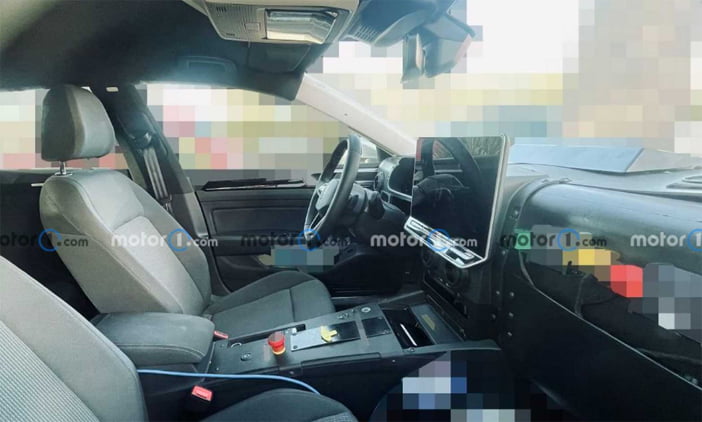
+++ The VOLKSWAGEN Arteon has another update on the way so that the German automaker can keep the big saloon fresh. Spy shots reveal that it’s receiving an interior overhaul by gaining a huge tablet on the dashboard. Starting on the inside, the big display is by far the most significant change there. Given that the current Arteon has an 8-inch screen, this one looks to be in the 12- to 13-inch range to us, maybe even a bit more. In addition, the development team screws a panel around the instrument panel that might be hiding revisions in this area. The centre console also has a cover over it, indicating some design updates here. The photographer blurs out the equipment attached to the passenger side of the dashboard and in the footwell. None of this appears to be material for a production vehicle, though. On the outside, the Arteon’s front end has some small placeholder elements near the headlights. These might be for covering the future location of sensors for improved driving assistance tech. The rest of the exterior styling doesn’t seem to change on this estate. The powertrains aren’t significantly changing, according to Motor.es. Although, some of the options might gain a 48 volt mild-hybrid system. It’s not clear when the refreshed Arteon might debut. The changes don’t appear to be very extensive, except for the interior updates. The Arteon debuted in 2017 . VW unveiled a refreshed version in 2020, and Europe received the Shooting Brake and R variants. This will be the final major upgrade for the Arteon. VW won’t replace it at the end of the model’s life. +++