
+++ BMW has increased production in Munich of its M3 Touring to keep up with demand. The information comes from BMW M boss Frank van Meel. He said that the company was surprised by the amount of interest in the M3 Touring since its debut during last year’s Goodwood Festival of Speed. In fact, he said, the company had to facilitate a production ramp-up within its Munich facility. Despite that increased production, the backlog of orders means that customers are still on wait lists, he said. +++
+++ There’s no doubt that interest and demand for ELECTRIC VEHICLES has soared in the U.S. over the past few years but that doesn’t mean they are flying out of dealership lots. As a matter of fact, many unsold EVs are allegedly collecting dust at dealerships across the country. A new report from Cox Automotive has revealed that the likes of General Motors, Ford, Hyundai and Toyota currently have more than 90 days’ worth of unsold EVs at their stores. Additional data reveals that dealerships across the U.S. have more than 92.000 new EVs in stock. That’s more the triple the number of EVs at dealer lots 12 months ago and may suggest a brief pause in the market growth of EVs across the country. Reuters states that as of June 30, General Motors had 50 days’ worth of Cadillac Lyriqs available at dealerships and according to GM, more than 80% of the Lyriqs and GMC Hummer EVs that it has built are still in transit to dealers. Cox Automotive says that Ford has 86 days’ worth of F-150 Lightnings and 113 days worth of Mustang Mach-E inventory but according to Ford itself, these estimates are too high. The head of Ford’s U.S. sales analysis, Erich Merkle, says that F-150 Lightning inventories sit at 58 days and that includes vehicles at transit. Mustang Mach-E inventories are slightly larger at 83 days of supply. “By no means are those inventories high”. Merkle said. What we do know for sure is that Ford built 46.238 units of the Mustang Mach-E in the first half of the year and sold 14.040. Volkswagen has acknowledged “some softening in EV sales in the U.S. recently” and according to Cox’s data, it has 131 days’ worth of ID.4s in its inventory. The German brand noted that there is strong demand for the electric crossover but that it doesn’t have enough all-wheel drive versions to meet demand. VW also says that there is some “customer confusion” due to the “tax credit eligibility of EV models”. “There’s a natural speed of market growth here that many are fighting against, and there’s a lot of confusion in the market with too many brands”, added investment banker Vitaly Golomb. “The strong will survive here and the rest will struggle”. +++
+++ FORD is entering negotiations with the United Auto Workers (UAW) union and while it produces more of its vehicles in the U.S. than rivals General Motors and Stellantis, it has been revealed that doing so comes at a cost. Approximately 80% of all the vehicles that Ford builds are brought to life in the United States. However, company sources assert that this puts it at a $1 billion annual cost disadvantage to GM and Stellantis. Ford has a $9-an-hour labor cost gap compared to foreign car manufacturers with nonunion workers. It spends an average of $112.000 annually on wages and benefits for each hourly worker and that figure is expected to rise after negotiations with the UAW. In fact, UAW president Shawn Fain has said that he will push for significant raises and additional benefits for its members in response to the record profits enjoyed by Ford, GM, and Stellantis over recent years. The UAW wants to reinstate cost-of-living adjustments and scrap a tiered wage system that caps workers to around $32 an hour. In some regards, Ford has gone above and beyond what it had agreed to when it signed its latest labor contract with the UAW in 2019. In fact, it has created or retained 14.000 UAW jobs since 2019, some 5.600 more than it had committed to. Additionally, it has invested $1.4 billion more than it originally planned and has converted almost 14.100 temporary workers to permanent status in the past 4 years. Appeasing the UAW won’t be easy, however. Last month, Shawn Fain criticized a U.S. Energy Department plan to lend $9.2 billion to a joint venture between Ford and battery manufacturer SK for 3 large EV battery factories in the U.S. Fain said the loan does not take into consideration the wages, working conditions, or rights of union workers. +++
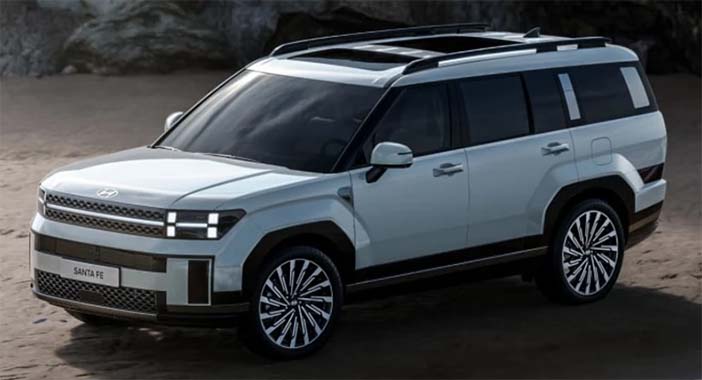
+++ HYUNDAI ’s nearly all-in on its electrification efforts, but it hasn’t forgotten the bread-and-butter SUVs that have brought it this far. That’s why we’re seeing an all-new Santa Fe for 2024, the model’s first complete makeover since 2018, bringing a striking change in the Santa Fe’s appearance. The first and most impactful change with the update is the Santa Fe’s styling, which has been transformed into a boxy, beefy-looking family hauler. Hyundai said it used the Santa Fe’s shape to convey a sense of grandeur, giving it a high hood, sharp fenders, and unique H-shaped headlights that follow other H-ish shapes in the front fascia. The SUV gets 21-inch wheels and now looks the part of a serious off-roader. The automaker also stretched the Santa Fe’s wheelbase, and while we don’t have the new measurements, the change should improve ride quality and interior space for the popular SUV. Hyundai said it designed the new Santa Fe with lifestyle use top of mind. The interior features fold-flat second- and third-row seats and follows the same H-heavy styling that the SUV’s exterior wears. Hyundai equipped a 12.3-inch digital gauge cluster in a curved panoramic display and said that the Santa Fe’s cabin offers contrasting upholstery colors and high-end materials throughout. Sustainable materials headline the interior design, with portions of the headliner and seatbacks made from recycled plastics. Even so, the SUV gets more traditional luxury accents like wood trim and available embroidered Nappa leather. I don’t have specs or details on the new Santa Fe’s specs and configuration, but the automaker plans to share more detail during a full launch of the Santa Fe next month on YouTube. Hyundai also recently showed off the Ioniq 5 N, so it’s shaping up to be a busy year for the Korean automaker. +++
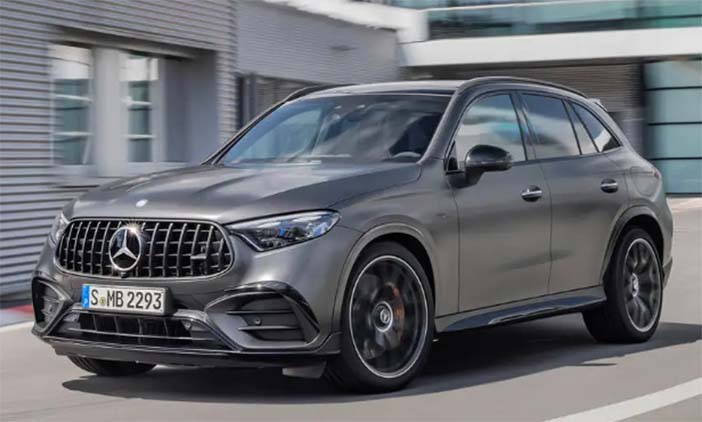
+++ The new MERCEDES-AMG GLC has been revealed, with new design updates, improved interior technology and a 680 hp hybrid-powered range-topper for the first time. Set to go on sale in the coming months, the new Mercedes-AMG GLC will be positioned above the GLC Coupé, which opens for order this month. The entry-level Mercedes-AMG GLC 43 4Matic is powered by a 2.0-litre turbocharged 5-cylinder engine, producing 421 hp at 6.750 rpm, supported by a 14 hp belt-driven starter/generator. Torque stands at 500 Nm at 5.000 rpm. The GLC 43 can sprint from 0-100 kph in 4.8 seconds. For reference, the V8-powered BMW X5 M60’s achieves it in 4.3 seconds. Mercedes-AMG’s flagship GLC 63 S E Performance pairs a 2.0-litre turbocharged engine with a 204 hp electric motor and a 6.1 kWh battery. It has combined outputs of 680 hp and 1.000 Nm. This range-topper possesses a significant hike in performance, with a 0-100 kph in just 3.5 seconds and a top speed limited to 270 kph. Mercedes says the model’s efficiency has improved thanks to its electrification. An on-board charger can supply power at speeds of up to 3.8 kW and the car can travel on electric-only power for up to 14 km. The AMG GLC is also equipped with several technologies to bolster driving dynamics. All cars have 4-wheeldrive and are equipped with AMG Dynamics, which improves electronic stability and steering response in the pursuit of better cornering ability. AMG Ride Control is also fitted as standard in a bid to enhance comfort on uneven road surfaces. Both models gain a sports braking system, active rear steering and a sound-enhancing AMG exhaust system as standard. Mercedes-AMG has kept the traditional yellow and black theme alive with the AMG GLC’s interior. All cars feature black nappa leather upholstery and steering wheel with yellow stitching and seatbelts. Pricing has yet to be revealed for the new Mercedes-AMG GLC. +++
+++ After it invaded Ukraine, almost every foreign brand in the United States’ circle of influence pulled out of RUSSIA . Now, monthly auto sales are down to about a quarter of what they were pre-war, and they are being pointed to as a sign of just how beleaguered the wider economy has become. Before it invaded Ukraine, Russians bought about 100.000 vehicles per month. As a result of reduced supply and other factors, that figure is now down to about 25.000 sales per month. “Russians are just buying less cars, period”, Steven Tian, a Yale researcher who is studying the nation’s economy, told. “That speaks to the weakness of the consumer in Russia. This is as close to a proxy to deteriorating consumer sentiment as there is, and the story it tells is profoundly distressing. Russians just aren’t spending money”. One of the reasons for the rapidly falling sales is the embargo imposed by the U.S. and its allies in Europe, Korea and Japan. Although Russia did have a bit of a domestic industry before the war, its consumers preferred vehicles made by foreign automakers. “It’s not only that sales have plummeted, but it’s that sales of foreign brands were just so high before the war”, said Tian. “If you go around Moscow and St. Petersburg, you find that elite Russians only drive the car brands we recognize, like Porsche, Jaguar, Hyundai and so forth. The only Russians driving Ladas were those with less disposable income”. However, more Russians are now turning to Lada or Chinese brands like Geely. The latter has seen its sales increase by 88 percent year-over-year, but that’s not making up for what was lost following the invasion. Indeed, Tian suggests that the availability of foreign vehicles (and other consumer goods) is just one piece of the economic puzzle. In addition to supply, Russians are also struggling with soaring prices and deteriorating consumer sentiment, negatively impacting the wider economy. +++
+++ The global car industry has been wrestling with a mixture of Covid-related shutdowns and parts shortages over the past few years, meaning that sales figures haven’t been truly reflective of consumer demand. But now most automakers are getting back on track, the sales figures for the first half of 2023 give us a clearer look at the state of the new vehicle market in the UNITED STATES. Figures show General Motors beating out Toyota in the table of biggest selling automakers, as it did last year, and pulling away. GM shifted 1.29 million units, and was up 18 percent, while Toyota’s sales fell 0.7 percent to 1.04 million. Fifth-placed Stellantis was the only other automaker to see sales fall (by 1.3 percent to 809.000); the others making up the top 10 all grew by more than 9 percent. Third spot was for Ford with 999,766 sales (+9.9 percent) and Hyundai-Kia was fourth with 820.180 sales (+17 percent). The rest of the top-10 consists of Honda (631.532; +25 percent), Nissan-Mitsubishi (525.711; +22 percent), Tesla (343.000; +50 percent), Subaru (304.092; +15 percent) and the Volkswagen Group (excl. Porsche 256.697; +12 percent). There was more bad news for Toyota over in the brands table. It was down 2.8 percent to 889.000, putting it in second place behind Ford, which grew 11 percent to 961.000, and under pressure from third-place Chevrolet, whose sales grew by 17 percent to 846.000. Next came Honda (557.890; +23 percent), Nissan (447.885; +24 percent), Hyundai (394.613; +15 percent), Kia (394.333; +18 percent), Tesla (343.000; +50 percent), Jeep (335.487; -12 percent) and Subaru (304.092; + 15 percent). The data reveals sales growth in nearly every segment of the North American market, the biggest of which at over 1.2 million units, compact crossovers, was up by 15 percent. Full-size pickups weren’t far behind in volume and were up 11 percent, while sales of large crossovers grew by 10 percent. Midsize SUVs (down 9.8 percent to 338.000) was the only segment to suffer a drop in sales. No one will be surprised to learn that Tesla dominated the EV segment taking 3 out of the top 5 spots. Its biggest performer was the Model Y that found 191.000 buyers, up 76 percent, in no small part due to some aggressive price cuts, while the Model 3 registered 122.000 sales and was up by 35 percent. The Volkswagen ID.4 and Ford Mustang Mach-E were miles behind on 16.500 and 14.000 respectively, but while the VW’s numbers were up by 273 percent, Ford’s fell by 21 percent. The Chevrolet Bolt took third spot with 33.659 sales (+361 percent). Next came the Tesla Model S (19.100; -5.9 percent), the Volkswagen ID.4 (16.448; +273 percent), the Ford Mustang Mach-E (14.040; -21 percent), the Hyundai Ioniq 5 (13.641; -0.4 percent), the Tesla Model X (11.900; +16 percent), the Kia EV6 (8.328; -34 percent) and the Rivian R1T (7.811; +117 percent). In the first half of 2023, the bestselling models in the United States (pick-up trucks excluded) were the Tesla Model Y (190.500; +76 percent), the Toyota RAV4 (187.017; -6.9 percent), the Honda CR-V (163.697; +40 percent), the Toyota Camry (150.742; +11 percent), the Nissan X-Trail (147.745; +69 percent) and the Jeep Grand Cherokee (124.956; -7 percent). +++