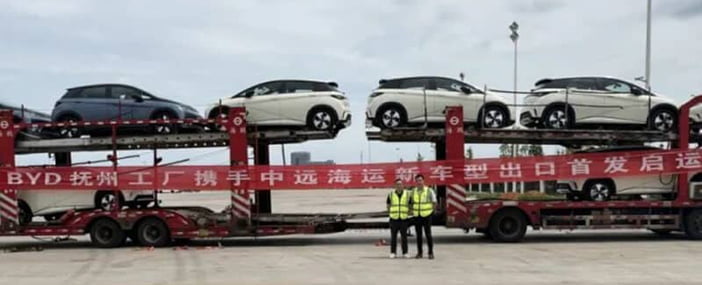
+++ The ship with the first batch of BYD Dolphin cars has set out to Europe. It contains 152 units with different trim level and body color. Honestly, it isn’t a great number. Maybe, BYD is just testing waters and the next batches will be bigger. The Dolphin’s size is 4.290 x 1.770 x 1.570 mm with a wheelbase of 2.700 mm. The more expensive versions of the Dolphin are equipped with the 60 kWh LFP battery, made by BYD. It is paired with the 204 hp electric motor. As for the range of the Dolphin, it can run up to 427 km on a single charge. This powertrain is similar to the Atto 3 that is already being sold in Europe. In Europe, the Dolphin starts at 29.990 euro. It is clearly aimed at the Volkswagen ID.3. Previously, the BYD Dolphin sales in Europe were said to start in June. But the first batch of actual cars is only on its way to Europe at this point. It seems that something didn’t go as planned on the BYD side. So, these cars will arrive in Europe only in August. +++
+++ Across the room from FORD Advanced Product Development chief Doug Field was a pile of two-dozen auto parts, each with its own small computer, and software written by the parts manufacturer. Field, who was hired away from running Apple’s secret auto project 2 years ago, and before that served as Tesla head of engineering, explained at an investor event that the automaker is moving to get rid of the pile, consolidating most computing decisions into a central processor running software written by Ford. The change will fundamentally change how people use their cars. Most automakers are counting on software services to boost future profit margins. Field, 57, also Ford’s chief technology officer, talked to The Associated Press about the change and the transformation to electric vehicles. The interview is edited for length and clarity. Question: How far along is Ford on moving to this central computing system? Answer: “The transition has happened where we designed the hardware and the software for the immediate user interface, the center screen. That’s gone into both the F-150 Lightning EV as well as the internal combustion F-Series. The next step is with our next generation of electric vehicles (coming in 2025). We’re expanding to control the overall vehicle and control over the autonomy system. There will be software in parts that comes from suppliers that is appropriate. The reason for that is to make it as fast as possible. A great example is firing the airbag. We don’t want that coming back through the central passage”. Q: As a driver, why should I care about this? A: “The car’s a robot, which means the interaction with the software includes pieces of hardware. So something like an Amazon interface where you know a delivery is coming. A one-time code opens the trunk. Doesn’t open the rest of the car. They get to drop it off. That requires an interaction between centralized software and what today is a locking-unlocking module. There also are sensors that we don’t have access to the information. An easy example is an autonomy system that’s supposed to keep you in the lane. There’s a camera. We can’t say to the customer that we’re going to give you a dash cam for free or for a subscription where it’s always running. And if we detect any kind of a bump or anything like that, you’ve got a 30-second recording. We will be able to do that. We talked a little bit about our ability to predict if the car is heading toward a failure or a wear-out situation. I want to count wiper strokes combined with how much water is coming down and where it’s being driven and how dirty it is. Maybe develop an algorithm that knows exactly when your wiper blades are wearing out”. Q: How do you come up with something that’s compelling enough to get me to part with my hard-earned money and subscribe? A: “The model is already transitioning from ‘you check a box when you buy the car’ to ‘you can get a free trial.’ You only part with your hard-earned money after you are on the road trying it and say, ‘this is pretty great.’ A big part of how I try to guide the engineers is you must earn the right to collect money. You’re going to come up with things, you’re going to try them”. Q: You’ve shown the bear cam, where a Bronco parked at a campsite recognizes a bear nearby and may honk the horn to scare it away. How important is security? A: “We are going to build a whole set of services around this. The car is the most sophisticated sensor that you have in your life, and the number of accelerometers and microphones and cameras and things on it will allow it to be not only something that protects you when you’re in the car, but it’ll actually be useful when you’re not there. Even acting as a remote sentry if there’s stuff going on outside the house”. Q: Does having a centralized computer open you more to the possibility of hacking? A: “Anything where you are allowing the car to be software-updated opens you to that possibility. You need to have an architecture where that has been really carefully thought through. And the more you go toward things like firing the airbags or controlling the steering, the more that becomes a pretty involved process to actually update your access”. Q: How long will Ford still be selling internal combustion vehicles? A: “There are a number of applications where it is going to be near impossible for an EV to perform the same mission. There will be many, many places where EVs are a slam dunk. There will be ones where it’s going to take a lot of work to get battery technologies to the point where it could serve that mission. There are ones we see now that the ICE engine needs to be a part of it. Maybe we partially electrify it, but they’ll be out there. The incremental value to the world of getting those last ice engines out versus the value that they provide to an ambulance in Alaska. That will take a very, very long time”. Q: Affordability has become a big issue. Ford has gotten out of cheaper cars in the U.S. Is there a $20,000 EV coming? A: “I don’t want to talk a lot about what we’re doing here. It is possible, with the advent of EVs, to make step changes in the way vehicles are built and sourced. Yes, I believe very low cost EVs are possible. I also believe the way the business model is changing is going to require it. If you are in the software business, what you want is installed base. How many people can I sell software to? To do that, you need affordability”. +++
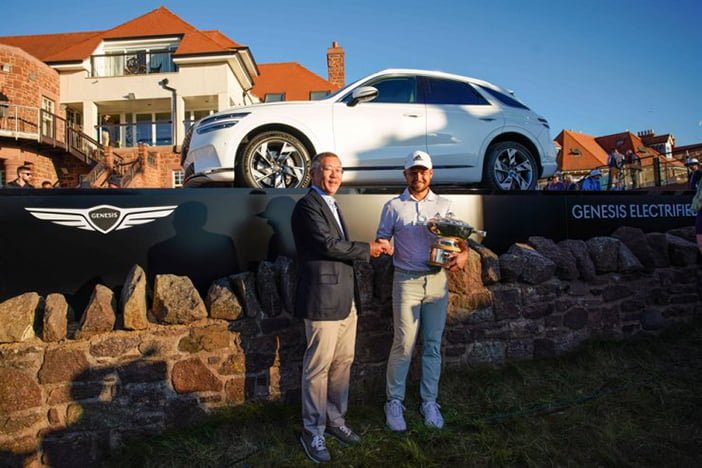
+++ The Hyundai Motor Group has been pushing to enhance the image and recognition of its luxury brand GENESIS in the global market. As part of such efforts, the automaker has been sponsoring major international golf tournaments. Song Min-kyu, global head of Genesis, said in an interview that the prestigious sports events were selected to promote the automotive brand, as they share the ideals of “respect, integrity, and excellence”. “We are committed to building a legacy through golf and we believe that our differentiated standards of design, technology, and hospitality will help us to achieve this goal”, Song said. “As Genesis expands its market globally, we would also like to expand our global golf platform to be closer to our customers in major markets”. Genesis has been involved with the sport ever since the brand was launched on the global stage in 2015, sponsoring 6 international golf tournaments including the Genesis Invitational, Genesis Championship, the Presidents Cup and Genesis Scottish Open. He is enthusiastic about the upcoming 2023 Genesis Scottish Open, one of Europe’s most prestigious golf tournaments, set to kick off at the Renaissance Club in North Berwick, Scotland between July 13 through July 16. “This year, we are looking forward to another world-class field, and having our Korean players compete against the best golfers in the world”, he added. “We worked tirelessly to upgrade the level of care for players and their companions to reflect our uniquely sophisticated approach to hospitality, where we treat all our customers and stakeholders as ‘son-nim,’ or honored guests”. Song believes sponsoring world-class tournaments creates more opportunities on a global scale, and the Genesis Scottish Open could enhance recognition of the brand, which is relatively new in the market, as well as being a means to reach out to more European customers. The Genesis brand has been making strides since its launch in Europe in May 2021 and has been pushing to transition to electric with the launch of 3 electrified models: GV60, G80 and GV70. “We began our momentum in Europe last year, and this year, we’re making strong progress in the region, the home of premium luxury cars, by continuously expanding our lineups and brand spaces. In fact, our new studio located in Edinburgh is set to open next week, further contributing to our growing brand presence in the UK market”, Song said. Song has been the Global Head of Genesis & Chief Operating Officer (COO) of the luxury brand since the beginning of 2023. He was appointed COO in September 2021 and played a leading role in strengthening global business operations, elevating the brand’s value in the luxury automobile market. +++
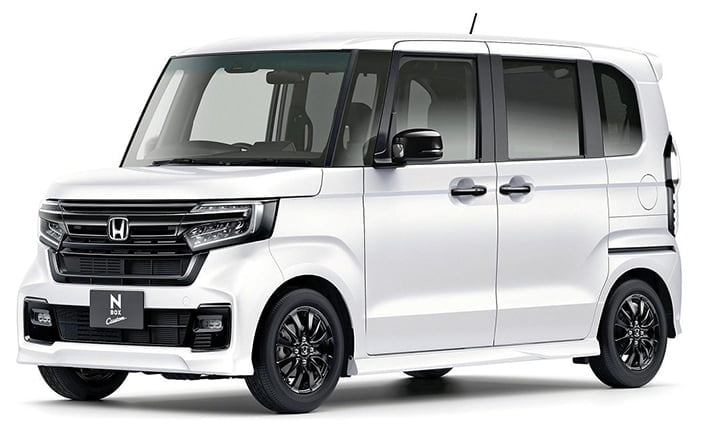
+++ The bestselling new car in Japan in the first half of 2023 was HONDA ’s N-Box minicar, up 8.0% from the last year’s same period to 112.248 units, the Japan Automobile Dealers Association and the Japan Light Motor Vehicle and Motorcycle Association announced Thursday. Toyota’s Yaris came in second with 97.421 units and Toyota’s Corolla came in third with 82.374 units. +++
+++ RENAULT ’s new Scenic, which is set to take on an all-new bodystyle as it transitions into an SUV. Renault is undergoing a so-called ‘Renaulution’ at the minute, with the legendary 5 and 4 returning as electric cars and the Scenic is set to get a fully-electrified powertrain, too. The replacement of the Scenic has already been teased by the Scenic Vision Concept in May of 2022, which previewed the styling direction that the new car will take. Now the production version, which will be similar in size to the hybrid-only Austral, has been spotted undergoing development for the first time. The new Scenic will use the all-electric CMF-EV platform that made its debut in the new Megane Electic. Whereas the Megane is a competitor for Volkswagen’s ID.3, the Scenic will be a larger car, rivalling the ID.4. The same CMF-EV architecture also underpins the Nissan Ariya. Lead designer Gilles Vidal, said the Scenic Vision Concept’s exterior design is “more than 90 per cent production car”. As for the interior, the concept’s yoke-style steering wheel and intricately detailed dash won’t make its way onto the finished Scenic. I expect the Scenic E-Tech Electric will go on sale in 2024 and it will be distanced from the new electric Megane according to Renault boss, Luca De Meo: “We are not going to do another MPV; we’re going to make a more progressive model than that”. He added that the Scenic would need to offer “space and range” beyond that of the new Megane. The new Scenic will only be available as a 5-seater. When asked at last year’s Munich Motor Show if the CMF-EV platform could support 7 seats, Renault’s executive vice-president of engineering, Gilles Le Borgne, told me: “No, it’s not planned to do that. We can have 4-wheel drive, but not 3 rows”. That doesn’t rule out a new 7-seat Grand Scenic model on a revised CMF-EV platform at some stage; similar to the new Espace which is essentially a stretched 7-seat version of the Austral. And Le Borgne’s comments did imply that a successor to the 4-wheeldrive RX4 version of the original Scenic would be technically possible. The CMF-EV platform should allow 3 different takes on the Scenic to be offered. A cheaper version with a 40 kWh battery and a range of around 320 km would target buyers in urban areas, while a 60 kWh battery is likely to appeal to those wanting to take their families on longer journeys. Rapid charging should enable a top-up from 15 to 80 percent in around 30 minutes, while the latest electronic safety and driver-assistance technology should maintain the Scenic’s reputation for excellent crash-safety scores. The Scenic’s Nissan Ariya sister car is available with an 87 kWh battery with either a 242 hp single-motor or 306 hp dual-motor powertrain and it’s possible we could see these feature in a range-topping Scenic. The taller Scenic should go some way to answering criticisms over a shortage of space in the back seats of the Megane; one of few drawbacks of the new model. The greater height will have huge benefits in the boot, too. And as with the original Scenic, expect some clever seat-folding engineering that will let the car switch simply from 5-seater to van. Elsewhere, the Scenic is expected to make use of the Megane’s impressive interior technology, with a 12.3-inch digital instrument cluster that’s seamlessly linked to a 12-inch portrait-orientated infotainment screen, powered by Google. Expect eco-friendly sustainable materials to feature throughout the cabin, too. Even though large 20-inch wheels are likely to follow on to the Scenic from the Megane, Renault engineers will probably move the focus more towards comfort to suit more family-orientated buyers. However, unlike with the upcoming new 5 Electric, Renault performance arm Alpine has no plans to fettle either the Megane or the Scenic, concentrating on its own CMF-EV SUV model, the GT X-Over that’s set to arrive after the Scenic in 2025. +++
+++ TESLA is set to realise fully autonomous vehicles “later this year”, CEO Elon Musk said Thursday, in the billionaire’s latest forecast for the long-anticipated milestone. “In terms of where Tesla is at this stage, I think we are very close to achieving full self-driving without human supervision,” Musk said via video link at the opening ceremony of an artificial intelligence conference in Shanghai. “This is only speculation, but I think we’ll achieve full self-driving, maybe what you would call Level 4 or 5, I think later this year”, the billionaire added, referring to 2 of the most advanced levels of autonomous driving technology. The mercurial entrepreneur and Twitter owner admitted that he had been wrong in previous predictions on this timeline, but added: “I feel like we’re closer to it than we ever have been”. Musk has missed his own deadlines for a fully autonomous vehicle, and Tesla’s driver-assistance technology has provoked regulatory probes in the United States. China is the world’s biggest electric vehicle market and Tesla announced in April it would build a second massive factory in Shanghai. His appearance at the World Artificial Intelligence Conference in Shanghai marks his latest effort to maintain close links to China, following a visit to the country in May. Electric vehicles make up a quarter of car sales in China, the world’s largest car market, and dozens of new models from domestic and Western brands were unveiled in April at the country’s first auto show since Covid restrictions were lifted. Tesla reported a drop in first-quarter earnings this year, with the company undertaking a series of price cuts in the face of competition from other automakers. +++
+++ TOYOTA is considering running 2 of its domestic factories 24 hours a day, including on Saturdays and Sundays, to produce electric vehicle batteries. Toyota’s factories usually do not run late at night, early in the morning or on holidays, but this exceptional measure is being mulled in anticipation of greater demand for EVs. When producing automotive batteries, time is required to start and stop the machinery, and interrupting the production process midway can lead to more defects. Continuous operation is seen as essential for quality batteries, which are a core component of EVs. The 24-hour battery production plan targets Toyota’s Myochi Plant in Miyoshi, Aichi Prefecture, and its Shimoyama Plant, also in the city. Both plants are scheduled to begin battery production by 2026, and discussions with labor unions have already commenced. Other automotive battery manufacturers have implemented 24-hour operations, and Toyota intends to follow suit. Toyota aims to boost its global EV sales to about 3.5 million units by 2030, around 140 times the current figure, and the company is expected to accelerate EV production in Japan. Last year, Toyota announced plans to invest up to ¥730 billion in battery production in Japan and the United States. In the U.S., it is constructing a new factory in North Carolina in collaboration with Toyota Tsusho Corp. +++
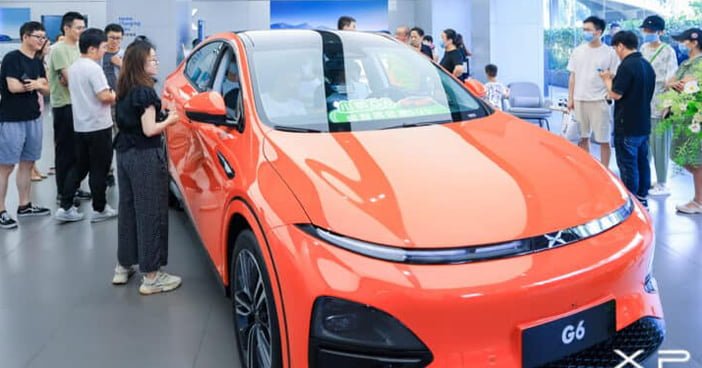
+++ The XPENG G6 fastback electric SUV received 35-40 pre-orders per store in first 72 hours after the market launch in China. The Tesla Model Y is the biggest rival of the G6, according to customers. As mentioned, the Xpeng G6 is a fastback SUV that is based on the SEPA 2.0 architecture. It is a mid-size crossover with dimensions of 4.753 x 1.920 x 1.650 mm and a wheelbase of 2.890 mm. The G6 adopts the brand’s latest design language with a drag coefficient of 0.248 Cd. It is available in Pro, Max and Performance trim levels. Depending on the battery, the G6 has 580 to 755 km of range. The RWD version has 296 hp, and the 4WD version got 484 horses. The price range of the G6 is 51.000 to 69.000 euro (Dutch pricing). As for the customer profile, they are aged 25-40 years. 70% of them are male. The proportion of housewives as customers increased. Female customers have more interest in intelligent driving functions than male customers do. As for the most popular trim level, it is the Max trim level with silver exterior color and gray interior color. Worth mentioning that demand in trim levels varies by regions. For an example, the G6 Max is the most popular configuration in top tier cities such as Shanghai, Beijing, Wuhan, Chongqing, Guangzhou and other cities. But in smaller cities, customers prefer the Pro version. As for the performance version, the demand for this trim-level is quite low in China. Speaking about the main competitors of the Xpeng G6, customers were also asked what other cars they weight in for purchase. 40% of customers compared the G6 with the Tesla Model Y. Moreover, in big cities, customers that are interested in intelligent driving pick the G6 because of the City NGP system. On the other hand, another group of customers stays with Tesla because of the brand power. 20% of buyers compare the G6 with BYD Seal. The extended delivery date of 10-12 weeks is leading to a lower conversion rate with the potential customers. It means that Xpeng need to push the production process to keep the demand high. Currently, there are 288 Xpeng stores in China. It means that there were 10.800 to 11.520 orders in 72 hours. But we should keep in mind that only 55-60% of customers confirmed these pre-orders. It means that the actual number is lower, at 5.940-6.480 units. Since the delivery time of the G6 reaches 10-12 weeks. It means most of them will happen only in August. So, Xpeng’s July sales number will be still relatively low. I expect the explosive number of units sold in August. +++