
+++ In GERMANY , The BMW Group, Mercedes-Benz and Audi each produce an array of electric and hybrid offerings. While some of these automakers’ vehicles might appear similar on paper, the technical underpinnings and EV strategies behind them are incredibly different. The first out of these manufacturers to the EV party was none other than BMW. Releasing the i3 in May 2014, BMW has taken an early adopter approach to the silent powertrain. After the turn of the decade, the Bavarian automaker introduced several new EVs to the U.S. market, including the i4, iX, i7 and the i5, which will be available this fall. While BMW Group has been delivering multiple well-regarded EV models, the automaker predicts that half of its sales will be electric by 2030. In other words, BMW hasn’t pledged to go fully electric by a specific date. That said, BMW’s upcoming Neue Klasse platform is set to debut, plus the manufacturer recently made a $1.7 billion EV investment into its Spartanburg, South Carolina-based manufacturing facility. In a push for more EV sales, BMW’s sub-brand, Mini, is taking a more aggressive EV approach with 3 upcoming electric models. With new exterior and interior designs, Mini can reestablish itself as the premier offering for high-end city cars. Audi is also adopting electric vehicles in several vehicle segments, and the brand is currently working on adopting a new naming convention for its lineup. Audi’s electric products will be designated with even numbers, whereas internal combustion engine models will feature odd numbers. Audi currently offers the Q4 e-Tron, Q8 e-Tron and e-Tron GT. There will be a Q6 and A6 e-Tron available next year. Out of the 3 German car manufacturers, Mercedes is taking the most intrepid approach. Mercedes-Benz says it will be fully electric where market conditions allow, and all of its new vehicle architectures will be electric from 2025 on. The Mercedes team estimates that 70 percent of its vehicle sales will be attributed to EVs at the turn of the decade. +++
+++ JAGUAR reports 15.467 global retail car sales during the second quarter of 2023, which is nearly 2 percent more than a year ago. In sold 30.901 cars in the first half of 2023 (up 4%). The Land Rover brand noted a much higher growth rate of 36 percent and sold 86.527 cars in the second quarter (up 36%) and 173.982 cars (up 36%) in the first half of the year, allowing the broader Jaguar Land Rover Group (part of Tata Motors, now called JLE) to noticeably rebound to 101.994 sales (up 29 percent year-over-year) in the second quarter and to 204.883 cars (up 30%) in the first half of the year. The all-electric Jaguar I-Pace, on the other hand, is fading. The model noted just 1.339 units in the second quarter (down 38 percent year-over-year), which is the 8th consecutive quarter of year-over-year decline. BEV share also decreased from 14.3 percent a year ago to 8.7 percent recently. During the first half of 2023, a total of 2.798 Jaguar I-Pace were sold (down 33 percent year-over-year), which was about 9.1 percent of the brand’s total volume. For reference, in 2022, Jaguar I-Pace sales amounted to 7,307 (down 27 percent year-over-year; 11.9 percent share of total Jaguar sales). Cumulatively, over 60.000 Jaguar I-Pace were sold globally. 2019 was the best year with 17.355 sales, next came 2020 with 16.457 sales and 2021 with 9.970 sales. 2023 is now on track to become the slowest year for Jaguar I-Pace sales: potentially around 5,000 units. It’s hard to be optimistic about the Jaguar I-Pace, as the 2024 model year will retain its existing powertrain, while competition becomes more fierce, both on the performance/range level and in regards to pricing. Next year should bring a major change to Jaguar and Land Rover electrification, as a new wave of all-electric models will arrive. The first will be an all-electric Range Rover, scheduled for market launch in 2024. Jaguar is set to become a 100 percent all-electric luxury brand with multiple new models, including a 4-door GT cross-over (scheduled for unveiling in 2024 and assigned to the production facility in Solihull, United Kingdom). Some of the new BEVs might get a driving range of up to 700 km. +++
+++ LOTUS , the Norfolk-based sports car manufacturer that was established 75 years ago by Colin Chapman, is known for a lot of things but massive production numbers aren’t one of them. Until now, that is. In the first half of the year, the Geely-owned marque saw its order book grow to approximately 17.000 vehicles worldwide, the company said, breaking all previous sales records and surpassing with great ease the measly 576 units it sold in all of last year. The biggest contributor to this massive improvement is the all-electric Eletre, a SUV which debuted in the spring of 2022 and got in the hands of Chinese customers at the end of March this year, with UK and European deliveries set to begin later this summer. Built at Geely’s factory in Wuhan, China, the Eletre is powered by a 112 KWh battery pack that sends juice to a pair of electric motors which are capable of making 612 hp and 710 Nm of torque in the base variant and 918 hp and 985 Nm in the R trim, enabling a 0 to 100 km per hour sprint in as little as 2.9 seconds. It also costs 98.690 / 124.090 euro in the Netherlands, so it’s up there with heavy-weight names like the Tesla Model X and the recently revealed Cadillac Escalade IQ. The Emira mid-engined sports car also made a big splash, being produced in over 2.200 units in the United Kingdom in the first 6 months of the year, which is a 381 percent increase compared to the fiscal year 2022, Lotus says. Historically, the brand known for its lightweight sports cars like the Elise and Exige rarely had years when it managed to ship more than 1.500 cars. Back in 2020, it sold 1.378 vehicles and in 2021 it saw an increase of 24 percent (1.710 units), making it the best year in a decade in terms of sales. Now, that record is a thing of the past, as the Emira alone sold roughly the same number of units in the first half of the year as the whole output for 2022 and 2021 combined. As for the 2.520 kilogram zero-emissions SUV, it might not be the vehicle of choice for purists, but the fact of the matter is that SUVs sell and that helps Lotus stay alive and continue to develop engaging, low-to-the-ground sports cars like the Emira. It’s the same story as Porsche, which introduced the Cayenne in 2002 and made enough money from selling it to continue churning out the 911. Expansion has been another crucial strategy for Lotus, extending its retail network to 193 stores by opening 24 new outlets in the first half of 2023. This expansion enhances accessibility for customers, providing a stronger foothold in the competitive luxury car market. The partnership with Kolon Mobility Group also marked Lotus’s reentry into South Korea, tapping into one of the largest luxury markets in the world. Recognition in the form of awards further solidified Lotus’s reputation. 9 awards were won globally, including ‘SUV of the Year’ for the Eletre at the GQ Car Awards and ‘Best Performance Car’ for the Emira at the UK Car of the Year Awards. These accolades celebrate Lotus’s commitment to innovation, performance, and design excellence. Feng Qingfeng, CEO of Lotus Group, summarised the success best when he remarked on the company’s transformation since 2018. According to him, Lotus is “firmly on track to becoming a global performance brand by 2028”. Plans for the second half of the year are already underway, and Lotus expects to surpass all previous years in production and sales. Lotus’s record-breaking first half of 2023 is a compelling showcase of the brand’s strength, innovation, and adaptability. While Lotus spent most of its history with a much smaller, yet passionate following that celebrated its cars’ superior handling and dynamics, as well as the brand’s racing prowess, this new era for the brand has catapulted it into global stardom at the forefront of innovation. It stands as a testament to the new era of luxury vehicles, with a clear emphasis on electric mobility and global expansion. The industry will undoubtedly keep a close eye on Lotus’s continued growth as they race towards a promising future. +++
+++ The long-awaited successor to the McLaren P1 is set to use electric power when it launches at the end of the decade. Since the P1 was launched in 2012, the firm has frequently said through various different managements that there would need to be a step-change in technology for a successor to follow. MCLAREN has launched several hypercars since the P1, including the Senna, Speedtail, Elva and Solus GT, but none has been in the same lineage as the 1992 F1 and P1. However, developments now, and ongoing over the rest of the decade, in battery-electric drivetrains make such a model more likely than it has ever been. When asked if a model at the very top of the McLaren range was in the works to rival the likes of the all-electric Porsche Mission X, Porsche’s own successor to the P1-rivalling 918 Spyder, company boss Michael Leiters said: “We’re quite busy, yes”. Leiters detailed EVs as 1 of 3 pillars of powertrain development for McLaren, alongside internal combustion engines and hybrids, which will grow over the next 5 years to make up 90% of McLaren sales by that point. As it stands, Leiters said the firm was “not sure” on electric supercars. “The main reason for that is weight. We don’t want to make a car that is 2.000 kg and 2.000 hp. Anybody can do that. That’s not in the DNA of McLaren. “We want to make a car that is comparable to the 750 weight-wise; we don’t need 2.000 hp. We’re working on concepts for that, we’re exploring that and we have really exciting ideas around that. But it has to outperform what we do on an ICE”. ‘Outperform’ refers to not only the pure power output or performance figures but also the way the car handles and its agility. McLaren also expects a technology change for EVs not only in their capabilities but also in their ability to be exciting to drive and to fit within the brand’s DNA. Leiters expected such an electric car to be ready “maybe at the end of the decade”. On the positioning of what that electric car would be (hypercar or supercar) Leiters said: “In general, I think the best way to introduce a new technology is top down”. That hints at potential for any innovative lightweighting measures and battery hardware to trickle down into the Woking firm’s more ‘mainstream’ line-up. However, while McLaren is investigating electric cars, it is doing so without customer demand for them yet, as Leiters revealed when asked if any McLaren owners had asked for an EV. “No, but we have to be careful”, he said. “Times are changing and we have to prepare for new times. The success of the 750S shows our customers love ICE cars, but maybe there are other customers and they’re interested in other stuff”. More broadly, he welcomed the EU’s proposal to allow cars powered by e-fuels to stay on sale as he doubts there is one technology to cover all use cases. “For a use case like we have, low volume and low mileage, you have to invest so much in the emissions in the production of an electric vehicle. How can we recover that in our lifecycle? It doesn’t make sense, right? So I think it’s very important to always consider the environment and the circumstances in which you are making decisions”. +++
+++ The PORSCHE TAYCAN might be a hefty car, but it doesn’t handle like one in an emergency. Newest proof was a challenging moose test. The Taycan GTS sits in the model lineup between the 4S and the Turbo. It has a dual-motor powertrain making 517 hp (517 metric horsepower) and 850 Nm. The EV can crank out up to 598 hp for short bursts with launch control, which can propel the sedan to 100 km per hour in just 3.7 seconds. The Taycan was taken through the slalom first, and it handled the course well, stable through the cones. It completed the course in 21.5 seconds, beating cars like the Alpine A110 S (21.6 seconds), the Smart #1 Brabus (22.5 seconds), the Polestar 2 (22.8 seconds) and the Audi RS3 Sportback. The Porsche also excelled at the moose test. Its initial pass at 76 km/h impressed the reviewer, with no cones sacrificed to the tire gods. The EV’s best attempt came at 78 km/h). The car couldn’t complete the course over that speed without hitting a cone. It continued killing cones at 80 and 83 km/h), but still handled well at the limit. The Taycan GTS matched the figures of Taycan Turbo S in the moose test. It also bested the Taycan Cross Turismo, which could only make it through the challenging course at 74 kph. The GTS wore Pirelli P Zero 21-inch tyres measuring 265/35 ZR21 and 305/30 ZR21. Drivers hope they never have to take evasive manoeuvres behind the wheel, but they do happen, and understanding how a car reacts in that situation could make a big difference in the outcome. The moose test doesn’t push vehicles to their extreme; instead, it tests them in a real-world scenario where seconds matter. Cars with tall statues, like crossovers and SUVs, can struggle in the test. The high centre of gravity is harder to keep stable with quick manoeuvres. EVs have the added benefit of putting a lot of the vehicle’s weight low in the body, lowering the centre of gravity, and helping to improve the handling. +++
+++ As the European car market continues to change (thanks to the Tesla boom and the arrival of Chinese brands) a lot has happened to the traditional segment leaders. Europe is by definition a very competitive market with high safety/emissions standards. It is the third largest in the world, after China and the United States, and second in the adoption of electric vehicles. But who has won and who has lost in the last 20 years? Between 2003 and 2023, one of the most important moments in the European automotive market was the SHIFT IN BRAND DOMINANCE . The region has traditionally been led by 7 major automakers: Fiat from Italy; Citroën, Peugeot plus Renault from France; Volkswagen plus Opel from Germany and Ford from the United Kingdom. In 2003, these 7 brands (Opel including Vauxhall) controlled almost 58 percent of new car registrations in Europe (considering 29 markets). Their placement in their respective home markets has allowed them to occupy a relatively strong position compared to Japanese and Korean brands. For example, market share in their home markets ranged from 10 percent of Opel in Germany to 27 percent of Renault in France. While these figures were significantly lower than those of the 1990s, they were satisfying because at that time Korean brands had not yet taken off and Japanese brands were trying to win over European consumers. This started to change with the SUV boom, ushered in by the first-generation Nissan Qashqai. Meanwhile, Hyundai and Kia opened plants in the Czech Republic and Slovakia, producing competitive cars that have met the taste of local motorists. The result? In 2013 the Big-7 accounted for almost 49 percent of volume in Europe, down 9 points from a decade earlier. Between 2003 and 2013, the market share lost by 6 of these brands varied between 0.9 points for Fiat and 4 percentage points for Renault. The only exception was Volkswagen, which increased its market share from 9.8 percent in 2003 to 12.6 percent in 2013. This year, in June, the situation for these brands was even worse. Fiat, Citroën, Opel/Vauxhall, Ford, and Peugeot hit their lowest level in 20 years. Renault placed second among the lowest market shares, after gaining 0.2 points from the full-year 2022, when it had recorded an all-time low. On the other hand, Volkswagen managed to increase its market share, or at least maintain it. With a share of 10.6 percent in the first half of 2023, it lost 2 points compared to 2013 but gained 0.8 points compared to 2003. The Dieselgate scandal was certainly offset by high-quality cars and the ability to introduce products in the right segments at the right time. In addition to the small gain the German manufacturer recorded, the big winners over the past 20 years have been German premium brands, Toyota, Hyundai, Kia and, most recently, Tesla. All of them have something that the big European brands don’t have: greater flexibility. This allows them to offer fresh products on a quicker scale that better fit the latest consumer needs. At the same time, most of them were less exposed to the European crisis than there were between 2011 and 2014, and many have used their strong global presence to save costs. Will their struggling colleagues take note? +++
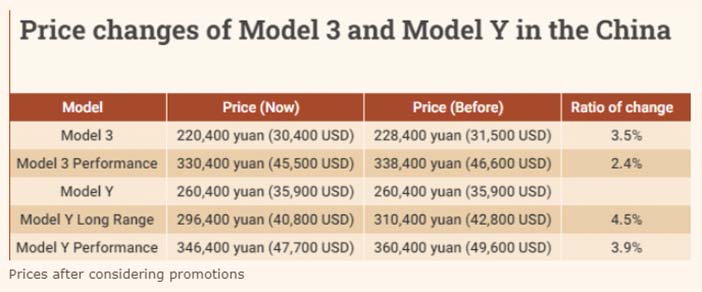
+++ On August 7th, TESLA made a price cut in the Chinese market by announcing price reductions for Model 3 and Model Y. This adjustment in pricing was accompanied by a time-limited subsidy initiative targeting the Tesla Model 3 vehicles currently in stock. The newly introduced subsidy amounts to 8.000 yuan ($1.100), aimed at enhancing the appeal of the Model 3 to potential buyers. Specifically, the alteration in pricing involves the Model Y long-endurance version, which saw its starting price decrease from 313.900 yuan ($43.200) to 299.900 yuan ($41.300). Similarly, the Model Y high-performance version underwent an adjustment from 363.900 yuan ($50.100) to 349.900 yuan ($48.200). The price cuts signify Tesla’s strategic efforts to enhance the accessibility and attractiveness of its offerings within the Chinese electric vehicle (EV) market. Reports indicate that between August 14th and August 30th, individuals placing orders for the Model 3 rear-wheel drive version and completing the vehicle’s delivery process are eligible to receive the 8.000 yuan ($1.100) subsidy. Furthermore, customers availing themselves of this subsidy must purchase car insurance through affiliated insurance agencies. It is worth noting that Tesla has retained a previously existing preferential activity whereby inputting the recommendation code of other car owners can lead to a discount of 3.500 yuan ($480). These combined initiatives underscore Tesla’s commitment to creating a favorable pricing landscape for potential customers. In the backdrop of Tesla’s pricing adjustments, it is noteworthy that the broader EV market in China has witnessed a trend of price reductions among more than 10 electric vehicle brands over the past month. This competitive pricing environment has prompted consumers to speculate about the potential launch of a new Model 3 by Tesla. Consequently, the sales performance of the Model 3 experienced a notable decline within the Chinese market. This decline and a noteworthy increase in existing Model 3 vehicles contributed to a challenging sales performance for Tesla’s Shanghai plant in July, which marked a nadir for the year. These factors underpin Tesla’s strategic decision to introduce price reductions for its high-end models to stimulate demand and bolster sales. Upon accounting for the various preferential activities and incentives, the adjusted minimum purchase prices for Tesla’s new vehicles in China stand at 220.400 yuan ($30.400) for the Model 3 and 260.400 yuan ($35.900) for the Model Y. These revised price points are aimed at increasing Tesla’s competitiveness and appeal within the dynamic and rapidly evolving Chinese electric vehicle market. +++
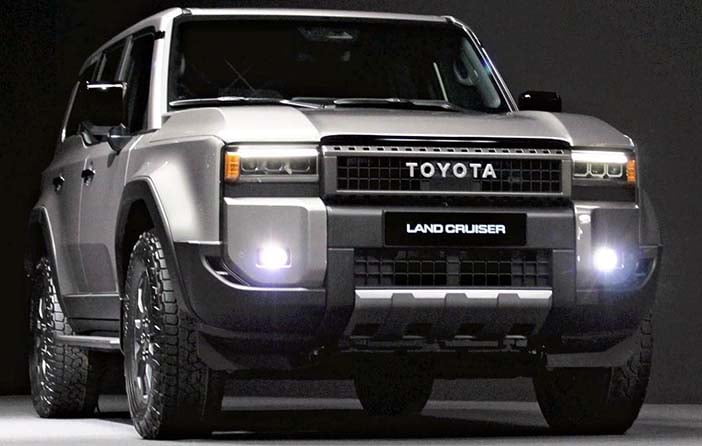
+++ The newly revealed Europe-bound TOYOTA LAND CRUISER retains the beefy appeal of its predecessors, albeit with a retro twist, and seems to have garnered positive reactions from enthusiasts. But how will it age in an era of increasingly strict emissions and electric cars? As of now, Toyota has no immediate plans of introducing plug-in hybrid (PHEV) or fully electric (BEV) versions of the retro-styled SUV. Even though its turbocharged 2.4-litre engine will be paired with a 48 hp electric motor (housed within the eight-speed transmission), it’s safe to assume that the e-motor will have a diminutive impact on emissions. The Land Cruiser will likely remain a gas-guzzler. But Toyota is considering PHEV, fuel-cell, or an all-electric version of the iconic SUV. Incorporating any of the alternative propulsion systems into the TNGA-F platform would have pros and cons, said the vehicle’s chief engineer Keita Moritsu. Although Toyota engineers have reportedly started brainstorming future electrified variants. The capabilities of a fuel-cell version would be ideal for long-range driving and towing, but limited infrastructure could hinder its wider adoption, said Moritsu. If anyone can master a fuel-cell EV, it’s Toyota, as the brand was among the first automakers to introduce the technology, for which it owns over 5.000 patents. Toyota deemed the patents so important that it opened up the technology for royalty-free use until the end of 2020. Moreover, the ladder frame platform isn’t designed to accommodate hybrid and fully electric powertrains and will have to be modified should Toyota choose to go green with the Land Cruiser. The brand’s existing EVs like the bZ4X and the Lexus RZ use tweaked versions of the TNGA. Although Toyota CEO Koji Sato outlined three steps for a successful transition to EVs in April 2023, which included a purpose-built EV platform. But the questions remain: Would the Land Cruiser incorporate a modified TNGA platform, or would the upcoming BEV-only architecture be scalable enough for the SUV? Many consider Toyota a laggard in the EV race. But the Japanese automaker has recently mounted a multi-front effort to plug the gap to rivals. The brand plans to launch 10 new EVs by 2026, including a three-row full-size electric SUV that will be manufactured at its Georgetown, Kentucky plant. It has also claimed a breakthrough in solid-state battery technology – a pack with 745 miles of range could be in the pipeline. +++
+++ Sales of the VOLKSWAGEN ID.3 have seen a remarkable surge in China, increasing over 3 times compared to the previous month. This surge is attributed to a strategic price reduction implemented by SAIC-Volkswagen in early July. The move saw the starting price of the Volkswagen ID.3 drop from 142.900 yuan to 119.900 yuan ($19.800 to $16.600), resulting in a 16% decrease in price. The impact of this price adjustment was evident in the sales figures for July, as the Volkswagen ID.3 achieved sales of 7.378 units in China, in stark contrast to the 1.819 units sold in June. This impressive 305% surge in sales from June to July. Notably, this July figure marks a significant achievement, as the monthly sales volume for this model had never exceeded 5.000 units in the Chinese market during 2021. The Chinese iteration of the ID.3 is a product of SAIC Volkswagen, a joint venture between SAIC and Volkswagen. It is offered in 2 versions: a base configuration priced and a higher-end variant with a price tag of 149.900 yuan ($20.800). In terms of dimensions, the Chinese version closely mirrors its European counterpart. Under the hood, the ID.3 is powered by a rear-mounted electric motor capable of producing a peak power of 170 horsepower and a peak torque of 310 Nm. Its driving force is derived from a 57.3 kWh ternary lithium-ion battery pack, facilitating an impressive range of 450 km as determined by China’s New Energy Vehicle Test Procedure (CLTC). Volkswagen’s electric lineup in China is predominantly represented by its ID series, encompassing models such as the ID.3, ID.4 and ID.6. During the same period, the ID.4 achieved sales of 4.031 units, while the ID.6 sold 1.513 units. These sales numbers have collectively culminated in a robust performance for Volkswagen’s pure electric models in China, with 12.922 units sold in July, marking the most robust month thus far in 2023. The success of the price reduction strategy for the ID.3 has increased its electric vehicle sales in the competitive Chinese market. While the ID.4 and ID.6 have not witnessed similar sales achievements, the surge in ID.3 sales presents an encouraging precedent. The ID.4 starts at 155.900 yuan ($21.600) and the ID.6 begins at 195.900 yuan ($27.200) in China. It is conceivable that by adopting a similar approach to that of the ID.3, Volkswagen may also be able to invigorate sales for these 2 models. However, amidst the rising sales figures, the ID.3 still contends with competition from formidable contenders, most notably 2 models produced by BYD: the Dolphin, priced at 116.800 yuan ($16.200) and the Yuan Plus (also known as Atto 3), which comes in at 134.000 yuan ($18.600) in the Chinese market. Even though the sales of ID.3 increased by more than 3 times last month, they were still less than these 2 competitors. +++
+++ The ZEEKR high-end electric brand under Geely announced a huge price cut of its liftback 001. Its price tag was reduced by 30.000 to 37.000 yuan ($4.150 – $5.120), depending on a trim level. As a result, the entry-level Zeekr 001 costs 269.000 yuan ($37.180) in China. It is the first time when Zeekr directly cuts prices of its first model, the 001. However, previously, they have made some special offers for customers. For an example, the R22 rims with 6-piston brakes were available for free. Nowadays, they cost 19.000 yuan ($2.630). So, Zeekr actually reduced the cost of its models. But they did it indirectly by adding some free options. However, now they have decided to make a direct discount. Worth mentioning that Zeekr called this discount temporary. However, it will last till the end of the year. So, the Chinese customers will have 5 more months to buy the 001 for a lower price. It also hints that the Chinese price war will last at least till the end of this year. However, we think that this tendency will continue in 2024. We can tell it because the stock of the Chinese automakers continues to grow, according to CADA’s data. In July 2023, Chinese automakers’ inventory coefficient reached 1.7 point with a 17.2% increase from the July 2022. +++