+++ BUGATTI ’s next hypercar will use a mammoth V16 engine, the company has confirmed. The new model will be revealed in full in June. Bugatti has revealed that it will swap from the W16 engine used by the Chiron and its Veyron predecessor for an all-new unit of a different shape. It will be the first production car in decades to use such an engine, the last having been the ultra-rare Cizeta-Moroder V16T in 1991. Bugatti has not given any more details about the engine, nor its capacity or whether it has been developed in house. The V16 will form part of Bugatti’s first hybrid powertrain, which the firm describes as “incomparable in every detail, it is a pure embodiment of Bugatti’s DNA, created not just for the present, or even the future, “but ‘Pour l’éternité” (for eternity). Previously, it was thought that Bugatti would downsize its engine in light of the potential electric power boost provided by a hybrid drivetrain, and the need to accommodate a battery and electric motors, but clearly the firm has found a means to stay true its 16-cylinder lineage as it embraces electrification. The firm had already told that the new powertrain would be “unlike anything else on sale” but had stopped short of revealing any technical details. The design of the car itself was signed off early last year, with designer Achim Anscheidt (who stepped down as Bugatti’s design chief recently) telling that it will “bring forward” Bugatti into a new era while retaining signature cues such as the horseshoe grille and crescent-shaped belt line. His replacement, Frank Heyl, promised the new car will be “even more amazing” than the Chiron. “It’s going to be amazing, proportionally, technologically, in terms of innovation, in terms of unexpectedness. It’s going to blow people out of the water completely, and it’s a true joy to work on this”. No doubt the colossal engine, combined with an electric drive element, will provide the car with comparable grunt to the 1.500 hp Chiron, which can do 0-100 kph in 2.5 seconds and tops out at 423 km/h even in its standard form. It is not yet confirmed whether the hybrid drivetrain will allow for engine-off running, or whether the two propulsion systems will work in tandem for maximum power output. +++
+++ When Tesla boss Elon Musk was asked in 2011 about the Chinese electric-car maker BYD (a company focused on cheaper eclectic vehicles with a name short for Build Your Dreams), he simply laughed it off. “Have you seen their car?” he said with a giggle, adding that BYD didn’t “have a great product” and “the technology is not very strong”. Musk’s juvenile expression of hubris was (and still is) singular, but his belief that CHINA ’s automakers were not a threat was shared across the U.S. auto industry at the time. A lot can change in 13 years. BYD eclipsed Tesla in 2023 as the best-selling EV maker in the world. 1 out of every 3 electric cars sold is made by the company, up from 15% in 2020. Instead of laughing off the competition, Musk is now sounding the alarm on threats from Chinese automakers. On a conference call with investors in January, he said Chinese EVs would “pretty much demolish” other American carmakers if allowed to enter the U.S. America’s biggest car companies have also started to recognize that they must figure out how to make electric cars cheap as soon as possible before China eats their lunch. While the likes of Tesla, General Motors and Ford are rolling out a handful of high-priced luxury EV models, Chinese companies already offer a slew of options across a range of price points: starter EVs, beater EVs, ones for getting from point A to point B. And while the American automakers are still trying to win over consumers just in their own country, Beijing is already planning to work around trade barriers and get these cars sold around the world, including in the U.S. “The thought that Chinese-quality engineering and design are not as high quality as the legacy carmakers: that should be put to bed”, Tu Le, the founder of Sino Auto Insights, a consultancy focusing on the Chinese EV market, told me. “Right now, the legacies don’t have competitive products. There’s a vacuum. If electric vehicle manufacturers from China were allowed to enter the U.S. today or next year, the legacies would be gutted”. We are witnessing a shock to the global automotive order unseen since Japan barreled into the market in the 1970s. China’s EV ascendance has sparked a fight that is forcing companies to stretch the limits of their technological capability and policymakers to reimagine the ideological underpinnings of decades of trade strategy. What’s at stake is nothing less than a U.S. industry worth $104 billion, about as much as Angola’s national GDP, and all the 3 million jobs that come with it. “It’s a global game. It has been a global game”, Le said. “Motherfuckers just haven’t been paying attention”. It’s safe to say EVs have moved beyond the “early adopter” phase of the technological life cycle and are now working to conquer mainstream car buyers in the U.S. In 2023, 1 million were sold in the country for the first time, up from 918.500 in 2022. Despite this growth, there have been flashing red signs that American automakers’ strategy (making EVs that are just like combustion-engine cars but about $10.000 more expensive) isn’t working. Projections for sales growth in the years ahead have come down, and consumers have expressed dissatisfaction with the crop of cars available. To overcome that, carmakers have realized they must lure customers with cheaper models. Earlier this month, Ford CEO Jim Farley said his company was “ruthlessly” focused on developing a more affordable mass-market car. Tesla has been saying a cheaper car is on the way for years, without delivering one (yet). While U.S. carmakers are still figuring out how to please a wide variety of customers, Chinese brands have EVs in about every form imaginable. Want a $10.000 car? Try the BYD Seagull. Want a luxury SUV that can float in water? That’s the BYD U8 Premium Edition. Want something more luxurious? Chery, another Chinese carmaker, launched a sexy EV sports car with scissor doors called the iCar, which costs between $21.800 and $58.000. China’s ability to expand its suite of offerings comes down to cost. Of course, the U.S. has higher labor costs, but China has also taken great pains to own the EV supply chain. Legacy carmakers are still searching around the world to source the raw materials and parts they need, a project the Chinese government has been working on for over a decade. In fact, many of these companies are selling their products to American firms: Tesla buys batteries from BYD, for example. The thought that Chinese-quality engineering and design are not as high quality as the legacy carmakers: that should be put to bed. That doesn’t mean Chinese car companies aren’t facing challenges. While the US’s strategy (or lack thereof) has left us without enough chargers or the right kind of inventory, China has the opposite problem. It has too many EVs, too many EV makers, and a flagging domestic economy. Electric vehicle manufacturers from China need to expand to new markets. The future of the auto industry hangs on whether it can start to do that before the rest of the world can catch up. The year Musk tittered at the idea of Chinese EVs overtaking Tesla, the country produced only 5.000 electric cars. But Beijing’s plan to dominate the global EV space was already well underway. The Chinese Communist Party started out by setting the goal of having EVs make up 25% of all cars sold in China by 2025 and showered money on companies with anything even resembling a plan to contribute to that goal. At the same time, the government set about marshaling all the raw materials Chinese companies would need for EV batteries and drivetrains, creating a domestic ecosystem for suppliers. In this way, its industrial policy for EVs copied past plans to dominate steel and solar panels: flood the market with supply until Chinese manufacturers were the only game in town. But in 2016, the CCP changed course. The grant money for EV research and development petered out, and the government announced that by 2027, it would phase out subsidies that lowered the price of electric cars for consumers. Beijing also instituted policies that opened the door for foreign carmakers to invest more in China’s domestic industry and move manufacturing there. The result was pure carnage for China’s domestic EV industry. Companies that depended on Beijing for subsidies began to implode and small players got pushed out of the market. But the chaos ended up strengthening the country’s auto sector, ensuring that the most competitive carmakers gained market share. What emerged started to look more like a more mature industry: one with the capacity to manufacture world-class products. Last year, China became the world’s largest auto exporter. None of this means the road ahead is any easier for the victors of Beijing’s EV wars. Chinese automakers now have to deal with slower domestic demand as the Chinese economy enters a protracted phase of slower growth. At the same time, they know that their growth and success are central to the vision of China’s technological landscape that its leader, Xi Jinping, has. Slowing down is not an option. The sector is expected to add capacity for 5 million more cars (most of them EVs) by 2025. Domestic sales are projected to reach only 3.7 million in that same period. Sales for standout startups such as Nio, Li Auto and XPeng are already coming in lower than expected. BYD alone has built enough capacity to manufacture 4 million cars in China. In 2023, it sold 3 million cars total. All these cars need somewhere to go, and for electric vehicle manufacturers from China, the more profitable option is to move them west: first to Europe, where trade barriers are easier to overcome (for now), and eventually to the U.S. That is why brands such as BYD, Chery and SAIC are all in discussions with the Mexican government to expand operations there. They need a toehold in North America to even begin conquering the U.S. market. In the meantime, the U.S. government is trying to spend an EV-parts ecosystem into existence, in part by handing out grants from the Energy Department to domestic companies working on battery technologies. No country wants to lose its automotive sector, so in Brussels and Washington, the rise of China’s national champions has become a thorny topic between international-trade interlocutors. In public forums, Chinese trade apparatchiks have talked a good game about culling excess capacity to assuage the fears of their counterparts. But at the same time, Beijing has put out an 18-point plan to counter trade restrictions and push Chinese EVs out to the world. None of this is really up for negotiation. To dominate the global market, Chinese automakers have to find ways to slip around the various barriers Western nations have put up. To crack Europe, BYD has announced plans to build a factory in Hungary. Cracking the U.S. is more complex. It has more trade barrier protection from a Chinese onslaught, but it may not work forever. Take, for instance, America’s taxes on Chinese EV imports. The Trump administration smacked a 25% tariff on Chinese EVs, bringing the total levy for their entrance to the U.S. up to 27.5%. To avoid the tariffs, brands like BYD, Chery and SAIC are all in discussions with the Mexican government to expand operations there. “Most likely, the way Chinese companies would be able to participate in the American market for electric cars would be by investing in the Mexican auto-parts sector”, Mary Lovely, an economist and senior fellow at the Peterson Institute, told me. Parts that come from Mexico would be considered North American-made and subjected to lighter restrictions under the U.S.-Mexico-Canada trade agreement. EVs fully built in China would also not be eligible for a $7.500 tax rebate for consumers created under president Joe Biden’s Inflation Reduction Act. They would be eligible, though, if they were built in Mexico and met specific battery-sourcing requirements. The United States wants to maintain an auto industry. That’s essential for jobs, national security, and for other sectors of the economy. But then the question is: how much protection do you need? It’s not a free lunch. For some stakeholders, the barriers aren’t high enough. U.S. consumers have shown that if the price is low enough, “Made in America” takes a backseat. That’s why the United Auto Workers union is already so worried about Chinese cars that it has asked the White House to raise tariffs even more. The Biden administration has said it’s seriously considering such a move. This auto industry has become caught up in the existential question that is bedeviling societies all over the world: is globalization worth it? In this case: What do we care about more, preserving the auto industry or giving consumers a variety of cheap EVs to choose from? “We want to maintain an auto industry in the U.S. That’s essential for jobs, national security and for other sectors of the economy”, Lovely said. “But then the question is how much protection do you need, recognizing that it’s not a free lunch. This is why people don’t like economists. We keep reminding people none of this is free”. There is no telling how this will all shake out. Sure, Chinese EV makers are lean and mean, but they’ve never had to deal with international markets before. Beijing is used to dealing with foreign brands entering its market, not the other way around. For most of China’s rise, it has operated in a cooperative world. Now it’s operating in a world where its most important trading partners no longer trust Beijing. EVs collect so much data that policymakers have started to frame this debate as one not just about trade but also about national security. That’s a harder debate for China to win. In the U.S., the race to counter China by building a cheaper EV is on. Tesla could pull ahead if delivers on its promise to get its $25.000 car out by 2025. But the company has a history of delayed product launches, an ongoing price war impairing cash flow, and an erratic, X-distracted CEO to deal with. Big Auto is contending with a more muscular United Auto Workers, more skittish shareholders, and management that has done nothing but fall behind. That said, America’s legacy automakers have experience fighting for their survival and winning. Whatever happens, what is guaranteed is a transformation of the auto industry. +++
+++ It is a known fact that buying a new car has become a luxury for the average person. But when the CEO of a car manufacturer reminds us of this at a motor show, the relevance is different. All the more so since Luca de Meo lays some of the blame for this disproportionate rise in car prices at EUROPE ’s doorstep, due to regulations that have allegedly “pushed up the product mix” over the past 20 years. Who gained? According to De Meo, those who build premium cars (read: the German manufacturers) and who, moreover, would have brought factories to Eastern countries with European money to the detriment of Italy, Spain, Portugal and France. “We need to go back to making small cars that people can buy”. De Meo pays lip service to this and not without a conflict of interest, given that he is going to sell these cars with a plan that envisages at least 3 new compact models, starting with the Renault 5 presented with great fanfare at the Geneva Motor Show 2024, which will be followed by the Renault 4 and Twingo remakes. However, during the meeting with the Italian press organised on the sidelines of the Swiss show, the Italian manager added a number of nuances on what would be the Renault Group’s competitive advantage in ‘small cars’, namely the new platform developed for the Twingo. “We are making a platform for the Twingo that allows us to profitably sell a car at less than €20,000 in price, a new generation. A good part of it is in the platform of the Renault 5, the Ampère Small. So we take it, shorten it, change the battery, engines, power electronics, all these things, and we have the possibility of reducing the cost by 40-50% between now and 2026 compared to a Renault 5. This is quite unique, we try to develop it in 2 years, it would be a record”. The issue of design speed for De Meo comes even before the reduction of production costs and would be helped by, among other things, artificial intelligence applied to internal processes. And it was by leveraging Renault’s competitive advantage that De Meo reiterated what he had anticipated in other public statements: “I say, to be able to go back to making small cars that people can buy in Europe, maybe it’s worth associating us to share investment costs, capacity utilisation. We are very open and we talk to everybody, we have something that nobody else has and we have a production capacity. Whoever wants to: be my guest, you can take over”. The subject of cooperation between European manufacturers is particularly dear to the Renault Group’s number one and should not be confused with the rumours of possible mergers with Stellantis that have circulated in recent weeks and have been repeatedly denied. According to De Meo, it would be enough to copy from what has been done in the past: “I remember when I was at Toyota, we launched the Aygo, C1 and 107 program with PSA in the Czech Republic. When there were the Fiat 500 and Ford Ka in that segment. It’s time to do it again. Otherwise we won’t be able to afford and allow small cars to be sold”. To reinforce his ‘small car manifesto’, De Meo cites a study by researcher Tommaso Pardi that highlights the contradiction of European regulations that have allegedly pushed the Old Continent’s industry to build bigger, heavier and more expensive cars over the past 2 decades. “Those who gained”, adds De Meo, “were the premium manufacturers, basically. Then on the other side they put all the money from the European Community in factories in Eastern Europe. The Germans went there to produce at low costs and sell at high prices and then they got bingo. They emptied Italy, they emptied Spain, they emptied Portugal, they emptied France. This is what happened”. So De Meo concludes: “we have to go back to having a balanced mix of premium cars and cars that people can buy. To date there is nothing that works apart from Dacia, basically, but Dacia is not produced in Western Europe. +++
+++ The LAMBORGHINI Huracán might be getting one more variant before it goes out of production. Recent trademark filings in Europe reveal the company has reserved the “Huracan STJ” name. The filings also disclosed a logo that could denote this new, previously unknown Huracán variant. The company announced in May 2023 that the Huracan was sold out, with the remaining production run set to be complete in 2024. So if the STJ is real, don’t expect a massive run of cars. And if you want one, it’s already too late. If we had to guess, the new variant is likely a track-ready or track-only version of the already-hardcore Huracán STO. The STJ logo design in the patent is similar to the SVJ badge used for the most track-focused variant of the Aventador. The Huracan STJ could sit between the STO and hotter GT3 race car, offering track-only performance in a more comfortable and complete package. The STO packs a 630 hp naturally aspirated V10 that can send the supercar to 100 km/h in 3.0 seconds. I predict the STJ will likely stick with that powertrain setup. The STJ will like likely be the last of its kind. Lamborghini launched the Huracan a decade ago, with the Italian brand is readying its replacement for a 2024 debut. The Huracan successor will almost certainly feature a downsized engine, most likely a twin-turbocharged V8, and plug-in hybrid technology. +++
+++ MG is indeed lining up a €23.000 electric car that will take on the likes of the new Citroen ë-C3 and the next-generation Fiat Panda. It’s likely to be badged ‘2’ and it could arrive as soon as the end of next year. The Chinese-owned British brand launched an all-new generation of its ‘3’ B-segment hatchback at the Geneva motor show. It brings in a full-hybrid powertrain and is likely to undercut the likes of the Toyota Yaris and Renault Clio in the electrified market. But speaking at the show, MG Motor UK’s head of product and planning, David Allison, revealed that the company is also working on an all-electric sibling to the ‘3’. “I think everyone seems to be looking in that area at the moment: B-segment or just below it, around 4 meter in length, with that magic 20.000-euro price bracket”, Allison said. “If anyone’s going to do that, we should be right there. There’s an absolute window of opportunity. It’s a combination of range, size and price. If you hit all, you’ll nail it”. When asked if the project was already in progress, Allison replied: “Yes. I’ve seen it already, in fact. I don’t see any reason why it shouldn’t fly. It’s probably a couple of years away, maybe 18 months, so we’re talking second half of 2025. But we’ll get there”. Allison added that the car would most likely carry the ‘2’ badge. “It’ll probably get a new name but it would sit quite nicely within the existing convention”, he explained. “If you said “MG 2”, then you wouldn’t be a million miles away; ‘2’ is the next step”. MG’s access to Chinese manufacturing and the economies of scale afforded by its parent company, the multi-brand group SAIC Motor, mean that it could conceivably match or even surpass the 44 kWh battery capacity offered on the launch version of the ë-C3, which has up to 320 km of range. I’d expect in-car tech to mirror that of the MG 3, which gets a pair of screens: a 7 inch digital instrument cluster and a 10.25-inch infotainment display. The MG 2 would cap a major range overhaul for MG; following the ‘3’, this year should also bring replacement for the EHS as well marking the launch for its new Cyberster roadster. Next year we’ll see a new all-electric ZS and the successor to the existing ‘5’. MG is also planning to introduce a next generation of the Marvel R as a potential rival for the Volkswagen ID.4, Renault Scénic and aforementioned Tesla Model Y. Allison revealed that the UK arm of MG is lobbying for a sportier trim level that could be added above the existing Trophy range-topper, and that the MG3 could be the model to introduce it. It wouldn’t get any extra power beyond the 192 hp launch model, however. “At the moment our range tends to be a bit limited, with a mid grade and a high grade”, Allison said. “What we need is something with a more sporty look and feel, but without necessarily having a boost in performance. “I think our brand would lend itself perfectly to that: something like an XP-Line. We’ve been talking about this for quite a while now and we just have to keep pushing at our end. The capability to do it in China is definitely there”. +++
+++ When RENAULT ’s new 4Ever hits the market in a year’s time, its look and driving characteristics will be “quite different” from the new 5 revealed at Geneva last week, according to its chief engineer, even though it will use the same wheelbase and EV-dedicated platform. The 4Ever and 5 E-tech are the first of 4 recipients of the Ampère Small platform, a new design that uses the frontal structure of Renault’s familiar CMF-B platform but has an all-new, highly versatile layout behind the firewall to accommodate different wheelbases and batteries of varying sizes. According to Vittorio d’Arienzo, chief engineer of the Renault Group’s small EVs, the platform will eventually be made in 3 wheelbases: one shared by the 4 and 5, a slightly longer one for a larger vehicle not yet identified and one for the low-priced Twingo, an innovative budget model that may yet be shared with Volkswagen, if a deal currently under discussion is eventually inked. The 4, whose styling takes the same ‘retro-futuristic’ tack as the 5, is considerably taller than its sibling, with higher seating, greater ground clearance and probably a softer ride. Renault is calling it the “Swiss army knife” of the B-segment. D’Arienzo said his engineers are still in the final stages of configuring the Renault 4’s dynamics, but acknowledged that the car is likely to have a considerably softer ride than its sibling. Ironically, one important reason for the differences in road behaviour is that the pair share a versatile, high-tech multi-link rear suspension design, which d’Arienzo described as “the best tech on the market”. It is compact, saves weight and space compared with a twist-beam set-up (which is good news for battery capacity) and allows excellent wheel control in different applications and ride heights. But d’Arienzo has warned customers not to expect the “funny French” ultra-low-rate ride and prodigious wheel travel of the legendary original Renault 4, on sale for more than 30 years from 1961. “With an EV, the situation is different”, he said. “You have to be careful about wheel travel because you have to protect the battery under the car. And you have to cope with the torque of the powertrain, which is so much greater than the original R4″. While the new 4Ever is likely to ride softly, it won’t have to cope with the extremes of body roll of the legendary original, engineers say. Today’s sophisticated suspension (and especially the new multi-link rear suspension) means you can now have one without the other. The 4 is expected to share the 5’s single-motor, front-driven powertrain options (3 in total), but Autointernationaal.nl understands that the new platform could accommodate a second motor at the rear, potentially paving the way for a 4-wheeldrive version of the 4Ever. The 4 is due to hit showrooms in 2025 as an evolution of 2022’s chunky, Dakar-inspired 4Ever Trophy concept. It was recently pictured for the first time in winter testing, revealing a much higher ride than the new 5, as well as the distinctive slanted C-pillar from the original 4. Retro lighting designs at each end, and no doubt a smattering of 1960s-themed trim details inside and out, will enhance its retro appeal. The 4Ever’s cabin will be an obvious visual departure from its Mégane and Scenic range-mates, but still centred around the latest generation of Renault’s infotainment system. The 4Ever Trophy concept’s more outlandish off-road-inspired design elements (its heavily flared wings and prominent plastic skirts) have been removed for the production car, which will be rather more overtly positioned as an urban-focused compact crossover, while adopting a few rugged cues that nod to the nameplate’s utilitarian origins. The concept’s designer, Sandeep Bhambra, previously told that the original 4 “was a car you could drive in the countryside, you could drive off road, you could drive in the city. So that versatility was part of the brief: we wanted to make the 4Ever the most versatile car in the segment, whereas the 5 E-Tech is more of an urban city car”. It is expected, nonetheless, to be offered exclusively with front-wheel drive, like the 5, and to major on in-town manoeuvrability and refinement. Renault has not said when it plans to reveal the new 4, but a likely venue would be the Paris motor show in October, which in 2022 hosted the unveiling of the concept. +++
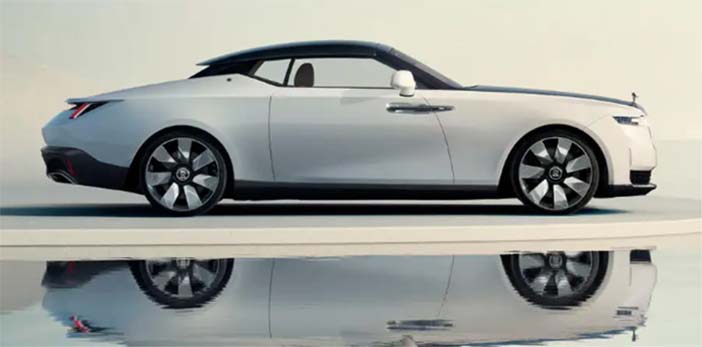
+++ ROLLS-ROYCE has revealed the third example of its €30 million (Dutch pricing) coachbuilt roadster, the Droptail, hailing it as an example of “daring in minimalism and subtlety”. Called the Arcadia Droptail, it follows the Amethyst and La Rose Noire cars shown last year as part of a production run of 4 units. The Arcadia is said to be inspired by the architecture and design from its commissioner’s favourite regions, including Indonesia, Singapore and Vietnam. The car’s white paint features aluminium and glass particles to create “a level of intrigue upon further study”, according to Rolls-Royce. The firm added that the Arcadia’s commissioner was “very particular and involved” in determining the intensity of the contrasting silver finish. Unlike on the 3 other Droptails, the lower section of the Arcadia’s carbonfibre tub is painted, receiving the same silver finish. Inside, the Arcadia’s wood panelling was developed with reference to the commissioner’s favourite houses and classic cars. Santos Straight Grain rosewood was selected for its “rich texture” but, having one of the tightest grains of any timber thus far used in a Rolls-Royce, presented a significant engineering challenge. Apparently it easily tears when machined and is prone to cracking while it dries. A bespoke lacquer also had to be developed to protect the wood for the lifetime of the car in tropical climates. Superyacht coatings were initially considered but would have required regular reapplications, according to Rolls-Royce. In all, developing the coating and working the 233 pieces of wood took more than 8000 hours of development, the firm said. The dashboard also features a clock of Rolls-Royce’s own design, said to be the most complex such part it has ever developed, requiring 2 years of research and 5 months of assembly. Design director Anders Warming said: “With the Arcadia Droptail, we witness daring in minimalism and subtlety, informed by the lifestyle of an individual who has a unique appreciation for British luxury. In creating this historic motor car, we once again prove our peerless abilities in synthesising and executing Bespoke design at its highest level”. The 2-seat roadster is powered by Goodwood’s familiar turbocharged 6.75-litre V12, fettled to produce an additional 30 hp, giving total outputs of 600 hp and 850 Nm. +++
+++ In the UNITED KINGDOM , car production increased dramatically in January with output rising by more than a fifth year on year, bolstered by healthy growth in electrified vehicle production. British car manufacturing grew 21% to 82.997 units, according to figures from the Society of Motor Manufacturers and Traders, representing the best January performance since 2021. It’s also the fifth consecutive month of growth in the United Kingdom, which the SMMT attributed to rising interest in British-built brands plus the gradual easing of global supply chain challenges. +++
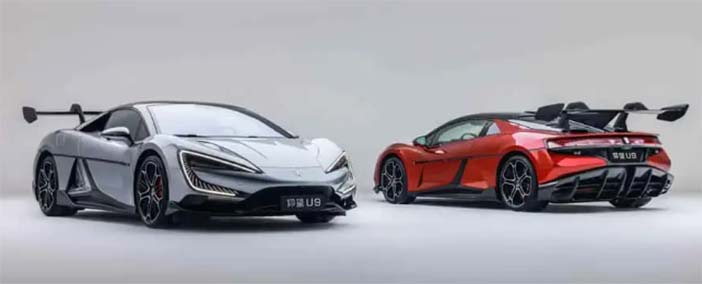
+++ Can a Chinese electric hypercar challenge Ferrari on the terrain of pure performance? On paper yes, as demonstrated by the YANGWANG U9 launched by BYD with 1.300 hp, 4 electric motors and a Dutch price of around €250.000 at current exchange rates. In reality, the Ferrari that comes closest to it is the SF90 Stradale, which has 1.000 hp and is a plug-in hybrid, but can count on the historic and glorious Prancing Horse marque, as well as undisputed prestige and recognition all over the world. Let’s find out if this YangWang U9 has what it takes to enter the Olympus of the most famous hypercars, that exclusive club that already includes Ferrari, Lamborghini, McLaren, Aston Martin and a few others. The YangWang U9, marketed for the time being only in China, but ready to storm international markets together with the YangWang U8 super off-roader seen at the Geneva Motor Show, has the shape of a low and sleek coupé with numerous aerodynamic appendages that make it look like something out of a video game. Unmissable, even on a Chinese hypercar, is the vertical opening of the two doors, as well as the luminous signature of the front end that aims to set a new standard for the extra-luxury brand of Chinese BYD. Large 21 inch rims fitted with Pirelli P Zero tyres complete a modern and altogether pleasing stylistic picture. The exterior measurements of the YangWang show a length of an impressive 4.96 metres, a width of 2.02 meters and a height of 1.29 meters. All this on a wheelbase of 2.90 meters, making it decidedly longer and wider, but taller, than a Ferrari SF90 Stradale. The rear hatch offers access to a luggage compartment with an as yet unannounced capacity, but which seems quite spacious. The unladen weight of the U9 is 2.475 kg, a mass that betrays the presence of a large and heavy 633 kg battery on board, in addition to the four electric motors. Inside the YangWang U9 we find a cockpit clearly divided into 2 parts by a sort of “bridge” that connects the dashboard to the central tunnel, housing a 12.3″ vertical touchscreen with all the main controls. The digital instrumentation is located on a 10.25 inch horizontal display behind the 3-spoke steering wheel, itself loaded with control buttons. The seats are 14-way electrically adjustable and offer passengers an immersive experience aided by the presence of the superior Dynaudio Evidence Series audio system. Also on board is the DiLink150 platform based on customised 4nm 5G chips and developed by BYD and Qualcomm, which offers an intelligent track driving assistance system and information on thirty Chinese racetracks. One of the strengths of the YangWang U9 is certainly its mechanics, based on the e4 platform and the DiSus-X Intelligent Body Control System. The 4 independent electric motors of the e4 architecture unleash 1.300 hp and 1.680 Nm of torque at all wheels. BYD’s DiSus-X intelligent body control system is a proprietary innovation that allows the suspension to reach 75 mm of maximum travel and lift each axle by 500 mm/s with a force of more than 1 ton. With this technology the U9 can even dance to the beat of the music by ‘dancing’ on the tyres. Thanks also to the 80 kWh Blade Battery, the new Chinese hypercar is capable of travelling 450 km on “1 full tank” in the optimistic CLTC cycle, reaching a top speed of 305 km/h, accelerating from 0 to 100 km/h in 2.36 seconds and covering the 400 meters from a standstill in 9.78 seconds. The maximum charging power of the battery is 500 kW. The body of the YangWang U9, made of carbon fibre with next-generation CTB technology with an unprecedented torsional stiffness of 54,425 N-m/degree, is equipped with 12 active and passive aerodynamic sets that also improve cooling. The Chinese price list for the YangWang U9 starts at 1.68 million yuan (compared to 4.98 million yuan for the aforementioned Ferrari), equivalent to around €250.000 in the Netherlands at current exchange rates. First deliveries are set for the summer of 2024. However, Chinese who want to buy it must first pay a non-refundable deposit of 600.000 yuan. To date, there is no official confirmation of the YangWang brand’s or the U9’s arrival in Europe, but according to rumors, BYD management is considering a European launch of the brand, perhaps under a different name. The presentation of the U8 in Geneva is a first step by BYD to introduce its most exclusive products to the Old Continent’s public. In addition to the Ferrari SF90, the YangWang U9 finds its most direct competitors in electric hypercars, starting with the upcoming Maserati MC20 Folgore and the Chinese Aion Hyper SSR. This is joined by the even more powerful Rimac Nevera, Pininfarina Battista, Aspark Owl and Lotus Evija. +++