
+++ In the age of downsizing, forced by stricter emissions regulations, ASTON MARTIN dares to go against the tide. The company recently announced a new twin-turbo V12 engine with a colossal 830 horsepower and 1.000 Nm of torque. Why? That’s what people want. The company’s product strategy boss Alex Long says internal studies have shown that people just want big engines. It’s as simple as that. In 2024, when tiny 3-cylinder 1.0-liter turbocharged engines are prevalent in Europe, Aston Martin reckons that not even a V6 makes the cut. Long mentions a “true emotional connection” between drivers and a V12 or a V8 that a smaller 6-cylinder engine can’t deliver, or at least it “doesn’t yet”. Of course, the likes of Ferrari, Maserati and McLaren would beg to differ with their V6 supercars. Aston Martin itself had planned 6-cylinder models not that many years ago. The Valhalla was initially supposed to get a twin-turbo V6, but the British luxury marque ultimately decided to go with AMG’s brawny V8 instead. The mid-engine Vanquish Vision concept debuted with a V6 before the company pulled the plug in late 2019. The DBX did get an inline-6 a few years ago in China with a Mercedes-sourced 3.0-liter engine. However, Aston Martin discontinued the smaller engine with the SUV’s recent facelift because of disappointing sales. Going forward, the Lamborghini Urus rival is offered exclusively in ‘707’ flavour. Long believes 6-cylinder engines are more mainstream than a V8, let alone a V12, arguing that smaller powertrains “very much aren’t in the premium segment”. Aston Martin had planned to go completely electric by the end of the decade. However, the Gaydon-based marque has reversed course and will continue to make cars with combustion engines well into the 2030s. Company boss Lawrence Stroll told earlier this year that customers want “sounds and smells” coming from petrol engines. Plug-in hybrids are coming since Aston Martin isn’t immune to increasingly tougher legislation regarding emissions standards. +++
+++ It is the world’s largest producer of electric cars (with 8.2 million global sales out of 14 million in 2023) and by now the sworn enemy of the four-wheeler West. We are talking about CHINA : the leading country in the battery-powered vehicle market, which for the past couple of years has been increasing its efforts to expand outside its borders, generating fears and tensions in Europe and the United States. On the one hand there is the United States, fresh from the clampdown on full electric cars “made in China”, operational since 1 August and raising import duties to 100 percent, and doubling the prices of vehicles arriving overseas. On the other hand there is the European Union, ready to follow the American example at the end of an investigation into subsidies for electric cars bestowed by Beijing and accused of being anti-competitive. But how did we arrive at the trade war winds? Let’s go back a few years, to 2009-2010 to be precise, when the rapid growth of the Chinese economy brought more customers to the dealerships and cars to the roads, however, with a downside: the growth of pollution. The country is therefore running for cover by launching a series of incentives for companies with the aim of increasing production and sales of zero-emission vehicles. Buyers of green cars were guaranteed a discount of up to 60.000 yuan (about €5.500 at today’s exchange rate). The government’s push is then helped by some local policies, with other bonuses and limits on the circulation of combustion engines. At the same time, Beijing supported the introduction of new brands in the shadow of the Great Wall, although some may disappear over time. The incentive programme lasted until the end of last year, for an expenditure of 200 billion yuan (€24 billion) to 2022, but the effects can still be seen today. Above all: the risk of overproduction, which leads many manufacturers to look to the Old Continent for new ground to conquer. Brussels and Washington are therefore putting Euro-Chinese imports and exports under the microscope, under the suspicion that the Dragon practises so-called ‘dumping’, i.e., that it sells goods abroad at prices lower than those practised at home or even lower than production costs, in order to impose itself in new markets. Today, the United States is therefore doubling the prices of electric cars ‘made in China’ (with possible side effects) while Europe is evaluating countermeasures, which could result in additional and punitive customs duties to be applied to vehicles with Chinese passports. They would come into force between summer and autumn and would overwrite the current taxes of 25% for European automakers entering China and only 10% for Asian brands travelling in the opposite direction. Meanwhile, Chinese manufacturers are trying to circumvent the new tariffs by looking for a home in the European Union, with BYD already announcing an electric car production plant in Hungary, operational within three years. But the conflict is constantly evolving. +++
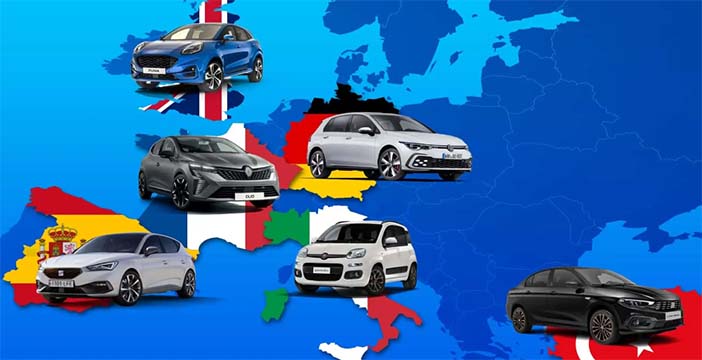
+++ The phenomenon of globalisation does not spare the car industry, and models that are so popular in EUROPE often end up conquering markets in China, the United States, Australia and Japan. The Tesla Model Y, which sells very well worldwide, is one example, but for one car that wins on a global scale, there are many others that are local phenomena. We’re talking about the queens of the various European markets that manage to become veritable symbols of industry and national pride. We’re talking about cars like the Fiat Panda, which has dominated sales in Italy for 11 years now, or the Volkswagen Golf, which has long been number-1 in Germany, or the Renault Clio, which remains one of the most popular cars in France. Which cars sell the best in Europe and why? Germans love the Volkswagen Golf since it first appeared on the market exactly 50 years ago. Since 1974, it has (almost) continuously been the most popular car in Germany, first in the Federal Republic and then throughout Germany. In some years, the number of new registrations has topped 400.000. Why was this? Because the Volkswagen brand had already acquired enormous market power in 1974, mainly thanks to the Beetle. What’s more, the Golf’s design was always recognisable, sometimes even timeless. This guaranteed a high resale value and everyone, from apprentices to bosses, could be seen in a Golf. The constant expansion of the model range also guaranteed this: diesel and GTI for the Golf I, Variant and VR6 for the Golf III, to name but a few examples. The Golf wasn’t and still isn’t cheap, but there’s something for every budget, from the entry-level model with a 1.1-litre turbo petrol engine to the crazy Golf R at the other end of the scale. Meanwhile, the Golf has come a long way from the figures of 35.000 new registrations in Germany in March 1992. 22 years later, new registrations are ‘only’ 11.621. The main reason for this is the expansion of VW’s product range. SUVs such as the T-Roc and Tiguan are giving the Golf a run for its money. Currently, some 35 million cars have been produced under the Golf name. What happens next? The next Golf 9 will probably merge with the ID.3 to form an all-electric ID.Golf. In the United Kingdom, the Ford Puma has consolidated its position as the bestselling car so far in 2024, with 19.393 units sold to the end of April. This follows on from the success of 2023, when the crossover topped the sales charts with 49.591 units sold, overtaking other popular models such as the Nissan Qashqai and Kia Sportage. The Puma’s practicality, sporty driving, distinctive appearance and unique features, such as the ‘megabox’, a washable luggage compartment, have largely contributed to its popularity. The Puma’s rise to the top marks a major shift in the UK car market from small hatchbacks to larger, more practical crossovers and SUVs. In 2021, the Vauxhall Corsa dethroned the Ford Fiesta, which had been the bestselling car for 12 consecutive years until 2020. The Corsa’s success is due to its affordability, efficiency and appeal to a wide range of buyers, including city dwellers and new drivers. In 2022, the Nissan Qashqai took first place, reflecting the growing preference for crossovers and SUVs. The Qashqai, with its spacious interior, advanced technology and hybrid powertrain options, became the first SUV to top the British sales charts for a full calendar year. Although the Japanese model has slipped to second place in 2023, it remains a strong contender in 2024, with 17.050 units sold so far. The Kia Sportage came third in 2024 with 15.824 units sold. The other models are the Audi A3 and the Nissan Juke, with 13.503 and 13.070 units sold respectively. Historically, Ford has dominated the British list of bestselling models over the last few decades, with a few rare exceptions. Why do the French love the Renault Clio? In 2023, a change took place at the top of new car sales in France. While the Peugeot 208 has held the top spot since 2021, the Renault Clio took over. The compact hatchback with the diamond badge has overtaken its former rival, while the Dacia Sandero completes the podium. Although the Renault Clio has not reached its pre-pandemic sales levels, 1.774,772 new cars were sold in France in 2023. The Renault Clio V and Peugeot 208 II alone sold 97.479 and 86.268 units respectively. Clio sales rose by 52%, while Peugeot sales fell by 2.9%. The year 2023 was not a success for Peugeot, which saw sales of the 208 plummet, as well as those of the 2008. These poor results can be attributed to logistical problems within the Stellantis group. But why is the famous Renault Clio such a success? First launched in the 1990s, Renault’s small city car has evolved and grown with the times. Over the generations, the Clio has evolved enormously in terms of design, safety and technology. Appreciated for its manoeuvrability and sobriety, it is available in petrol, diesel and, more recently, hybrid versions, adding many new strings to its bow. If the previous version didn’t win you over with its austere interior, the current generation brings a real revolution: qualitative and connected, it has a 9.3-inch touch-screen tablet, a 10-inch digital dashboard and an R-Link system. Finally, the exterior has also been given a facelift, with a more dynamic and sporty look. Why do Italians love the Fiat Panda? The Fiat Panda is a veritable myth in Italy, the city car par excellence dominating the sales charts since 2012, when the historic queen of the market, the Fiat Punto, relinquished its throne. In 2023, Italians registered 102.584 Fiat Panda cars, a figure which, out of an annual total of 1.566.448 cars, represents a market share of 6.5%. To understand the proportions of this enduring success, we need only look at the second-placed car, the Dacia Sandero, which registered 48.398 registrations. This historic trend is confirmed by sales figures for the first 4 months of 2024, which put the Fiat Panda in the lead with 44,637 units, ahead of the Dacia Sandero (23.065) and the Citroën C3 (17.462). There are a number of reasons for the Fiat Panda’s good fortune, starting with its compact dimensions, small engines and competitive prices, which enable the small Italian car to remain the most popular in its country. Nor should we overlook the issue of low running costs and service, with a dense network of Fiat service centres throughout Italy. Today, the Fiat Panda and the Pandina successor are only available in a 70 hp petrol mild hybrid version, but in recent years they have also and above all been appreciated for their alternative engines such as LPG, CNG, petrol and diesel, which have disappeared as demand has dwindled. The Panda 4×4 has also helped to make it almost ubiquitous on Italian roads, especially those in the mountains and hills, where a compact car with 4-wheeldrive and a simple petrol engine proves to be the solution in all weather conditions. The Panda is part of the long tradition of the Fiat brand, which dominated car sales in post-war Italy, first with the Topolino, then with the 600 and the Nuova 500. This was followed by the 850, the 127, the Uno, the Punto and finally the Panda. Why do Spaniards love the Seat Leon? The truth is that it’s difficult to talk about Spain’s favourite car. At least over the last 5 years, with 4 different market leaders: Seat Leon (2019 and 2020), Seat Arona (2021), Hyundai Tucson (2022) and Dacia Sandero (2023). However, if we broaden the view to include data from the last decade, we will see that the Seat Leon has been the most popular car among Spaniards, leading in 2018 and 2017 and remaining on the podium in previous years. In fact, only the semi-conductor crisis has deprived it of better results in recent years. But why is the Leon selling so well? Essentially because it’s a car ‘made in Spain’ (it’s produced in Barcelona) and because it has the same platform, engines and equipment as the Volkswagen Golf or Audi A3, but with a more passionate design and a more powerful engine. What’s more, for all you sporty fans out there, the thrust of the new Cupra brand, born in 2018, has given the Leon a much more desirable image. Having made it clear which car was Spain’s favourite over the last decade, it’s worth noting that the best-selling car in Spain over the past year has been the Dacia Sandero. And there are many reasons for this, starting with the fact that it is considered a smart buy. A model with an affordable starting price, increasingly high-performance equipment, plenty of Groupe Renault technology and a crossover version called Stepway, which has been a great success in a market dominated by SUVs. Another of its advantages has been to offer a version equipped with liquefied petroleum gas (LPG), which gives it access to the Eco environmental badge awarded by Traffic, with numerous advantages in terms of mobility in major cities. What’s more, the low price of LPG makes it very economical to use. Why do Turks love Fiat Egea? Turkey’s star car is the Fiat Egea from 2019. The model, which was sold under the Tipo nameplate in the Netherlands, takes first place in the first quarter of 2024. There are several reasons for this, but the main reason is the price : performance ratio. Fiat sells the Egea in Turkey in 4 different body styles: Saloon, Cross, Cross SW and Hatchback. We can see that the Egea Saloon has been leading sales since 2019. One of the main reasons for this is the price/performance ratio. The serious economic crisis in Turkey has caused a sharp increase in car prices with the effect of the exchange rate. Despite this, the Fiat Egea remains one of the most affordable cars sold in Turkey. In fact, it is one of the few models whose price does not exceed 1 million Turkish lira, or €28,600 at the current exchange rate. To explain the impact of this price, we need to talk about the economy. 50% of the people in Turkey earn a minimum wage. Currently, the minimum wage is 17.002 Turkish lira, which means that a worker has to work for 58 months to be able to buy a car worth 1.000.000 lira. Let’s take the official figures to illustrate Egea’s dominance. In 2023, the Egea family sold a total of 124.142 units. In 2023, which managed to break the previous decade’s record for total car sales, 967.341 cars were sold. In other words, the Egea family alone accounts for 12% of the total car market. The situation will not be much different in 2024. In the current period, according to official data, the Egea family leads total sales. In the first quarter of the year, it managed to sell a total of 29.736 units. The Egea saloon sold 19.568 units and the Egea Cross 9.755. In short, it looks as though the Egea will continue to be the leader in Turkey for some time to come, thanks to its price and performance. +++
+++ When it comes to taking to the track, FERRARI is afraid of no one. Not even when the race is electric, the sales market is competitive and the adversaries speak Chinese. This is stressed by Benedetto Vigna, CEO of the Cavallino, who was interviewed about the signs of a trade war between the European Union and China. We are talking about the possibility that Brussels will impose additional customs duties on imports of Chinese electric cars, as punishment to Beijing for giving subsidies considered anti-competitive to the car industry. A move that will depend on the results of the ongoing investigation and could trigger a counter-offensive by the Dragon, which has now landed in Europe at more competitive prices than its local competitors. “For me it is a call to action”, Vigna declares instead. “We hear talk of war”, he continues, “but I think more of a good competition”. The possible response from the East would in any case have less impact on Maranello than on various luxury brands. Ferrari would be less exposed, however, because it would retain a lower export share. “China is not for us what it is for other brands”, explains the CEO. “The market there is not yet mature”. Speaking instead of the Cavallino’s electric supercar, the CEO reiterates the goals of presenting the first full electric by 2025 and bringing vehicles on tap to 60 per cent of sales in the following year, after the arrival of the plug-in hybrid Stradale. Awaiting the official unveiling, Vigna gives updates on the project, “It is going as planned, but with some processes we are even ahead of schedule”. This is thanks to “a big step forward” made in the second half of last year, which leads on the “right path” towards a “unique” car. And soon the factory in Maranello for engines, inverters and batteries will also be ready. Appointment therefore for 2025. +++
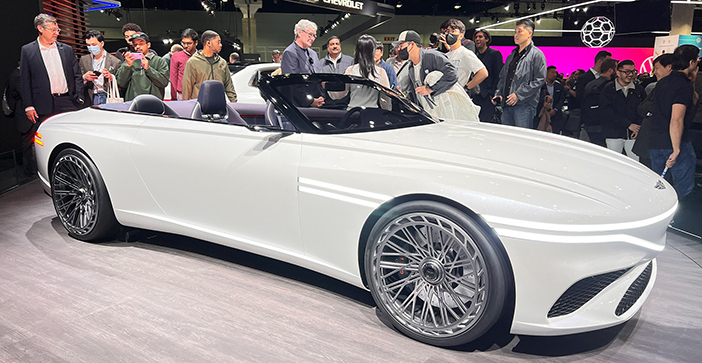
+++ Hyundai Group luxury brand Genesis and LUCID MOTORS are in the final stages of working out a deal for the former to buy electric motors from the latter. If a deal does go through, it would be Lucid’s second motor supply arrangement after agreeing to terms with Aston Martin almost exactly a year ago, or third if you count the front power units Lucid built for the Formula E race series. This is rumour until confirmed, though. When Hyundai was asked about the plans, an automaker rep replied with the expected, “I can’t confirm it”. We know Hyundai’s throwing huge resources at developing in-house platforms and motors, so why would it potentially make a deal with Lucid? Genesis is aiming to release the production version of the Genesis X Convertible Concept onto the market by 2026. That’s the droptop company execs reportedly previewed to dealers in January 2023 with Bentley in its sights. Now only 2 years away, Genesis saw the finish line looming and decided that “application of Lucid’s high-performance electric motors is relatively efficient in terms of time and cost”. The fact that Lucid’s motors have proved themselves in terms of refinement, range and output in a luxury segment where Genesis wants to play would also work in favour of a theoretical collaboration. Part of the fine-toothed work includes “ironing out details such as the pricing of the electric motors and the specific models they will be integrated into”, hinting the power units could end up in more than just the convertible. There’s supposedly a little backstory to this, with Hyundai chairman Chung-Eui-sun and CEO Jang Jae-hoon visiting Lucid headquarters in California earlier this year, and the Air as well as the coming Gravity SUV spotted on South Korean roads. The Lucid sightings in Asia could be related … +++
+++ We know JEEP ’s docket for the 18 months or so includes debuting the battery-electric Wagoneer S and Recon, putting the plug-in hybrid 4xe powertrain in the Gladiator, and just maybe switching up the engine mix in the Grand Cherokee. We’ve also known there’s a fifth-generation Jeep Cherokee on the way, the return of a nameplate so historically important to the brand that new CEO Antonio Filosa subtly questioned its retirement under his predecessor. Back when Jeep would discuss the new model, in 2022, I anticipated it in 2024 or 2025. Now, Italian newspaper Il Sole 24 Ore writes: “The Cherokee’s successor will be announced by the end of the year”. The Italians ar keen on the Cherokee because they believe there’s a chance Stellantis will build the SUV at the Melfi, Italy, plant for the European market. Stellantis has been meeting with Italian unions and government officials lately about production there, trying to prevent more revolts over production capacity and naming rights. The automaker’s confirmed 5 vehicles allotted to the plant, one of the next-generation Compass, the others reported to be 2 models from the DS luxury brand, the Lancia Gamma and the Opel Manta Electric crossover. The Cherokee name has never come up. Those 5 Melfi vehicles are all based on the STLA Medium architecture, whereas the next Cherokee keeps getting predicted for the STLA large platform. Italy’s Cassino plant, which currently builds the Maserati Grecale, could be transformed to models on the same architecture, like the future Alfa Romeo Stelvio and Giulia. The Cherokee for the American homemarket is expected to be built at Stellantis’ Toluca, Mexico, plant, the facility building just the Compass at the moment. The automaker confirmed this week the Wagoneer S on the STLA Large platform is headed to Toluca, so too the Recon on the STLA Frame architecture. On more solid ground, the coming Cherokee will grow some and offer upscale options like a Wagoneer trim. Comparing STLA Large specs to the platform of the old Cherokee, STLA Large comes with a wheelbase up to 20 centimeter longer than the old Cherokee, a vehicle length from 23 centimeter longer and a width about 3.5 centimeter wider. +++
+++ TESLA has published an interesting report on the safety of its electric cars, based on data collected during the first quarter of 2024. The report highlights the importance of using Full Self-Driving when travelling. According to the American company, its driver assistance system drastically reduces the probability of having an accident. It’s a claim that Elon Musk is constantly repeating, but one that the American authorities, led by NHTSA, have often called into question. Sometimes, it has to be said, because of the excessive nonchalance with which drivers relied on the system. Returning to the study, Tesla claims that in the first quarter of 2024, based on data from its electric cars and processed by its computers, there was 1 accident for every 12.5 million kilometres driven with active driver assistance. For drivers not using driver assistance, on the other hand, there was one accident for every 1.5 million kilometers driven. That’s almost 8 times less. The company would like to point out that “the comparison was also made using the most recent data from NHTSA and the FHWA (National Highway Traffic Safety Administration and Federal Highway Administration), according to which, on average, a car accident occurs every 1.1 million kilometres or so in the United States. Tesla has also published a graph showing the history of accidents with and without FSD (or Autopilot). Although there are noticeable fluctuations from 2018 to the present day, the trend shows that over time, the miles driven per accident are increasing, which shows that the company is making progress. Tesla said it was very proud of its results. Not least because it took into account accidents that occurred with active driver assistance, even those in which it had been deactivated less than five seconds before the impact. Tesla also explained that the accident is also taken into account in cases where no driver assistance system can intervene to prevent the event. This is the case, for example, when you are hit from behind while parked at a red light. +++
+++ Vietnamese electric car maker VINFAST is looking at further delaying a planned $4 billion factory in North Carolina, a person briefed on the matter said, as the loss-making company struggles to gain favour with U.S. consumers. VinFast announced in 2022 that it would build an EV and battery factory in the United States with an annual production capacity of 150.000 vehicles, seeking to take advantage of the Biden administration’s efforts to approve subsidies for EVs made in America. The company had initially planned to complete the factory in July 2024 but later pushed back the start of operations to 2025. It is considering another delay, the source said, asking to remain unidentified because the matter was not public. VinFast, which sold fewer than 1.000 cars in North America last year, said in a statement to Reuters it was “conducting a thorough review and evaluation of all aspects of the construction process for our North Carolina factory”. North Carolina’s Chatham County, where ground for the factory was broken in July, declined to comment about a possible delay. A spokesperson for the county government said VinFast had twice revised the size of the factory’s general assembly building. The latest revision was submitted in April and is still being reviewed by the county’s permits department. When VinFast announced in March 2022 its plans for the North Carolina factory, president Joe Biden said the plant would create more than 7.000 jobs. “It’s the latest example of my economic strategy at work”, he posted on Twitter at the time. Republicans won North Carolina in the 2020 presidential elections by a small margin and Biden’s campaign is spending heavily to win the state in the November presidential election. In addition to low sales, VinFast has been sued in the U.S. for not paying rent on a showroom. It also faces 2 separate probes, one over an April crash in California when 4 people died in an accident involving a VinFast VF 8 car and one for allegedly violating ArcelorMittal patents for aluminium used in the VF8. Vietnam sold fewer than 35.000 cars globally last year; the vast majority of that in its home market and despite having a factory in northern Vietnam with an annual production capacity of 300.000 cars. Most of its cars sold domestically are also sold to related parties. Its net loss last year widened 15% to $2.4 billion. Despite weaker global demand for EVs and a price war, VinFast said there have been no changes to its goal of selling 100.000 cars this year, twice as many as it targeted in 2023, as it expands abroad. It sold under 10.000 vehicles in the first quarter but attributed that to the usual slow start of the year for business, especially in Vietnam. By the end of June, VinFast plans to expand its vehicle line-up, including models with right-hand drive for markets like Thailand and Indonesia, it said, adding that the results should be visible in the second half of this year. It also confirmed plans to establish an assembly plant in Indonesia and another assembly plant in India by 2026. In Indonesia, “we expect to begin deliveries of the VF e34 model soon and will launch the VF5 model within the second quarter”, VinFast said, detailing so far unpublished plans for two of its economy cars. Founded in 2017 and fully focused on EVs since 2022, VinFast, which has yet to make a profit, logged a net loss of $618 million in the first quarter. Revenues for the period nearly tripled from a year earlier but tumbled 31% from the previous 3 months. +++