
+++ BENTLEY is putting the finishing touches on a new production line at its Crewe headquarters, built specifically to handle the Torcal, the automaker’s fourth model line and first electric car. The line sits inside a factory building that dates to 1938, and Bentley plans to reveal the finished car on September 23. The Torcal will be assembled by hand, and the new line forms part of a €400 million self-funded investment Bentley is making across the Crewe site. The building housing the line has a long history at Crewe. It served first as a machining shop, then more recently as Bentley’s research and development workshop, before being cleared out for its new role. Workers fitted the space with a precisely level floor, a requirement for the autonomous guided vehicles that will ferry partially built Torcals between stations. According to Bentley, the production line is nearing completion ahead of next week’s reveal.

The Torcal joins a lineup that already includes the Continental GT family, the Flying Spur and the Bentayga, all built at Crewe. Mulliner, Bentley’s bespoke department, also produces hand-beaten continuation models there, including the Speed Six. Bentley has occupied the Crewe site for 80 years and the company frames the new line as evidence that model development, engineering and assembly all remain in-house. The Torcal’s interior was also designed at the site. The Torcal is among the first vehicles to benefit from a new design studio that opened at Crewe in 2025. That facility also occupies a renovated building from 1938, and it houses the team responsible for Bentley’s upcoming models as well as Mulliner’s bespoke commissions. British suppliers back the car’s construction, including Fox Brothers of Somerset, which is a textile mill that provides the wool used in the Torcal’s cabin. Bentley has not named other suppliers involved in the build. More than 4.000 people work at the Crewe site, which spans 521.111 m2 in total, with 166.930 m2 of that space indoors. That footprint makes Crewe one of the larger employers in the surrounding area. Bentley previously marked its Crewe anniversary with a one-off Continental GTC, and the Torcal’s curved center screen has already surfaced in prior previews. The September 23 reveal will confirm full specifications and pricing. +++
+++ Jose Munoz has watched this movie before. Hyundai’s CEO spent roughly a decade running Nissan’s CHINA operations and this week in San Jose, California, he told what that experience taught him about Washington’s next big automotive problem. Chinese automakers have already gutted profit margins across Europe by undercutting rivals on price. Munoz warned the US could see the same pattern “at different levels” unless tariffs and other market-access rules stay in place. Munoz was direct. Chinese vehicles are running 30% to 40% cheaper (roughly a third to nearly half the price) than competing models in markets like Italy, Spain and France, he said, even with the European Union’s tariffs and minimum-pricing rules on Chinese-built EVs already in effect. Great-Brittain shows what happens without those guardrails. The country left the EU in 2020 and never matched Brussels’ tariffs, and Munoz says the result speaks for itself, as he said: “The UK, which in the past was a very profitable, very strong market, has become like China. All the top sellers are Chinese because there are no barriers”. The numbers back him up. Chinese-branded cars made up more than 9% of EU sales in the first half of the year, per the European Automobile Manufacturers’ Association, while Britain’s Society of Motor Manufacturers and Traders put that figure at 15% of new registrations earlier this year. Munoz is not calling for a total lockout. He wants Washington to attach specific conditions to any Chinese entry into the US market “to be able to minimize the impact”, while acknowledging bluntly that “the impact is going to be there for sure”. Ford CEO Jim Farley has voiced a similar timeline, telling employees in July that Chinese brands could realistically reach US shores within 5 to 10 years, a concern echoed elsewhere as Honda reacts to China’s growing strength as an auto parts supplier. The China warning was not the only news out of Munoz. Asked about Hyundai’s in-house Level 2++ driver-assistance system, the executive confirmed the company needs more time gathering data and validating safety before it ships. That system, pitched as comparable to Tesla’s Full Self-Driving software, was originally targeted for late 2027. The Hyundai Motor Group has now pushed the launch back to late 2029; a 2-year slip the company attributes to safety validation rather than a technical dead end. The delay lands at an awkward moment. Hyundai is simultaneously racing to expand US manufacturing, with plans to add 500.000 units of North American production capacity by 2030 and lift domestic parts sourcing above 80 percent from roughly 60 percent today. Munoz has been candid about why that buildout matters beyond software timelines. He credits existing US tariff policy with accelerating Hyundai’s American manufacturing push, pointing to models like the Alabama-built Santa Fe as proof that localization already pays off under current trade rules. +++
+++ MCLAREN will retire its Artura, 750S and GTS over the next 2 years as it lays the groundwork for a new and expanded line-up of models. Following the company’s announcement earlier this week of a major €580 million expansion strategy, 2 of its 3 core models will be phased out by the end of 2028. McLaren’s mid-engined grand tourer will depart first, with production likely to wind down in 2027. The carbonfibre-tubbed, V8, 2-seat GT(S) was introduced in 2019 as a more spacious and luxuriously appointed alternative to McLaren’s existing supercars, giving Woking a rival for the Aston Martin DB12 and Ferrari Amalfi. McLaren has been tight-lipped on the make-up of its new-era line-up, but the front-engined architecture that underpins its forthcoming SUV could be used for other models, possibly paving the way for a more traditional 4-seat GT in the vein of the Bentley Continental. The V6 hybrid Artura will follow the GTS into retirement in 2028, some 6 years after its launch. McLaren’s answer to the Ferrari 296 had a shaky start in life, its launch delayed by development issues and then hamstrung by the global semiconductor supply crisis. But a series of fixes and upgrades mean that it’s today among the most capable and acclaimed cars in its class, and it’s an important volume contributor for McLaren. The brand doesn’t break out sales figures by model, but it’s understood to roughly match the V8-powered 750S flagship, McLaren’s other series-production car, in sales terms. Plans for a successor remain to be confirmed, although the company has committed to continuing with rear-engined, 2-seat supercars in its new era and is developing a pair of bespoke hybrid powertrains that will power them. The company hasn’t given any precise details of their make-up, but Chief Operating Officer Michael Straughan suggested that developing its own engines in-house means “we don’t have to be constrained by a V6 and a V8 in the future”. Recently, a McLaren retailer with knowledge of upcoming models, said a new supercar will arrive by 2028 with a twin-turbo hybrid V6 producing 1.100 Nm of torque, more than the Artura. It will cost some €35k more than the Artura, too, with a claimed starting price around €300.000 in The Netherlands. However, it isn’t clear if this new model is intended as a direct replacement, and McLaren hasn’t officially acknowledged its existence. The 750S meanwhile remains in production and is still available to order, but it’s in the final stages of its life, having been introduced nearly 10 years ago as the slightly lower-powered 720S. McLaren hasn’t put an end date on production of the V8 supercar but recently revealed the limited-run 788HS as a hardcore, track-focused swansong, suggesting it won’t continue long into 2027. +++
+++ Fans of the NISSAN SKYLINE rejoice, as the new generation of the iconic sedan will debut in December 2026. The date was officially confirmed by Nissan president and CEO Ivan Espinosa, who described the new Skyline as a very important vehicle for the brand. The upcoming 14th generation of the sedan was originally announced in April 2026. The revealing teasers hint at Hakosuka-inspired looks with an aggressive face, sculpted fenders, and GT-R-style taillight graphics. During an interview with Japanese outlet Asahi Shimbun, Espinosa gave away more information about the ongoing development program and gave us a launch date. The Nissan CEO said: “We have great nameplates there like the very, very long-awaited all-new Skyline that is coming as well, which would be one of the icons of, I would say, the renaissance of Nissan and of a comeback that we have been working on”. Espinosa explained that the Skyline is “an icon of speed” not only as a car, but also as the first Nissan to go through an “accelerated development process”.
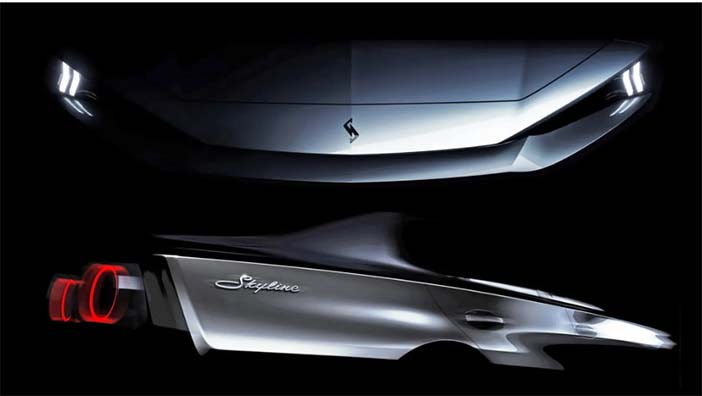
The production model was “completely developed” in around 26 months, with a launch event scheduled for December. The Nissan boss said this challenging project proves the “engineering capability” of the automaker and its ability to make cars “with speed”. He also added that the Skyline is “so important for us as a company”. During the original announcement earlier this year, Espinosa described the sedan as “a symbol of Japanese engineering and driving performance infused with raw emotion” and one of Nissan’s “Heartbeat” models. An earlier report by Nikkei revealed that Nissan used generative artificial intelligence and digital simulation tools across the design, engineering, testing and manufacturing phases of the new Skyline. This halved the development cycle from the 55 months of its predecessor to just 26 months. Espinosa admitted that China is setting industry standards in the fields of tech, cost competitiveness, and development times, suggesting that Nissan learned a lot from its joint venture with Chinese automaker Dongfeng. Nissan has also confirmed that the new Skyline will be manufactured at the Tochigi facility in Japan, debunking earlier rumors about production locations in China or the US. The Japanese plant is turning into a “dedicated sports car production hub”, and it already builds the Fairlady Z (400Z). Nissan has not shared details about the technical specifications of the new sedan that will most likely retain its RWD architecture. Under the hood, we might find a hybrid powertrain, but chances are it could also get the existing twin-turbo V6 engine with over 400 hp, potentially mated to a 6-speed manual transmission. Hopefully, the latter will be part of the expanding Nismo lineup. The new Skyline is expected to serve as a base for a future Infiniti model to be offered in North America, following the example of its predecessor. Note that the outgoing V37-generation Skyline remains unchanged since its Japanese debut in November 2013, following the US launch of the identical Infiniti Q50 in January 2013. +++
+++ VOLVO will preview the styling of its next-generation models with a concept timed to mark the firm’s 100th anniversary and design chief Thomas Ingenlath has vowed that future models will reintroduce more physical controls. Ingenlath returned to Volvo as its head of design earlier this year, after a stint as CEO of spinoff firm Polestar. He will introduce a revamped design language for the Swedish brand, which plans to launch 13 new models worldwide by the end of 2030. During Volvo’s global strategy update, Ingenlath confirmed that the first sign of his new design would be a new concept being shown in 2027. While he wouldn’t give any details, he did suggest that the design would build on Volvo’s history and heritage. “The brands that have heritage have a strong history”, said Ingenlath. “The foundation of how a Volvo is recognised first glance is the iron mark, a diagonal slash that supports that iron mark, and the surrounding of a grille that has framed our cars and the the logo for a long, long time”. Ingenlath added that it was a “big, big task” for design departments to “identify a way forward” and said it was a task “still ahead for us at Volvo to define for the future”.

He also said that he was looking at rethinking the interior user experience of Volvo models. At Polestar he was a leading proponent of minimalist interiors that featured few buttons and moved most controls to the touchscreen, but he said that Volvo and other firms “have to listen to our customers and recognise that how the interaction is in cars today is, to say frankly, not appreciated”. “The over-emphasis of screens and the interaction with the screens is something customers and journalists heavily criticize, and we have to aim for a better harmony, a better balance between the interaction that we have with our digital device and the physical interaction”. Citing the example of a Leica camera, Ingenlath said that Volvo “will not just go and introduce rows and rows of buttons” but “will be embracing what a physical interaction can do for you in a positive way as a customer”. “We’re not going away from touchscreen, it’s just to use the screen for what it’s good at. My dogma is any function you display all the time on the screen should not be on the screen. The screen is about flexibility and displaying what you don’t need to display all the time. So it’s use the touchscreen for what it’s good for and the reintroduction of a couple more buttons than in today’s cars”. Ingenlath also hinted at a more regionalised approach to Volvo design, which could potentially means the dedicated Chinese-market models will feature more screens, because digital interaction is more popular in China. +++
+++ You’d think that when it comes to autonomous driving technology, the system would see things fairly and equally. It would also be a fair assumption that the programmers of these autonomous systems would code the software the same way. It seems that isn’t the case; apparently it has come to light that some of these self-driving systems have varying parameters when it comes to pedestrian safety. A study by researchers in the United Kingdom reveals that large language models and video language models tell autonomous vehicles to yield to pedestrians depending on disability status or skin color. Strangely, large language models and systems were least likely to yield to pedestrians described as “paralyzed”. Video language models and systems were more likely to stop for skin colors described as “fair WHITE ”. Before you reach for your pitchforks, though, some testing showed inconsistencies: autonomous systems gave way to pedestrians identified as being of “Indian” descent. Researchers at King’s College London used 2 methods to identify and test the system’s bias. In the larger language models, the researchers created test scenarios that were equal in all aspects except for the demographic information. In the video model test, the researchers measured what the system said about the pedestrians’ demographics. In both tests, the researchers measured how the system responded depending on the parameters set. The report also says that academics and advocates have raised the issue of Autonomous Vehicle (AV) biases. There have also been other studies into biases before, back in 2019, that some pedestrian-detection systems had higher false-negative results on darker-skinned people. This latest study raises more concerns and questions about integrating AVs, especially how they will decide which pedestrians to yield to in safety situations. More and more governments have also voiced concerns about how AVs should be legislated for safety. +++
+++ While the influx of Chinese vehicles can provide buyers with affordable, tech-packed mobility options, it can also put pressure on competing automakers to cut costs to keep up. Regardless of how the situation is viewed, Chinese cars have a strong presence in the automotive landscape, reflected in the number of vehicles eligible for the 2027 WORLD CAR OF THE YEAR award. The World Car Awards have around 100 automotive jurors from across the globe, bringing diverse perspectives to the judging. The current list of candidates consists of 56 models, with Chinese marques accounting for 27 entries; nearly half the field. The pool widens further when other models with Chinese ownership ties, such as the Volvo EX60, are included. Those models include BYD Ti7, Changan Nevo Q05, Chery Q, Deepal S05, Deepal S07, Exeed Exlantix ET, Exeed RX, GAC Aion UT, GAC Aion V, Geely EX2, Geely Starray EM-i, iCAUR v23, Jetour G700, Jetour T2, Leapmotor B10, Leapmotor C10, Leapmotor T03, Lepas L6 EV, Lepas L8 PHEV, Lynk & Co 900, Onvo L90, XPeng G6 2026 Edition, XPeng L03, XPeng P7+ and Zeekr 8X. The MG 4 Urban is also part of this group, given that MG, which has British roots, is fully owned by Chinese automaker SAIC Motor. The rest of the field includes the BMW i3, Buick Electra E7, Chevrolet Aveo, Chevrolet Captiva EV/PHEV, Cupra Raval, DS N°7, Hyundai Bayon, Hyundai Ioniq 3, Hyundai Tucson, Infiniti QX65, Kia EV2, Kia Seltos, Kia Syros EV, Kia Telluride, Lexus ES, Lincoln Corsair, Mazda CX-5, Mazda CX-6e/EZ-60, Mercedes-Benz Electric C-Class, Mercedes-Benz Electric GLC, Mercedes-Benz GLA, Nissan Frontier Pro, Nissan NX8, Polestar 4 SUV, Renault Filante, Subaru Trailseeker, Subaru Uncharted, Volkswagen Atlas/Terramont Pro and Volvo EX60. It is also worth noting that every World Car of the Year winner since 2021 has been an all-electric model: the Volkswagen ID.4 (2021), Hyundai Ioniq 5 (2022), Hyundai Ioniq 6 (2023), Kia EV9 (2024), Kia EV3 (2025) and, most recently, BMW iX3 (2026). That streak gives readers a basis for judging whether the organization has done a good job picking its winners, while offering a clue about the kind of vehicle that could take the title this edition. To qualify, vehicles must meet criteria including annual production of at least 10.000 units, pricing below luxury-car levels in their primary markets, and availability in at least 2 major markets across two continents between January 1, 2026, and March 19, 2027. They must also be either all-new or significantly new. This marks the 23rd awards season, with jurors scheduled to test-drive eligible vehicles through January 2027. The top 10 finalists will be announced on January 5, followed by further testing and voting before the winner is revealed on March 24, 2027, at the New York International Auto Show. +++