
+++ When Chevrolet announced the 6th-generation CAMARO was going for retirement, officials were adamant the muscle car would eventually return. In particular, they told me “While there is no immediate successor, this is not the end of the Camaro’s story”. While the final model rolled off the assembly line in December, I’ve starting to learn more about the Camaro’s next chapter. GM president Mark Reuss said he wants the car to ‘return to its roots’ and be an affordable vehicle with wide appeal. He went on to suggest the Camaro could return as an EV with a base price of $34.995, meaning if would cost about €46.500 in the Netherlands. Little else is known about the next-generation Camaro and the sedan-versus-crossover debate hasn’t been settled within GM” yet. That being said, even if the Camaro returns as a sedan, it means it won’t be a coupe as that segment has all but evaporated. So, the Camaro could return as a 4-door coupe. This could make a lot of sense, but crossovers are king and Ford blazed a trail with the Mustang Mach-E. As a result, a Camaro crossover would be appealing to beancounters, although it would be tough fitting it in between the Blazer EV and Equinox EV. Given that a lot of things are still up in the air, it doesn’t sound like the Camaro is returning anytime soon. +++
+++ Italian fiscal police seized more than 130 FIAT cars imported from Morocco this week on the grounds that a sticker with the colours of the Italian flag on their doors could give a false indication of their origin, a spokesman for Stellantis Italia said on Saturday. The spokesman confirmed a local media report that 134 Topolino mini-cars produced by Stellantis brand Fiat had been seized temporarily at the Italian port of Livorno on arrival from the north African country, where they were made. “The sole purpose of the sticker was to indicate the entrepreneurial origin of the product”, the spokesman said, adding the group believed it had operated in full compliance with the rules. He said the design of the new Topolino, a historic model for Fiat since 1936, was conceived and developed in Italy by a team at Centro Stile Fiat, part of Stellantis Europe, which is an Italian company. However, the car is no more than a Citroën Ami with a different badge. The decision to produce the new Topolino in Morocco had been clear since the new model was announced. “In any case, to resolve any issues, it was decided to intervene on the vehicles with the removal of the small stickers, subject to the green light by the authorities”, the spokesman said. Italy’s right-wing government and Stellantis have been at odds over the group’s production choices for months, with Rome saying cars marketed as Italian products should be produced domestically. Last month, Stellantis brand Alfa Romeo said it would change the name of its new “Milano” to “Junior” to end a row with the government, which criticized the choice of an Italian name for a vehicle made in Poland. +++
+++ BMW, Jaguar Land Rover and Volkswagen have bought parts made by a Chinese company sanctioned under a 2021 law for using FORCED LABOR , an American inquiry found, prompting lawmakers to call for stricter enforcement. The automakers responded to the report, released Monday, by saying they have taken action to bring their cars into compliance with the law. The investigation, carried out by the American Senate Finance Committee over the past 2 years, discovered that BMW imported to the U.S. at least 8.000 Mini vehicles containing parts produced by JWD after the Chinese supplier was sanctioned in December for its links to China’s labour program in the far western region of Xinjiang. The Senate report said that Jaguar Land Rover imported replacement parts that included components made by JWD even after the automaker was informed of the presence of the problematic product in its supply chain. Volkswagen, however, disclosed to the U.S. border authorities that a shipment of its vehicles contained parts made by JWD, according to the report. The components were sourced via 2 contractors: California-based Bourns and Michigan-based Lear, the latter of which is a direct supplier for BMW and Jaguar Land Rover, according to the report. “Automakers are sticking their heads in the sand and then swearing they cannot find any forced labour in their supply chains”, said senator Ron Wyden, a Democrat from Oregon who chairs the committee. “Automakers’ self-policing is clearly not doing the job”. Jaguar Land Rover said in a statement that the subcomponent mentioned in the report “was used in a prior generation of technology and is not in current JLR vehicles for sale”. The company also said that once it was notified that the Chinese manufacturer was on the sanctions list, it immediately stopped shipment of the affected parts and all existing inventory containing the component was “quarantined for destruction”. BMW Group said it “has taken steps to halt the importation of affected products and will be conducting a service action with customer and dealer notification for affected motor vehicles”. Both automakers said they take protection of human rights and prohibitions against forced labour seriously. U.S. lawmakers in 2021 passed the Uyghur Forced Labor Prevention Act, banning the entry of products made with forced labour in Xinjiang, where the Uyghurs, a Muslim ethnic group, have been persecuted for their religious and cultural beliefs. The U.S. government has described this persecution as an act of genocide. Beijing strongly objects to this characterization, saying its efforts are aimed at countering terrorism. In Xinjiang, China also runs employment programs that it says boost job skills and connect the local workforce with better-paying jobs in other parts of the country, but human rights advocates say participation in those programs can be involuntary. In the United States, lawmakers have demanded that the 2021 law be strictly enforced and have criticized the automakers for not adequately scrutinizing their supply chains to ensure compliance with the law. +++
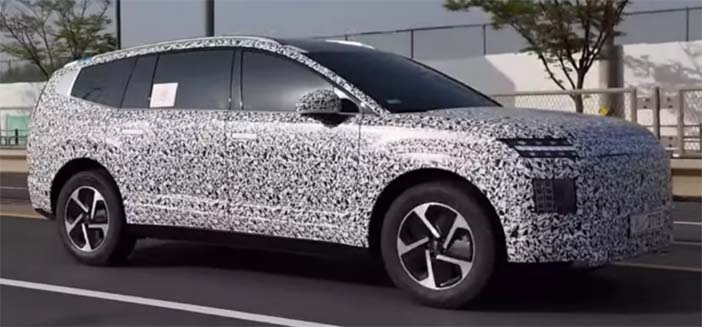
+++ HYUNDAI ’s first 3-row battery-electric SUV has been spied with skin-tight camouflage ahead of its expected premiere at next month’s Busan Auto Show in Korea. Prototypes of the Hyundai alternative to the Kia EV9 have been snapped on multiple occasions over the past 18 months but all have been adorned with thick body cladding, hiding many of the EV’s key design details. This latest prototype, snapped on the streets of Korea by Autospy, has ditched that cladding, and while it’s still wrapped in camouflage, we are provided with a good look at its design. Much like the Ioniq Concept-7, unveiled in late 2021, the Ioniq 7 has much smoother surfaces than the EV9. At the front end are split headlights with DRLs up top and separate headlamps lower on the fascia. Viewed from the side, you will notice door handles that sit flush with the bodywork, black and silver wheels, and roof rails. The rear of the Ioniq 7 appears slightly more upright than the EV9 and includes thick D-pillars with large side windows for the second row. The rear window also appears larger than what’s found on the EV9. Hyundai has also adopted an intriguing taillight design for the Ioniq 7 that includes a lighting array that stretches vertically and extends above the window. The Ioniq 7 is expected to use Hyundai’s current E-GMP platform and should share its powertrain options with the EV9. The Kia is currently offered in rear-wheel drive guise with a 218 hp motor, while a 384 hp all-wheel drive version is also available. Kia is also developing a potent EV9 GT with as much as 582 hp. Like the Kia, Hyundai is expected to offer the Ioniq 7 with a 76.1 kWh battery and a larger 99.8 kWh version. +++
+++ Volkswagen and Renault have not been able to come to an agreement regarding collaboration on an INEXPENSIVE ELECTRIC VEHICLE , and now the 2 automotive giants will have to go their own way. Talks between the companies were first confirmed by Renault in December, when the discussions were described as being at a very early stage. Although the companies could not ultimately come to an agreement, sources say that they got close to reaching a deal. The companies had been involved in months-long negotiations over the project, which both brands hoped would help lower the cost of developing a small EV, but VW decided to walked away from the deal. It was understood that the project would lead to the creation of the next Twingo, which Renault will now develop itself, and is set to go on sale in 2026 with a starting price of less than €20,000. Sources say VW’s decision to walk away from the negotiating table was prompted by its decision to develop a platform on its own, which would mark its latest change in attitude. A year ago, the German automaker was feeling bold about the cost savings its new in-house developed batteries would bring, and claimed that its upcoming €25,000 EV will be profitable, and that a €20,000 EV would even be possible. However, by November, Volkswagen CEO Oliver Blume wasn’t so sure that the brand would be able to make a profitable EV at the lower price point. Hopes for the project were revived by the revelation that the German automaker was in talks with its French competitor, and now it seems VW believes it’s a good enough idea to pursue on its own. Just because this partnership will not come to fruition doesn’t mean that Renault will give up on collaborating with other brands. The company’s CEO, Luca de Meo, has talked openly about his desire to work with other European brands to compete with incoming Chinese EVs. The executive has proposed an Airbus-style collaboration between brands to strengthen the continent’s industry and lower costs. +++
+++ LAMBORGHINI went to significant lengths to keep the naturally-aspirated V12 engine alive, but its naturally-aspirated V10 has nearly reached the end of its life cycle. Instead, the yet-unnamed model that will replace the Huracán will downsize, adopt forced induction, and electrify. Code-named 634 internally, the Huracán’s successor will get a 4.0-liter twin-turbocharged V8 rated at about 800 hp and 700 Nm of torque and linked to an 8-speed dual-clutch automatic transmission. For context, the 10-year-old Huracán uses a naturally-aspirated 5.2-liter V10 tuned to develop 640 hp and 600 Nm of torque in its most powerful state of tune and the Revuelto’s V12 makes 825 hp. The hybrid part of the drivetrain will consist of 3 electric motors and a battery pack whose capacity and chemistry haven’t been announced. The system’s total output also hasn’t been revealed, but it should check in well above 800 hp. Before rumours begin to fly, let’s get an important detail out of the way. Lamborghini is part of the Volkswagen Group, and several of its sister companies (including Porsche) offer a twin-turbo 4.0-liter V8, but this is not what you’ll find in the Huracán’s successor’s engine bay. The brand claims that the eight-cylinder is new; it was developed in-house on a blank slate. Its delivers its peak horsepower output between 9.000 and 9.750 rpm, it provides its peak torque output over a broad range that stretches from 4.000 to 7.000 rpm, and it revs to an un-turbo-like 10.000 rpm. The pistons are linked to flat-plane crankshaft, too. On paper, it sounds like Lamborghini developed a racing engine. The dual-clutch automatic is a version of the transmission developed for the Revuelto, which made its debut in 2023 as Lamborghini’s first series-produced plug-in hybrid super-sports car. Details about the electrified part of the drivetrain remain relatively vague: all I know at this stage is that 1 of the 3 motors is sandwiched between the V8 and the 8-speed transmission. Fear not, the model won’t sound like the average hybrid. It will likely be capable of driving on electricity alone for short distances, but Lamborghini stresses it spent a great deal of time tuning the engine’s exhaust note to ensure it sounds the way a modern supercar with a flat-plane crankshaft and a high redline should. Lamborghini will unveil the Huracán’s successor later in 2024, and I expect to hear more about it in the coming months. When it lands, it will complete the company’s shift to an all-electrified line-up: it will join the Revuelto and the plug-in hybrid Urus SE unveiled last April. +++
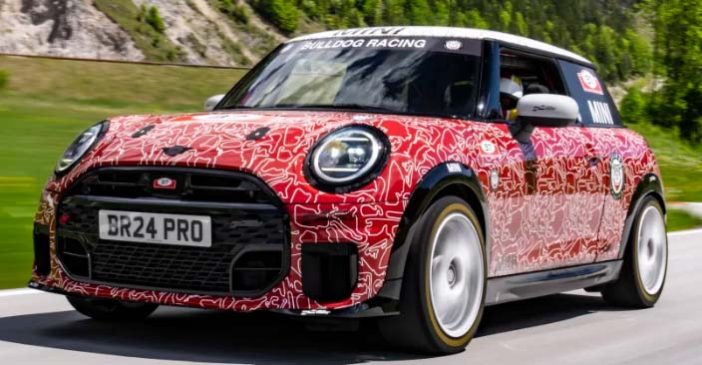
+++ Curious about the next MINI COOPER JCW ? Well, here’s a great sneak peek, as Mini just dropped a cache of photos showing it in race guise and wearing a thin layer of camouflage. We’ve already seen the electric John Cooper Works version of the 3-door Mini, but this is the petrol-powered variant. Many of the design elements we’re seeing here like the grille, front lower side vents, rear bumper and more should make their way to the production car, which Mini says will be revealed this fall. The grille might be new, but it looks a whole lot like the front end we saw on the outgoing Mini Cooper JCW. That said, it adopts the new shape and minimalist vibes from the Cooper we’ve seen in the less-sporty variants. The rear end with its taillights are what we expect from the production car, though the rear diffuser shouldn’t be anywhere near that aggressive. The specific car you’re looking at here is covered in red and white camo as an homage to the red and white colour schemes used in the 1960s for Minis in motorsports. It also has a “37” logo to commemorate the Mini Cooper S’ victory (a car wearing 37) at the 1964 Rallye Monte Carlo. I still don’t know specs, but since Mini is done with manual transmissions, expect this JCW to feature an automatic paired with an updated version of the 2.0-liter turbocharged engine found in the outgoing model. It should also feature a sportier version of the interior we’ve already seen in the new Cooper. All the details will be made available before the year is out, but for now, enjoy these photos as a preview of what’s to come. +++
+++ A train that travels from rural northern MOROCCO to a port on the Mediterranean Sea carries no passengers. 3 times a day, it brings hundreds of cars stacked bumper to bumper from a Renault factory outside Tangiers to vessels that transport them to European dealerships. Business incentives and investing in infrastructure like the freight railway line have allowed Morocco to grow its automotive industry from virtually non-existent to Africa’s largest in less than 2 decades. The North African kingdom supplies more cars to Europe than China, India or Japan, and has the capacity to produce 700.000 vehicles a year. Moroccan officials are determined to maintain the country’s role as a car-making juggernaut by competing for electric vehicle projects. But whether one of Africa’s few industrialization success stories can stay competitive as worldwide auto production transitions to EVs and increasingly relies on automation remains to be seen. More than 250 companies that manufacture cars or their components currently operate in Morocco, where the auto industry now accounts for 22% of gross domestic product and $14 billion in exports. French automaker Renault, the country’s largest private employer, calls Morocco “Sandero-land” because it produces nearly all of its subcompact Dacia there. Unencumbered by many of democracy’s checks and balances, the government tells companies looking to outsource production to cheaper locales they can get approval for new factories and complete construction in as little as 5 months. “We didn’t export 1 car 15 years ago. Now it’s the first exporting sector in the country”, minister of industry and trade Ryad Mezzour said in an interview. Mezzour said Morocco has distinguished itself from other outsourcing destinations by expanding its ports, free trade zones and highways. The government offered subsidies of up to 35% for manufacturers to put factories in the rural hinterlands outside of Tangiers, where Renault now produces its Clio as well as the Dacia Sandero, Europe’s most popular passenger vehicle, and soon plans to start manufacturing the hybrid Dacia Jogger. Chinese, Japanese, American and Korean factories make seats, engines, shock absorbers and wheels at the Tangiers Automotive City, a large campus of car parts manufacturers. Stellantis produces Peugeots, Opels and Fiats at its plant in Kenitra. Devoting immense resources to developing and maintaining an automotive sector that could employ a young and growing workforce was part of a 2014 industrialization plan. To create jobs, Mezzour said that he and his predecessors have focused on offering more than cheap labour to foreign automakers looking for new places to build cars and produce parts. Major automakers pay unionized factory workers less in Morocco than they do in Europe. But even with salaries 25 percent of France’s €1.766.92 monthly minimum wage, the jobs pay more than the median income in Morocco. The industry employs 220.000; a small but sizable chunk of the more than 200.000 agricultural jobs the country is losing annually amid a 6-year drought. Like in many African countries, Morocco’s domestic market for new cars is small. Less than 162.000 vehicles were sold there last year. The government’s success in building an automotive industry nevertheless has made cars the tip of the spear as Morocco works to transform its largely agrarian economy. “I have one simple priority: not exports or being competitive. My job is to create jobs”, Mezzour said. Abdelmonim Amachraa, a Moroccan supply chain expert, said the spending on infrastructure and training skilled workers puts the industry in a good position to lure investment from automakers looking to build out their electric vehicle supply chains. Moroccan officials have sought investment from both East and West, trying to lure industry players from China, Europe and the United States as they now race to produce affordable electric vehicles at scale. China’s BYD, the world’s largest electric vehicle maker when PHEV models are included, has at least twice announced plans to build factories in the country that have stalled before starting. “The important question is what can a small country do in this world”, Amachraa said, noting how rapidly global car manufacturing was changing. “We have this ability to coexist with Europe, Africa and the United States when a link can’t be found between China and the United States”. As Europe works to phase out combustion engines over the next decade, automakers like Renault are preparing to adapt in Morocco. Mohamed Bachiri, the director of the Renault Group’s operations in the country, said the company’s record of success in Morocco makes it an attractive destination for others to invest, particularly in EVs. He said the industry is likely to continue growing because Morocco’s “integration rate” (the percentage of parts that carmakers can source domestically) has steadily risen to more than 65%. The country also has a competitive advantage by having the experienced and skilled autoworkers that some other outsourcing destinations lack, Bachiri said. “We’re predisposed to manufacturing cars for customers in our sphere. And the day they decide they need electric vehicles, we will”, he said. The government has bankrolled public-private partnerships like a Renault-managed academy to train technicians and managers. Compared to comparable markets, Morocco’s political climate and proximity to Europe made it a safe investment, Bachiri said. “It’s like being on an island next door”, he said, noting instability in neighbouring countries throughout North and West Africa. However, as the United States and European countries encourage their automakers to “onshore” electric vehicle production, it’s unclear how Morocco will fare. The country has long prided itself on being a free market that eschews tariffs and trade barriers but finds itself squeezed as countries vying for EV production advantages enact policies to protect their domestic automotive industries. Western governments that have long pushed developing countries to embrace free trade are now enacting policies to boost their own EV production. France and the United States both passed tax credits and incentives last year for consumers who buy electric vehicles manufactured in Europe or North America, respectively. Though the U.S. incentives can extend to Morocco because the countries share a free trade agreement, Mezzour said they complicated the global supply chain and sometimes made his job more complicated. “We’re living in some kind of new age of protectionism”, Mezzour said. “We’re living in instability in terms of trade rules that makes it more difficult for countries like Morocco that invested heavily in open, free and fair trade”. +++
+++ TESLA is working to appease some European leasing companies after the automaker’s repeated retail price cuts tanked their fleets’ value and its slow service and expensive repairs alienated their corporate customers. The efforts include unofficial discounts on purchases of new cars if they are in stock and efforts to address widespread service, repair and ordering complaints after years in which fleet managers and leasing firms say Tesla has ignored those problems, according to 9 executives from major leasing and rental-car firms, along with about a dozen corporate fleet managers. Tesla’s retail price cuts aimed to bolster sales in response to softening electric-vehicle demand globally and rising competition, especially from Chinese EV makers such as BYD. But that damaged the bottom lines of its biggest customers in Europe where fleet purchases represent nearly half of auto sales. Leasing companies buy new cars and arrange leases calculated on how much they believe they can sell them for at the end of the lease. Sudden drops in price undercut those residual values, costing leasing firms money. There’s “nothing worse” than continuously dropping the value of a fleet buyer’s assets, said Richard Knubben, director general of Brussels-based Leaseurope, a leasing- and rental-industry group which represents national groups across 31 countries. “Tesla is now actively telling our members: We can give you discounts and compensate you”, Knubben said. “But Tesla’s residuals have dropped so fast, I’m not sure the discounts they’re offering are enough”. Tesla’s falling resale values and tensions with fleet customers are known, but its damage-control campaign to address them has not been previously reported. A top executive at a large European car-leasing firm, who spoke on condition of anonymity because he did not have permission to comment publicly on Tesla, said that, starting in mid-2023, Tesla offered unofficial end-of-quarter discounts on its Model 3 and Model Y by up to 2.000 euros for leasing-company purchases, if those vehicles were in stock. Since late last year, he said, those discounts have been available all the time. Tim Albertsen, CEO of Ayvens (Europe’s largest auto-leasing company with a fleet of 3.4 million cars, about 10% of which are EVs) said Tesla’s service has improved but its falling resale values have been damaging. “Tesla has understood that and is coming with solutions that help us with that”, he said. Albertsen declined to elaborate on what Tesla has done to mitigate Ayvens’ losses on EVs. Arval, the car-leasing unit of BNP Paribas’, is now talking to 3 Chinese automakers about buying EVs after taking losses tied to declining Tesla values. When Tesla first started cutting prices last year, Arval told the carmaker: “You are really shooting yourself in the foot”, said Arval Deputy CEO Bart Beckers. Arval leases about 170.000 EVs as part of its 1.7 million-vehicle fleet, Becker said. He said Tesla is working to fix repair-and-service problems but added the automaker’s “new challengers” (i.e. Chinese EV makers) seem to be avoiding Tesla’s mistakes by focusing on maintaining strong resale values for cars. The automaker faces the same resale-value problem with rental-car companies. Hertz has been selling off Teslas in the U.S. market, while German rival Sixt has stopped buying them. Asked about the impact of Tesla’s price cuts, Sixt said lower residual values on EVs from Tesla and other brands reduced its 2023 earnings by 40 million euros. Fleet customers are important in any automotive market but especially so in Europe, where firms often lease large numbers of company cars for employees, in part because of associated tax breaks. Leasing and rental-car company purchases comprised 44% of Tesla sales last year in the UK and 15 EU countries, according to market research firm Dataforce. Tesla’s first-quarter fleet sales in those countries fell 2.3% while the market as a whole was up 3.5%. Even as its fleet sales fell, leasing companies’ and rental car firms’ share of Tesla’s business in those markets rose to 49%. Tesla’s sales and profits are falling globally after a long period of sharp growth. The automaker reported an 8.5% drop in global deliveries during the first quarter, its first decline in 4 years. The decline in fleet sales in those 16 European countries comes after 57% growth in 2023, over the previous year, according to Dataforce. Tesla posted the same percentage growth for all sales across Europe, according to the European Automobile Manufacturers Association. Until recently, Tesla had a first-mover advantage that meant European corporate customers had few alternatives for EVs to meet internal climate goals or EU emissions targets. That’s changing swiftly. Chinese automakers including BYD are bringing lower-cost electric models to Europe and aggressively courting Tesla’s corporate customers, according to fleet managers, along with executives from leasing firms. Legacy automakers such as Volkswagen and BMW are also producing increasingly competitive EVs. Slow and expensive Tesla service has been another sore point with European leasing companies and their customers, according to interviews with about a dozen corporate fleet managers. Most declined to be identified because they are actively seeking to resolve problems with Tesla. Its repairs take too long and cost far more than other vehicles, partly because of pricey parts, they say. Even so, Tesla does have satisfied fleet customers. Octopus Electric Vehicles, the car-leasing arm of UK energy firm Octopus Energy, has about 5.000 Teslas among about 15.000 EVs. CEO Fiona Howarth said that Tesla, as an EV pioneer, needed time to figure out service operations and that legacy automakers now face similar challenges with their own EVs. She said Tesla resale values were artificially high during the coronavirus pandemic and needed to come down. “We’ve had a really good working relationship with Tesla”, she said. Lorna McAtear, fleet manager at UK energy firm National Grid, described much rockier relations with Tesla. She’s been compiling data on repair costs and found Tesla’s to be triple the industry average. Other problems, McAtear said, include a cumbersome ordering system and cars arriving with defects. For instance, she said, Tesla delivered a number of EVs with warped windshields and declined to fix them under warranty. National Grid has more than 500 Teslas in its company-car fleet of 2.000 vehicles. McAtear said she has planned to propose her company drop Tesla from its fleet unless the problems are addressed. Meanwhile, Tesla’s chief Chinese rival, BYD, is starting to deliver cars to National Grid. McAtear said she pushed for a face-to-face meeting with Tesla representatives in mid-April. During that meeting the automaker promised service improvements and an ordering-system fix, along with additional meetings and a “roadmap” for resolving outstanding problems leaving McAtear feeling like “we finally have customer service”. The automaker has been unresponsive in the past, she said: “There have been years of pent-up frustration that fleets can’t talk to Tesla”. +++