
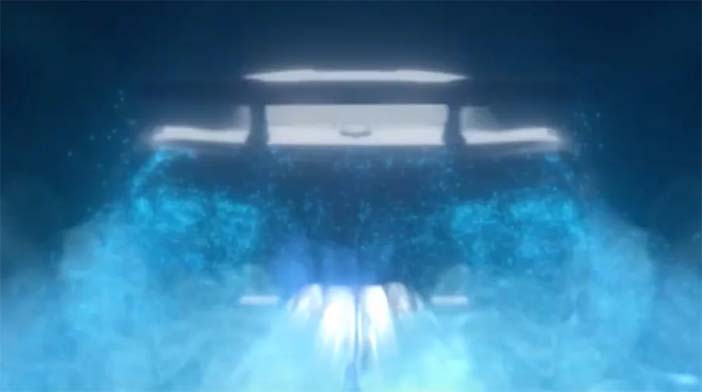
+++ The next CHEVROLET CORVETTE ZR1 teaser is here, and this time there’s a halfway decent shot of the car’s tail end. The ZR1 is clearly rocking a central exhaust exit just like the Z06 (the Stingray (and E-Ray) with its 6.2-liter V8 positions its exhaust tips on the outer edges of the rear bumper). The central exhaust is further confirmation that the ZR1 will have the 5.5-liter V8 behind the cabin, and if all the reports and rumors are true, it’ll be a turbocharged version of that engine. Whether it sticks with the flat-plane crank of the Z06 or switches to a cross-plane crank design is yet to be determined. A peek at the mega-aggressive rear wing is also on offer. It definitely looks even bigger than what’s offered on the Z06. The final reveal date still isn’t available, but Chevrolet reiterated in its video that the ZR1 will be revealed “this summer”. I suspect there will be even more teasers as a proper reveal gets closer. +++
+++ European regulators are poised to slap big tariffs on auto imports from CHINA to give local brands a fighting chance, but now some experts say it won’t make a difference. They think Chinese carmakers are so efficient, and their profit margins so massive, that they’ll easily be able to absorb the financial penalties and still deliver bargain-priced EVs to European customers. Lawmakers in Europe are concerned that state subsidies are giving Chinese brands an unfair economic advantage as their cars have begun arriving in large numbers. They have been investigating the situation since the beginning of this year. They’ve visited Chinese factories and are expected to make a decision next week about what tariffs to introduce. Analysts expect Europe to announce a 30 percent tariff, but experts said that this kind of levy simply won’t be enough to reduce the number of Chinese EVs arriving in Europe. Chinese automakers’ huge margins could easily handle that kind of tariff, the report says, and the buyer won’t notice any difference in pricing, although the automakers themselves would be generating less profit. The analysts suggest that tariffs would have to be as high as 50 percent before they began to throw the Chinese import juggernaut off course. But that’s not a view held by everyone in the car industry. A recent study from the Kiel Institute for the World Economy predicts that approximately $3.8 billion worth of EVs from China will no longer be imported into Europe if the EU hits Chinese EV imports with 20 percent tariffs. That $3.8 billion could translate as around 125.000 fewer Chinese EVs landing in the bloc, which some experts think would boost sales of domestically produced electric vehicles by as much as $3.3 billion. China is likely to retaliate in kind if the EU does apply tariffs, and hit European cars exported there with new taxes. “For consumers, this is likely to result in higher prices for electric vehicles because production within the EU is significantly more expensive than in China due to higher energy and material prices and, above all, significantly higher labor costs”, Kiel Institute trade researcher Julian Hinz said. “However, it is by no means a foregone conclusion that European car manufacturers will fill the gap, Chinese manufacturers such as BYD could also meet local demand with new plants in Europe”. Kiel’s simulation does not consider any retaliatory measures China is expected to make if the EU announces new tariffs. China has said it could impose tariffs as high as 25% on vehicles with large engines, a change that could impact many European automakers, including Mercedes-Benz and BMW. BYD could prove to be one of Europe’s biggest Chinese EV makers. The car manufacturer is already working on its first electric car factory in Europe, located in Hungary, and last month, it revealed it’s investigating a potential second car factory on the continent. A key part of BYD’s European expansion will include launching a local version of the Seagull. +++
+++ The latest series of crash tests carried out by EURO NCAP , the European car safety body, features 1 new German car and 2 new Chinese cars eagerly awaited on the European market, all of which have been awarded 5 stars, the highest rating. The 3 cars whose results have just been published by Euro NCAP are the Volkswagen Tiguan, the Zeekr X and the Zeekr 001, the latter belonging to the now large Geely group, which is becoming increasingly important on the Old Continent. As always in such cases, the 3 cars proved that they were capable of meeting the requirements aimed at avoiding or mitigating impact damage, including damage to vulnerable road users such as pedestrians and cyclists. Here are the details. The new Volkswagen Tiguan made its European debut a few weeks ago with light petrol hybrids, petrol plug-in hybrids and diesel engines. In the tests carried out by Euro NCAP, it was awarded 5 stars, thanks in particular to a remarkable set of Advanced Driver Assistance Systems (ADAS) safety measures. The safety rate for adult occupants is good, at 83%, and even better for children, at 88%. But that’s not all. For vulnerable road users, the safety score achieved by the new German SUV is also very high, at 84%. More generally, Volkswagen’s ADAS, as specified in the technical data sheet published by the automaker, performed very well, showing a little more uncertainty only in automatic emergency braking in front of pedestrians and in slowing down the car when it detects a slower vehicle. These are just details, of course. The second car tested by Euro NCAP last May was the new Zeekr 001, a car from the brand belonging to the Geely Group, which was awarded a total of 5 stars, thanks to a safety score of 89% for the protection of adults and 88% for the protection of children. The result for the protection of vulnerable road users, such as pedestrians and cyclists, was also very good, at 84%, a value similar to that obtained when the safety systems (including ADAS) of the new Zeekr 001 were assessed, at 83%. The only area in which the Chinese brand’s new compact estate failed slightly was the cyclist impact warning when opening the doors. The third car tested by the European road safety body in May was the new Zeekr X, a crossover which, like its aforementioned sister, scored 5 stars overall thanks to high values for adult protection (91%), protection of smaller occupants (90%) and protection of the most vulnerable road users, such as pedestrians and cyclists (84%). The Zeekr X also achieved excellent results in the area of driver assistance systems (ADAS), where it scored an excellent 83%, failing only in slowing the car down when it detects a slower vehicle. +++
+++ EUROPE is seeing some interesting trends in new car purchases. The relocation of car production has enabled manufacturers to cut costs by moving to countries where manufacturing is cheaper. This is part of the commercial game encouraged by globalisation, which creates winners and losers. This ‘game’ explains why Eastern Europe has played an increasingly important role in car production over the last two decades, to the detriment of lesser leadership in the West. The changing landscape of car production in Europe has placed the Czech Republic at the forefront. Although it is a small market (220.000 units in 2023) and a small country in terms of population (only 10.5 million inhabitants), it is the 4th largest car producer in Europe, behind Germany, Spain and France. However, these 3 markets are much larger than the Czech Republic in terms of population. In fact, the total number of vehicles produced per 1.000 inhabitants was 134 in 2023. This is probably why most of the most popular cars in the Czech Republic are produced locally. According to data from Jato Dynamics, 7 of the 10 best-selling models between January and April 2024 were produced in Czech factories. After all, as Skoda is a local brand and produces most of its cars in Czech factories (86% of its overall production in 2023), it’s normal to see these results. Despite the changing economic situation in Europe, Germany remains an important production centre. Last year, 49 new cars were produced for every 1.000 inhabitants. There is a symbiosis between German car manufacturers and the economy itself, and although it is quite expensive to produce cars in Germany, production is a key part of the country’s economy. The Top 10 from January to April 2024 shows that 6 models were produced locally: Volkswagen Golf, Tiguan, Passat, Opel Astra, Audi A4 and BMW 3 Series. An indicator which shows that conditions are still good for car production in Europe’s largest economy. It’s no surprise that the Italian industry has fallen on hard times in recent decades. When Fiat, the country’s largest carmaker, absorbed most of its local rivals (Lancia in 1969, Alfa Romeo in 1986, Innocenti in 1990, Maserati in 1993), Italy was left with just 1 major local manufacturer. The lack of competition at a time when European markets were not as economically integrated as they are today made Fiat less competitive and more dependent on state funding. When foreign competition became evident, the company began to lose market share. In the January-April Top 10, only one model, the Fiat Panda, was produced locally. In 2023, only 15 cars were produced per 1.000 inhabitants. France is not far behind. The Peugeot 208, Renault Clio and Dacia Sandero are produced abroad, while the 7th model in the January-April Top 10, the Peugeot 308, as well as the 8th, the Toyota Yaris, and the 10th, the Toyota Yaris Cross, are produced locally. If this continues, France could soon find itself in the same situation as Italy. +++
+++ On 5 June, the EUROPEAN UNION is expected to present a first draft of the duties to be imposed on the import of Chinese electric cars to the Old Continent, a harsh response to the investigation that has shown that the Asian giant has (and is) incentivising its electric vehicle industry. All of this would result in higher prices for battery-powered models from China, leading to lower sales. A manoeuvre that, according to Reuters, is convincing Beijing to enter into negotiations with the European Commission. According to a report by the news agency, a 10 percent increase in duties on Chinese electric cars, on top of the 10 percent already in place, would cost eastern exporters around €1 billion more. Costs that are bound to rise given the current trend, with more and more models coming from the People’s Republic. The European Commission could impose additional duties of between 9 and 26 percent from July, with the possibility of making them retroactive by 3 months. The damage would be incalculable. A harsh action that, however, would not be in anyone’s interest. On the one hand China needs a commercial outlet in Europe to counter the fall in domestic margins, and on the other hand, European manufacturers (primarily German) do not want to undermine relations with the Asian giant, an important market both for sales and for partnerships with local brands. The spectrum of duties for the time being sees China threatening to raise tariffs on imports to 25 percent, but open to the possibility of reducing them to 10 percent (they are currently at 15 per cent) in the event of a U-turn by the European Commission. It now remains to be seen whether Europe and China will open negotiations to resolve the issue peacefully. +++
+++ Inside a 111-year-old former Detroit train station, FORD boss Jim Farley is charting a path for the auto giant’s next 100 years. Just don’t expect it to include electric trains. “The building has really been revitalized physically, but what’s important is that it will have software people here, the future of our pro and our EV business will be down here”, Farley told. Constructed in 1913, the Michigan Central Station in Detroit’s Corktown neighbourhood ran trains for about 75 years before officially closing in 1988 due to waning ridership; a by-product of Detroit’s manufacturing decline. The building, decked out in early 1900s architecture, stood abandoned until 2018. Led by executive chairman Bill Ford, Ford purchased the building and several surrounding locations for $90 million, with a vision to re-establish Detroit as an epicentre for high-tech jobs. Close to $1 billion of renovation work later, the rehabbed Michigan Central Station is now the center of a new mobility innovation district. The central building will house Ford employees working on autonomous vehicle projects. Google also signed on in 2022 as a founding member of the district. Google will share its cloud technology for the site’s various mobility projects. The company will also offer workplace development training to local high school students and job seekers. Over time, Ford envisions the mixed-use site to include hotel and retail options to lure in vital tech talent to the rebuilding city. Farley says the development should help the company attract the best and brightest to develop autonomous and electric vehicles. The reopening arrives at a critical time for Ford and the race car-driving Farley, who will reach his 4-year mark as CEO in October. Ford’s stock has downshifted in the past 2 years as the company dealt with issues like quality control, a slowdown in the EV market and losses in the EV business. Under Farley’s watch, Ford debuted the Mustang Mach-E and the Lightning F-150 pickup to compete in an EV market led by Tesla. He also struck up a partnership with Tesla to allow Ford EVs to charge at its Superchargers using adapters. That partnership has created a relationship with Tesla CEO Elon Musk, who Farley says he just texted the other day to ask for more charging adapters. “I think there is a mutual respect”, Farley said of his relationship with Musk. Ford’s shares are down 14% in the past 2 years, lagging the 28% gain for the S&P 500. Its rival General Motors’ stock has gained 12% in that span, supported by stock buybacks and aggressive cost cuts. Farley has pivoted as market conditions evolved. The company said in April it would push back the release of its 3-row electric vehicles from 2025 to 2027. It’s also delaying EV production at the massive BlueOval City EV campus in Tennessee from 2025 to 2026. In October 2023, Ford postponed $12 billion in planned EV spending, including the construction of a new battery factory in Kentucky. But the company committed to making more hybrids to bridge the gap during the EV transition. A more cost-minded Ford is beginning to show up on the company’s balance sheet. In April, Ford guided to the high-end of $10 billion to $12 billion for full-year operating profits. Adjusted free cash flow guidance was lifted to $6.5 billion to $7.5 billion; previously, the range stood at $6 billion to $7 billion. “If Ford can continue executing in the coming quarters, the stock should benefit from positive EPS revisions and an increasingly compelling case for multiple expansion post last year’s re-segmentation; all anchored by a strong B/S & improved FCF conversion”, Citi analyst Itay Michaeli wrote in a recent client note. Even still, the EV division will likely be the one driving the stock’s narrative, though the narrative hasn’t been a bullish one. The Model e division (Ford’s electric segment) lost $1.32 billion in the first quarter on $100 million in sales (down 84% compared to last year). The number of vehicles sold for the division fell 20% year over year as consumers navigated away from EVs despite price cuts. The Model e division is on track for $5 billion in operating losses this year. Farley said he has a date in mind for EV profitability but declined to share it. “We wouldn’t allocate capital if I didn’t think it was profitable”, he said. +++

+++ Toyota, Subaru and Mazda held a joint conference earlier this week, promising to save the internal combustion engine by making it run cleaner. Toyota unveiled several new inline-4 engines while Subaru previewed a next-generation hybrid boxer. MAZDA brought something more exciting: a prototype for a 2-rotor engine. Although the company didn’t go into specifics about the new hardware, it did announce it could be installed in a performance vehicle one day. As seen in the Iconic SP concept, the rotary engine would work as a generator by juicing up the battery rather than being mechanically connected to the wheels. Mazda already offers a single-rotor engine in the MX-30 where it’s installed transversely. In the potential RX revival, the 2-rotor setup would be longitudinally mounted. “This concept unit is equipped with 2 longitudinally mounted rotary engines for power generation, enabling a larger power supply and realizing low center of gravity proportions. The unit also aims to improve vibration and emissions by increasing the displacement. It is also being considered for use in sports cars”. There you have it: a new RX is officially on the table. The big news comes just as I learned an RX-7 reboot was considered in the mid-2000s. Mazda pulled the plug because of the financial crisis. It would’ve been a front-engine, rear-wheel-drive sports car positioned above the MX-5. However, it looks as though the RX could come back one day. After years of rumours, speculations, and a gorgeous concept, we now have it written in black and white that this new 2-rotor engine could go into a fun car. Let us not forget the Japanese automaker has a dedicated rotary engine team. It was formally established in February and consists of 36 engineers working together on “attractive cars that excite customers”. The last time Mazda had a rotary sports car in its portfolio was in 2012 when the JDM-spec RX-8 Spirit R served as the model’s swan song. In October 2023, the company’s chief designer, Masashi Nakayama, said the Iconic SP was intentionally made bigger than it needed to be. Why? To create a bigger splash at the Japan Mobility Show where the concept debuted. He went on to mention that Mazda can shrink the car to the size of a Miata, despite having to cram in a 2-rotor engine, an electric motor and a battery pack. The Iconic SP was substantially larger than a MX-5, but still with just 2 seats. It tipped the scales at 1.450 kilos (distributed 50:50), so a lot more than the featherweight MX-5. With 365 hp on tap, it had about twice the power of the diminutive sports car, which turns 35 this year. Having given the current MX-5 a third important update this year, Mazda is unlikely to launch the fifth-generation model anytime soon. It’s unclear whether a production Iconic SP would be the next MX-5 or the plan is to sell a larger, more expensive sports car. That’s provided the Iconic SP is actually going to happen, of course. Fingers crossed! +++
+++ When PORSCHE debuted the new 911 GTS this week, I discovered it had added a hybrid while leaving out a few of the 911’s iconic ingredients like the analogue tachometer (maybe gone for good) and a manual transmission (probably not). Based on spy video from the Nürburgring, there’s another iconic ingredient on the way back, though: The 911 GT2 RS. It’s been 4 years since the last, that car using a twin-turbo 3.8-liter flat-6 with 700 horsepower and 750 Nm of torque to set production car lap records at tracks from the ‘Ring to Road Atlanta. The spied mule for the new generation is wearing the body panels and graphics from a GT3 RS. The audible turbocharger whine gives away the game; the GT3 RS is powered by a naturally aspirated 4.0-liter flat-6. The new 911 GT2 will go hybrid just like the 911 GTS. It’s also possible the top gun will go with a single turbo instead of the usual twin-turbo setup borrowed from the 911 Turbo, filling in the loss with an electric motor in the gearbox and a lithium-ion battery behind the front seats. Company execs have spoken of using tech from the current 963 World Endurance Championship car that’s powered by a 4.6-liter turbocharged V8, and lessons from the previous 919 Hybrid might prove fruitful here as well. Engine displacement won’t change, at 3.8 liters, the target output being more than 700 horsepower, some saying Porsche might get close to the 4-figure mark, which could be a reason to keep that second turbo. More importantly, “a significant increase in torque” over the previous model is on the way. Aiming to hold weight gain to no more than 100 kilos over the last GT2 RS, owners should enjoy straight-line performance surpassing the 2.9 second 0-100 km/h-sprint of before. And after the Mercedes-AMG One claimed the ‘Ring lap record for production cars from the Manthey-prepped last-gen GT2 RS, the trophy might change hands again. Stay tuned for a 2025 market launch. +++
+++ Results from TOYOTA ’s investigation into testing methods and certification methods in crash testing found wrongdoing as it pertains to 7 different models. This comes 2 years after certification issues cropped up at Toyota Group companies, including Hino Motors and Daihatsu, prompting Toyota to investigate its own company. Toyota chairman Akio Toyoda apologized Monday for the massive cheating on certification tests. As a result of the investigation, Toyota has halted shipments and suspended production of 3 models (the other 4 of the 7 models are not in production anymore). Involved vehicles were only sold in Japan and include the Corolla Fielder, Axio and Yaris Cross. The other 4 models that Toyota found errors in crash test methods for include the Crown, Isis, Sienta and RX, none of which are still being sold. Toyota stresses that there is no reason to stop using the affected vehicles and that it can confirm “there are no performance issues that contravene laws and regulations”. A statement in response to the investigation was posted on Toyota’s global media site. “We sincerely apologize for any concern or inconvenience this may cause to our customers and stakeholders who have placed their trust in Toyota. We take it seriously that the problem was discovered at Toyota following the recent discovery of certification issues at Hino, Daihatsu and Toyota Industries”. The wide-ranging faulty testing at Japan’s top automaker involved the use of inadequate or outdated data in collision tests, and incorrect testing of airbag inflation and rear-seat damage in crashes. Engine power tests also were found to have been falsified. “We sincerely apologize”, Toyoda said, bowing deeply at a news conference in Tokyo. Also Monday, Japanese rival Mazda reported similar irregular certification testing, and halted production of 2 models, the MX-5 and the ‘2’. It said incorrect engine control software was used in the tests. Mazda, based in the southwestern city of Hiroshima, also acknowledged violations on crash tests on three discontinued models. The violations don’t affect the vehicles’ safety. Tokyo-based Honda also apologized late Monday for improper tests, such as those on noise levels and torque, on a range of models whose affected older versions are no longer in production, such as the Accord, Odyssey and Fit (Jazz). The safety of the vehicles is not affected, it said. Toyoda said the company may have been too eager to get the tests done and abbreviated them at a time when model varieties were burgeoning. Toyota sells more than 10 million vehicles around the world. Toyoda, the grandson of the company’s founder, suggested some certification rules might be overly stringent, noting such tests differed around the world. But he repeatedly said he wasn’t condoning the violations. “We are not a perfect company. But if we see anything wrong, we will take a step back and keep trying to correct it”, said Toyoda. +++