
+++ The prime minister of CAMBODIA , Hun Manet, has posted on X, formerly known as Twitter, that he had met with Liu Xueliang, CEO of BYD Asia Pacific Auto Sales Division, and claimed that BYD would build a 20.000-unit capacity factory in the country. The tweet follows a previous announcement on June 27 by Hun at a small and medium-sized enterprise day held in the Cambodian capital, Phnom Penh, that BYD would open an assembly plant in Cambodia in the near future. The announcement of a plant in Cambodia comes months after BYD’s expansion into Vietnam hit trouble. In May 2023, the Vietnamese government announced that BYD would be building a plant in Phu Tho province to produce EVs, but it is believed that this plan was put on hold in favour of a plant in Indonesia. If the reports are correct, the decision to put on hold a plant in Vietnam but go ahead with one in Cambodia seems a strange decision. First off, sales of electric vehicles were only recorded in Cambodia for the first time in 2020 when sales were all of 5 units. This increased to 63 in 2021 before hitting a peak of 663 in 2022 before sales reduced to 604 last year. The term electric vehicles in this data include not only 4-wheeled vehicles but also those with 2 and 3 wheels. As of February this year, the total number of electric vehicles registered in Cambodia was 1.887, of which 906 were 4-wheeled. Public charging infrastructure amounts to 18 charging stations. The “Electric Vehicle Development Policy (2024-2028)” forecasts the number of electric 4-wheel vehicles to increase to 30.000 by 2030, of which 25.000 will be cars. Various Chinese media outlets are gushing about the potential of the Cambodian market, quoting various Cambodian politicians. Sun Chanthol, Cambodia’s Deputy Prime Minister, in October 2023, speaking to BYD’s vice president, said, “We can supply the Greater Mekong Subregion (GMS): a huge, potential market in 6 countries including Vietnam, Laos, Cambodia, Myanmar and Thailand”. What Sun seemed to be forgetting is that BYD already has a plant in Thailand with a capacity of 150.000 and is also building a plant in Indonesia. Plans call for the Indonesian factory to start production in early 2026, and it will also have a capacity of 150.000 cars. Against this background of a limited market in Cambodia and better-placed BYD factories elsewhere for export, the prospects for the Cambodian factory do not look particularly good. 2023 saw a total of 33.683 cars sold in Cambodia, according to data from Focus2Move, a market intelligence company. That was a nearly 11% year-on-year increase. There are currently 6 car assembly plants in Cambodia. In Hun Manet’s speech in June, he reportedly also mentioned that Ford, Toyota and Hyundai had decided to set up car assembly and production plants in Cambodia. BYD initially entered the Cambodian market in 2020, and this year, 2 new stores opened in Phnom Penh. There are currently ten international companies selling new energy vehicles in the Cambodian market, including BMW, Tesla and Toyota, along with (from China) Hongqi, Wuling, and GAC Aion, in addition to BYD. BYD, however, has established market leadership and, in the first half of 2024, sold 658 cars, more than 40 percent of the 1.614 electric cars sold during the period. To put the alleged plan for Cambodia in context against Vietnam, car sales in Vietnam were 404.294 units last year. EVs are believed to have made up about 6% of the sales, and BMI Research forecasts a compound annual growth rate of 26% between now and 2032, meaning an estimated market of 65.000 vehicles per year by 2032. It should be noted that BYD has not made any announcement about a Cambodian plant. Until more details are known, I remain highly skeptical about the plan and its likelihood of seeing a factory that reaches production. Further casting doubt on the whole plan is that Cambodia notoriously has some of the highest electricity prices in the region for both domestic and industrial users. The country suffers from problems producing enough electricity to meet demand and with the infrastructure to deliver it. Vietnam, in terms of market size, growth projection, and infrastructure, is a far better location for a BYD factory than Cambodia. +++
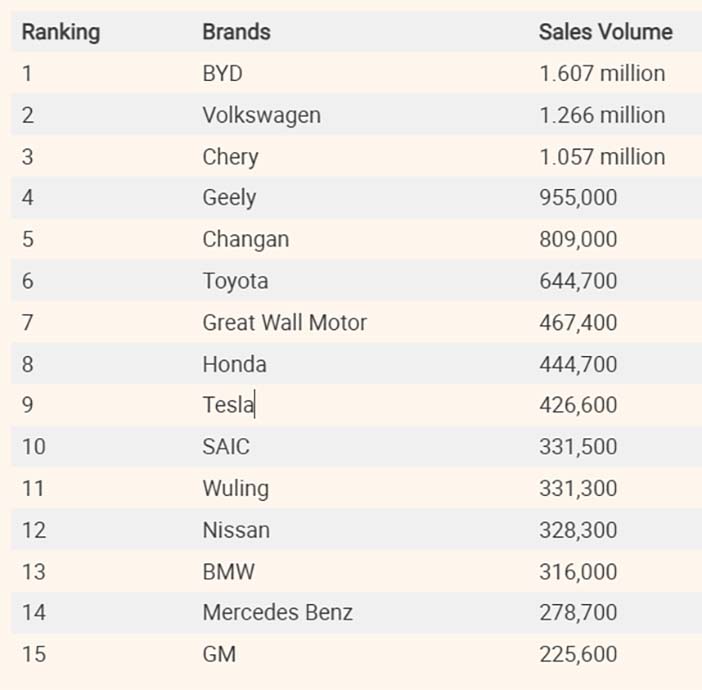
+++ Recently, the CHINA Passenger Car Association (CPCA) and China Association of Automobile Manufacturers (CAAM) released China’s auto industry report cards for the first half (H1) of 2024. In H1 2024, China’s automobile production and sales were 13.891 million and 14.047 million vehicles, up 4.9% and 6.1% year-on-year, respectively. In particular, the sales growth rate of new energy vehicles was significantly higher than that of gasoline-powered vehicles: the production and sales were 4.929 million and 4.944 million units, up 30.1% and 32% year-on-year, respectively; accounting for 35.2% of the market share. Furthermore, the top-10 Chinese automotive companies’ combined sales volume was 11.917 million vehicles, a year-on-year increase of 6.3%, accounting for 84.8% of the total automobile sales. More specifically, the top three automakers’ (BYD, Chery and Geely) sales volume was 4.871 million vehicles, a year-on-year increase of 1.1%, accounting for 34.7% of the market share. BYD sold 1.607 million cars, Volkswagen 1.266 million and Chery 1.057 million. Breaking it down further by brand types, the sales volume of domestic Chinese brands reached 5.559 million vehicles, a year-on-year increase of 17.8%, with a market share of 56.5%. The cumulative sales volume of German brands was 1.907 million units, a year-on-year decrease of 6.2%, with a market share of 19.4%; the sales volume of Japanese brands reached 1.466 million vehicles, a year-on-year decrease of 12.4%, with a market share of 14.9%; and the sales volume of American and French brands decreased by 19.2% and 19.1%, respectively. +++
+++ It was reported that BYD sold 1.084 cars in JAPAN in the first half of this year. What was not so widely reported is that BYD now has a 2.7% share of the Japanese EV market. The Japan Automobile Importers Association (JAIA) figures show that imports were 113.887 units in the first half of 2024, down 7% year-on-year. Sales of BEVs, however, were up and now account for nearly 9.5% of the total, up by 2 percentage points from last year, with a total of 10.785 cars. This means BYD has 10% of the total number of imported EVs. These sales may not sound much, but domestic Japanese car companies are not strong with their EV offerings. Sales of domestic EVs during the same period amounted to 29.282, according to preliminary data from the Automobile Dealers Association, the Japan Light Motor Vehicle and Motorcycle Association, and the Japan Automobile Importers Association (JAIA). This was a 39% year-on-year decline. That decline was largely because of a 38% drop in the sales of the Nissan Sakura, a micro EV somewhat similar to the Wuling Hongguang. Light EVs such as the Sakura make up 13.540 units of the total sales; the Sakura itself amounts to 90% of light passenger EV sales. EVs accounted for 1.6 percent of Japan’s passenger car market during the first half of 2024, a decrease of 0.7 percentage points from a year earlier. While imports generally account for a very small percentage of the Japanese car market, they hold an almost 27% share of the BEV market. Argus, a market intelligence agency, claims foreign brands dominate the Japanese EV market. They quote a representative of the Japan Automobile Importers Association (JAIA) saying that foreign companies offer a wider range of models than domestic producers. BYD began selling in Japan on January 31, 2023 with the Atto 3. Since then, BYD has introduced the Dolphin in September last year and the Seal in June of this year. BYD’s sales in Japan in the first half of this year increased by 88% year-on-year. This increase helped BYD move from 19th place to 14th place in the sales rankings of importers to Japan. Sales in June were 149 units, a 60% year-on-year increase, showing that momentum is continuing. BYD aims to have 90 sales outlets in Japan by the end of the year, up from the current 55. Furthermore, as we have previously reported, BYD aims to storm Japan with sales of 30.000 in 2025. +++
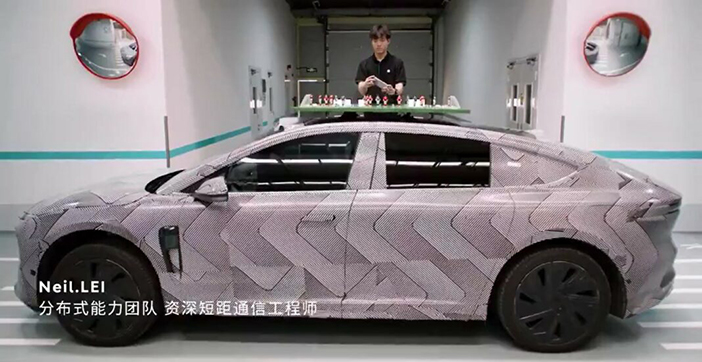
+++ NIO shared a new video promoting its active suspension system, Skyride, which will debut on the ET9 flagship sedan in early 2025. In the video, Nio ET9’s active suspension quickly adjusts to a phone’s movement. Tabletop football is mounted to the top of the car, so the whole “playground” moves with the vehicle, and the player can direct the ball into the net. This is because the Skyride suspension is connected via Bluetooth to the phone, which is, like all smartphones, equipped with a gyroscope so that the car can imitate the phone’s movement. The whole test is conducted by Nio’s senior engineer Neil Lei. Nio’s Skyride intelligent chassis system is the world’s first integrated hydraulic fully active suspension, according to Nio. This system can respond within 1 millisecond and the high-performance brushless motor can make up to 1.000 torque adjustments per second. Another feature is the independent control of all 4 wheels. Each of ET9’s wheels can be controlled independently, allowing for 6-way adjustment, Nio claims. This capability is promoted in the video. When playing tabletop football, the car body can be adjusted along 6 axes using the phone’s gyroscope. The Shanghai-based startup wants to showcase that active suspension electric has low latency and quick response times, providing high control precision and a fluid driving experience. The Skyride suspension adjustment range is between +40 mm and -50mm, catering to various driving scenarios. The system can raise the vehicle by 40 mm in 2 seconds and lower it by 50 mm in less than 2 seconds. This capability Nio promotes in another video shared by Wang Yufei, Head of the Chassis team. In the video shared on Weibo, Nio ET9 is juggling the ball on its roof. Wang comments that “the ET9’s SkyRide active suspension adjusts 60 times faster than traditional air suspension”. The supplier of Skyride suspensions to Nio is ClearMotion, a US-based startup. The startup from Boston that aims “to make car rides less bumpy and more fun” raised $39 million, led by Nio Capital, in September 2022. In April, it was revealed that Porsche would join the bandwagon and use Clearmotion’s active suspension tech. Clearmotion received an order for 3 million suspension-related products from Nio, covering the production of 750.000 vehicles. This doesn’t represent the ET9 production capacity. Nio ET9 will be the most expensive car from Nio and will launch in early 2025. It was unveiled on Nio Day in December 2023, and preorders for 800.000 yuan (€160.000 in Dutch pricing) were started. +++
+++ Only Apollo Go gives way to pedestrians in Wuhan, joke the city’s citizens. Unfortunately, the Baidu driverless taxis were not so good at giving way last week when 1 car hit an e-bike rider running a red light. Earlier this year, I reported on Baidu’s launch of its 6th generation ROBOTAXI , the RT6, which costs less than a Xiaomi SU7. Plans call for 1.000 of the RT6 robotaxis to be deployed on the streets of Wuhan by the end of 2024. Currently, Apollo Go operates more than 500 robotaxis of varying generations on the streets of Wuhan, the capital of Hubei province. To say that the robotaxis of Wuhan are having a mixture of reactions is an understatement. The only comment on my previous article about the RT6 robotaxi was one complaining about traffic being clogged up on the streets of Wuhan due to the robotaxis. Many in Wuhan feel this way and another area for complaint is from drivers who believe they are suffering financially because of them. Taxi drivers are petitioning Wuhan to limit the use of Apollo Go. One operator said that 4 of its 159 drivers had quit since April. It’s believed that Apollo Go, at its peak, received an average of 20 orders per day per vehicle. China News Weekly quotes a Beijing ride-hailing driver as saying that these days, he usually gets 16 or 17 orders a day, but 2 or 3 years ago, 20 orders a day was not much. Although there may be an issue with the robotaxi service charging less than regular ride-hailing services, the real issue is more likely the state of the economy. Robotaxis make up only around 1 percent of the taxi and ride-hailing fleet in Wuhan, so they alone cannot be the reason for falling driver income. Wuhan’s robotaxis have so far accumulated more than 300 complaints on an official traffic management website. Many of those complaints are about the robotaxis causing an obstruction and being slow to react to events such as traffic lights. There have been many problems with robotaxis not being able to get into the correct lane, mainly due to their interaction with human drivers on the road. Luobo, as Apollo Go is known in Chinese, which means radish, has become synonymous in the Wuhan dialect with being stupid and naïve. A recent video that went viral on social media showed a robotaxi stuck because of a bag in the road which it saw as an obstruction, finally after pedestrians moved the bag the robotaxi slowly left. Even regular users of the Apollo Go service in Wuhan say that robotaxis journeys take longer than with a human driver. China News Weekly quotes Liu Shuang as saying that one of the routes she takes would take an experienced driver 6 or 7 minutes but takes Apollo Go more than 10 minutes because the robotaxi prioritizes routes using main roads, which have more traffic lights. She also says that the driving is not as smooth and the robotaxis will often brake suddenly because of pedestrians or other obstacles. Liu who initially tried the Apollo Go robotaxi out of curiosity with her child, has since used the service at least 10 times within 1 month. One of the main reasons she has used it so many times is the price. On a 5-kilometer route from her home to the cram school where her child has classes, the cost of a Didi (China’s Uber equivalent) is between 11 and 15 yuan ($1.5 – $2); however, using Apollo Go the cost is only 7.5 yuan ($1). Using discount vouchers, the fare is reduced even more and sometimes down to just 2.5 yuan ($0.35), whereas using vouchers, the Didi fare can be reduced down to 7.5 yuan ($1). When the robotaxis started operating in Wuhan, a safety driver was sitting in the front passenger seat. All robotaxis in Wuhan only allow passengers in the rear seats with a plastic screen to prevent them from interfering with the operations of the robotaxi. The number of robotaxis operating on the streets of Wuhan without a safety driver is increasing, reaching a total of 70% in April, and it is expected to rise to all robotaxis by the end of the year. No longer requiring a safety driver will be an obvious cost-saving for Apollo Go. Furthermore, Baidu claims that the 6th generation robotaxi’s price has decreased significantly compared to previous generations. At the launch of the RT6 robotaxi, Baidu showed an official invoice which put the cost for a single taxi at 204.600 yuan; this compares to around 480.000 yuan for the fifth generation. Apollo Go predicts that it will break even within the next year, currently the price of rides is subsidized and the company makes a loss. Apollo Go’s service area in Wuhan covers 3.000 square kilometers and 3,378.73 km of actual roads. The catchment area is home to 7.7 million people, over half of Wuhan’s population. Although Apollo Go operates in other cities, Wuhan is currently the largest service area. Baidu has previously said that it plans to cover 100 cities with robotaxis by the end of the decade. +++

+++ Xiang Xingchu, chairman of JAC, has said the first car from the new brand developed between JAC and Huawei is planned to roll off the assembly line by the end of the year and will be launched in the first half of 2025. Speaking at the China Auto Forum, which runned July 11-13, Xiang mentioned that the car has now entered the vehicle verification stage. The first model in the new brand between JAC and Huawei is codenamed X6 and is an MPV. Huawei works with several Chinese auto producers to varying degrees. The company has 3 basic business models. Cooperation with JAC is based on the all-encompassing HIMA (Harmony Intelligent Mobility Alliance) level where Huawei not only provides an intelligent cockpit and intelligent driving solution but is also involved with elements including the design, production, sales, after-sales and other stages of the vehicle but stops short of actually producing the car. This business model is the same as with Seres for the Aito brand, Chery for Luxeed and BAIC for Stelato. The as yet unnamed brand with JAC is being positioned as ultra high-end and will be priced at around 1 million yuan (€200.000). The new EV will plug the perceived gap in China’s ultra-luxury smart electric vehicle market. Richard Yu (Yu Chengdong), chairman of Huawei’s smart car unit, has said that the benchmarking will far exceed the level of Maybach and the ROLLS-ROYCE Phantom. Currently, the first model has entered the software and hardware verification stage. Under the cooperation agreement, JAC is responsible for the overall product development of the joint models and for building a production base to achieve the delivery of them. Xiang revealed that the JAC smart factory that will be used for the production is basically complete. The new smart factory integrates digital R&D, green and low-carbon manufacturing, brand experience services and other functions. It can support an annual output of 200.000 vehicles and it will be used in the future to produce other new models in cooperation with Huawei. In the first half of this year JAC’s R&D investment increased by 64% year-on-year and accounted for 7.6% of revenue, with the investment expected to increase in future years to about 9%. JAC Motors signed a smart new energy vehicle cooperation agreement with Huawei on December 1, 2023, which is valid for 10 years from the date of signing. Under the agreement, JAC is responsible for the product development of the models jointly operated by the two parties and for providing a production base. Huawei on the other hand provides the sales service worldwide and is also responsible for the ecosystem and marketing. JAC is probably best known as the former partner of Nio. It is also successful in the commercial vehicle market but less so when it comes to passenger vehicles. JAC also has a joint venture with Volkswagen. However, Volkswagen now has 75% ownership and due to a shareholding in JAC Motors’ parent group (JAG) effectively has an even higher share. +++
+++ Chinese media reports that SAIC is negotiating with Spain’s Ministry of Industry to build a factory in the country to produce MG cars. Reports claim that SAIC Motors will make a decision by September 30. Other countries still in the running include Hungary and the Czech Republic, which have lower labour costs. SAIC intends to make the decision soon so that construction of the plant can begin, with plans calling for the first vehicles to be produced in the 4th quarter of 2027. The decision is a direct result of the EU’s investigation into Chinese subsidies of EVs, which hit SAIC with the highest temporary tariff of 37.6%. Because SAIC didn’t cooperate with the investigation, it received the highest tariff rate (SAIC did not release core information, including battery data, in accordance with the EU’s requirements). Previously, while the EU investigation was underway, SAIC chairman Wang Xiaoqiu said at the 2023 shareholders meeting that SAAC would not give up the EU market. By building a factory in an EU member state, SAIC will no longer be affected by tariffs. Last year, SAIC’s MG 4 was the 6th best-selling BEV within the EU, with 72.421 registrations. This model will almost certainly be produced at the new factory in Europe, along with possibly the recently declared MG S5 SUV. Another likely car to be produced in the EU is the successor to what is known as the MG 5 in Europe (Roewe Ei5 in China). The EU tariffs were announced in June and commenced on July 4. There was a slight decrease in the level of tariffs from the level initially announced in June with the rate for SAIC dropping from 38.1% to 37.6%. The tariffs introduced earlier this month are meant to be a temporary measure until more permanent tariffs are introduced in November this year. Under the current tariffs, BYD is subject to 17.4%, Geely 19.9%, car companies that cooperated but didn’t receive an individual figure 20.8% and 37.6% for those who did not cooperate. +++