
+++ CATERHAM has created a separate company, funded by investors, to finance its Project V electric coupé, CEO Bob Laishley has revealed. Laishley said the EV, due to be unveiled in 2026, falls under a separate firm called Caterham Evo, because “the meagre profits we make from selling Sevens” won’t fund its development. He continued: “That money will need to come from within the group (Caterham is owned by Japanese automotive sales giant VT Holdings) or external funding. It’s significantly tens of millions above what we would invest in developing new Sevens, for example”. Laishley added that development of Project V is “progressing”, that “the project is moving forward and the next phase will be some prototypes” and “it will emerge at some point”. He had already confirmed that the car wouldn’t be built at Caterham’s new £5 million facility in Dartford, Kent. Meanwhile, development of the Seven is continuing. Ford stopped making its 1.6-litre Sigma engines in 2021 and has now also finished with its 2.0-litre Duratec engine, and although Caterham has a plentiful stock, it’s seeking a new engine partner and already has a shortlist of interested manufacturers. “We have to move the Seven forward with a new powertrain for the next decade, which we’re planning to do from Dartford”, said Laishley. “But where we’re sitting now, there’s no plans to bring Project V into this building. It’s a separate thing in its entirety, with four times the volume, more consistency between models. It’s a different animal altogether”. +++
+++ The sharp decline in fortunes hitting global volume car brands in CHINA is starting to be repeated among premium brands, including Audi, BMW, Jaguar, Land Rover, Mercedes-Benz and Porsche. Premiums brands typically derive a much greater share of their overall sales from the world’s largest market than than volume players do; more than a third of them in the case of Audi. Until recently, they were relatively insulated from the brutal price war being waged by ever-improving Chinese brands fighting to capture market share. Brand power was the protective insulating material. However, their sales are skidding downward this year, sending a shiver through boardrooms as executives work out whether this is a blip attributable to the overall lower consumer confidence in China or the start of a longer downward trend. +++
+++ DS is testing an all-new electric SUV designed to take on the likes of Audi, BMW and Mercedes in the premium car market, but with French flair. The car will be revealed before the end of 2024. The coupe-SUV will be influenced from the firm’s Aero Sport Lounge concept back in 2020. It will be a car similar in size to the new Peugeot E-3008 with which it’ll share the same SLTA Medium underpinnings. With the STLA Medium architecture, the DS should use the same 73 kWh battery as the E-3008. Range could rise over the Peugeot’s 520-km maximum due to the DS’ slipperier coupe shape. The platform will also cater for a 98 kWh battery and given the model’s position as the flagship DS, it’s possible it will only be offered with this unit for a range of around 700 km and a greater premium appeal. Power will come from a 210 hp single-motor or a 320 hp dual-motor set up. While the STLA Medium architecture can allow for internal-combustion engines, DS announced in 2021 that it will only launch all-electric new cars from 2024 onwards. This new flagship will be fully unveiled in October and pricing will sit comfortably above the cheapest Peugeot E-3008 at around €58.000 in the Netherlands. +++
+++ FORD has scrapped its plan to launch a 3-row, 7-seat electric SUV next year, warning that the move could cost the company $1.9 billion. It has been cancelled because it would not have been profitable within the first year of its launch. The company highlighted the increasing cost-consciousness of new electric car buyers, as well as the “scores of new electric vehicle choices hitting the market over the next 12 months” as factors limiting the model’s viability. Ford will now prioritise the development of new hybrid 3-row SUVs, reducing its annual spend on electric vehicles from 40% of its total investment to 30%. In turn, the T3 electric pick-up has been delayed from next year to the second half of 2027. This will allow Ford to adapt the model to use less expensive batteries, it said. The news about Ford’s US-focused electric cars comes as it shifts its focus in Europe towards more affordable electric SUVs, with successors to the Fiesta and Focus mooted for launch around 2026 and 2027. An electric Ford Puma, named the Gen-E, will arrive later this year. “If you look at our line-up globally, at this point we don’t really have much in the affordable segment”, Marin Gjaja, chief operating officer of Ford’s Model E division, recently told. Gjaja added: “The key for us is to be affordable, differentiated and profitable. For too long we stayed in the affordable segment, either at break-even or losing money. “The question is: how do you compete in that segment, especially if you have got a very low-cost manufacturing location like China pumping out affordable vehicles? That’s the dilemma. There’s no question that if we’re going to be a true mass brand, we want people to graduate to a vehicle like Explorer, but where do you start them? That’s what we’re doing in the US with an affordable platform, and there’s no reason why that platform wouldn’t be able to create products for Europe as well”. +++
+++ The most deliciously unpredictable business of the last half century? That’ll be the global automotive industry, which has altered beyond all recognition since 1974. In those 50 years, the former No.1 car-producing nation that is (or was) the USA has proved that it ain’t what it used to be, while Australia inexplicably expunged itself as a car-building country. Never mind, the likes of China (from nowhere to No.1) plus tiny South Korea (the new No.5) have quietly stepped in to replace them. And then some. On the face of it, troubled manufacturers such as Saab, Rover and Daewoo died a natural death. Or were they cruelly murdered by a combination of bankers, clueless politicians, aggressive unions and (in Rover’s case) dodgy directors? Or, in the case of Saab, the talent of American companies like General Motors to destroy but at the same time being unable to rebuilt? We also lost icons like the Jeep Cherokee on its 49th birthday and the Volkswagen Beetle after a production run of well over half a century. RIP both. These important, somewhat sad, but in some respects inevitable changes demonstrate that nothing lasts forever. Every dog has its day. Let’s move on and raise the game, blah, blah. But few, if any experts, analysts or consumers dared to forecast the unthinkable: that GERMANY (arguably the mass manufacturer of the greatest, most desirable and durable real-world cars from the 1970s to the 2010s) would take a massive step backwards in quality, credibility and value come the 2020s. But that, evidently, is what it’s done. Until recently, Germany’s 3 best-selling premium mainstream brands had a real whiff of prestige, class and exclusivity. But not any longer, I fear. They’re to be admired for climbing up the sales charts and raking in the healthy profits necessary to keep them alive. But BMW and Audi comfortably outsell Ford in Europe. And Mercedes thrashes Fiat and Opel. Put another way, these ‘upmarket’ brands have become common as muck. Split the 32 marques in the 2024 Driver Power survey into 4 divisions and BMW sits close to the bottom of Division 2. Mercedes and Audi (plus the sub-premium VW) do even worse as they languish in Division 4, beaten by ‘lesser’ (or maybe not) Spanish, Czech, Romanian, British, French, Korean and American brands. Also, every Japanese marque is either ahead of, or way, way ahead of Audi, Mercedes, BMW and VW. Evidently, Audi has almost rock-bottom scores for value for money. Mercedes is considered woefully poor in areas such as running and servicing costs (and, incidentally, of the large and diverse bunch of friends, family and associates I have, those with a Mercedes complain the most to me about their cars and what they describe as appalling aftersales service when faults crop up). BMW is better, but it too scores badly for overall value and servicing costs (with borderline premium VW among the worst for quality and reliability). These giants haven’t yet lost their reputation for making the greatest, most desirable and durable real-world cars. But if they don’t rapidly up their game in vital areas such as running and servicing costs, quality, reliability and value for money, they soon will. +++
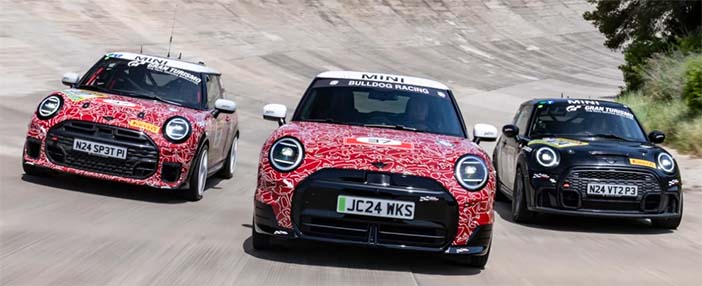
+++ Get ready hot hatch fans, because the new MINI John Cooper Works is going to be revealed this autumn, and for the first time ever, it’s going to be available with a choice of petrol or all-electric power. Prototype versions of the JCW, dubbed ‘JCW PROtotype’, have already had a busy summer, from making their rolling debut in front of packed crowds, to track time at major racing events, showing Mini is serious with the latest iteration of its popular hot hatch. That started with the Nürburgring 24 Hours back in June, where the petrol prototype took a class victory on its first attempt; highlighting not just its performance but also suggesting good things for its durability. The electric version then made its own public debut at this year’s Goodwood Festival of Speed, with a ‘dynamic demonstration’ running up the hill; coincidentally, the same weekend that the Alpine A290 electric hot hatch also enjoyed a few runs, suggesting the future of the genre won’t be as bleak as some might imagine. The JCW PROtotype’s camouflage uses the same red and white colour scheme as classic Mini rally cars from the sixties, particularly the one Paddy Hopkirk drove to victory at the 1964 Monte Carlo Rally. The ‘37’ numbering is also a tribute to that famous car. We do still get some clues about changes made for the JCW, such as the chequered-flag pattern for the octagonal grille, which also looks to be more open to allow for better cooling. Of course, the standard car’s classic round headlights still feature. The wheel arches have been flared, and at the rear, there’s a twin roof spoiler above a single large exhaust pipe in the centre of the more aggressive rear bumper. The customisable tail-light panels from the new Cooper remain. Sticking with the petrol Mini JCW for now, the last one used a highly tuned version of the turbocharged 2.0-litre four-cylinder petrol engine found in the Mini Cooper S, and it’s all but sure to be the same story this time around. The new Cooper S produces 204 hp, compared to 184 hp in the previous generation car, so if the Mini JCW gets a similar power boost, we may see it deliver close to 252 hp; the old JCW model had 231 hp on tap. Unfortunately, we’re all but certain that the new Mini JCW won’t be offered with a manual transmission, as the regular petrol-powered Cooper is available exclusively with a 7-speed dual-clutch automatic gearbox. Meanwhile, the all-electric Mini John Cooper Works E is probably going to use the same 54.2 kWh battery as the Cooper SE. That model has a range of roughly 400 km, although the souped-up JCW E is unlikely to go as far on a charge. I expect it’s going to be front-wheel drive as well, just like its forthcoming rival, the Alpine A290. That said, the head of Mini ’s product line, Stefan Flöck, told me last year that the Cooper EV’s platform could accommodate a dual-motor setup and 4-wheeldrive if the team wanted to go down that route. +++
+++ Philipp Römers has been named as POLESTAR ’s new head of design, replacing Maximilian Missoni. Römers was previously Audi’s head of exterior design and is credited with designing cars including the outgoing Audi A6, the A8 and e-tron GT, as well as the Mk7 Volkswagen Golf. Missoni, who was Polestar’s design chief since it was hived off from Volvo in 2018, has left to take a new role at a different company.Thomas Ingenlath, Polestar CEO, said: “I thank Max for his leadership and companionship during the inception of Polestar as Europe’s only pure-EV brand. Max established the innovative design standards that combine aesthetics, luxury and performance in a way that is truly Polestar. We wish him all the best in the future. “At the same time, I am delighted to welcome Philipp to Polestar. Philipp’s modern approach to automotive design and experience from the luxury, performance segment will really support us as we take the next step in developing our model line-up”. Römers arrives at a critical moment in Polestar’s development, as it expands from one model, the 2, to a broader line-up of luxury cars. It’s aiming for break-even cashflow and 155.000 sales next year. Among the cars Römers is likely to be charged with designing are the follow-up to the 2, as well as mid-life updates for the 3, 4, 5 and 6. +++
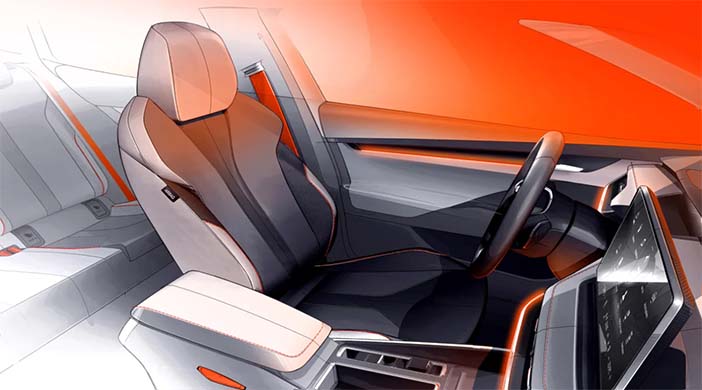
+++ Here’s a new all-electric small SUV joining the fray towards the end of this year from SKODA and it’s called the Elroq. I’ve already driven it in prototype form, but now there are the first images of the Elroq’s interior which Skoda claims follows the brand’s ‘“Modern Solid’ design language”. We’ll have to wait until October for the full unveiling of the Elroq, as previously confirmed by Skoda’s CEO Klaus Zellmer. The Elroq will be the first production model to be designed using Skoda‘s new ‘Modern Solid’ design philosophy, which was previewed by the Vision 7S concept in 2022 and the Skoda Epiq concept unveiled earlier this year. This should mean the car will have a robust look, while Skoda’s head of design, Oliver Stefani, believes “no doubt, our brand-new Elroq sets a new tone and is a real eye-catcher”. As expected, the Elroq will come with a variety of different ‘Design Selections’. Skoda has prioritised the use of recycled material in the Elroq with each Design Selection using different sustainable materials. For instance, the Loft Design Selection uses something called ‘Recytitan’, which is a material comprising 78 per cent recycled PET (polyethylene terephthalate) and, for the first time in any Skoda, recycled clothing. Skoda claims the Elroq’s interior “emphasises simplicity, spaciousness, and clean lines.” These first sketches show an interior heavily inspired by the firm’s first bespoke EV, the Enyaq. The switches and overall layout of the Elroq’s centre console is similar to the Enyaq’s, as is the dash, which looks like it borrows the same 13-inch central touchscreen from its larger sibling. Also like the Enyaq there’s no massive ‘virtual cockpit’, instead you’ll find a much smaller 5.3-inch screen and the seats look identical to the ones in the Enyaq too. As for the exterior of the Elroq, a previous teaser image of the mid-size electric SUV revealed a split headlight design that wraps slightly around to the car’s sides, and the Skoda lettering on the sharply contoured bonnet. Below that is the Elroq’s blanked-off ‘Tech-Deck Face’, which is a flatter and wider reinterpretation of the traditional Skoda grille design. It’s hard to pick out any other details, although slightly unusually, Skoda has said that the Elroq will sport some large wheel designs, plus matrix LED headlight technology. Importantly for a family car, Skoda is promising the 4.5-metre-long Elroq will offer a generous amount of interior space and “exceptional practicality”. The Elroq has a 470-litre boot, plus 48 litres of additional storage in the cabin, and the luggage capacity can expand to 1.580 litres when the rear seats are folded down. There are plenty of Skoda’s signature ‘Simply Clever’ touches onboard as well, including some brand new ones like a storage net for the charging cables and a QR code in the boot that links to some handy instructional videos. The Elroq sits on the Volkswagen Group’s EV-dedicated MEB platform, also used by the Enyaq and its coupe counterpart. I am told there will be 4 versions available, starting with the Elroq 50 that uses a 55 kWh battery and a 170 hp rear-mounted electric motor. Next up, the Elroq 60 gets a larger 63 kWh battery and 204 hp e-motor. The range-topping Elroq 85 gets an 82 kWh battery for a claimed range of more than 560 km, and a single 286 hp e-motor. The Elroq 85x adds a dual-motor setup offering four-wheel drive and a combined output of 299 hp. I also know that there will be a high-performance Elroq vRS model further down the road. The Elroq is 1 of 6 new electric cars that Skoda plans to launch over the next few years, including its own seven-seater flagship, a road-going version of the Epiq and an affordable entry-level EV. +++
+++ The TESLA Model Y, the world’s best-selling car, will be substantially updated in 2025 with a new look, an interior overhaul and substantially improved performance figures. The SUV’s immense success makes it Tesla’s most important asset and the American EV maker will look to leverage it in an attempt to move out of a prolonged sales dip, during which it has been without a month-on-month deliveries increase since the end of 2023. Tesla CEO Elon Musk has previously said the Model Y will not be updated in 2024, with the firm prioritising other product launches. However, the first pictures of the updated SUV (codenamed Project Juniper) have been published online, informing our artist’s rendering and suggesting a reveal is near. The Model Y has not been updated since its 2020 launch, which means it no longer so obviously offers a usability and performance advantage over its rivals. The SUV’s maximum 530 km range, for example (seen as a headline attribute at its launch) has now been surpassed by cheaper rivals such as the Renault Scénic E-Tech and Peugeot e-3008. Addressing that shortcoming will be a focus of the Model Y’s facelift, as it was for the Model 3, which can now travel up to 8% further on a charge than it did previously, thanks to extensive revisions to its aerodynamics and electronics. The Model Y will follow its sedan sibling in gaining a revised front end, with the headlights and bumper reshaped to cut through the air more efficiently and boost range while also reducing wind noise at a cruise. This treatment lowered the Model 3’s drag coefficient from 0.23 to 0.219, making it one of the slipperiest cars on sale. A similar treatment for the SUV could contribute to a range of more than 560 km in its most efficient form. Another focus of the refresh will be to improve the Model Y’s usability and quality credentials. To that end, the Model 3’s redesigned centre console, new upmarket textiles and 8.0 inch rear touchscreen are expected to be carried over. One of the more controversial elements of the Model 3’s facelift was the migration of the indicator controls from a stalk to the steering wheel and it remains to be seen whether Tesla will react to criticism of that by retaining the Model Y’s traditional controls. The latest images of the new Model Y suggest it will be differentiated most obviously from the current car by a new rear light bar that is notably different from the C-shaped clusters added to the back of the Model 3. Tesla is not expected to make drastic changes to the powertrain and charging system (the Model Y’s 250 kW maximum charge speed is still one of its strong suits) but the top-rung Performance version is likely to receive a significant increase in power to take the fight to the new electric Porsche Macan Turbo. As an indication, the 4560 hp Model 3 Performance cracks 0-100 kph in just 3.1 seconds and achieves a top speed of 254 kph. Assuming the Model Y gets close to those figures, it will be one of the fastest crossovers on the market. +++