
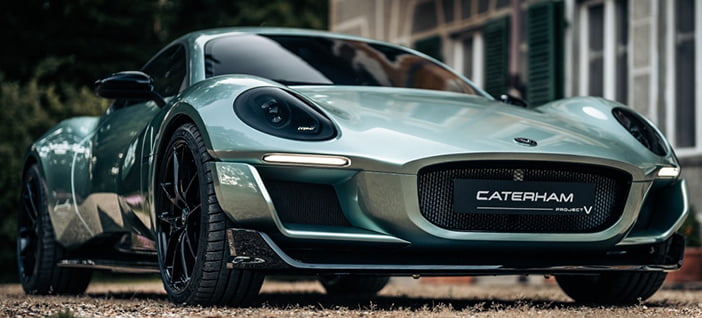
+++ CATERHAM ’s new Porsche 718 Cayman rival has edged closer to reality with the announcement that Yamaha will develop its electric powertrain, and the first prototype will be running in less than a year. Caterham has today confirmed that the world’s third-biggest motorbike manufacturer will equip the sub-€100.000 Project V sports coupé with a “cutting edge e-axle” and provide “its technology and expertise in vehicle motion control”. Just over a year after the Project V concept was revealed at the Goodwood Festival of Speed, Caterham is “moving to the next phase of its development”, en route to putting a final product in showrooms in the coming years. Details of its Yamaha powertrain have yet to be confirmed, but the concept was said to have a single motor giving 272 hp to the rear wheels for a sub-4.5 seconds 0-100 kph time. Yamaha is already developing motors for cars and describes them as “featuring industry-leading output density”, courtesy of highly efficient conductors and learnings “garnered through our engine development efforts to date”. Notably, it has already installed a quartet of its ‘Hyper EV’ motors producing 272 hp a piece (matching the Project V concept) in Subaru’s wild 1.088 hp STI E-RA racer, which is targeting a Nürburgring lap time of just 6 minutes 40 seconds. Yamaha also recently signed up as a technical partner to the new Lola Formula E team, which will make its debut in the 11th season of the electric single-seater championship from December. Caterham CEO Bob Laishley told that the decision to collaborate on the Project V was as much Yamaha’s as it was his own: “As you can imagine, global companies like Yamaha do not make decisions without detailed discussion and consideration, our discussions with them for Project V have been maturing for quite a while. We are very honoured to be working with them and it is great news for the Caterham brand that we can make this announcement today. In terms of why Yamaha as opposed to other options, they have a long-proven record of supporting OEMs with technology and, through their two-wheel business, clearly understand the need for weight optimisation. In the end, the decision was a mutual one from both sides, rather than us specifically choosing them in a traditional supplier selection”. The Japanese giant has never put a road car into production itself, but in 2015 it revealed a compact sports car concept designed in partnership with Gordon Murray. Dubbed the Sports Ride, this relatively realistic proposal for a lightweight 2-seater was remarkably similar in size, shape and positioning to the Project V, although had it entered production, it would have used a tiny turbocharged petrol engine. Before that, in the early 1990s, Yamaha also built a small number of fully functioning prototypes of an outlandish V12-engined supercar called the OX99-11, which was designed effectively as a road-going Formula 1 car. Neither car ever reached showrooms, but no doubt Yamaha can still draw from learnings around their packaging, construction and engineering as it develops the drivetrain for the Project V. “Caterham’s brief for the Project V’s development remains the same as always: lightweight, simple and fun-to-drive”, Laishley said. Caterham has also confirmed that Japanese engineering outfit Tokyo R&D will build the first prototype, which is due to be completed by mid-2025, though Laishley suggests the car may not launch as early as 2026, as was originally planned. “I don’t want to speculate on the final start-of-production date but 2026 will be a challenge”, he told. Tokyo R&D has previously been involved with the development of various experimental prototypes, test mules and concepts for Japanese manufacturers. It also produced its own compact 2-seat sports car, the Honda-engined Vemac RD200, from 2004 to 2008. Caterham has given no indication that its partnering with 2 Japanese companies on the Project V programme means the car will be built in Japan. The Japanese-owned British company has previously confirmed that it won’t build the Project V alongside the Seven in its Dartford factory and is in talks with a range of potential candidates to build the car on a contract basis. Laishley has told that there is still “no decision on the manufacturing location yet”. +++
+++ CITROEN will provide a first look at its future when it unveils an all-new concept car at the upcoming Paris motor show. The French brand said the show car will sit “in a major segment”, suggesting that it’s most likely a B- or C-segment hatchback or SUV, although Citroën has yet to provide further detail. It is very possible the new concept car give a preview of the next-generation C5 Aircross. It added that the facelifted Citroën C4 hatchback and C4 X saloon will be shown alongside the new concept. As previously reported, the duo will receive new lighting signatures and more squared-off bumpers, inspired by the Oli concept that was shown two years ago. It’s possible that the unveiling of the facelifted C4 alongside the new concept is no mere coincidence: it’s due for replacement around 2026 or 2027, which would also fit the traditional timeline of taking a concept through to production. Alternatively, it may be a radical model inspired by the Ami quadricycle. Although Citroën hasn’t officially hinted at any such plans, CEO Thierry Koskas previously told that “we are going to extend the Ami line-up and do many changes”. “We will reveal everything in the Paris motor show,” he added. The new Citroën C3 Aircross will also make its public debut at the show. The crossover is based on the same Stellantis Smart Car platform as the new C3, but has been stretched to 4.390 mm long to fit a small third row of seats. It’s set to become one of the UK’s cheapest 7-seaters when it arrives next year. +++
+++ KIA is gearing up to launch a series of electric commercial vehicles from 2025, alongside which will sit a choice of practical people movers designed to hit models like the long-wheelbase Volkswagen ID.Buzz exactly where it hurts. The first of these will be the MPV version of the Kia PV5, which we recently caught testing on the open road ahead of its launch early next year. Dimensions are unknown, but it’s understood Kia has had feedback from fleet operators to ensure it offers generous capacity and a low total cost of ownership. As such, expect the PV5 to push the extremities of the segment, sitting at the top of the market that models like the near-five-metre-long ID.Buzz and Ford Tourneo Custom also compete in. It’ll be boxier and therefore more practical than the Volkswagen, however, with a huge wheelbase and what looks like sliding rear side doors. The upright windscreen and stubby front end are similar to those on the ID.Buzz, although the Kia looks to have a smaller quarterlight, which may affect forward visibility. One point of note is the door mirrors, which will grow for the production version. These were shown in a shadowy teaser image at the IAA Transportation show in Hannover last month, but don’t appear on the disguised prototype testing here. From that same teaser shot we can see the van’s distinctive daytime running-light signature, which will extend from the nose, right up to the base of the windscreen. This design should feature on each of Kia’s future CVs from 2025 and beyond. From the spy pictures, we can see a separate set of headlights lower down, alongside plenty of contrast trim and silver scuff plates. Deep side windows run the length of the car, with darkened A, B and C-pillars giving the effect of a Range Rover-style floating roofline. At the rear, there’s a set of tail-lights; a single-piece tailgate will set the MPV apart from the van, which will get two doors split vertically down the middle. The concept version of the PV5 was apparently designed specifically for private-hire drivers, with a single seat in the front and a space on the passenger side reserved for suitcases and other luggage. However, the production version is likely to follow a more conventional format, with two chairs up front and a further two rows of seats behind. It’s not clear at this time whether Kia will squeeze in 2 rows of 3, or go for the normal 2-3-2 (or 2-2-3) layout. Either way, the electric architecture, developed specifically for the maker’s LCVs, should ensure every occupant gets plenty of headroom and legroom, with a totally flat floor and the possibility of a walk-through cabin in both the front and rear. There’s a chance Kia may fit sliding and swivelling seats, plus it should also offer the ability to remove the second and third rows entirely to allow it to double as a van. I don’t know all that much about the batteries or electric motors that will sit under the skin of the PV5, although the fact Kia has said the van will charge from 10-80 per cent capacity in “less than 30 minutes” and offer fast charging of “up to 150kW” would suggest it’ll use a 400-volt electrical system like the one found on the EV3, rather than the more advanced 800v set-up from the EV6 or EV9. Vehicle to Load (V2L) tech will also feature, allowing owners to power external appliances such as hobs or coolboxes. Given the car’s size and the space inside, Kia might see the opportunity for its PV5 to double up as a part-time campervan, and offer bespoke aftermarket accessories like fold-out beds or awnings. Assuming a battery of around 81 kWh (as found in the top-spec EV3) the PV5 should be capable of returning around 480 km of range. Smaller batteries, strictly targeting urban mobility solutions like taxis or private-hire vehicles, may also be offered. Kia has confirmed that its commercial vehicle range (including passenger variants like the PV5) will get the same 7-year, 150.000 km warranty as its car line-up. There’s no explicit confirmation that the MPVs will come to the UK, but we’re told Kia is eyeing up 30 sites capable of selling and servicing its electric LCVs through the next 12 months, and a total of 60 in time. I expect the PV5 to be unveiled as both a cargo van and an MPV in tandem, possibly as soon as February next year. Specs and prices will follow in time, with production likely to start in the summer. The PV1 and PV7 have also been shown as concepts, and are due towards the end of the decade. A PV3 has been mooted, too; Kia’s plans to conquer the light commercial vehicle market clearly knows no bounds. +++
+++ New Stellantis brand LEAPMOTOR INTERNATIONAL won’t cannibalise sales from Citroën, Fiat, Peugeot and Opel, but rather “present new opportunities for cross-shopping”, its CEO said, despite it having broadly similar brand values. “We consider Leapmotor as complementary to the 14 brands we have in the family, for a number of reasons”, Tianshu Xin said. “Number 1, Leapmotor is a pure-EV brand and hailing from China. Number 2, it’s complementary to what the Stellantis group has in terms of technology. Number 3, how we position the brand in the family is different. “For customers who are technology-savvy, maybe younger customers who enjoy technology, there are a lot of other functions. It’s like operating a mobile phone: you have so many functions. Different customers have different preferences from that perspective”. Stellantis has invested €1.5 billion into the Leapmotor International firm that it has jointly formed with nascent Chinese EV maker Leapmotor, and it’s now leveraging its vast global operations to launch the brand across Europe, Oceania, South-East Asia, India, South America, the Middle East and North Africa, with the expectation that it will increase its sales to 250.000 this year and 500.000 in 2030. “State-of-the-art technologies and the rapid growth that Leapmotor has been able to achieve in the past several years, plus its strong in-house vertical R&D capabilities and quality, are why we chose Leapmotor to build up this strategic alliance”, Xin said. Key among this technology is Leapmotor’s ‘cell-to-chassis’ construction method, which, it claims, improves an EV’s battery layout, leaves more space for passengers and increases torsional rigidity (to the benefit of ride and handling), all while reducing production costs, and which, Xin said, could possibly be synergised with other Stellantis brands in the future. The former PSA executive confirmed that Leapmotor International will launch 3 more EVs in Europe, after the already-launched Leapmotor T03 city car and C10 family SUV: the B10 compact crossover, which is due to be presented at the Paris motor show, and then what are believed to be an E-segment SUV and a C-segment hatchback. It also “has a plan” for bringing its extended-range electric vehicle (EREV) technology here, Xin told, citing huge demand from potential customers for an EV with a “1.000 km range”. An EREV version of the C10 is already on sale in China with a 1.5-litre petrol engine and a 1.080 km range on the Chinese test cycle; a powertrain shared with the C11 SUV and C01 saloon. While the C10 is made at a Leapmotor factory in China and therefore in line to be hit with an 21% import tariff into the EU, the much cheaper T03 is built at Stellantis’s factory in Poland, on the former Fiat 500 production line, apparently for a similar price to the Chinese-market version. Xin denied that building the T03 within the EU was purely an insurance policy against any future tariffs, saying: “If you look at our target audience, the customer is very price-sensitive. So by localising production, one of the biggest chunks you save is on transportation costs. All the decisions made are not just based on one factor but based on a holistic business case assessment. And the end game is to provide a mobility solution to customers around the globe”. +++
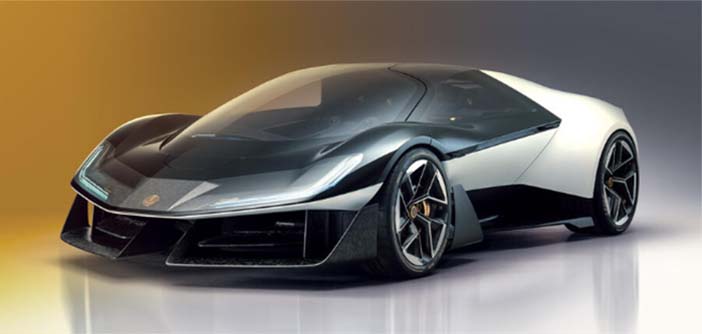
+++ Most concept cars promise to run on unicorn farts, pump out 9.000 horsepower, deliver nano-second 0-100 kph times, and even cook your dinner if you ask nicely. We’ve often thought, “What a nice concept, it’ll never happen”. They’re show-stoppers meant to highlight something that could possibly, maybe appear one day on a family sedan. And while they’re a neat distraction from the mundanities of the 9-5, they ultimately mean very little. The LOTUS THEORY 1 is not that. This concept car is an actual sign of things to come. It has toys on board that actually work, and features that could appear on future cars. When it comes to Lotus, the future is sprinkled with a dash of the past. Ben Payne, Lotus Group Design Vice President, was in London to talk us through the company’s new baby. Payne is all too aware of how the past needs to be respected. “You can’t ignore the past, because one of the most important things we have is our heritage. Ignore that at your peril. It’s extremely important we don’t just do something that looks beautiful. It needs to have some genuine story behind it; how we can explain why it does certain things, or why it looks that way”, Payne said. Of course, the Theory 1 is a tech-fest, but it still nods to one of Lotus’s best-known icons: the Esprit. “It isn’t a pastiche, no. For us in the creative team it was more about taking the spirit of the Esprit and imagining what that looked like 50 years ago”, he said. There are nods to the Esprit all over the Theory 1: from the sheer wedginess of it, to lines along its flanks, and more. Looking back to inform the future, it seems, is a luxury Payne and his team seem to enjoy rather than endure. The Lotus back catalog is full of hits, why not use some of them as inspiration? Though here, if a customer, fan, or… whoever spots that some of the old stuff is present in the mix that’s seen as an objective win. Seeing an Emeya alongside, though, shows that it’s very much an evolution of the current design direction. The present isn’t to be ignored either. It’s fair to say that delving into the firm’s past is, perhaps, wise. The firm’s EV offerings, the Eletre SUV and Emeya sedan, have received mixed reactions. Lotus purists, the devotees of lightness, affordability, and simplicity, have been vocal online about their heft, tech, and anything else they can pick holes in. The ‘simplify and add lightness’ quote of old is bandied around with nauseating frequency, but the Lotus that the faithful are used to didn’t come with huge batteries, 900 hp, or (in most cases) rear seats. Today’s Lotus, or at least the Lotus that built Theory 1, is taking a different approach: “The subject of weight, of course, is something everyone comes back to most. You have to understand that if that’s what people think about your brand, your brand is what other people say, not what you say. So it’s a core part of it: we have to deliver an efficiency in terms of a balance of weight, performance, and practicality, and that’s really the equation with EVs”. Payne explains that the lightness craved by many online can happen, but at a cost of either power, or range: finding the balance of what’s right for the brand, its direction and customers is key. Getting it right requires, according to Payne, a new take on simplifying and adding lightness. “Start from nothing, add the minimum. Just start from nothing, and only add what you need to see where you get to”, Payne said. EVs, of course, come in all shapes and sizes, but for Lotus to offer one with 1.000 horsepower, a target weight if 1.500 kilos and 400 km of range, you need to start with some chunky kit: a large battery (in this case 70 kWh), motors capable of delivering serious grunt, a structure that’ll keep occupants safe (and warm), and the level of tech you’d expect from a supercar. The Theory 1 isn’t a family car, it’s not dripping in plushness, and it’s not the sort of thing you can put a dog in the back of, largely because the back is full of pushrod suspension bits, EV running gears, and the sort of engineering solutions that will make your inner engineer contort with glee. It’s a supercar through and through. Its seats are shaped into its carbon tub: 1 in the middle for the driver and 2 set back on either side for their mates. The pedals and steering wheel move toward the driver silently when it’s time to go. Rather than sit on bare carbon, padding is strategically positioned, but it’s not ‘just’ padding. It’s active. The Theory 1 comes with haptic fabric. Developed by a company called MotorSkins, the fabric can react to various inputs and change its shape depending on what you need. For example, if you change the car’s drive mode the seat will reconfigure its bolsters. If Theory 1’s myriad safety systems (it comes with plenty of that; even the same active LiDAR as the Eletre and Emeya) detect a car in your blind spot, it can theoretically give you a tap on the shoulder. Lotus can even build buttons into the car that appear at first as flat fabric, but spring to life when needed, hen you want to take a call, for example. It works with layers of fabric and air channels, which keeps it light, keeping extra tech to the minimum that Payne was talking about. +++
+++ MINI is making advances that it hopes will allow it to offer fully recycled and recyclable interiors “within a generation”, according to the brand’s head of colour and trim, Kerstin Schmeding. Responsible for much of the interior trim for the new Aceman, Schmeding told us a totally recyclable cabin is “something Mini is truly targeting; this is the right way to go”. The company is currently looking at durability and other technical aspects, but says its goal is “definitely possible”.| The new Aceman uses 2D knitted fabric (a material MINI claims is made from 90 percent recycled polyester) for the dashboard, door panels and some of the car’s lidded cubbies. Apparently, this method of manufacture uses 98 percent less water than cotton, and reduces CO2 emissions by around 80 percent versus conventional polyester processing. Schmeding told me that Mini is “looking at how you build a car, and how you disassemble it again”. She said her team has spent time talking to recycling centres and that a big part of a more sustainable future will be a focus on using “fewer materials” at the point of manufacture. Mini’s head of colour and trim didn’t seem to think this new strategy would have a detrimental effect on perceived quality, however. Speaking about the Aceman, which is seen internally as an early step in Mini’s intended direction, Schmeding told me that “focusing on a few elements gave Mini freedom to really focus on the detail and the quality. “From a material standpoint, it’s very special”, she told. “The dashboard has some completely new technology; by cleaning up the surface, it gives the dashboard a really nice finish”. With Mini’s line-up almost complete (just the revised Cabriolet is left to launch) it’ll be some time before we see the fruits of the company’s labour. Any fully recyclable interior isn’t likely to come to pass before 2030 at the earliest. +++
+++ SKODA has delayed a crucial new electric car and extended the lifespan of its small combustion-engined models in response to waning demand for EVs across Europe. The Czech brand had previously planned to launch 6 electric cars over the next 2 years: the new Elroq and Epiq crossovers, the production version of the Vision 7S concept, a 4.7 meter long estate and facelifts for the Enyaq and Enyaq Coupé. However, it has now decided to delay the estate (all but confirmed to inherit the Octavia name) until late 2027 or 2028. Skoda CEO Klaus Zellmer told: “To be totally honest, with the slowdown of the transformation into battery-electric vehicles, we’re revisiting that timeline. “We’re checking the sequence of those cars. The cadence now is we’ve had the Enyaq Coupé, the Elroq, the next one is the Epiq, and the next one down the line will be the SUV, the 7S you’ve seen the concept car of. After that (it could be 2027, 2028) we’re aiming for an Octavia estate”. Meanwhile, the Fabia, Kamiq crossover and Scala hatchback have been given a stay of execution until 2030. Zellmer said: “Originally, we said that we were going to phase out the Fabia, Kamiq and the Scala by 2027, but we have now green-lighted those cars to stay with us until the end of the decade, because the EV sales slowdown is happening as we speak”. According to figures from European car industry body ACEA, electric cars’ share of the region’s new car market (including the European Free Trade Association and the UK) fell from 15.1% between January and August 2023 to 14.0% over the same period this year. “We have always said that we would cater to what consumers want and not what we think is the right method of transport or drivetrain”, Zellmer said. “We always said we’re going to try and be as flexible as possible”. Zellmer attributed the shortfall in electric car sales to various factors, including failings in the charging infrastructure, range anxiety, the cost of electricity and the significantly higher price of EVs. Indeed, Skoda marketing boss Martin Jahn conceded that the company is sacrificing its profit margin on the new Elroq to ensure it is priced at a level to attract strong sales, and therefore allow Skoda to meet its CO2 emissions targets for 2025. “I admit that this is not the most profitable car in our line-up, and we just have to work on the costs, especially on the battery costs, to make the electric cars more profitable in the future”, said Jahn. Zellmer also pointed to the lack of variety in bodystyles as a barrier to growing EV sales. He said: “I’ve always said people always buy cars for the least probable cause they need them for. So they buy a combi because they were at one point in time at Ikea, they had to put this huge box of a wardrobe in the car, so now they need a combi again. “Like with range anxiety, this is totally emotional; it’s not rational. Who exceeds a range of 560 km on a regular basis? And even if you do, you do one charging stop in between, get the car down to 30%, charge it back to 60%, it takes you 15 or less minutes and off you go. It’s not a problem. “It’s changing the habits, but people still find it difficult to change their behaviour towards battery-electric vehicles so we need to give people time to be ready for that, and this is why we offer alternatives”. +++