
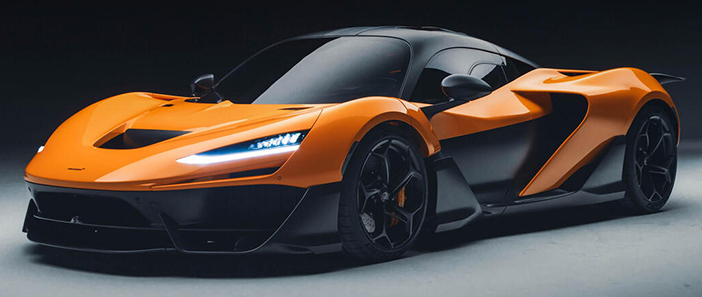
+++ The successor to the MCLAREN P1 mixes Formula 1 aerodynamics with a mighty new V8 hybrid drivetrain that sends all of its 1.280 hp to the rear wheels. Although the McLaren Senna and Speedtail have followed in the decade since the P1, the €2.5 million McLaren W1 is considered by its maker to be the true successor to that hypercar, which was itself a follow-up to the seminal McLaren F1. The W1 breaks all records for the company in terms of power and performance. It laps circuits quicker than the aero-focused Senna and accelerates faster than the speed-focused Speedtail, all in a package that weighs 1.399 kg thanks to a forensic approach to weight-saving for every component, from the engine to the sun visors. The P1 was famously launched at the same time as the LaFerrari and Porsche 918 Spyder to create a ‘holy trinity’ of hypercars and Ferrari is understood to be readying its own LaFerrari successor for an imminent launch as a rival to the W1. At the heart of the W1 is a twin-turbocharged 4.0-litre flat-plane-crank V8 engine from McLaren’s long-time collaborator Ricardo. McLaren says the engine is new from the ground up and designed specifically to work with hybrid systems. The engine, which uses both direct injection and port fuel injection, produces 930 hp on its own to give the highest output per litre of any McLaren engine yet Codenamed MHP-8, the engine works in conjunction with an e-module, which comprises a motor control unit and a 350 hp radial flux electric motor with performance aping a Formula E car’s motor. This is used primarily to add more performance via a small, 1.4 kWh battery (the car is not a plug-in hybrid) but it also acts as a reverse gear for the 8-speed dual-clutch transmission, enables silent start-up and allows for 3 km of EV range. An e-differential also features. McLaren says the W1’s hybrid components weigh 40% less than those in the P1 but offer 40% more power. The combined peak torque is 1.300 Nm; a huge rise from the 910 hp P1’s 900 Nm. The 0-100 kph time is 2.7 seconds. Top speed is limited to 347 kph and McLaren promises a “crescendo” from the exhaust note that builds towards the engine’s 9.200 rpm redline. Different powertrain modes allow for varying levels of electric assistance, from a Sprint mode that gives maximum e-power over one lap to a GP mode that manages its assistance on a longer track run. A Boost setting gives instant full power, mimicking a race-style push-to-pass system, and this can be combined with an F1-style drag reduction system (DRS) on the rear wing to increase straight-line speed further. Both of these systems are accessed using the only two buttons on the steering wheel. Four-wheel drive was not deemed necessary for the W1 due to the grip and load afforded by the aerodynamic package and suspension. Managing that amount of power and torque through the rear wheels was achieved by “Formula 1 know-how”, according to McLaren, whose F1 team currently leads the 2024 constructors’ championship. The W1 follows only the Aston Martin Valkyrie in being a road car with true ground-effect aerodynamics thanks to its underbody design. There are active front and rear wings, including the W1’s signature feature of an Active Long Tail rear wing, which extends 300 mm rearwards rather than upwards to work with the underfloor and rear diffuser to create extra downforce without adding drag. This function is available on track only. In the aero’s most extreme setting, Race mode, the W1 produces 350 kg of front downforce and 650 kg at the rear for a total of 1.000 kg. Yet, as chief aero engineer Robin Algoo explained, what’s different about the W1 beyond the headline numbers is its stability and predictability while cornering at such high speeds, which allows it to lap the Nardò handling circuit (McLaren’s reference track) 3 seconds quicker than a Senna. The starting point for the aero package on the W1 is the central Aerocell carbonfibre monocoque, which the car is built around and integrates the two seats for the cabin to allow for a shorter wheelbase. Almost every component and installation in the W1, from the mounting of the engine to the suspension design, has been done with aero performance in mind. For that reason, the doors are anhedral rather than dihedral, a McLaren first, and the scoop on the roof, recognisable from the F1 and P1, acts as a flow diverter to the rear. In road mode, the active front wing lifts and the Active Long Tail rear wing integrates into the body. McLaren says a key part of the W1’s story is the civility with which it can be driven at everyday speeds and road conditions. The continuously active race-bred double-wishbone suspension design, called McLaren Race Active Chassis Control III, is new and its operating range has been engineered to span comfortable road driving and blistering track performance. Comfort, Sport, Race and Race+ modes are selectable. Comfort puts the focus on a “smooth ride quality” while Race and Race+ provide stability for the aerodynamic package to unlock the full performance potential on track. The ride height adjusts between modes. Pushrods are another McLaren first and work with inboard dampers using F1 expertise at the front to channel airflow, while outboard springs and dampers are used at the rear. Titanium is among the materials used for construction and 3D printing is one of the production methods used for suspension components in the pursuit of lightness. McLaren has retained hydraulic steering for the W1 and has fitted Carbon Ceramic Racing+ brake discs with an extra ceramic layer over previous discs to further boost stopping power. The W1 will go from 100 kph to a standstill in 29 meter and 200-0 kph in 100 meter. Bespoke tyres from Pirelli have been designed for the W1, including track-focused yet road-legal P Zero Trofeo RS rubber and more road focused P Zero R and P Zero Winter 2. The alloy wheels are made from magnesium. The W1 is 4.635 mm long, 2.074 mm wide and 1.182 mm tall, with a wheelbase of 2.680 mm, which makes it marginally bigger than a P1. Extensive use of carbon fibre helps to enable a 1.399 kg dry weight that’s almost at parity with the P1. The design is more an evolution of the Senna than the Speedtail but it also has plenty in common with the current 750S, albeit with that quite aerodynamic overhaul. McLaren says the W1’s interior has “unmatched supercar ergonomics and best-in-class visibility”. It also talks up the comfort and spaciousness of the car by supercar standards. Particular focus has been placed on making ingress and egress as easy as possible and the engine quiet when a more civilised driving manner is called for. The pedals, as well as the steering wheel and primary controls, are adjustable, while the fixed seats are fully upholstered and more reclined than normal to improve comfort. The A-pillars are McLaren’s thinnest yet to aid visibility. The steering wheel is smaller than is typical for a McLaren and optionally incorporates shift lights to show when the redline is approaching. Key switchgear is used for major chassis and powertrain controls but there is a central 8in touchscreen that runs Apple CarPlay. Android Auto isn’t offered. There is storage for 2-weekend bags (or helmets) behind the rear seats, a sliding cupholder and an extra central storage area. All 399 examples of the W1 have already been sold ahead of production starting in Woking in 2026. The transaction prices are expected to be far higher than £2m as a result of the “unlimited” customisation options that are available. As part of the usability pledge for the W1, a 4-year service plan is included with the car. It has 12-month service intervals and similar service requirements to one of McLaren’s V6 hybrids, which is atypical for a track-focused machine. +++
+++ It’s no secret that the latest MERCEDES-AMG C 63 has struggled for sales since it was unveiled 2 years ago, so the German brand will be hoping the sleeker CLE 63 coupe version will fare a little better. The C 63’s sales stumble is largely attributed to the model’s hybridised 4-cylinder engine, despite having a whopping 680 hp and 1.020 Nm. The car became synonymous with V8 power after the rowdy naturally-aspirated 6.2-litre unit of the W204 generation and the wonderful bi-turbo 4.0-litre found in the previous model, so it’s perhaps understandable that the hybrid has failed to convince petrolheads. I’ve spotted the CLE 63 testing numerous times over the past few year, and what has become a prolonged development period suggests Mercedes may have made a U-turn on the car’s proposed hybrid tech, even though it has said only larger models (such as the E 63) will only get V8 power in future. The CLE sits on the same MRA2 platform as the C-Class, but also the larger E-Class, so fitting a V8 under the bonnet shouldn’t be too much of a task, especially when you consider the CLE 450 uses an in-line 6-cylinder. I don’t expect the CLE 63 to come with as much power as the C 63 hybrid, although it should exceed the 510 hp bi-turbo unit of the old car. It is also likely to weigh a bit less than the C 63, given it will probably only use a mild-hybrid system. Compared with the standard car, we’ll see wider wheel haunches housing a larger, bespoke set of wheels with a beefier brake set-up behind. To the front there will be the same ‘Panamerica’ grille but with a special AMG insert. The lower part of the front bumper will be revised to add extra cooling to the engine bay and give the AMG model a more aggressive look. A core design trait of full-fat AMG models is the quad-tip exhaust layout, clearly visible on the test car I’ve spotted. There could also be a new rear light signature, while on the bootlid there’s a small lip spoiler. Rather than go down the route of the new E-Class’ interior with the optional ‘Superscreen’ dash layout, the CLE will borrow plenty of elements from the C-Class. Inside the CLE 63, we expect the same overall cabin at the standard CLE, but with the typical AMG garnish of sportier bucket seats, an AMG steering wheel and some extra performance-focused driving modes. +++
+++ Electric vehicles will have greater long-term life than petrol or diesel models according to RENAULT , with the company’s CEO Luca de Meo saying batteries are proving to have more longevity than early predictions. “EVs will last longer than ICE because there are fewer moving parts; contrary to what people thought would happen, batteries are lasting a lot longer than they were expected to”, said de Meo at the launch of a new partnership with recycling expert Suez. The goal of the new venture is to develop the “circular economy” and use more recycled materials in new car production, plus increase the usage of recycled parts as replacements in existing cars. It also aims to tighten up the collection and treatment of vehicles at the end of their life to reuse and recycle more components. As well as being more environmentally friendly, the reusing, refurbishing, repairing and remanufacturing of replacement parts will, according to Renault, lead to lower costs for drivers of older cars, helping to extend the usable life of vehicles by making them cheaper to repair. The tie-up with Suez is designed to help Renault to position itself among what it described as the “standard-setters in the automotive industry’s circular economy”. It sees the environmental expert take a 20 per cent stake in a company called The Future is Neutral, with Renault owning the other 80 percent. The company is aiming to attract other carmakers as well as distributors, insurers, equipment manufacturers and private customers. +++
+++ A year ago, in early September 2023, the CEO of Volkswagen Passenger cars, Thomas Schäfer, told the press at the Munich Auto Show that SEAT would stop selling cars once the lifecycle of the current model line-up was over. The very important news was immediately commented on by many analysts, journalists and car enthusiasts around the world. Seat, the Spanish car brand founded in 1950, was saying goodbye. The company’s immediate reaction to these statements was to specify that the brand would have a new role within the Volkswagen Group and would survive by moving away from traditional car production and becoming a mobility company. Despite the public relations campaign and declarations, the facts indicate that the Seat brand continues to lose lustre within the German group. In the past year, no new cars have been presented, the last launch being the Seat Leon in January 2020. The oldest in the range is the Ateca, unveiled in March 2016, followed by the Ibiza in January 2017, the Arona in June 2017 and the Tarraco in September 2018. Although there has been nothing new from the Spanish brand, sales have been quite good this year. According to data from Jato Dynamics and other sources, Seat sold around 220.000 new cars between January and August 2024; a 12 percent increase over the first 8 months of last year. This is not a bad result considering the difficult times the European industry is going through. In addition, Seat, unlike the other Volkswagen Group brands, does not have an electric car in its current range and is therefore not exposed to declining sales of these vehicles. Looking then at last year, Seat delivered 288.500 units; a growth of 24 percent over 2022. Considering these double-digit growth rates, one could conclude that there is a future for the brand. After all, selling around 300.000 units per year is no small feat. The main problem for Seat’s future would seem to be Cupra. Although they are part of the same subgroup within Volkswagen, Cupra is becoming Seat’s natural successor. Between 2020, when Seat stopped introducing new cars, and today, Cupra has launched 3 cars: the Born in May 2021, the Tavascan in April 2023 and the Terramar last month. These are joined by the Leon, Ateca and Formentor, so the Cupra range includes 7 models (if you split the Leon’s body types) against Seat’s 6 models. It is clear that the group is investing more in Cupra. For what reason? The average retail price of a Cupra in Germany in August 2024 was 43 percent higher than that of a Seat. A Cupra Ateca costs on average 33 percent more than its Seat twin; the Cupra Leon costs 29 percent more than the Seat Leon. And they all share almost everything, which means their production costs are almost the same. So why not go for the brand that brings in the most money? +++
+++ SKODA has confirmed that its Fabia and Scala small cars and the Kamiq baby SUV have received a stay of execution and will remain in the Czech brand’s line-up until 2030, as a result of the slowdown in demand for electric cars. “We have just decided that we will have those cars in our line-up until the end of the decade”, Skoda CEO Klaus Zellmer told. “If you had asked me a year ago, we would have said: ‘No, we’re phasing them out by 2027’. But since we see consumers being very open to driving these cars, we have decided to give them until the end of the decade”. That doesn’t mean there will be new generations of any of the trio, but 2 rounds of cosmetic and tech facelifts to keep the cars competitive are possible. “The current legislation suggests that by 2035 it won’t be possible to register internal combustion engines any more, so you have to decide whether to invest huge amounts or whether you do a gradual update, and the latter is what we’re doing”, Zellman continued. Skoda’s boss also said the longer range of the latest Kodiaq plug-in hybrid is increasing the popularity of the petrol-electric model. “With an electric range of more than 100 kilometres, it’s worth recharging the battery; with less than 50 km, people were debating whether it was worth it”, he explained. “If you look at the CO2 emissions now, this is as close as we get to battery electric vehicles. It’s 10 g/km, so it makes sense from a legislative point of view, from a customer sentiment point of view, and range anxiety doesn’t play a role because you have the internal combustion engine to bridge long distances the way you’re used to”. +++
+++ The date is Thursday 10 October, the place is Los Angeles (California, United States) and the event is the presentation of the TESLA Robotaxi, an electric self-driving vehicle that promises to revolutionise passenger transport services. I don’t know much about Elon Musk’s next creature, but 2 things are certain: the first is that the vehicle will represent the culmination of the manufacturer’s Autopilot and Full-Self-Driving (FSD) technologies; the second is that the Cybercab (this is the most probable name) will be built on the same platform as the highly anticipated Model 2, the €33.000 electric car that has been in the pipeline for a long time. As such, it seems Tesla will use the occasion to reveal some information about the future battery-powered car. But Robotaxi and Model 2 aren’t the only models on the way, as other projects such as the new Model Y and Roadster are boiling in the pot. So let’s see what the future holds. Starting with the Cybercab, ambitions are very high. The aim is to compete with giants such as Uber and Waymo, and to enter the sector with a completely new vehicle. More details in a few days, but in the meantime Morgan Stanley drops the rumour that entry into service will be between 2025 and 2026. The second hypothesis is more likely, given that the Cybercab should be fitted with the new 4680D batteries, due to be released in 2 years’ time. Turning now to the Model 2 (again, not a confirmed name), the carmaker’s plans for the car peeped out in 2020, when Elon Musk hinted at an entry-level car to open the doors of electrification to all motorists, or almost all. Since then there have been rumours upon rumours, ranging from imminent production to cancellation of the project. In any case, the Model 2 is unlikely to hit the road before the second half of 2025. The production location also remains unknown. Or rather, the locations, since the car will have to be made in more than one Gigafactory if it is to make big numbers. Among the existing ones, Shanghai and Berlin are in pole position; among the new ones, the unknowns become greater. There had been talk of India, but talks between the manufacturer and New Delhi seem to have broken down. The Mexico hypothesis therefore remains more likely. From a design point of view, it is also likely that we will be looking at a compact car, perhaps with references to the Cybertruck. We now come to the new Model Y, a restyling of the 2023 sales champion electric SUV (and not only among full electric cars). The subject of the project christened ‘Juniper’, the vehicle has already shown itself several times under camouflage through a series of spy photos taken during tests under real conditions. The Model Y’s update is expected to echo that of its Model 3 sibling, with revised headlights (slimmer) and bumpers (more aggressive).The rear end should feature a red led light bar with large black ‘Tesla’ lettering. The interior will also be inspired by the revamped electric saloon. At the same time, more power and range are expected. And now, all that is missing is the new Roadster, a remake of the hypercar that marked Elon Musk’s entry into the world of 4 wheels. We have been hearing about it since 2017, and every year seems to be the right one, but the project always ends up back in the drawer. Musk talks about 2025, but who knows? Coming to the specifications, it seems that the Roadster will reach 100 kph in about 2 seconds and reach a top speed of 400 kph, with a range of 1.000 km, a 1.000 hp engine, a 200 kWh battery pack and a price tag of at least €270.000. A rocket package from its cousin SpaceX is also planned. +++
+++ In the UNITED KINGDOM , 1 in 5 new cars sold last month were EVs as September saw the most new electric cars hit the roads in any month so far this year. The introduction of the ‘74’ registration plate also helped bolster the sales of hybrid-powered cars. As many as 275.239 new cars were registered in the UK in September, which marks a marginal (1 percent) increase over the same period last year. It’s also more than three times the number sold in August; undoubtedly due to the arrival of the aforementioned new 74-plate. Such figures were bolstered by a surge in the sales of new EVs, of which 56.387 were registered in September. Accounting for 20.5 per cent of all cars sold last month, this is still slightly below the government’s tough ZEV mandate target of 22 percent of new cars sold being electric. So far August has been the only month to match the ZEV mandate quota, with EVs expected to account for only 18.5 percent of new registrations at the end of 2024. Following the spike in EV sales, the market share of petrol and diesel cars fell year-on-year in September by 9.3 percent and 7.1 percent respectively. Petrol cars made up just over half of new cars registered in September, while diesel continues to fall ever further out of favour, making up just 6.4 percent of monthly and year-to-date sales, despite actually rising in popularity among private buyers. The dips in registrations for traditional combution-engine cars in favour of electrified alternatives can be partly explained by the fact that fleet sales underpinned the majority of new-car registrations in September. Hybrid and plug-in hybrids, which both benefit from greatly reduced company car tax rates (albeit nowhere near as much as EVs do), witnessed a year-on-year jump in registrations last month, by 2.6 percent and 32.1 percent respectively. The top-selling models in September were the usual contenders, with the hybrid and plug-in hybrid-powered Kia Sportage taking the first-place spot, followed by the Ford Puma (the UK’s best-selling model year-to-date) and the Nissan Juke. The Tesla Model Y, which finished fourth, was the only EV to make it onto the top 10 list, despite the rush in electric car sales. +++