
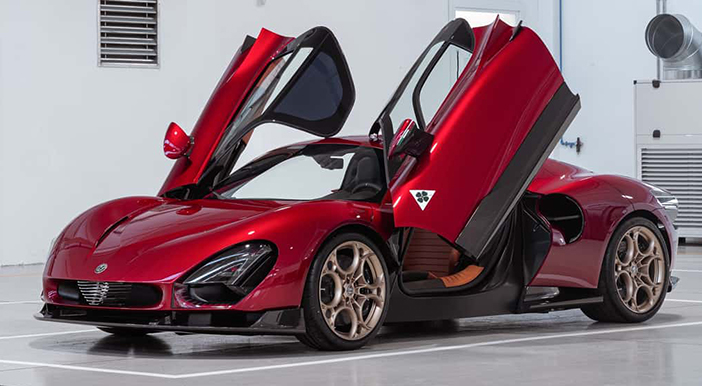
+++ Built in only 33 examples, ALFA ROMEO ’s new 2-seater coupé is ready for delivery. The first example of the 33 Stradale completed the production process on 13 December, a date that holds important symbolic value because in 1966 Carlo Chiti entrusted Franco Scaglione with the study of the bodywork for what would become the 33 Stradale. Exactly 58 years later, the first example of the new generation is ready for its first customer, a member of Club 33 who for reasons of privacy remains anonymous, just as it is not known what the car’s configuration is. The customer has been waiting for this Alfa Romeo since the Monza Grand Prix in September 2022. From that moment, a discussion began, both virtually and in person, with the Alfa Romeo team to define the customisation of the car, exactly as it happened in the workshops of the famous Italian coachbuilders of the 20th century. The final version of the Alfa Romeo 33 Stradale, we recall, carried out the tuning tests first on the Nardò Ring and then at Balocco. Precisely on the circuit of the Centro Sperimentale in Stellantis, Valtteri Bottas, Formula 1 driver for the Alfa Romeo team as well as future owner of the car, put the new supercar through its paces to perfect its set-up, steering and brakes. “Being able to test the 33 Stradale was a very special opportunity. I hope my feedback will be useful to the experienced Alfa Romeo development team for the final tuning. Configuring my personal car with the ‘Alfa Romeo workshop’ was engaging and exciting, testing it today was really exciting. All I can do now is wait for my 33 Stradale to be ready!” +++
+++ HONDA ’s future will continue to be hybrid, at least until the transition to 100% electric mobility is fully completed. The company announced this during a press conference to present the evolution of its business and the progress made with its two-motor hybrid system. The Japanese carmaker is also studying how to make its cars more efficient, using new-generation engines, implemented capacity batteries and new platforms. Honda’s future hybrid cars will be equipped with the evolution of the current e:HEV powertrain and will be based on a new, more rigid and lighter platform. To go into more ‘practical’ detail, this new full hybrid system (just like the current one) will be able to be used in 3 very different driving modes: EV mode, i.e. with electric drive only, hybrid mode, i.e. with the electric motor fed by the combustion engine as a range extender, and ‘engine’ mode, with the combustion engine directly connected to the wheels by means of a clutch pack. And speaking of petrol engines, the new powertrains will be made up of new 1.5 and 2.0-litre Atkinson cycle engines with direct injection and several innovative features, combined with a new automatic transmission Honda S+ Shift. Finally, there will also be the option on some models to have E-AWD with a second electric motor positioned on the rear axle. To achieve carbon neutrality by 2050, Honda aims for battery and fuel cell electric vehicles to account for 100 percent of its global sales by 2040. However, considering the current high demand for hybrid cars, the company explained that it will continue to develop new full hybrid models in the coming years, at least until the end of the transition period to electric, which it expects to be 2030. +++
+++ In a recent interview, Ola KALLENIUS , the CEO of Mercedes-Benz, who has come under pressure, discussed the high sickness rate in Germany and blamed it for the current crisis. He criticised the fact that it is too easy to call in sick in Germany and called for stricter controls and reforms to reduce the high sickness rate in German factories. Källenius emphasised that the sickness rate in Germany was disproportionately high compared to other countries. “This is also the case in our German plants”, said the CEO of Mercedes-Benz. “Our plants are the same all over the world, there are the same health benefits, the same working environment. And yet the sickness rate in Germany is sometimes more than twice as high”, he said. For him, this discrepancy is a clear sign that the sickness absence system in Germany needs to be reconsidered. If these figures are correct (which I was unable to verify due to a lack of data) this really does not reflect well on Germany as an industrial centre. The Mercedes boss went on to say that the high sickness rate was not only a problem for companies, but also for the economy as a whole. “Those who take unjustified sick leave are not showing solidarity”, explained Källenius. The current practice of sick leave invites abuse and thus impairs the productivity and competitiveness of the German economy. Källenius is apparently referring to the regulation in place since the coronavirus pandemic that allows sick notes to be obtained by telephone without a doctor’s appointment. This regulation has already been criticised by several bodies. Källenius therefore called for political measures to reform the system. “It must not be so easy to call in sick”, he emphasised. He suggested that stricter checks and controls should be introduced to ensure that only those who are genuinely ill receive a sick note. These measures are necessary to prevent abuse and strengthen solidarity among employees. In his interview, Källenius also pointed out that companies themselves only have limited options for reducing sickness rates. “I sit down with our company doctor in charge once a year. Then I ask him: What can we do to improve this? He always says: Nothing beyond what we’re already doing”, he reported. This makes it clear that the problem needs to be solved at a political level. Källenius’ comments have triggered a broad debate. While some support his calls for stricter controls, others see them as a threat to workers’ rights. Critics argue that stricter checks and inspections could lead to a deterioration in the working atmosphere and that the causes of the high sickness rate are underlying problems such as high workloads and stress. Despite the controversy, Källenius is sticking to his position. He believes that a reform of the sickness absence system is necessary to ensure the competitiveness of the German economy. “The new government must hold up a mirror to Germany. And it must look with great honesty at what is going well and what is not. And then it must also be prepared to make unpopular decisions”, he demanded. This offensive is no coincidence. Källenius is currently under massive pressure because Mercedes-Benz is weakening. It was recently announced that tough cost-cutting measures have been decided as a result. Around 5 billion euros are to be saved by 2027. More than 20,000 jobs in the Group are at risk. However, compulsory redundancies are actually ruled out due to job security until the end of 2029. So there is more fuel for the fire and things will certainly not calm down around the Star at the turn of the year. +++
+++ The old JAGUAR is dead. The new Jaguar is moving upmarket while saying goodbye to the internal combustion engine. This striking Type 00 concept provides a window into the British firm’s spectacular reinvention as an upscale EV brand. The Tata Motors-owned marque will focus on profit margins rather than volumes, accepting that it’ll sell fewer cars given the higher asking prices. How much? Jaguar’s Managing Director Rawdon Glover told that the first EV from the new era will cost at least 140.000 euro in the Netherlands. This means the average sales price is expected to double. According to the head honcho, customers who can afford one are primarily interested in how it looks, inside and out. As to what’s underneath the hood, it ranks low on the list of priorities: “People buy cars for their design and interior. Powertrain is about 13th on the list”. Consequently, Jaguar’s head honcho argues that the all-electric setup won’t deter shoppers looking for a striking 4-door GT: “They’re going to buy it because they think it’s beautiful, and the brand resonates”. Glover is confident that the new car has what it takes to stand out. The ultra-luxury grand tourer will compete in a segment flooded with cars that “look like a bar of soap” because designers and engineers are fixated on aerodynamics to squeeze more range. The first model of Jaguar’s rebirth will be the “antidote” to high-end, aero-driven EVs, with a “completely different” design and “incredible presence”. The concept’s dramatic silhouette, elongated hood, massive 23 inch wheels, and absence of rear glass indicate how Jaguar wants to disrupt the segment. The concept, pronounced Type Zero Zero, also previews a minimalist interior with floating screens, not seen in any of the models from the old guard. Although range won’t be the main priority, the first car underpinned by the Jaguar Electric Architecture (JEA) will target 770 km in the WLTP cycle. Using the maximum charging power supported, it will take 15 minutes to recharge the battery for 321 km. It will hit the market in 2026. +++
+++ Mercedes is readying a mid-life update of the S-Class and following close behind is the uber-luxurious MAYBACH variant. The 7th generation of the S-Class arrived in 2020 so I expect to see the wraps come off Mercedes’ flagship limousine in the coming months. The current Maybach S-Class joined the party just under a year later, so a late 2025 launch could also be on the cards. The Maybach will gain the same front-end treatment as the updated S-Class with a larger grille and re-worked bumper. The usual Maybach trimmings are likely to apply: think additional chrome and a Maybach inscription, although not the ‘double-M’ bonnet badge which was abandoned 2 generations ago. The side will likely retain Maybach’s emblem on the rear pillar. We should also see a bespoke set of forged alloy wheels and a new rear-light signature inspired by that of the newer E-Class. The current Maybach S-Class is offered with 2 engines. First, there’s the S 580 4Matic with its twin-turbocharged 4.0-litre V8 sending 503 hp and 700 Nm of torque to all 4 wheels, combined with a 48 volt mild-hybrid system. However, although Mercedes has phased out the V12 in its models, Maybach has retained the S 680, which comes with a 6.0-litre V12 with 612 bhp and 900 Nm of torque. A plug-in hybrid version with a 3.0-litre straight-6 petrol was offered on some markets too. The current car features things like an uprated sound system, Mercedes’ interior assistant with gesture control for the rear, and a pair of electrically adjustable and reclining chairs in place of the standard S-Class’s bench seat, both of which feature massaging leg rests, and footrests built into the floor. However, we’ll have to wait to see what goodies Mercedes decides to give the Maybach for its expected release in late 2025. +++
+++ NISSAN is fighting for its life, again. One of Japan’s flagship brands is on the brink after weak sales in the US and China triggered huge losses that left top brass with little choice but to cut jobs, slash a fifth of the carmaker’s manufacturing capacity and lower its annual profit forecast. Nissan’s last crisis was about 25 years ago and was remedied by Renault stepping in with a cash injection and dispatching “Le Cost Killer” Carlos Ghosn, who orchestrated a dramatic turnaround. The good times didn’t last and tensions mounted between some top Nissan executives and Ghosn. This led to Ghosn’s dramatic arrest in 2018 and detention for suspected financial crimes, and his ouster from Nissan. Before facing trial, Ghosn slipped out of Japan in late 2019 hidden in a case for audio equipment that was loaded onto a private jet. He fled to Lebanon where he found sanctuary. Ghosn said he was the victim of a conspiracy among Nissan executives and escaped what he called Japan’s “rigged” justice system. Chief executive officer Makoto Uchida is trying to stop the bleeding on the balance sheets, fend off activist investors and revive the brand. Nissan’s current financial position doesn’t look great on paper. Nissan lowered its operating profit forecast for the current fiscal year by 70% to about 900 million euro when it announced quarterly earnings in November. Net income plummeted 94% during the first half of the fiscal year. The company in November said it would sell about a third of its stake in partner Mitsubishi (worth about 450 million euro when the plan was announced) after burning through 2.6 billion euro during the same 6-month period. Nissan has about a year of breathing space before hitting a record bond maturity wall. The carmaker and its group firms have about 1.6 billion euro of debt due next year; a slight decrease from 2024, but that jumps to around 5 billion euro in 2026; the most since 1996. Nissan’s sales have been falling for some time now in Japan, China and the United States; its biggest and most important market. An outdated product line-up and inventory backlogs are fuelling a cycle that threatens to hasten the carmaker’s decline. Even when plans go well, things can take a wrong turn. Nissan released the world’s first mass-market electric vehicle (the Leaf) which went on sale in 2010. But it was never able to capitalize and create a global model like Toyota did with its Prius. Now, Nissan doesn’t have the EVs or the hybrids to compete in either the US or China. Among the various elements of Uchida’s 3-year plan to reinvigorate the business was a pledge to sell an additional 1 million cars a year by 2027. Less than a year later, that hardly seems within reach, as Uchida indicated in early November when he said: “Meeting our sales goals will be a challenge”. Nissan lowered its production and sales outlook for the fiscal year ending in March 2025 after paring forecasts in each of its major markets, including North America, China, Japan and Europe. It now expects to make about 3.2 million vehicles, and to sell 3.4 million. In June, the company announced it would cease production at a plant in Changzhou due to poor sales. Nissan’s stock has fallen about 47% since Uchida became CEO in December 2019. It’s the worst performance for shares under any leader at the company in at least 5 decades. A fund controlled by Effissimo Capital Management took a 2.5% stake in the carmaker. It’s not clear why it made the move that was disclosed in November and Effissimo isn’t talking. It might have been that shares were too cheap to pass up: Nissan trades at around 0.25 times book value, much lower than most other legacy automakers around the world. Another possibility is that Effissimo might leverage its stake to pressure Nissan to buy out 50% of Nissan Shatai, The purpose would be to protect the financial firm’s minority interest in Shatai by pressuring Nissan to merge the companies and pay a fair price … and hand Effissimo a big check. Hiroto Saikawa, Ghosn’s successor, stepped down as CEO in 2019 over a scandal involving allegations of excess compensation and other executives left in the turmoil. The most recent change came on December 11 when the company overhauled its executive bench. Uchida remained in place, while Jeremie Papin was tapped to become chief financial officer effective January 1. Current CFO Stephen Ma will be transferred to head operations in China. The shift for Ma comes about 17 months after the departure of Ashwani Gupta, formerly chief operating officer. Nissan hasn’t had a COO since Gupta left. At this point, Nissan might have to lean on one of its two strategic partners: Renault and Honda. Selling part of its stake in Mitsubishi offered Nissan little relief but swapping shares with Renault or Honda could do the trick, at least temporarily. In 2023, Nissan and Renault realigned their decades-long alliance. Renault lowered its stake in Nissan and they made plans to put forward a range of new models along with junior alliance partner Mitsubishi. Nissan and Honda made a preliminary deal in March 2024 to work with Mitsubishi to develop in-house software, batteries and other EV components. While details are forthcoming, this would pit the trio against Toyota and its partnerships with Subaru, Suzuki and Mazda. +++
+++ STELLANTIS is changing its tune and expressing strong doubts about stopping the sale of petrol and diesel cars in Europe from 2035. “Let’s hope that the EU authority understands that you don’t mess around now. We need a change of pace”, is the wish (and the invitation) of Jean-Philippe Imparato, European head of the group, who appears at the Ministry of Enterprise and Made in Italy (Mimit) to present the so-called Italy Plan to the government. But a change of step is also being made by Stellantis itself, which until now, through the mouth of its now former CEO Carlos Tavares, had always declared itself in favour of banning combustion engines. “Global warming is a reality and it is our responsibility to do something for future generations. Rather than arguing about regulations, it is better to come to an agreement”, were the words of the then CEO during a hearing in Parliament in October. Then the situation changed. Tavares probably paid the price being “all-in” on the electric car, which is being blamed for the slump in sales, and Imparato took his place in talks with politicians, pending the appointment of a new CEO. This led to Stellantis’ re-entry into ACEA (an association that brings together European manufacturers and proposes a reappraisal of the discontinuation of combustion engines) and culminated in the Italy Plan and Imparato’s statements. Working alongside Minister Adolfo Urso, the French manager (of Apulian origin) will lend a hand to the executive in the battle in Brussels against ‘all electric’ from 2035. In fact, the manufacturer will move “in line with what is outlined in the Italian government’s ‘non-paper’ “, the informal document that launches the idea of bringing forward from the end of 2026 to the beginning of 2025 the application of the phase-out review clause. The aim is to allow the sale of not only electric but also combustion cars powered by e-fuel and biofuel, if they prove to be zero greenhouse gas emission fuels. This would save manufacturers the inevitable industrial overhaul and all that it entails. The ministry’s text, written together with the Czech Republic, would already boast “a broad convergence on the part of the various EU countries”, while the European Commissioner for Sustainable Transport, Apostolos Tzitzikostas, would have given “full readiness to dialogue on the issue with governments and industrial partners”. Updates are expected on 21 January in Strasbourg, at the next plenary session of the European Parliament. Meanwhile, the non-paper will end up on the desk of president Ursula von der Leyen, who has promised to personally deal with the automotive sector in the first 100 days of this second term. But first there is the other knot to be untangled: cancelling the fines for manufacturers who do not reduce emissions from new registrations as early as 2025: a rule that would mean selling many more electric cars at a complicated time, with battery-powered vehicles losing market share. Imparato explains that the group would have to increase deliveries from the current 12 percent to 21 percent, under penalty of €300 million for every percentage point missed, which is potentially €2.7 billion. Too much for those who want to recover after a difficult 2024. On paper remain the targets of the Dare Forward 2030 plan, which envisages the total electrification of all brands by the end of the decade. Will this really be the case? +++