+++ CITROEN is considering reviving the legendary 2CV more than 3 decades after this no-frills car went out of production. Preliminary design work on a successor to the classic car that is widely credited with mobilising post-war France is under way, a senior source has confirmed, although the project is currently at an early stage. The news signals a change of heart from Citroën, which has previously denied any plans to bring this famous model back. The firm’s rethink is understood to have been prompted by the retro-inspired Renault 5 E-Tech. The hatchback has been an immediate hit in France, with 9.973 examples having left showrooms last month. That’s 1.721 more units than Citroën sold of the new ë-C3. In November 2024, the 5’s first full month on sale, the new hatchback played a key role in boosting Renault’s share of France’s electric car market from 16.3% (for January to October) to 23.2%. Unlike the 5, which was designed by envisaging how the original would have evolved had it remained in continuous production, the 2CV is understood to more closely mirror the design of its classic counterpart. Citroën has already hinted at its appetite for more distinctly retro-flavoured models with the new Ami, which was unveiled at the 2024 Paris motor show. It borrows several design cues from the original 2CV, including boggle-eyed headlights, vent-like indentations across its wings and the historic Citroën logo. Citroën design boss Pierre Leclercq doesn’t want to be drawn into publicly confirming the new 2CV, but he said the brand is “not closing the door” on retro designs. He said: “The things you remember from Citroën is not especially that you want to redo the shape of the vehicles that have been good. But we’re not closing the door. But I think the philosophy is important”. As implied by Leclercq’s comment about the significance of the underlying ethos, simplicity and affordability will surely be key considerations during the development of the new 2CV. The original was billed as the minimum viable product required to bring mobility to the wider population in rural, post-war France. That brief has some parallels with today’s society, because the transition to EVs (as well as other issues such as the rising cost of energy and materials) has caused new car prices to balloon and pushed EVs beyond the reach of many working-class and middle-class buyers. With affordability in mind, a new 2CV would be most likely to use Citroën parent Stellantis’s cost-cutting Smart Car platform, which underpins cars including the new C3, Fiat Grande Panda and Opel Frontera. However, it is possible that it could be decontented to further reduce costs. Even the C3, the most affordable of the cars to use the platform so far, receives luxuries such as hydraulic bump stops. As for the car’s powertrain, it is expected to prioritise efficiency rather than performance and that will enable the fitment of a small and therefore cheaper battery pack. Citroën CEO Thierry Koskas recently told that batteries are the biggest barrier to cutting the price of new electric cars, accounting for around 40% of a vehicle’s overall cost. “We still need to have a breakthrough in terms of battery costs”, said Koskas. For reference, the similarly conceived Dacia Spring packs a 26.8 kWh lithium ion pack, which gives a range of 230 km and is key to it hitting a starting price of €18.900 in the Netherlands. Although the Smart Car architecture can also support petrol and mild-hybrid powertrains, it is possible that the 2CV’s design could restrict it to a more compact electric set-up. The largest engine that Citroën ever fitted to the original car was a 602 cc flat-twin petrol unit, abnormally small by modern standards and, with just 32 hp, much too impotent as well. Renault’s designers have said on many occasions that the new 5 could only have been an electric car. Fitting it with a petrol engine would have required a longer bonnet, compromising its snub-nosed proportions. Either way, the new 2CV is expected to bridge the gap between the Ami and the C3. That would thrust it into direct competition with the value-focused Dacia Spring and the Leapmotor T03 at the low end, but a new 2CV might also be a larger car than those rivals, undercutting the Renault 5. There is no indication when a new 2CV might arrive, but a typical four-year development cycle would put it on track to be launched in 2028. Coincidentally, that year marks the 80th anniversary of the original car’s unveiling at the Paris motor show, as well as being the next staging of the biennial show after its return in 2026. +++
+++ Sales of EVs around the world have been somewhat inconsistent in 2024. While the US and China recorded strong growth, countries in Europe have reported slowdowns, with German sales crashing by 28 percent and Australia reporting similar declines. Now it seems it’s JAPAN ‘s turn, as in 2024, electric vehicle sales plummeted by a staggering 33%, marking the first decline in 4 years. With just 59.736 units sold, EVs now account for less than 2% of all vehicle sales in the country; an eyebrow-raising contrast to overall global markets where sales rise, albeit, in some of them, not at the rate initially anticipated by many automakers. Nissan, which dominates half of the country’s EV market, suffered a massive blow. Sales nosedived by 44% to 30.749 units; the lowest since 2021. Toyota didn’t fare much better. Despite a modest 10% bump in sales of its BZ4X (a pricey proposition starting at 5.5 million yen), the automaker’s overall EV sales dropped by 30%. Meanwhile, Mitsubishi recorded a shocking 64% drop in EV sales, while the Honda E was axed and won’t get a successor. So what caused EVs to plunge last year? The key reason is hybrids. Japan remains loyal to its hybrid vehicles, which offer fuel efficiency without the higher price tag of EVs. Combined with the limited infrastructure, many consumers still aren’t sold on going fully electric. Meanwhile, foreign automakers have been quick to spot opportunities in this underperforming market. BYD posted a 54% increase in sales, driven by the success of its Seal sedan and the affordable Dolphin, starting at just 2.99 million yen. While BYD still trails local giants like Nissan, its sales are now 40% as high as Tesla’s, which remains the top imported EV brand in Japan. South Korea’s Hyundai also made headway, with EV sales climbing 24% thanks to updates to its Ioniq 5 and plans for a smaller, budget-friendly EV in 2025. Japanese automakers may have been pioneers in hybrid technology, but their sluggish response to the EV boom is proving costly. Foreign brands are stepping in to fill the gap, both locally and worldwide, capitalizing on price-conscious buyers and offering models that are competitive in both cost and tech. For now, hybrids continue to dominate Japan’s roads, but the winds of change are blowing. As EV sales were up 25% up globally in 2024 vs 2023 and are projected to rise by 30% this year, while at the same time international players like BYD and Hyundai push harder, Japanese brands may need to rethink their strategy, or risk being left in the rearview mirror. +++
+++ An electric version of the LAND ROVER DEFENDER is unlikely to appear until the end of the decade, when the model emerges in next-generation form using a new platform. JLR’s chief commercial officer, Lennard Hoornik, confirmed that the British manufacturer’s investigations into the potential for electrification of the current premium SUV have revealed packaging difficulties that may prove to be insurmountable. “Electrifying the current ‘L663’ car, on its D7x platform, is not what we want”, said Hoornik. “The L663 is brilliant at what it does and we do have a 4-cylinder plug-in hybrid version already, but it’s not easy to find the extra space you need within that chassis for batteries, given the axle packaging and capability that it needs”. Even switching the Defender to JLR’s bigger-battery, 6-cylinder plug-in hybrid powertrain (popular with customers of the MLA Flex-based Range Rover and Range Rover Sport) is precluded by the D7x platform, company insiders have confirmed. “We have said that we will make an electric production model for each of our new brands (Range Rover, Defender, Discovery and Jaguar) and remain committed to that”, continued Hoornik. “But finding the space on the current Defender platform is really hard, so we will need to use something different”. Hoornik wouldn’t confirm whether this meant waiting for a second-generation Defender atop a new platform or instead introducing a second Defender-brand model on a dedicated EV platform before then, but his comments suggest the former scenario is more likely. “The EV will need to come at quite a significant step in the evolution of the Defender”, he said. Hoornik also expanded on JLR’s motivation behind its 2026 entry into the World Rally-Raid Championship (which includes the famous Dakar Rally) with a team of 2 Defender Octas. “We will learn a lot from simply taking part”, he said, “but it also gives the Defender Octa a sense of purpose and will improve the product, creating an ecosystem of technology”. +++
+++ LEXUS has confirmed that its sole remaining F model is facing the chop, as RC F production winds down in 2025. However, the end is not nigh for high-performance cars from Toyota’s luxury arm, as there’s an exciting new generation waiting in the wings. The first will be the Lexus LBX Morizo RR, named after the infectiously enthusiastic Toyota chairman Akio Toyoda’s alter-ego ‘Morizo’. This model leans on a collaboration with Toyota Gazoo Racing, taking the best bits from the GR Yaris and integrating them with Lexus’ normally hybrid-only small SUV. At the 2025 Tokyo Auto Salon, Gazoo Racing chief engineer Naohiko Saito said that the idea of the LBX Morizo RR “originally came from Morizo San’s passion”. Saito said: “He wanted us to make a sports car by ourselves, developed by ourselves, also produced by ourselves in our factory. Because at this moment, we have GR86 and Supra, but as you know those products are developed in collaboration with our partners. In this case, he ordered us to learn from motorsports”. Unfortunately, for the time being there are no plans to bring the LBX Morizo RR to Europe, although there’s no mechanical reason for it not to be sold here. But this is just one green shoot in Lexus’s much grander plan. That’s because the Japanese brand is also on track to relaunch its F high performance sub-brand, headlined by a V8-powered supercar. Designed to homologate a new GT3-class racer in the World Endurance Championship, the new model will follow Gazoo Racing’s strategy of using motorsport to inform its new road-going models, with Saito telling us “learning from motorsport is a philosophy we share, so we have to deeply collaborate”. We should be seeing more of the supercar later this year, with it set to feature a brand new V8 mounted ahead of the driver, but behind the front-axle, making it front-midengined. While not a direct replacement for the iconic LFA, it will be a spiritual successor, plus serve as a potential rival for the new Lamborghini Temerario, Ferrari 296 GTB or Maserati MC20. I’ve already seen prototypes at the Nürburgring featuring race car-like aero tech and composite glazing, suggesting that just as it did with the LFA, Lexus will likely put the new GT3 racer on the track before the production car hits the road. This will fulfil Toyoda’s brief of learning from its motorsport programme, with Saito telling us “we have many failures when we race in order to make a better car. Then, in the future we can upgrade using those learnings”. Together, both programmes represent a new dual-pronged approach to Lexus’ high-performance model plan. This suggests there’s plenty of room within the Lexus range to borrow other high-performance powertrain and chassis components from Gazoo Racing in more future models, to complement its own development programs as the brand strives to rival what’s on offer from Mercedes-AMG, Porsche and BMW M. The possibilities could be endless, with Lexus likely to be looking at the success of flagship four-door models such as the BMW M5 or Audi RS 7 and assessing how it could develop a model to compete. This has been done before, of course, with the likes of the GS F, but with all the major high-end marques now using hybrid powertrains, Lexus would be well placed to take advantage of its expertise in this area. A high-end performance variant of one or more of its SUV range may also be under consideration, given that they now represent the vast majority of global Lexus sales. +++
+++ The proposed MERGER between Nissan, Honda and potentially Mitsubishi has the potential to reshape the automotive industry. However, for Nissan, the path forward is far from straightforward. The company is under immense pressure to significantly increase its profits, an essential step to securing Honda’s commitment to the deal. Without a clear financial turnaround, the merger may never come to fruition. At a joint press conference, the automakers unveiled a graph projecting Nissan’s ambitious goal of a significantly increasing its operating profit by August 2026, the tentative timeline for the merger. To hit this target, Nissan will need to rake in approximately 400 billion yen in fiscal 2026; roughly $2.6 billion at current exchange rates. That’s a tall order, especially considering Nissan’s operating profits plummeted by 90.2%, dropping from 336.7 billion yen to 32.9 billion yen (equal to $2.3 billion to $225 million at today’s rates), representing an operating profit margin of just 0.5%. Meanwhile, net income took an even steeper dive, falling 93.5% from 296.2 billion yen to 19.2 billion yen ($2.02 billion to $131 million) in the first half of fiscal year 2024 compared to the same period the previous year. The combined group aims to generate 3 trillion yen ($19 billion) in annual earnings while establishing synergies worth 1 trillion yen ($6.4 billion). For Nissan, this means contributing around 600 billion yen ($3.8 billion) in profit over the long term. However, if Nissan cannot present a credible strategy to triple its profit by the 2026 financial year, the merger could fall apart before it even begins. These details come shortly after Honda president and chief executive Toshihiro Mibe put it bluntly, “The integration will not be realized unless Nissan and Honda execute it as 2 companies that are able to stand on their own feet”. Honda is in a much better position to do so. It’s expected to earn roughly 1.42 trillion yen ($9.1 billion) in operating profit during the 2024 fiscal year. By comparison, Nissan recently downgraded its full-year outlook to a measly 150 billion yen ($950 million). This is a monumental fall of 74% from fiscal 2023 and does not paint a pretty picture for the embattled Japanese automaker. Following planned capacity cuts, Nissan will be able to manufacture 4 million cars annually. According to company boss Makoto Uchida, Nissan can make a profit if it sells 3.5 million units and allows for shareholder returns and growth investments. Unfortunately for the brand, it’s only expected to sell 3.4 million vehicles this fiscal year. Many terms of the merger still need to be finalized. Nissan and Honda will finalize their share transfer ratio in June, taking into account average stock prices before the memorandum of understanding was signed. Honda’s share price took a battering after the announcement of the planned merger due to fears that Nissan could hold it back. +++
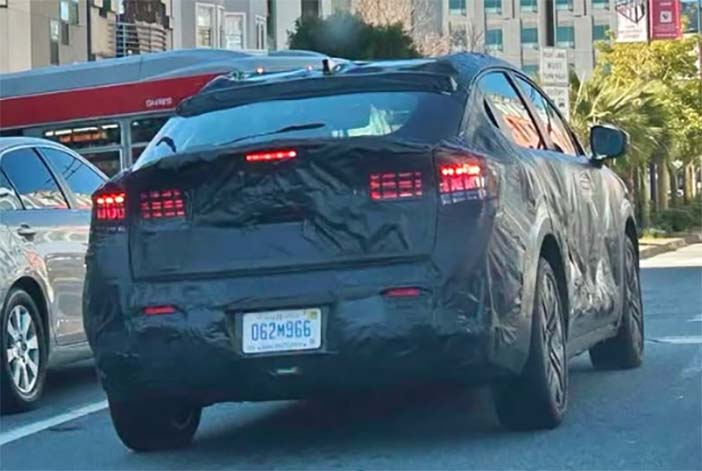
+++ After months of anticipation, I finally have the first spy photo of the new NISSAN LEAF . Expected in mid-2025, the third generation of the Japanese electric compact car was first seen during tests in San Francisco. The car is completely camouflaged and hidden by thick black sheets, but we can already catch a glimpse of the body shape and the rear lights. According to the American media, it is most likely the Leaf itself. According to what I have gathered over the past few months, the new Leaf is preparing to evolve into something completely new. Abandoning its compact hatchback form, the Japanese electric car will become a pure crossover, with a design inspired by the Chill Out concept presented in 2021. In particular, the production model could come very close to the render we have created. The design should be distinguished by an arched roof and minimalist flanks, with a rear dominated by a glossy black panel and pixel-style led lights. As for the interior, it is plausible that the instrumentation will take its cue from the Ariya, albeit with some changes in the controls and graphics to suit this specific model. At the moment, there is no official information on the motors and batteries of the next Leaf. However, it is likely that Nissan will use the CMF-EV platform, the same one used for the Ariya. This platform supports powertrains with 66 kWh and 91 kWh batteries and electric motors with power outputs of up to 394 hp. The Japanese manufacturer is also working on the development of solid-state batteries, although these will not reach the market until 2028. Despite this, it is to be expected that the future Leaf will offer a longer range than the current model, with mileage up to 300 km. Production will begin in March 2025 at the Sunderland plant in the United Kingdom. +++
+++ The newly-appointed CEO of POLESTAR , Micheal Lohscheller, has said he will speed up his company’s retail expansion by turning its back on the fashionable shopping centre locations in favour of more conventional dealer showrooms; mostly alongside existing Volvo franchises. Lohscheller admitted the firm’s online ordering process and retail-style shopping-centre stores needed to evolve. “Buying a car is an emotional thing”, he told. “You need to understand the technology; I personally want to have somebody who explains that to me. Traditional OEMs have defined everything to the last detail, and that increases costs and it upsets everybody, and does the customer really care? We’ll go to a pragmatic (we call it a non-genuine agency) model; not a pure agency model”. It means that Polestar, along with other major OEMs, will ditch the no-negotiation, fixed-price sales model that it has been championing since the Polestar 2 launched in 2020. Instead, it’ll revert to a system whereby individual dealers can offer incentives and discounts depending on targets and margins. “If you come and you say ‘ah, is there another 5 percent discount?’, we find a solution for you”, Lohscheller said. “In a pure agency model that would not be possible. I think everybody is giving up on this black and white, right?” Lohscheller doesn’t believe placing his dealers alongside or within Volvo showrooms will damage his business or cannibalise sales. “The 2 brands complement each other very well”, he told. “Volvo is about safety, comfort, we are about performance, sustainability. You have maybe one or two customers who go from A to B, but they are the minority”, he said. “Volvo dealers know the service; I want to find more Volvo retailers who want to take Polestar; it’s incremental business”. Lohscheller says he wants to take Polestar’s retail presence from 9 locations to 17 in the next 18 months. “I don’t want another 50 places, because then you have small volume. Give it to the people who want it”, he said. +++
+++ The new SMART #5 is set to be sold with a plug-in hybrid drivetrain alongside previously revealed pure-electric variants in response to growing concerns around sales in some global markets. The move, confirmed by Chinese-based Smart officials after photos of test mules were posted on social media, represents a major step-change for the Geely- and Mercedes-owned company, which previously committed to exclusively selling new-generation Smart models with electric power. Commenting on the move, European operations spokesperson told: “We see individual mobility powered by combustion engines and, in particular, with hybrid drives as a transitional technology towards purely electric driving. It is important to respond to the increasingly diverse demands and desires of the customers. Smart cannot exclude any technological solution for the future at the current point of time”. The decision to begin offering the largest Smart model to date with a plug-in hybrid drivetrain is also likely to be a reaction to changing sales dynamics in Smart’s largest market, China, where plug-in hybrids and range-extenders have experienced strong sales recently. Technical details of the plug-in hybrid version of the #5 remain under wraps, though it is thought to use a variant of the Thor system already fitted to other recent new Geely models, including the Galaxy 7 EM-i. It combines a turbocharged 1.5-litre 4-cylinder petrol engine and electronic dual-hybrid transmission (E-DHT) developing 110 hp in combination with a 218 hp electric motor. In the Galaxy 7 EM-i, the Thor system comes with the choice of either an 8.5 kWh or 19.1 kWh lithium-iron-phosphate battery providing respective ranges of 45 km and 90 km. With a maximum 1.724kg kerb weight in combination with the 19.1 kWh battery, the Geely’s overall range is put at 1.410 km. By comparison, the electric versions of the #5 offer between 340 hp in single-motor and 422 hp in dual-motor guises; the former running a 400 Volt and latter an a 800 Volt electric architecture. They are coupled with 76 kW lithium-iron-phosphate and 100 kWh lithium ion batteries with ranges of between 525 and 740 km on the Worldwide Harmonised Light Vehicle Test Procedure (WLTP). A similar plug-in hybrid drivetrain is also offered in the Zeekr 7X; a model already confirmed for sale in selected European markets in 2025. While details of Smart’s plans for sales of a plug-in hybrid #5 have yet to be revealed, the indications are that it is being readied for launch in 2026. Electric versions of the new SUV model are set to go on sale in European markets in mid-2025. Geely’s and Mercedes-Benz’s decision to step back from original plans to make Smart models purely electric comes after Geely’s Lotus brand announced it would also abandon its strategy of electric-only models. Speaking at the Guangzhou motor show last November, Lotus CEO Feng Qingfeng said the British-based car maker would introduce models featuring so-called ‘Super Hybrid’ technology with turbocharged combustion engines, electric motors and ultra-fast charging to extend their overall range to up to 1.100 km. Lotus has yet to divulge which models are planned to receive petrol-electric power, though it is anticipated that both the Eletre and Emeya will receive hybrid drivetrains as part of plans to broaden their reach in key markets such as China, the US and the UK. Another Lotus model expected to feature hybrid power is the company’s upcoming Porsche Macan-rivalling SUV, currently under development and due to be previewed in 2025. “At Lotus, we have always chosen the best power technology available, whether it’s pure petrol, pure electric, hybrid or range-extended EV”, Feng told in an interview. Feng’s specific reference to range-extended technology suggests Lotus could be looking beyond conventional hybrids in favour of a new range-extender set-up in which the combustion engine acts purely as a generator to produce electricity, rather than providing direct drive to the wheels. Meanwhile, Geely-owned brand Zeekr has confirmed it plans to launch three plug-in hybrid models in 2025, including a new range-topping SUV model, in a move that will see it diversify from its original plans of offering pure-electric models only. +++
+++ STELLANTIS chairman John Elkann met Trump in Washington, a report says. The automaker imports around 40 percent of the vehicles it sells in the U.S. from Mexico and Canada, analysts said. President Trump could impose a 25 percent duty on imports from the 2 countries. Elkannspent 4 days in Washington and held 2 meetings with Trump, people familiar with the matter told. Elkann, who is leading the Chrysler and Jeep parent company while it looks for a new CEO, was invited to the inauguration ceremony, but missed it because he flew back to Italy after his meetings to welcome seven-time world champion Lewis Hamilton as the new Ferrari Formula One driver. +++
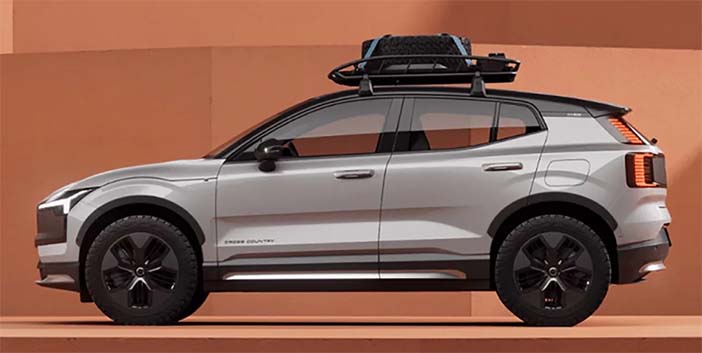
+++ VOLVO revealed the EX30 in 2023 and alongside it we saw the Cross Country variant, which showcased the Swedish car firm’s desire to take its smallest EV and tackle the great outdoors. The Cross Country was scheduled to be available in 2025 and now I can reveal it should go on sale by the summer. Production is slated to start in the spring, ahead of a launch a few months later. When the EX30 Cross Country does arrive, it’ll provide a rather unique offering in a niche segment. The SEA2 (Sustainable Electric Architecture) underpinnings and the body will be the same as the regular EX30, but Volvo will equip the Cross Country with a few tweaks to differentiate it from the rest of the line-up. Although specifics haven’t been finalised for the production car, the pre-production version’s black front facia and rear are expected to feature, along with ‘Cross Country’ badging and unique bumpers. The large chunky tyres will likely be toned down for the production model, although Volvo has said the model will sport some bespoke alloy wheels. Volvo hasn’t said what will power the EX30, but given its off-road nature, the EX30’s ‘twin-motor’ set-up seems the natural choice, because it would offer all-wheel drive. The 69 kWh battery sends power to a 428 hp dual-motor in the EX30 Twin Motor Performance, with a rapid 3.6 seconds 0-100 kph time the result. With the Cross Country, which will get lifted suspension as standard, this accelerative performance will most likely take a hit. Despite Volvo’s range of XC-badged SUVs gaining their name from ‘Cross Country’, there’s no current model in the range that bears this trim level, which used to be offered on the old V40 plus the V60 and V90. The EX30 Cross Country would be the first time the name has appeared on one of Volvo’s all-electric cars. +++