
+++ A wave of new tariffs from the European Union aims to slow the sale of Chinese vehicles, but new factories from some of CHINA ’s biggest manufacturers might help them break in. Tariffs totalling up to 35% on imported electric vehicles (EVs) from China have posed a significant challenge for Chinese automakers in the EU. Designed to counteract state subsidies that give these manufacturers a competitive edge, the tariffs have already impacted market dynamics. Chinese brands like SAIC-owned MG have seen their market share in Europe drop while experiencing a steep 58% year-over-year decline in registrations this past November. While the EU’s actions aim to level the playing field for local automakers, Chinese car manufacturers are expanding their global manufacturing footprint in a bid to circumvent the trade barriers. SAIC Motor recently announced a $135 million investment in a new manufacturing facility in Egypt. Scheduled to begin production in 2026, the plant will initially produce 50.000 vehicles annually, with plans to scale up to 100.000 units. Located in Egypt’s New October City, this facility will not only serve local and regional markets but also position MG strategically close to Europe. The first product from the factory will be the facelifted MG 5 and there are plans to produce a range of SUVs and new-energy vehicles over time. By establishing a manufacturing base outside China, MG can potentially avoid the steep EU tariffs on Chinese-made vehicles, making its models more competitively priced for European consumers. In addition to its Egyptian plant, MG is actively exploring the construction of an EV-focused manufacturing facility within Europe. Potential sites in Spain, Hungary, and the Czech Republic are under consideration, with Spain reportedly being the frontrunner. A European factory could mitigate tariff-related challenges and solidify MG’s presence in the EV market. Other Chinese automakers are also pursuing similar localization strategies. BYD is taking bold steps to establish a stronger presence in Europe, aligning with the broader manufacturing strategy employed by Chinese automakers. It will consider building a second assembly plant in Europe in 2025, according to its European managing director, Michael Shu. This expansion builds on BYD’s earlier announcement of its first European EV manufacturing facility in Hungary, marking a significant milestone for Chinese automakers seeking to localize production within the region. Even as new tariffs take effect, not all Chinese automakers are feeling the pinch equally. BYD, for example, managed to weather the storm in the first full month since the EU’s new tariffs took effect. In November 2024, the company recorded 4.796 vehicle registrations in Europe; a 127% increase from the same period last year. BYD’s tariff exposure is lower than MG’s, and its models continue to appeal to both private buyers and fleet operators. In contrast, MG’s European presence has dropped sharply since new tariffs took effect. In November, the automaker reported that it had sold just 3.762 vehicles. The brand’s struggles underscore the importance of diversifying production and supply chains to remain competitive in the global EV market. The EU’s new measures reflect a growing trend of protectionism as countries seek to safeguard local industries. Europe’s automotive sector, which employs hundreds of thousands of workers, is grappling with the costly transition from combustion engines to electric drivetrains. By imposing higher tariffs on Chinese imports, the EU aims to give domestic automakers breathing room to adapt. The tariffs, however, have created uneven effects across Europe. While Chinese EV registrations have halved in key markets like Germany and France, the United Kingdom (no longer part of the EU) has seen a 17% increase in Chinese vehicle sales over the past year. The stakes are high for Chinese automakers. The European market remains a critical battleground for the future of EVs, and overcoming tariff barriers will require significant investments and innovation. Establishing local manufacturing hubs, exploring partnerships and developing tariff-friendly supply chains are essential strategies for staying competitive. The broader EV market is also becoming less predictable. Slowing adoption rates, fluctuating consumer demand, and political pressures are forcing automakers worldwide to rethink their strategies. For Chinese brands, this means navigating protectionist policies and contending with inconsistent market demands. +++
+++ The next-generation DACIA Sandero will retain its conventional hatchback shape even as it gains an electric option and is restyled with influence from the chunky Duster and Bigster SUVs. Due in 2027, the next-generation Sandero will be a heavy evolution of today’s car, remaining atop the Renault Group’s CMF-B architecture, which will allow it to retain combustion power while adding an electric option. Dacia design boss David Durand acknowledged that while the brand’s design language is increasingly off-road-influenced in its chunkiness and utilitarianism, there are no plans for Dacia to become a pure-SUV brand, and it will not give the Sandero an overtly rugged makeover and a suspension lift for its second outing. “It’s true that the outdoor and very strong formal language fits perfectly well, but nothing is forbidden, and I think something that’s important for us and for the Sandero is not showing off too much. It’s a very serious and well-made car, and it fits a lot of customers like that. “It’s not so easy to innovate on every body type, and the hatch is very well known by customers, and this is what they need: a car which has a lot of roominess, which is really part of the DNA of Dacia, and compact at the same time, because it’s easy to park, easy to drive, not too heavy, not too high-consumption. So the hatch is the good solution. “We also have to face CO2 emissions, so aerodynamics are important and we take all of that into account to continue to tick the box that this very essential and central car in our range is covering”. Asked whether Dacia will turn the Sandero into a mini-SUV like the new Citroën C3, Durand said: “No. Redesign, of course, but the bodytype is a hatch”. He added that the higher-riding, off-road-flavoured Sandero Stepway is seen as almost an entirely separate model and it is important to maintain that distinction going into the next generation. “We have noticed that Sandero owners are not hesitating over the Stepway. They want to buy a Sandero, and people coming for the Stepway are not considering a Sandero at all. So we are talking to different people, and so we have to take everybody into account and understand that some people just need a good car, not showing off too much”. Asked whether Dacia could consider differentiating the 2 model lines more overtly, he said: “We could have a separated Stepway or more differentiation between them, but the fact that we are using a lot of common parts between the 2 cars and we are really using the same base is also part of the ingredients to make the costs low. We could say ‘okay, we will make 2 different cars’, but we will have to double the investment, and people at the end will pay it somewhere”. Durand also suggested that the electric Sandero won’t look substantially different to the petrol car, saying: “I think EV can be just a powertrain. It’s not that because you are an EV that you need a special design”. He refused to be drawn on when the next Sandero will break cover but hinted at the possibility of a concept being shown before the final production design, but that’s unlikely to be this year. Speaking more broadly about the evolution of Dacia design, Durand acknowledged that other brands are employing similar themes of utilitarianism and ruggedness as they seek to make cars more attractive but for less money but said he is confident that Dacia’s cars will remain distinct. “I’m not too worried”, Durand said, “because this position that we built over a long time is not only about design and product; there’s also a big infrastructure behind it. It’s using the assets of a group, and it’s the story we built with our Romanian past, and so it’s not so easy to copy. There is also a company culture about designing to cost, how to make the design to cost, how can you reduce the number of parts and the way we discuss with our suppliers; all of this, it’s not so easy to just say ‘let’s do it’. This is also something which is strong in our brand: it has a story, it’s coming from somewhere. It’s the result of a long process”. +++
+++ FERRARI ’s first electric car will get a patented sound system mimicking combustion engines. The debute is planned for the end of this year, and fans of the brand’s iconic engine roars have reason to pay attention. The system, based on a patent Ferrari filed roughly 2 years ago, amplifies the sounds of electric motors and directs them out of the rear, giving the EV a voice of its own. The sound is designed to remain subtle during quiet cruising but comes to life as drivers push the throttle. While the prototype’s bassy tones differ from Ferrari’s classic V8s and V12s, they aim to preserve the sensory thrill of driving a Ferrari, albeit with a controversial twist. The test mule spotted in action sports a 5-door cross-over coupe body, borrowing parts from existing Ferrari and Maserati models, while the final design remains a mystery. CEO Benedetto Vigna has assured fans that Ferrari EVs will not be silent, highlighting the importance of sound in maintaining the brand’s identity. Drawing inspiration from systems like the Hyundai Ioniq 5 N’s artificial exhaust notes, Ferrari’s approach could offer drivers a range of customizable sound profiles. Ferrari’s entry into the EV market is set to be an exclusive one. Reports suggest the price could exceed €550.000 in the Netherlands, placing it firmly in the hyper-luxury segment. With a debut expected in late 2025 and sales slated for 2026, the EV represents a significant step in Ferrari’s adaptation to an electrified future. However, the challenge remains: Can artificial sounds and high-tech design satisfy purists who equate Ferrari with the visceral experience of internal combustion engines? And if so, can the automaker convince Ferrari diehards to fork over hundreds of thousands of dollars for an EV? It will be a bold experiment that promises to blend new technology with a reverence for the brand’s traditions. For purists, the words ‘EV’ and ‘Ferrari’ are a nonstarter, but the Italian automaker is making a big bet that it can bring people around to performance EVs. Whether the fake exhaust noise wins over fans or fuels skepticism, it nevertheless signals that Ferrari has a clear vision for what its first EV will sound like. Hopefully, it’ll have a prettier body than the prototype. +++
+++ FIAT plans to launch an all-new 500 in 2029 and an all-new Panda in 2030, in a commitment to producing city cars in Italy for the foreseeable future. “The plan for Fiat is very clear”, Jean-Philippe Imparato, Chief Operating Officer for Europe at Fiat parent company Stellantis, told. “The 500 will be completed by a hybrid version of the electric 500 in November. Second, the next generation of 500 will come around 2029 and will be built at the Mirafiori factory in Turin. “The Pandina (an internal nickname for the current Panda) will be built at the Pomigliano factory in Naples until 2030, and then there will be a new generation, which will be built at the same location. And you will have the Grande Panda coming in March 2025, sporting both electric and hybrid versions. So customers will be a able to choose from a new 500, a new Pandina and the Grande Panda within the line-up of the A- and B- segment for Fiat”. This means Fiat will continue to build the cars that have defined its brand since the original ‘Topolino’ 500 of 1936, resisting the temptation to abandon the city-car class for more profitable crossovers and SUVs that many of the 500 and Panda’s rivals have succumbed to in recent years. Citroën and Peugeot axed the C1 and 108 siblings in 2022 and 2021 respectively; Volkswagen, Seat and Skoda gradually killed off the Up, Mii and Citigo trio between 2020 and 2023; and the Ford Ka+ was pulled from sale in 2019. There are, however, green shoots sprouting: Kia, Hyundai and Toyota all continue to offer petrol-engined city cars (the Picanto, i10 and Aygo X) and Renault will launch a new electric Twingo next year. Chinese firm BYD is also expected to bring its Seagull EV to Europe. The 500 and Panda have been a linchpin for Fiat over the past decade. Indeed, the Panda remains one of the best-selling new cars in Italy, despite it having been launched 14 years ago. The 500 has been less successful of late, however. The big-selling petrol-engined 500, launched in 2007, was axed last year because of the introduction of stricter EU cybersecurity regulations and the electric 500e has yet to pick up the mantle. Such is the slow pace of 500e sales that production of the EV (and its Abarth 500e hot-hatch sibling) was paused last September and won’t resume until later this month. This has prompted the development of the 500 Ibrida that Imparato confirmed will be introduced in November. This is a 500e retrofitted with a mild hybrid powertrain, the goal being reinvigorating sales to safeguard the Mirafiori plant. The 500e itself is due an upgrade over the next year, too. +++
+++ Despite the heavy government incentives given to Chinese automotive manufacturers and their rock-bottom prices, it seems some traditional automakers can still find a way to break through. FORD ’s Chief Executive Officer, Jim Farley, reported that the American manufacturer earned around $600 million last year. Although Ford does not usually report its asset earnings by region, Farley saw the opportunity to tout its success in such a famously challenging country. “I’m happy to say that Ford makes money in China, and I’m very proud of that because not many automakers can say that”, Farley said following a vehicle reveal for the Detroit Auto Show. Ford has made a particular effort to be a part of the Chinese economy with the Lincoln Nautilus, a mid-size luxury crossover SUV, whose second generation is produced by Changan Ford in China while Ford is retooling their Oakville Assembly plant to produce electric vehicles. Like Farley said, other manufacturers have not been so lucky. Hyundai partnered with Chinese state-owned automobile manufacturer BAIC to create a $1.1 billion joint venture dubbed Beijing Hyundai Motor. The Korean automaker hopes to alleviate its tanking sales in China, which amounted to losses of 2.6 billion yuan ($358 million) for the first 9 months of 2024, according to Beijing Hyundai. Toyota reported a 9% drop in Chinese sales in 2024. The same year, GM announced a $5 billion hit to its profits as part of a restructuring effort to address its falling operations in China. Even Honda saw a 46% decline in sales. Ford’s victory may be a sign that succeeding in the Chinese automotive market is not as impossible as previously thought. While Farley didn’t explicitly state how the company managed to turn a profit in China despite many other companies’ failure to do so, its partnerships might be a clue. Ford currently has 2 joint ventures in China: with Changan Automobile, called Changan Ford (CAF for short) and with Jiangling Motors, called JMC. Via CAF, Ford builds a few China-exclusive vehicles, like the Kuga and the Mondeo. With JMC, it builds the Transit, a pick-up based SUV called the Everest, and a line of light trucks. +++
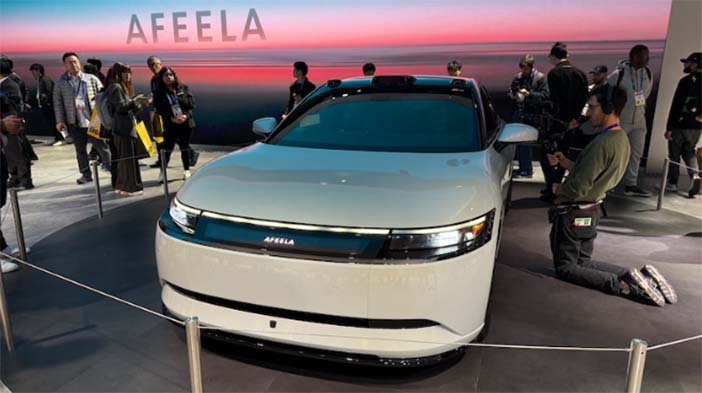
+++ Among the big automotive stories at this year’s CES in Las Vegas was the next chapter in the launch of Sony HONDA Mobility and its unveiling of a near-production version of the €120.000 high-tech electric Afeela 1 sedan. The EV will rely on Honda’s vehicle design and be assembled at one of its factories in Ohio. Sony will supply software to support the artificial intelligence elements as well as entertainment properties. A product such as this creates the kind of buzz you would expect from a world-class event like CES. But Honda’s dealership network isn’t so excited. The Sony-Honda joint venture, as of now, plans to bypass Honda’s U.S. dealerships and sell directly to customers. It’s a similar strategy Volkswagen is using for its nascent Scout brand. Tesla, Rivian and Lucid already have established direct-sales networks. As expected, National Automobile Dealers Association CEO Mike Stanton said in a statement that the group is “disappointed” with the decision and that such a direction would put the EV in direct competition with the Honda and Acura dealership network. “Honda should understand that any misguided attempt to bypass or undercut its U.S. dealers will be challenged in statehouses and courthouses across the country, with NADA’s full support”, Stanton said. I don’t know how well Sony Honda Mobility or the Scout brand will fare legally taking this route, but one thing is for sure: Many lawyers will make a lot of money on this litigation for many years. +++
+++ HYUNDAI and KIA , South Korea’s automotive powerhouses, are facing mounting challenges in their home market. While the sister companies broke sales records in the United States, 2024 was a decidedly more difficult year for Hyundai and Kia back at home. A dip in domestic demand and rising political uncertainty hurt domestic sales for South Korea’s automotive industry. Both brands have projected sales to increase in 2025, but with Chinese automaker BYD set to enter the South Korean market this month, those goals could be difficult to reach. Hyundai and Kia’s combined sales in South Korea fell in 2024, marking a sharp contrast to their performance overseas. Hyundai sold 705.010 vehicles domestically, a 7.5% drop from 2023, while Kia’s local sales decreased by 4.2% to 540.010 units. These results underscore a growing weakness in their home market, even as Kia achieved a global sales record. This decline comes amid political turmoil. South Korea’s president Yoon Su Yeol declared martial law in December, leading to widespread protests and his subsequent impeachment. The resulting uncertainty has dampened consumer confidence, further affecting the auto market. Adding to the pressure, BYD is set to enter the South Korean market on January 16. The company plans to sell at least 10.000 electric vehicles (EVs) by year’s end, starting with models like the Seal and the Dolphin. With competitive pricing, BYD’s EVs could pose a significant threat to Hyundai and Kia’s dominance, even though South Korean consumers have traditionally favoured domestic brands. BYD’s move coincides with its global expansion strategy as the Chinese giant leverages its growing reputation for affordable, reliable EVs. However, South Korea’s entrenched loyalty to Hyundai and Kia, coupled with the latter’s strong EV offerings, may prove to be a formidable obstacle for BYD. Despite these challenges, Hyundai and Kia remain optimistic. Both companies have set ambitious sales targets for 2025, aiming for 7.39 million vehicles globally, a 2% increase from 2024. Hyundai plans to boost domestic sales to 710.000 units, while Kia targets 550.000. To achieve these goals, automakers are doubling down on electrification and local production, especially in the United States, where they performed well last year. Hyundai’s Georgia Metaplant in the U.S. reflects a broader push to weather global headwinds, including potential tariffs from president-elect Trump. Hyundai and Kia are at a critical juncture in their home market. Declining domestic sales, political unrest, and BYD’s entry into South Korea pose significant hurdles for the automotive giants. However, their global resilience and strategic pivots (particularly their focus on EVs and international production) could help offset these challenges. +++
+++ Stellantis had a rough 2024, with production shutdowns on multiple occasions, the abrupt resignation of their Chief Operating Officer, and mixed consumer sentiment regarding their upcoming EV offerings. With the year having finally come to a close, it’s becoming clearer just how bad Stellantis Italy’s production is faring. It turns out the future of a 110-year-old brand MASERATI could be at stake. In the United States, it was fairly obvious Stellantis was struggling, and the story was very much the same elsewhere. According to the manufacturing union, Stellantis saw its vehicle production fall 37% since last year. As a result, the brand’s production of cars has officially hit its lowest point since 1956. Luxury and performance marques Alfa Romeo and Maserati weren’t outliers due to their price or limited lineups. All of the conglomerate’s commercial vehicle production fell by 17% compared to 2023. Overall, Stellantis manufactured 475.090 vehicles in its 5 Italian production facilities. In 2023, those same facilities produced 751,384 vehicles. Of all of the brands under the Stellantis umbrella, Maserati was hit the hardest. Stellantis paused production at its Mirafiori facility multiple times, with production expected to resume in February. The facility makes the Fiat 500e and 2 Maserati sports cars. Overall, production at the Mirafiori facility declined by 70% in 2024. The Mirafiori plant in Turin wasn’t even the most affected one. The Maserati plant in Modena performed even worse, posting a 79% drop in production. The Modena plant most notably produces the MC20 supercar and Nettuno V6 engine that powers the Grecale. “We are very worried about Maserati”, Ferdinando Uliano, the union’s leader, said. “We expect quickly a clear and detailed project for Maserati”. While Maserati’s full 2024 sales aren’t out just yet, in the first 3 quarters, Maserati sold just 8.600 vehicles, down from 20.600 in the same period in 2023. That’s a decline of more than 50%, and the reason for it varies depending on who you ask. “Maserati is in the red. The reason is marketing. The Maserati brand is not clearly positioned and the storytelling is not how it should be”, Carlos Tavares, who abruptly resigned as CEO last year, told at the Paris Motor Show. Maserati also saw a change in leadership in October 2024, when its former CEO, Davide Grasso, was replaced by Santo Ficili, who is also the head honcho of Alfa Romeo. Ficili reportedly plans to bring the 2 marques closer together, which could mean an entirely new direction for Maserati. Stellantis has been quick to get their plans for the Modena facility out before the production numbers dropped. Executives claim there’s a future for the Modena plant, and it revolves around becoming the central point for the group’s high-end vehicles. The automotive conglomerate announced a $2.1 billion investment in its Italian production facilities to boost EV production. The Alfa Romeo plant in Pomigliano and the Melfi facility, which will produce an electric replacement fr the Jeep Compass, are 2 facilities set to receive a slice of those investments. The Atessa plant currently produces electric vans under a number of Stellantis brands, including Fiat Progression, Peugeot and Citroën. The Termoli production facility, which currently builds engines, will be reworked for battery production. While plenty of electrification work is ongoing throughout Stellantis Italy, there is no further information regarding the specifics of the Modena production facility. If it follows suit, the Modena facility will likely play a role in high-end EV production. Stellantis is in trouble, but its problems are spread throughout its brands. It’s clear there’s growing concern for the future of legendary brands like Maserati amongst enthusiasts and industry professionals alike. Fortunately, Maserati has its reputation and 110-year history behind it, so it’s more likely to be sold off than shut down – that is if Ficili can’t turn it around. +++
+++ With 2024 over, automakers in the UNITED STATES have plenty to celebrate. Nearly every major brand saw an increase in sales, with some models standing out more than others. SUVs and pick-up trucks once again dominated the market, but a few sedans and hatchbacks managed to secure spots among the bestsellers. These are the top 20 bestselling cars of 2024, ranked from lowest to highest. 20) Subaru Outback: 168.771 units. The Outback maintained its momentum, climbing slightly with a 4.3% sales increase. While its current generation dates back to 2020, Subaru is already developing a new model, expected to embrace a more traditional SUV design. 19) Subaru Forester: 175.521 units. The Forester saw an impressive 15.1% jump in sales, bolstered by a refreshed design for 2025. Despite retaining its signature 2.5-liter flat-4 engine, subtle updates helped keep it competitive. 18) Subaru Crosstrek: 181.811 units. Joining its Subaru siblings on the list, Crosstrek sales climbed 14.2%. The new Wilderness trim, with enhanced ground clearance and rugged aesthetics, attracted buyers looking for off-road versatility. 17) Toyota Tacoma: 192.813 units. A transition year hurt the Tacoma’s sales, which dropped 17.9%. The all-new 2024 model arrived mid-year, offering a fresh design and a hybrid option, but it wasn’t enough to regain its 2023 sales rank. 16). Ford Explorer: 194.094 units. Ford’s second-bestseller got a slight facelift for 2024, but sales were up just 3.9%. Despite a minor dip in the 4th quarter of the year, the Explorer remains a popular choice for family-friendly SUV. 15) Chevrolet Trax: 200.689 units. Cherolet’s affordable Trax surged 84% in sales, proving there’s still strong demand for budget-friendly options. The stylish subcompact pairs affordability with practicality. 14) Hyundai Tucson: 206.126 units. Hyundai’s Tucson saw a small 2% drop in sales despite its recent redesign. The popular SUV continues to offer solid value, with its sales holding steady. 13) Chevrolet Equinox: 207.730 units. The Equinox is holding its ground as Chevrolet’s topselling SUV despite a slight decline. A redesign aims to breathe new life into this aging model. 12) Jeep Grand Cherokee: 216,148 units. The Grand Cherokee dropped 12%, reflecting a challenging year for the brand. Despite its 3-row option and recent updates, Jeep’s overall sales fell 6% in 2024. 11) Toyota Corolla: 232.908 units. Small cars made a surprising comeback, and the Corolla helped drive the charge with its affordable price, reliability, and hybrid efficiency. It remains a go-to choice for budget-conscious buyers. 10) Honda Civic: 242.005 units. The Honda Civic enjoyed a strong year, with sales surging 20% compared to 2023. This impressive growth highlights the enduring appeal of Honda’s compact car, which continues to attract a wide range of buyers. The Civic’s line-up, including the hybrid model that earned praise as one of 2024’s best deals, played a significant role in its success. Offering a blend of sporty handling, efficiency, and practicality, the Civic remains a benchmark in the compact car segment, appealing to both younger drivers and seasoned commuters alike. 9) Nissan Rogue (X-Trail in Europe): 245.724 units: Although sales of the Rogue dropped 9.5%, it remains one of the brand’s best-performing models in the United States. Known for its stylish design, spacious interior and competitive pricing, the Rogue continues to hold appeal for families and budget-conscious buyers. Nissan’s updates to the model in recent years, including the addition of advanced safety features, have helped it stay relevant despite increasing competition in the crowded SUV market. 8) Toyota Camry: 309.876 units. Defying the growing dominance of SUVs, the Toyota Camry posted a 3% sales increase in 2024, surpassing 300.000 units sold. The Camry’s reputation for reliability and comfort continues to draw loyal buyers, while its hybrid options attract those seeking fuel efficiency. A major redesign for the 2025 model year promises to build on this momentum, with updates expected to enhance its appeal further in a segment that refuses to go out of style. 7) GMC Sierra: 322.946 units. The GMC Sierra posted a 9.8% increase in sales, making it a standout performer in the pick-up market. With its premium styling, strong towing capability, and range of trims, the Sierra appeals to both work-focused buyers and those seeking a luxury truck experience. The Denali and AT4 trims, in particular, remain popular choices for buyers looking for upscale features and off-road performance. GMC’s success with the Sierra reflects the enduring strength of the full-size pick-up market in the U.S. 6) Ram Pickup: 373.120 units. The Ram Pickup experienced a notable 16% decline in sales, dropping out of the top-5 bestselling vehicles for the first time in years. This decline can partly be attributed to the brand’s transition away from the Hemi V8 engine, a feature long favoured by Ram enthusiasts. Despite its reduced sales figures, the Ram 1500 remains a strong contender in the segment, offering a mix of luxury features, innovative tech, and a reputation for smooth ride quality. 5) Honda CR-V: 402.791 units. The Honda CR-V saw an 11.4% jump in sales, further solidifying its position as a family-friendly SUV. The 6th-generation model, introduced in late 2023, brought incremental updates that resonated with buyers, including improved interior space, advanced technology and the addition of hybrid trims. These features helped the CR-V remain competitive in a market increasingly crowded with new and refreshed entries, ensuring its continued success in 2024. 4) Tesla Model Y: 416.000 units. The Model Y maintained its dominance as the topselling electric vehicle in the United States. While global sales dipped slightly, its popularity on the homemarket remains strong, thanks to its sleek design, impressive range and Tesla’s well-established charging network. The Model Y’s ability to balance practicality with performance makes it an appealing choice for EV buyers, helping it stay ahead in the rapidly growing electric crossover segment. 3) Toyota RAV4: 475.193 units. The RAV4 continued its reign as America’s bestselling SUV, with a 9.3% increase in sales. Its wide range of trims, including hybrid and plug-in hybrid options, helps it cater to a diverse audience. The RAV4’s balance of reliability, practicality and affordability makes it a consistent favourite among families and adventurers alike. Its ability to stay competitive in a fast-evolving SUV market demonstrates Toyota’s skill at anticipating consumer needs. 2) Chevrolet Silverado: 542.517 units. The Silverado managed a 1% increase in sales, maintaining its position as the second bestselling vehicle in the United States. Buyers are drawn to its powerful V8 engine options, wide range of trims, and strong towing capabilities. The Silverado’s workhorse reputation continues to resonate with pick-up enthusiasts, while newer features and designs ensure it stays relevant in the face of strong competition from other full-size pick-ups. 1) Ford F-Series: 765.649 units. The F-Series retained its crown as America’s best-selling vehicle, with a 2% increase in sales and a total of 765.649 units sold. A mid-cycle refresh and strong performance in the 4th quarter of the year helped boost its numbers, reinforcing its decades-long dominance in the market. The F-Series’ blend of capability, innovation and brand loyalty keeps it a top choice for truck buyers, making it the undisputed leader in the full-size truck segment for yet another year. However, if sales of the GMC Sierra and its twin Chevrolet Silverado are combined, General Motors can claim having the bestselling pick-up in its portfolio (865.463 units). Final thoughts: The American auto market saw gains across the board, but SUVs and pick-ups continue to dominate. Still, sedans like the Corolla and Camry showed surprising resilience, and affordable options like the Trax and Civic reminded everyone that price-conscious buyers still matter. What’s next? With EVs like the Tesla Model Y climbing the ranks and automakers investing in hybrids, 2025 could see even more disruption in the sales charts. +++