+++ Late last year, Renault confirmed its plans to build the outrageous 5 Turbo 3E: a hand-built, rear-wheel-drive electric hot hatchback with more than 500 hp and a 6-figure price tag. It’ll be produced in limited numbers, via a specialist team in France. Now, Renault brand CEO Fabrice Cambolive has suggested the firm’s sporty ALPINE off-shoot could create its own take on the 3E formula, possibly with more power and even more hardcore internals. Speaking to the media at the Brussels Motor Show, Cambolive said the Turbo 3E gives Alpine “motivation to do even better”. While far from absolute confirmation that Alpine is now working on an uprated 3E, Cambolive emphasised how the Renault 5 and Alpine A290 had been considered as one model in the recent European Car of the Year discussions: “We presented R5 and and the A290 together for Car of the Year,” he said. “After that, we spoke about Turbo 3E. And of course this is part of the Renault history: you can’t have another brand taking this heritage”, he told. “That’s why we decided to do this car, which is for us a complement of what the Renault 5 did in 1972: to go through all the social classes and all the price brackets of the automotive world. So that’s what we will do with Turbo 3E and, of course, this will give Alpine another motivation to do even better. That’s my point”. How an Alpine A290 Turbo 3E might look is open for discussion. The standard A290 is a little bit more aggressive than the conventional R5, with more muscle around the bumpers and lower portions of the car. But the Renault 5 Turbo 3E turns the dial to 11, with a wide, race car-inspired body kit, huge air intakes and a wild rear diffusor. I can expect much of the same, plus a few subtle differences, for any Alpine-badged alternative. Yet it’s under the metal where the biggest changes could play out. Even the standard A290 gets a bigger, more powerful motor than the Renault 5, plus wider axles, a unique subframe and a completely new suspension geometry with hydraulic bump stops. If these differences were manifested (and exaggerated) on any so-called Alpine Turbo, the performance uplift could be substantial; playing to Cambolive’s comments about the sporty sub-brand doing things “even better”. Of course for now, any future extra-hot Alpine remains firmly under wraps. Whatever happens, it’s likely parent company Renault will want to sell, build and deliver its ration of R5 Turbo 3Es before announcing further variants, meaning any Alpine derivative is likely years rather than months away from being revealed. +++
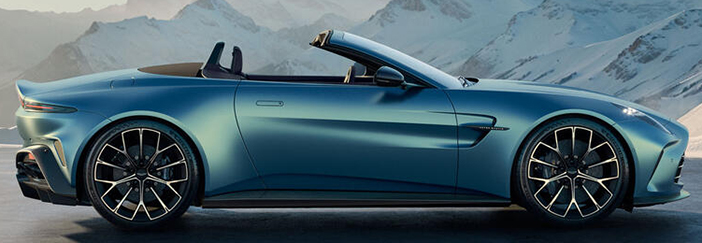
+++ The new ASTON MARTIN VANTAGE ROADSTER is one of the most powerful drop-top sports cars on sale following an extensive, performance-focused upgrade. With 665 hp and 900 Nm from a reworked version of the existing twin-turbocharged 4.0-litre V8, the new Roadster packs substantially more power than its 510 hp predecessor and has been set up to be a more dynamic proposition. Now more powerful than rivals such as the Porsche 911 Carrera 4 GTS Cabriolet and Ferrari Roma, the Aston’s new power levels even push it to vie with some models in the class above, such as the Maserati MC20 Cielo and McLaren Artura Spider. The new drop-top follows the coupé that was launched nearly a year ago and was described by Aston as “the most driver-focused and fastest Vantage in the famous nameplate’s 74- year history”. The Vantage Roadster draws power from the same Mercedes-AMG-derived powerplant as the coupé. Although the convertible is 60 kg heavier, due to its extra rigidity bolstering and roof mechanics, it can still match its sibling in a straight line with a 0-100 kph time of 3.5 seconds. Top speed for both is limited to 325 kph. That makes it as fast as the outgoing 700 hp V12 Vantage Roadster, the most powerful drop-top Aston has produced to date. The car’s pace is the result of an “extensive” overhaul of its V8. Aston Martin has added new cam profiles and larger turbos, tweaked compression ratios and improved cooling. The firm has also adjusted the ratios and calibration of the eight-speed automatic gearbox for “punchier” in-gear acceleration and quicker gearchanges. To improve the driving dynamics, the aluminium chassis has been stiffened and work has been done to keep the car at a near-50:50 weight distribution. As before, double wishbones are fitted at the front and multi-link at the rear. Aston claims the car’s rear end is up to 29% stiffer under load, to the benefit of handling and driver feedback. New bespoke-tuned Bilstein DRX adaptive dampers also increase responsiveness. There is a choice of steel or carbon-ceramic brakes and its standard 21in alloy wheels are shod with bespoke Michelin Pilot Sport S 5 AML tyres. Aston Martin claims the new convertible has the fastest-folding roof on sale today. The cloth top opens or closes in just 6.8 seconds and can be operated at road speeds of up to 50 kph. For comparison, the Roma Spider’s takes 13.5 seconds. The new car is visually marked out from its predecessor by a revised front end (notably with a larger grille) and a 30 mm increase in width. Inside, it mirrors the Vantage Coupé, which ushered in a completely new cockpit arrangement. The cabin gets a 10.25in touchscreen, wireless smartphone mirroring and an array of buttons, switches and dials for the most used functions. Pricing has yet to be announced, but Autointernationaal.nl understands it will start at around €295.000 in the Netherlands. +++
+++ DACIA will continue its rollout of hybrid powertrains through 2025 and beyond, with CEO Denis Le Vot confirming the technology will be “growing more and more in the future”, including the possibility of a plug-in hybrid (PHEV) powertrain for the Bigster. In an exclusive interview, Le Vot told that his team will continue to utilise all the parts available to them, insisting that parent company Renault has “all the solutions”, from ICE (internal-combustion engines), to hybrid, plug-in hybrid and fully electric. “We recoup the assets developed by the Renault Group”, Le Vot told me. “We put them back and make our own soup with the leftovers. We make good business with that for us, and for the clients and we manage, as a whole, the CO2 emissions of the Group”. Le Vot told us the 1.0-litre TCe turbo (as found in the Jogger and Duster) and even the 1.6 HEV are too small for the Bigster. It’s for this reason that Dacia is utilising a new 1.8-litre hybrid in its flagship SUV: an engine born from the so-called ‘Horse’ joint venture formed in 2024 by Renault and Geely to develop new electrified powertrains. We asked Le Vot if there might be space for Renault Group, Dacia or Horse to develop a plug-in hybrid powertrain for the Bigster and he said: “We have plug-in hybrids in the company. PHEV is in the panorama, but maybe not tomorrow morning”. So while a plug-in hybrid is possible (and likely), its introduction doesn’t appear imminent. In 2022, Dacia accounted for a significant 7.6 percent of the European retail market, and with so few financial incentives available to private customers, there is seemingly less reason for Le Vot to push ahead with PHEV, at least while he’s able to pool Renault’s EV mix and meet the necessary ZEV (zero-emission vehicle) mandates. +++
+++ The DS 4 will gain an electric option and a new name when it is facelifted this year. Since its 2021 launch, the premium hatch has been the brand’s best-seller. In mainland Europe, where it sold 10.405 examples in 2024 alone. The arrival of an electric variant will give the model added appeal. Because it uses the same EMP platform as the Opel Astra and Peugeot 308, it is likely to adopt the same powertrain option those cars offer. This means a 1546 hp motor and a 54 kWh pack, yielding 440 km. DS is understood to be debating whether there is still a place for the plug-in hybrid model. Arriving in September, the hatch will also be renamed Numéro 4, aligning with the brand’s new naming strategy, which started with the recently revealed Numéro 8 flagship. The facelifted ‘4’ will also gain design cues from its bigger sibling. These include swapping the current car’s wide grille for the Numéro 8’s thinner and more defined split grille. At the rear, a less sculpted body and sharper LEDs, like those found on the Numéro 8, also appear to have been added. Inside, the No4 is expected to adopt a new 7.0 inch digital instrument screen and the 10.0 inch infotainment touchscreen will get updated software. The new model could also get plusher materials than the current car’s, given DS’s intention to move upmarket. +++
+++ OPEL is rethinking its plan to go all-electric from 2028, recognising that the European EV market is vastly different from how it had predicted when setting its transition timeline. The company announced in 2022 that it would launch its final petrol car in 2024 and was committed to that objective as recently as 2023, but CEO Florian Huettl has told that the firm will now maintain a flexible powertrain offering for the foreseeable future. Speaking at the Brussels motor show, he said: “Going forward, it is fair to say that if we re-evaluate and look at today’s reality in comparison to the hypothesis we, the European Union and many actors made a couple of years back, the reality does not live up to that”. Asked if he was rethinking Opel’s EV transition timeline as a result, he said: “I think we need to step back a little bit from that question. What I like to put the focus on these days is the fact that we are already fully electrified”. He also highlighted that the new Frontera is available at €30.499 with electric power in the Netherlands and that the Grandland Electric offers up to 700 km of range, saying these things were “great steps” towards popularising EVs. Huettl stopped short of putting a new date on Vauxhall’s petrol phase-out but said: “We have a very clear strategy. I see Opel as full-electric down the road, no doubt. “Now we have the good situation to be in a multi-energy strategy environment, which means that every one of our well-known cars offer the choice”. Huettl believes there are 3 building blocks that must be in place to accelerate EV adoption in Europe: 1) A great offer of products, 2) Charging infrastructure that is progressing really well and 3) a clear direction by the government. He pointed out that Opel already offers a wide choice of EVs across its line-up. +++
+++ RANGE ROVER ’s upcoming fleet of all-electric vehicles is coming into clearer view as more software information is revealed for the upcoming Velar replacement. A new EV will arrive in 2026 to take the mid-size luxury SUV’s spot in Range Rover’s line up, and JLR says it will “deliver a smarter and more intelligent driving experience”. The new electric successor to the Velar won’t use a version of the Modular Longitudinal Architecture (MLA) platform that will underpin the full-size Range Rover Electric, instead it will sit on the firm’s new EMA platform. The firm said in 2023 the first car to make use of this technology would be a “medium-size modern luxury SUV” that will go into production in 2025, and will be a “model from the Range Rover family”. After initial plans to make EMA a multi-fuel platform, it was confirmed to be electric-only. The EMA architecture will heavily use over-the-air updates, focusing on features such as ‘evolving advanced driver-assistance systems’, ‘non-stop access to media streaming’ and exchanging data between JLR and EMA-based cars, such as the new Velar, for additional service and maintenance prompts to ‘reduce costs for the client and JLR’. Judging by its dimensions, the positioning of the fresh EV will place it directly under the Range Rover Electric as a rival to the new Porsche Macan EV, Maserati Grecale Folgore and the upcoming BMW Neue Klasse SUV (iX3). The car’s design has a more rakish appearance than the already pretty sleek Velar. The headlight arrangement will look similar to the current Range Rover’s, along with a prominent grille that I expect will be largely filled-in to enhance aerodynamics. There will be bulky wheel arches that house some massive alloy wheels and a sloped windscreen to reduce drag. The new Velar will get a more coupé-SUV shape with a pronounced rear shoulder line. A pair of thin rear lights conform to Range Rover’s current design language. Given the EV rides on an all-new platform, there’s little in the way of technical details around, but 800 Volt architecture is expected to allow rapid charging up to 350 kW. +++
+++ SKODA ’s new seven-seat electric SUV has been spotted for the first time, nearly 3 years after the Czech brand unveiled the bold Vision 7S concept that previewed its future flagship electric car and introduced us to its new ‘Modern Solid’ design language. ‘Modern Solid’ is the same philosophy used to create the Skoda Elroq that was launched late last year, with certain design elements then carried over to the Enyaq during its recent, rather extensive facelift. Up front will be the ‘Tech Deck Face’, which is a much slimmer interpretation of the traditional Skoda grille, and is used to house the various sensors, radars and cameras for the car’s driver-assistance systems. The sleek nose also incorporates a pixel-like daytime running light design, which we can see poking out from the camouflage and should extend onto the front wings. Other details that appear to have been carried over from the Vision 7S are a twin-fin roof spoiler and super-slim tail-lights that extend onto the bootlid. The overall shape is close to the concept’s too, with the very square front end and traditional SUV proportions, but with short overhangs at the rear that’ll help maximise interior space for passengers and their luggage. Unsurprisingly, the coach doors on the Vision 7S haven’t made it to production, given that we can see the pop-out rear door handles are where they’d normally be. The concept’s unconventional ‘six-plus-one’ seating arrangement has almost certainly been replaced by a more traditional choice of five or seven-seat options, although we have yet to get a look inside the production car. The zero-emissions alternative to the award-winning Kodiaq isn’t due to be unveiled until the end of 2026, or potentially in early 2027, but it’s likely to feature a similar set-up inside to the Enyaq and Elroq. That should include the huge 13-inch central touchscreen, a 5-inch driver’s display, various sustainable materials and plenty of ‘simply clever’ touches. So far, the only detail Skoda has confirmed about its seven-seat EV is that it’ll be around 4.9 metres long. That’ll make it the biggest model in Skoda’s line-up by far, and bigger than the Peugeot E-5008 it’ll be going up against. However, it’s not quite as colossal as the Hyundai Ioniq 9 or Kia EV9; 2 other contenders in the steadily expanding 7-seat EV segment. Underneath the Skoda’s camouflage is almost certainly the same MEB bespoke electric-car platform that’s used by the Enyaq and Elroq, as well as around a dozen other EVs including the Ford Capri. Another is the nearly five-metre-long Volkswagen ID. Buzz LWB minibus, so we know the architecture can accommodate a vehicle this large. The 7-seat Skoda will probably get the same 86 kWh battery as the ID. Buzz LWB, which we’d expect to provide a range of nearly 640 miles. That’s on par with the Hyundai Ioniq 9, but still some way off the up to 665 km of range offered by the Peugeot E-5008, in the right guise. A choice of single-motor, rear-drive and dual-motor, all-wheel drive powertrains is likely to be offered, and we wouldn’t be surprised if there was a hot RS version too, considering that both generations of the Skoda Kodiaq have been given the same treatment. +++
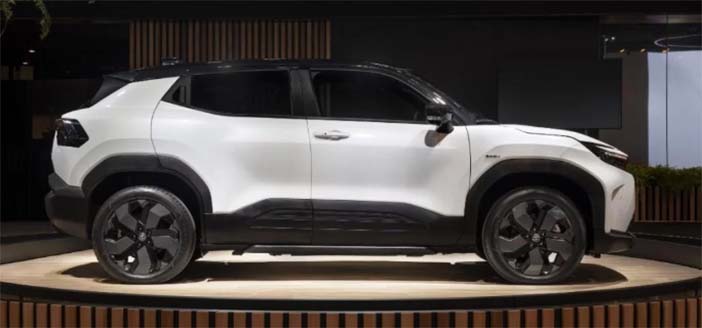
+++ TOYOTA is set to raid more of its back catalogue for names of future electric models, rather than continue the alphanumerical naming convention it started with the BZ4X. The BZ4X arrived in 2022 as Toyota’s first EV, with ‘BZ’ standing for ‘Beyond Zero’ (emissions), 4 being the size of the car in Toyota lexicon and ‘X’ referring to it being a crossover. However, the Japanese firm’s second EV, the Urban Cruiser, ditches that naming convention in favour of a name from its extensive back catalogue. Andrea Carlucci, Toyota Europe’s director of marketing and product development, confirmed at the Urban Cruiser’s Brussels motor show unveiling that he expected the B4X name to “remain a bit isolated” in the Toyota range. The desire to return to word names was the result of “a clear request from Europe that was very much heard and followed by Japan”, said Carlucci. “We have a number of models. If you start multiplying by technology, by segment, the nameplates tend to proliferate too much. We wanted to rationalise this”. He added that Toyota wants to “avoid this inflation of nameplates for the simplicity of the consumer”. The Urban Cruiser will join the related Suzuki e-Vitara in being manufactured in India. Carlucci wouldn’t be drawn on when production of Toyota EVs in Europe would begin, confirming only that “the philosophy of Toyota is to sell where we produce”. More broadly on how Toyota would be able to stand out for making EVs as it has done for hybrids, Carlucci said it was that expertise in batteries and energy management that has already “created a lot of trust from customers” in Toyota EVs. “Toyota knows better than anyone about how to manage a battery, how to make it stable and so on”, he said. He sees “no boundaries” for the performance division GR to become involved in the firm’s EVs in the future, saying “I think GR stays as a very strong ICE” proposition for now. +++