
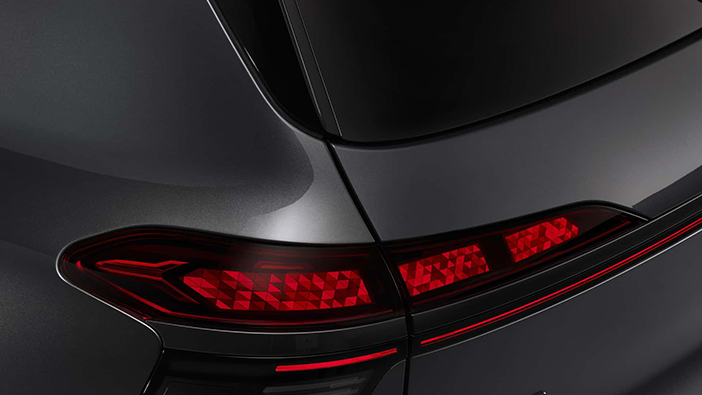
+++ AUDI ’s new flagship SUV has a lighting trick nobody else on the road can match. The Q9 uses curved digital OLED taillights made from six glass panels just 0.1 millimeter thick that wrap around the rear quarter panels instead of sitting flat. Audi calls the setup a world first and previewed it when the Q9 debuted this past July. The hardware backs that up with 512 individually controllable lighting segments spread across those 6 panels. Conventional led taillights sit behind flat lenses, which limits how far the light can wrap around a car’s body. Audi’s curved digital Q9 flagship SUV changes that by shaping the glass substrate itself to match the rear quarter panel. The lighting follows the curve of the body instead of stopping where a flat panel would.
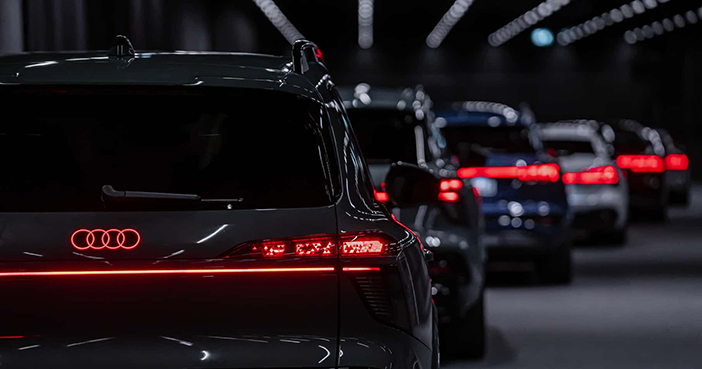
The 0.1-millimeter glass substrate is thin enough to bend without cracking the OLED layer bonded to it. The result is a light element Audi says measures just 1 millimeter thick overall, built on technology the brand has spent a decade developing for production cars. Audi was the first automaker to put segmented OLED lighting into a production vehicle and the digital version in the Q9 pushes that further. Each OLED rear light connects to the car’s electrical system control unit through a bus system.
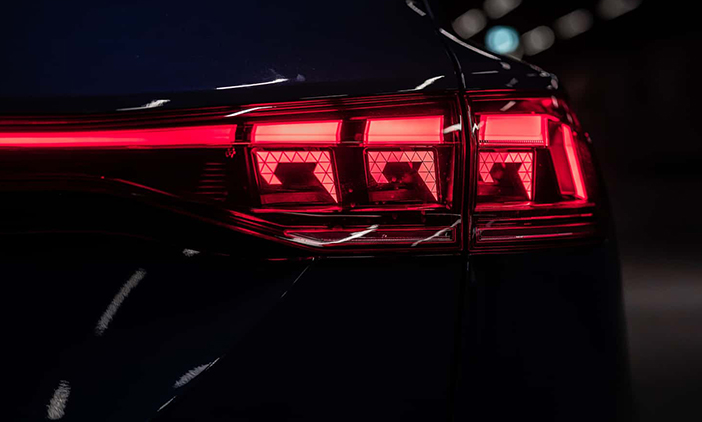
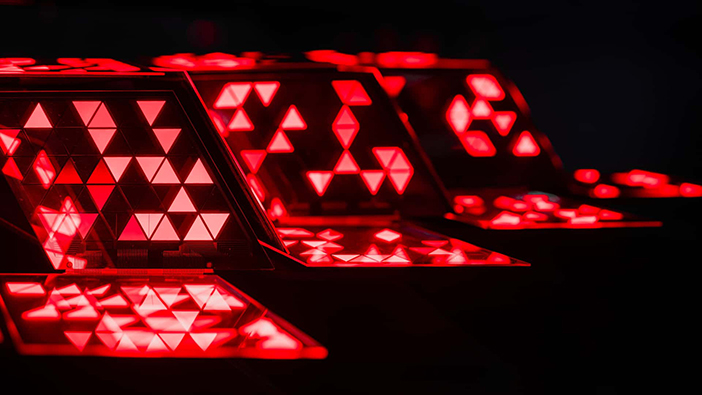
That link lets hundreds of segments be controlled on their own instead of lighting up as one block. That fine control also keeps the curved panels easy to read from the side, not just straight on. A driver approaching from an angle in a parking lot or at an intersection gets a clearer view of the brake and turn signals than a flat-panel light would usually give at that angle. The 6-panel layout splits the lighting across the width of the tailgate and rear quarter panels. Audi states the outer curved panel on each side is the largest rear-light panel it has built. The breakdown lists 99 segments for each outer panel, 84 for each central panel and 73 for each inner panel, which adds up to the 512 total segments across all 6 pieces.
Audi pairs the OLED rear lights with digital Matrix headlights up front, and the 2 systems work together at night. The Q9 can project a stylized turn-signal pattern onto the pavement ahead of the car, in sync with the dynamic indicators front and rear. Audi previewed this turn-signal projection feature on the smaller Q7 before bringing it to the new flagship.
Audi has shared the panel count, the segment total and the glass thickness as production specifications tied to the Q9’s unveiling. The brand’s own digital Matrix headlight technology already appears on some models. What Audi has not detailed yet is how much of that 512-segment system drivers can customize through onboard settings, or whether every market gets the same signature lighting sequence at startup and shutdown. Those specifics, along with pricing, should become clearer as the Q9 gets closer to its on-sale date. +++
+++ Partnerships between major carmakers are becoming the norm, with an ever-evolving industry and never-ending competition. This has forced the established automakers to rethink their business models and strategies, leading them not away but into each other’s arms. BMW and Rimac are 2 very successful companies in their own right; this year, they decided to band together, and it seems more cars forged from this partnership are on their way. The partnership between the 2 brands is set to expand beyond the already for 2027 announced BMW i7. Rimac founder Mate Rimac told that 2 more models are in the partnership. “There are 2 more cars in the pipeline that we are doing, but I can’t provide additional details yet”, Rimac told. The i7 is the first car to feature Rimac technology and it shows the Croatian automaker’s ability to meet BMW’s strict standards for cost, quality, production capacity and performance. At this point, I can only speculate that BMW’s Neue Klasse cars are the prime candidates for Rimac’s EV technology. Rimac, being the outspoken person he is, admitted that it took time to win over the BMW partnership. He said it took them 3 years of development work and as with anything in the automotive industry, many suppliers, along with Rimac, were bidding for the spot. To stand out, Rimac made a bold move before securing the contract from BMW. When brand representatives visited the Rimac campus, he showed them where their production line would be. He bet on building the facility to meet BMW’s production requirements even before securing the contract, showing his and the brand’s commitment to the partnership. As a fun fact, this partnership marks a full-circle moment for Rimac, whose first EV project was converting an old E30 into a full EV. Under the current partnership, Rimac helped BMW integrate cylindrical battery cells into the i7 for the mid-cycle facelift. This achievement pairs the Gen6 technology with a Gen5 module design, delivering a 20% increase in battery energy density. In effect, the reworked technology with Rimac gives the updated i7 an additional 120 km for a new total of over 720 km. As a fun fact, this partnership marks a full-circle moment for Rimac. +++
+++ The Volkswagen Group wanted BUGATTI ‘S CHIRON SUCCESSOR to be electric. Still, Mate Rimac pushed for a different approach: a clean-sheet design with a naturally aspirated V16 engine at the heart of a hybrid setup. His experience with the Nevera convinced him that demand for ultra-expensive electric hypercars was too limited to justify turning Bugatti’s flagship into a pure EV. When Rimac took control of Bugatti alongside Porsche in 2021, the VW Group was moving aggressively toward electrification in the wake of the messy and immensely costly Dieselgate. In theory, an electric hypercar would have aligned with that strategy while allowing the French marque to benefit from Rimac’s expertise in high-performance electric powertrains. However, Rimac wasn’t interested in taking the easy route. As he explained in an interview, the quickest and most cost-effective solution would have been to put a Bugatti badge on the Nevera and call it a day. Instead, he wanted a completely different product that would offer customers something they couldn’t get from his own electric hypercar brand. “When we started discussing with VW about our ownership of Bugatti and the future of Bugatti, they were pushing me to make the next Bugatti electric. I had an electric car platform already for the Nevera, which offered 4-wheel drive, a 400-km/h top speed and the comfort of a cruiser that could be driven long distances. On paper, it could be a Bugatti on the Nevera’s platform, right? Plus, it would be a lot easier than doing a completely new car with a new combustion engine. However, that is what I ended up doing with the Tourbillon because based on the feedback from the market on the Nevera I realized the market was going in a different direction. Thanks to the Nevera, we recognized this very early and we decided to make the Tourbillon a V16 plug-in hybrid, which was absolutely the right decision”. The Nevera’s relatively slow sales reinforced his conviction. Although the 1,914-horsepower EV showed what electric performance could achieve, wealthy customers weren’t necessarily looking for another battery-powered machine, no matter how fast it was. Mate Rimac recently revealed on Instagram that only 71 Neveras had been sold, despite a planned production run of 150 units. His determination to preserve the internal combustion engine in Molsheim’s next hypercar helped pave the way for the Cosworth-powered Tourbillon, giving Bugatti a distinct identity from Rimac Automobili. While the Nevera showcases the extreme performance possible with a fully electric powertrain, the Tourbillon combines electrification with the sound, character, and mechanical drama of a sixteen-cylinder engine. For this clientele, exclusivity and emotional appeal matter just as much as outright performance. A battery-powered hypercar can deliver astonishing acceleration, but a bespoke V16 offers a different kind of experience. The VW Group may have envisioned an electric future for Bugatti, but Rimac chose a different path. Rather than turn the Nevera into a French-badged EV, he developed a new flagship that keeps the combustion engine alive while embracing electrification on its own terms. The strategy appears to be paying off, with all 250 Tourbillons already spoken for. Bugatti Rimac developed the hypercar without VW or Porsche involvement, according to Rimac. Porsche recently ended its involvement altogether, selling its stakes in Bugatti Rimac and Rimac Group in early September. That marks the end of an era that began under Ferdinand Piëch, but Rimac sees a bright future for Bugatti: “There are so many cool Bugattis we have planned in the product portfolio. We know what we want to bring to the market for the next 10 years. I’m so excited. I can’t wait to show this to the world because what we are doing is incredible. It’s fine art on 4 wheels. With the independence that we have now and the freedom I have to run the company, I think it will be so enriching to the auto industry and enthusiasts of the world to see these cars”. The most intriguing question is what those future Bugattis will actually look like. With Rimac promising a decade’s worth of new models, it’s hard to imagine every one of them being a multi-million-euro hypercar. There could be room for a more practical grand tourer like a spiritual successor to the 5-door Galibier liftback, giving Bugatti a broader lineup without sacrificing its exclusivity. Whatever Rimac has planned, the prospect of a more independent Bugatti exploring new segments is certainly exciting. Even with Bugatti out of the picture, the VW Group is still catering to the supercar crowd with Lamborghini, Audi’s Nuvolari, and the Porsche Mission S concept, which will become a permanent model above the 911. +++
+++ FORD has reworked the entire Mustang Mach-E line-up for 2027. The electric pony car now gets standard larger batteries and a slight price drop compared to last year’s model. A new off-road Trail package joins the range for the Select eAWD.
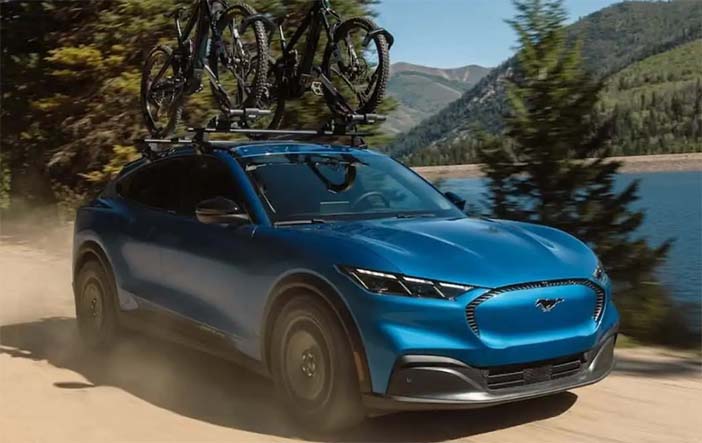
Every 2027 Mach-E now comes with an extended-range battery as standard equipment. Select and Premium trims carry 88 kWh of usable capacity, while GT and Rally step up to 91 kWh. Ford says final range figures will be announced closer to the car’s on-sale date. A new secondary drive unit powers the front motor on eAWD models. Ford says it delivers the same output as the outgoing unit but costs less to produce, which helps offset the larger battery and keep the Select RWD at the current price. Ford’s onboard power system, Pro Power Onboard, comes standard on the Trail package and is available on Premium and GT, including the Mustang Mach-E Rally. The 400-watt, 120-volt system draws from outlets in the cargo area and rear center console to run small accessories or charge devices. BlueCruise 1.5, Ford’s hands-free highway driving assist, is standard on GT and Rally and optional on Select with the Tech Pack Lite or Premium with the Premium Tech Pack. The package includes one year plus 90 days of service, with a one-time-purchase option available on any trim that has the required hardware. Trail buyers must select BlueCruise hardware at the time of order. It can’t be added later. The Trail package is exclusive to the Select eAWD configuration, so it isn’t offered with rear-wheel drive. It raises ride height by 10.0 millimeters up front and 15.0 millimeters in the back compared with the base Select and Premium setup. Underneath, Trail gets specially tuned front and rear struts and springs along with the same steering rack used on the Rally. The package also adds 19-inch High Gloss Dark Carbonized Gray wheels with as-cast graphics, wrapped in 235/55 R19 Michelin CrossClimate 2 tires. Visually, Trail models get unique bodyside graphics, a Carbon Black lower front fascia, and a Mach-E Trail logo stamped into the center armrest. The Rally gets a steeper ride-height bump of 10 millimeters front and 20 millimeters rear, while the performance-oriented GT sits 10 millimeters lower at both ends. 2 paint colors, Desert Sand and Shadow Black, come standard. Buyers who want something else can pay extra for Adriatic Blue Metallic, Eruption Green Metallic, Glacier Gray Metallic, Race Red, Star White Metallic Tri-coat, or Velocity Blue Metallic. +++
+++ MERCEDES-BENZ drove 2 CLA models into each other on purpose at 56 km/h with nobody touching the brakes. The automaker calls it the world’s first public high-speed side-impact test between 2 moving production vehicles. A hybrid CLA Shooting Brake struck the driver’s side of a fully electric CLA, recreating a T-bone collision at an intersection. Each car weighed around 2 tonnes. 8 crash-test dummies rode inside to measure what the impact did to the people.
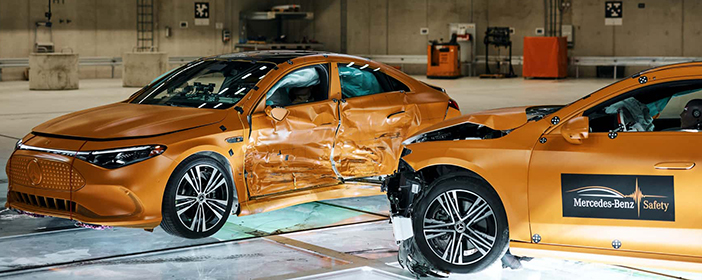
The setup mirrored a real intersection crash with one car running perpendicular into the side of another, both moving, neither braking. Mercedes-Benz describes the impact speed of 56 km/h as the upper end of typical intersection crashes. It says the passenger compartments of both CLA models stayed intact after the hit. That is the basic goal in any side-impact crash test, a cabin that holds its shape instead of folding in on the people inside. “Mercedes-Benz’s ambition is to build the safest vehicles in the world”, said Jörg Burzer, the company’s chief technology officer for development and purchasing. He called the test “a powerful demonstration of that ambition” and presented it as proof the automaker designs for how crashes actually happen. Paul Dick, Mercedes-Benz’s director of vehicle safety, linked the test to the brand’s long-running habit of feeding real crash lessons back into new designs. He calls that approach “Real-Life Safety” and says the two-CLA demo shows it working in practice. The company has reconstructed roughly 6.000 real-world accidents since 1969 for exactly this kind of development work. The 8 dummies represented 4 adults and 4 children, seated to capture how the impact loads differ by size and position. Every reading came back below the biomechanical limits Mercedes-Benz uses to judge occupant protection. That is the headline result behind the electric CLA’s structure. The battery was the real question mark going in, since a side impact aims straight at the pack sitting under the floor. Mercedes-Benz reported the high-voltage battery stayed intact with no breach of its cells. The electric CLA’s high-voltage system also disconnected automatically on impact, a safeguard meant to cut electrical risk for occupants and first responders the moment a crash happens. Combined with an undamaged pack, that’s the result an automaker needs before it can call a T-bone survivable. This single test sits inside a much larger program. Mercedes-Benz runs around 150 physical crash tests and roughly 15.000 crash simulations for every new model, well past what regulators require. Regulatory and consumer programs usually fire a moving barrier into a stationary car. This public demo used 2 moving vehicles to showcase that wider, mostly hidden validation effort. +++
+++ Future RENAULT models will have more “restrained” styling with greater commonality between models, according to Renault Group design chief Laurens van den Acker. The French brand has recently launched a string of retro EVs (the 4, 5 and Twingo) that all feature highly individual designs, but it has continued to pursue more modern designs with its ICE offerings, including the new Clio. Asked about its future design direction, van den Acker said this split approach would remain but hinted that, outside of its retro icons, future designs will feature more uniformity, due to a shift in direction under new group CEO François Provost. Van den Acker said Renault will “keep apart” its “legendary icon” and “future icon” product ranges explaining: “The goal of the legendary icons is to be an icon first and foremost and to be recognisable. The Twingo and 5 have the Renault logo, but we’re not trying to give them the same eyes or the same layout. The form language is completely different. But when somebody buys a Twingo, they want a Twingo first and they’re not buying into a Renault design language as such”. Alexandre Malval joined earlier this year to head deign for the Renault brand and van den Acker said that “we’re going to regroup a little bit with the future icons”, suggesting a more unified design language. “For those of you who’ve studied history, when I joined Renault, I created a brand from a Twingo to a Master, then Luca de Meo came in as Group CEO and he wanted more personality in all the cars. “It’s kind of a pendulum that swings, and there is no right or wrong approach necessarily. So we gave every car a unique identity, and now we’re on the other end of the spectrum, where they’re all different. And so this might be the right time to find a good balance. But our icons need to live their own story: they need to be Twingo first, 5 first and 4 first”. Van den Acker said the new E-Space concept was an example of this approach. While inspired by the original Espace MPV, it features a fresh styling approach. He said the fact that Renault is now developing models on bespoke EV platforms means their designs will “become innovative by default”. He added: “Future platforms will be EV-driven, and that will give them different silhouettes just from the get-go: longer wheelbases, bigger wheels, short overhangs, cars that aren’t as tall as an SUV but not as low as a saloon. That means the form language is up to us. Our challenge is not in the B-segment, because we are very strong in this part of the market and we feel very confident, but in the C- and D-segments. “I think the form language with the arrival of Alexandre is going to be a little bit more restrained (not constrained, but restrained) which you already can see in the E-Space.
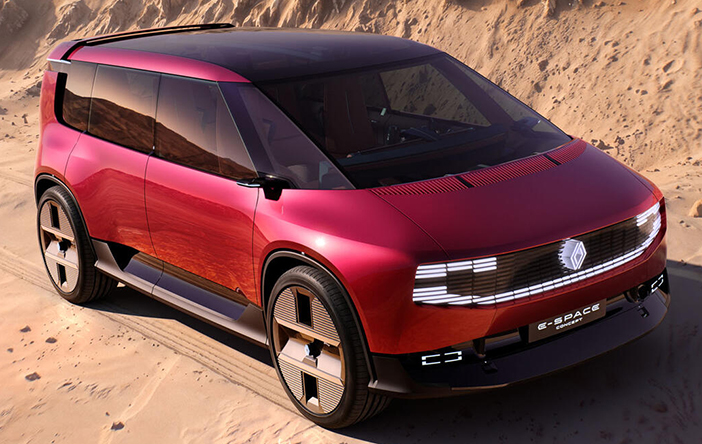
“When you move up in price, the cars become a little bit more timeless, and with that comes a form language that conveys that, and we need to make the cars look very serious and solid, so you might find a bit less surface entertainment. But at the same time we’re a Latin brand: we’re not cold like the Germans, we’re not hot like the Italians. We need to find our own way”. +++
+++ Love ’em or hate ’em, SUV COUPES remain a popular choice among luxury SUV shoppers. They offer all the practicality of a traditional SUV, but with a swoopier design and, depending on the automaker, potentially sharper driving dynamics. Mercedes-Benz is one of the biggest purveyors of the body style. It currently offers three coupe SUVs, along with 3 four-door ‘coupe’ sedans. And based on their popularity, don’t expect that number to drop anytime soon. Speaking with Mercedes-Benz vice president of Product Strategy and Product Steering Christoph Starzynski, I asked whether customers still want these swoopy SUVs. His answer was pretty clear: “I see strong demand for the coupe. There’s a fan base for the coupe, you know? Because you actually have a very, very spacious vehicle with a very, very sporty driving behaviour. We are happy that we have that car”. In 2024, rumours suggested Mercedes-Benz might consider killing off some of its coupe SUV options as the automaker looked to streamline its line-up. German newspaper Handelsblatt reported that the GLC and GLE Coupe could be among the first models on the chopping block. While we’ve yet to see a new GLC Coupe based on the latest-generation model, the return of the GLE Coupe for 2027 suggests there’s still an audience for the niche body style. Buyers can choose everything from the base 350 to the considerably hotter AMG 53 and 63 models. And Mercedes-Benz isn’t alone. Audi, BMW, Genesis and Porsche still offer coupe versions of some of their most popular SUVs. Hell, Audi still has 2 coupe SUVs in its line-up, the Q5 Sportback and Q8, while Porsche lets you choose just about any version of the Cayenne as a Coupe, including the EV. Infiniti recently pulled the plug on its swoopy QX55 after just a few years on the market, and it’s unclear whether that body style will ever return to the line-up. Volkswagen, meanwhile, ended production of the ID.5 in Europe as it revamps its entire ID line-up. For Mercedes-Benz, though, the coupe SUV remains a staple. And based on what the automaker says, it doesn’t sound like that’s going to change anytime soon. +++