
+++ ALFA ROMEO ’s new CEO, Santo Ficili, has announced that the next Giulia will “be available with a hybrid gasoline version”. The car will sit on the Stellantis group’s new STLA Large architecture that’ll allow for a fully-electric option, too. Alfa Romeo had been finalising its plan to become a fully-electric car company by 2027, and while it isn’t turning its back on electric cars, this latest announcement follows a statement from ex-Alfa boss (and now Stellantis Europe CEO) Jean-Philippe Imparato who told in 2024: “As we are blind in terms of changes in regulation, my only answer is that I have the means to adapt. We will assess where we are. If the current global ecosystem does not change, the Giulia will be 100 percent electric. If I see it is changing, or that I’m not matching what I want, it is not a problem to adjust with alternative powertrains”. This move follows the recently-released Junior, which comes with pure-electric and hybrid power. Both the Giulia and Stelvio will utilise Stellantis STLA Large architecture, which will also support other models within the wider Stellantis stable, from the Jeep Wagoneer S to a super-luxurious new Maserati SUV. Both the Giulia and Stelvio will be produced in Italy with the SUV set for a reveal later this year ahead of a 2026 market launch. While he gave no specific dates, Ficili says the Giulia ‘will follow’ and we expect the executive car to join the line up sometime next year. The Giulia EV’s underpinnings will offer a minimum of 800 km of range, with battery sizes ranging from 85 kWh to 118 kWh, according to Stellantis investor information. This would give the electric Giulia one of the longest ranges of any EV on sale. It will apparently have class-leading rapid-charge capability, with 30 kmi of range added per minute. Speaking at the 2024 Paris Motor Show, Imparato told his Alfa successor Santo Ficili “has the flex” to implement a multi-fuel strategy if market conditions and customer appetites dictate it necessary. These comments contradict the then Alfa CEO’s stance from a few years ago, and reflect Europe’s softening EV market. Back in 2022, Imparato said a move to full electrification for its core saloon was a must as the brand looked to turn its portfolio of models to fully electric by the end of the decade. “I have to make some big choices”, he said previously. “If I want to have more than an average level of performance, I must be bold. If I say I go electric, I go electric. I’m not half pregnant, if you see what I mean? It doesn’t work. It is a risk, but that’s normal. We are here to take some risks, but we have passed the tipping point for me”. One thing that hasn’t changed, however, is the maker’s focus on engagement. Imparato previously said that the brand would continue to prioritise the driver-centric and sporty approach its cars have become known for. In Paris, he told us: “You will see, on STLA Large, the level of performance we can reach”. He doesn’t see this being diluted with Alfa’s EVs, either: “I would love to have this ‘light is right’ tagline for Alfa Romeo”, Imparato said. “Even if I have 1 ton of battery behind me, I want to convey an idea of lightness, even if I am electrified. It’s a fundamental of Alfa Romeo and we are building this new range based on that. But it’s not enough. We are working on the vibe you will feel when you drive an Alfa Romeo in 2025”. This won’t be an artificial sound either, according to Imparato. The Frenchman outlined that he doesn’t want to bring fake features to Alfa’s cars, which would not be in keeping with its values. As a result, his innovation team is working on sensations it wants its customers to feel, vibrations, feedback “probably some new sounds and movements, but nothing fake. That is the intention”. On the performance end of the Giulia scale, the Quadrifoglio’s future is not clear. There is potential for more powerful all-wheel drive models to sit on the STLA Large platform, with Stellantis claiming a 0-100 kph time of 2.0 seconds is possible for cars based on this tech. Imparato has said that if Alfa Romeo was not able to deliver the right level of performance a Quadrifoglio model needed to bring in any given sector, the brand would not compromise by building such a car. Alfa Romeo will study a performance-focused Quadrifoglio version on all of its new-car launches, looking to offer this higher-powered, more aggressive option that’s “fully consistent with the Quadrifoglio message that we stand for since the beginning of the brand”. For the EV, Stellantis will have 3 electric drive modules at its disposal, with the third offering 400 or 800 v tech and up to 450 hp per motor. It means to reach the required performance level for a Giulia Quadrifoglio it would likely use a dual-motor 4-wheeldrive set-up. Any combustion-engined option is likely to pair a 6-cylinder turbocharged engine with either mild or fully-hybrid power. To protect the characteristics Alfa needs for its future cars, it will have a member of its product team embedded in the development of the STLA Large architecture. “The guy who is embedded by us to define the specification, the features, the performance, is Fabio Migliavacca, the guy who developed the GTA version for Alfa Romeo”, Imparato said. “He breathes Alfa Romeo, so he will give the features we need to define this totally clean-sheet design”. There are also a number of “dream cars” Imparato and the team he leaves behind would love to create. While he admitted a GTV is on that list, he said: “If I have to make a choice, I go for the Duetto Spider. Obviously, we have designed that car, but I will not dare to put that on the table before Alfa Romeo is completely secure [in its finances]. But we can do it with the technological bridge we have in the product plan, no problem”. +++
+++ AUDI is considering a new halo model that rekindles the spirit of some of its most iconic sports cars, and the original TT is cited as a key potential source of inspiration. Having retired the TT and R8 supercar in the past 18 months, Audi is currently without a dedicated 2-door sports car in its line up for the first time in decades. But CEO Gernot Döllner has suggested that a re-entry into this segment could form part of an extensive overhaul of the company’s product line-up and positioning. Asked at the company’s 2024 financial results presentation whether he would consider re-adding a sports car to the brand’s portfolio, Döllner said: “For sure. That’s part of the brand’s DNA, and we have to find the right way, timing wise, to integrate it into our portfolio”. He suggested it wouldn’t be appropriate to hint at a portfolio expansion while the company is in the midst of a wide-reaching restructuring programme that includes 7500 job cuts but said he has a “broad view on where Audi should be and where Audi is heading and thinking in that direction, sports cars are an integral part of such a set-up”. He emphasised the important role that sports cars have played in Audi’s past, citing 1980’s 4-wheeldrive Quattro as a car that “really started a new era of automotive”. He also highlighted the continued relevance of cars like the aluminium-based A8 and the efficiency-focused A2 on Audi’s current line-up. But he also mentioned the original TT as a car of particular importance and said Audi’s new design boss, Massimo Frascella (who arrived in Ingolstadt last year following a long career at JLR), is a particular fan of the late-1990s coupé. “I’ve discussed that car so much with Massimo. That was an inspirational car for his whole career. When he was a young designer at Giugiaro, he took a day off when the TT was launched in Italy, went to the Audi dealer in Milan and sat in the showroom for a day just looking at the car. The absolutely fantastic aspect is that it seems that he somehow had Audi in his mind for his whole career. Now is the time to let Audi out of the mind of Massimo Frascella”. Notably, Frascella was heavily involved in the rebirth of the Land Rover Defender in his previous role, which nods to the legacy of its long-running 4×4 namesake while embracing a modern, minimalist new design ethos. Döllner believes this approach to styling makes him a logical fit at Audi. “I would say he tries to optimise as much as possible, to take everything away that you don’t need for the expression, and I think that’s a unique talent”. Notably, minimalism and functional design are defining tenets of the Bauhaus art movement that so heavily influenced the original TT, suggesting that some of that car’s defining characteristics could be reinterpreted for a new age. However, Döllner was emphatic that “you can’t copy your past” as a car manufacturer, saying: “You really have to analyse what the essence of Audi is and use the essence to come up with something absolutely new”. “These copies of successful cars of the past are definitely the wrong way,” he added, although he did say it was “thinkable” that Audi could bring back some historic model names. The TT was launched in 1998 and sold more than 650.000 units across 3 generations over a 25-year production run, which came to a close in November 2023 with no successor in the frame. The V10-engined R8 supercar retired soon after, leaving Audi with no two-door coupés in its line-up for the first time since the Quattro was launched in 1980. Even if Audi is planning a return to the sports car segment, however, it isn’t expected to be for some time. The firm’s immediate priorities (following a turbulent 2024 in which its volumes reduced and its profit margin was squashed) are to bring a “future-proof” software architecture to market, benefitting from the Volkswagen Group’s new joint venture with Rivian, and to successfully ramp up production of crucial new models (including the A5, A6, Q3 and Q5) in 2025. After that, said Döllner, “then is the time to talk about the right portfolio in these niche areas. The transition takes all our energy right now, and that definitely starts in the core segments. That’s where we have to make Audi robust as the first step”. He wouldn’t be drawn on a potential launch date for a new sports car and when asked if Audi planned to preview its plans in this segment said only: “Not yet”. Asked whether Audi could offer a dedicated sports car with a plug-in hybrid powertrain, rather than as a pure EV, Döllner said he is “open-minded” but suggested that electric power makes more sense in an “everyday use” context. “There’s so much uncertainty that all this discussion delivers to the market that I would say in the long-term, in the sports car segment, there will be a place for fully electric sports cars,” he said. “Not for the track but for crossing the Alps and having fun on a country road, there’s nothing to say against an electric car. You have a coffee break, the cars recharge and everything is perfect”. Döllner spoke about the need for Audi to lean on “synergies” within the Volkswagen Group in certain segments (particularly at the lower end of its EV line-up, where it shares platforms with Volkswagen, Skoda and Cupra) and said there’s scope for technical collaboration with Audi’s premium siblings in more niche segments too. “I was head of group strategy when the set-up was defined: for Volkswagen to lead the A0- and A-segment, Porsche and Lamborghini to lead some areas for D-segment platforms and Audi to cover B-, C and D-minus platforms. We have that set-up and we will use it intelligently in the future”. Döllner stopped short of giving any technical plans, but any compact Audi sports car would be a logical candidate to share components with Porsche’s upcoming electric 718 Boxster/Cayman. As recently reported by Autointernationaal.nl, Audi also has plans for a third-generation R8 supercar, which would be based on the new Lamborghini Temerario plug-in hybrid. +++
+++ BENTLEY has confirmed it will launch a new plug-in vehicle, using full electric or plug-in hybrid technology, every year over the next decade. These electrified launches will be led by new lower-powered PHEV variants of 3 existing Bentley models due this summer. Bentley brought PHEV versions of the Flying Spur, Continental GT and Continental GTC to market last year and, chief executive officer Frank-Steffen Walliser confirmed that plans are now set out for a decade-long succession of new models. The British luxury brand has also begun construction work transforming the oldest building at its Crewe plant, known as A1, to become its new battery electric car assembly line, ahead of the new Bentley electric SUV launching in 2027. Bentley’s PHEV powertrains are currently only offered in 782 hp on the Flying Spur and Continental GT/GTC models (Speed specification), but new lower-powered versions will join the line-up this summer. Walliser said customer acceptance of plug-in Bentleys has been high. 4 months of PHEV sales have surpassed the last full year of the W12 petrol powertrain. “It’s been a very positive response from our customers to this car and this drivetrain”, he said. Walliser declined to reveal how many of the planned plug-in Bentley models would be full electric versus plug-in hybrids, but said Bentley is already taking into account customer demand for EVs not accelerating as expected. “Our ‘beyond 100 plus’ strategy already considers a slowdown in electrification, our original plan was to be electric by 2030, where now we say 2035, for sure, we will have a very, very close look at all the markets and the acceptance”, said Walliser. “Our judgment is at the moment that we are really at the, I would say, deep point on the acceptance of electric cars. We assume it will come back. Maybe it was a little bullish in the beginning but as customers gain more experience it’s difficult to judge exactly where the journey goes”. Walliser was speaking in the wake of Bentley announcing a 4th consecutive year of what it called “high profitability” and 6th in the black in a row. Operating profit, however, was down 37 percent year-on-year to €430 million, which the firm blamed on “global challenges in 2024 and the run-out and replacement of 3 of our 4 model lines”. +++
+++ CITROEN hopes to spark a revival of the small car-based Van segment by launching a €17.000 ë-C3 electric Van. The commercial variant of its new entry-level electric car is due in April. Only the Dacia Spring Cargo will be cheaper, yet the ë-C3 van will have a longer range. It will be based on the larger-battery (44kWh) version of the ë-C3 with 320 km of range and charging speeds of up to 100kW. Power comes from a 112 hp electric motor. Citroën “can see a niche” for the appeal of such a model, according to a spokesman. “Part of our goal is to reinvigorate that segment, and we’re excited to start with this”. The ë-C3 van is designed to appeal for last-mile deliveries and short-distance journeys and for businesses that don’t need a larger van. “It’s gone to tenders and there are use cases”, said Taylor. “There are people who don’t need a Berlingo and it can give something that the market can’t offer at the moment”. The new van will have the rear seats and seatbelt points removed and have a mesh bulkhead installed. It will have 1.3 square metres of load space. Otherwise, it will come with all of the features of the car on which it is based, including the Advanced Comfort front seats and suspension. It’s part of a wider push from Citroën to launch a range of affordable EVs. The firm already has five EVs available for less than €36.000, including the ë-C4 and ë-C4 X, which have had their prices cut to coincide with their facelifts to start from €35.215 and €35.915 respectively in the Netherlands. The Ami, ë-C3 and upcoming ë-C3 Aircross complete the 5 vehicles. Citroën is also in the process of developing an 8-year warranty to roll out across its entire model range. Taylor said the finer details and launch date were still being worked on but the brand sees it as a way of retaining aftersales and servicing within its network; and keeping in touch with buyers of new vehicles for longer and with people buying its cars used. +++
+++ FORD is stockpiling components ahead of expected new tariffs. It’s too early to get any concrete data, but warehouses near the Canadian border may be getting a whole lot of new occupancy. Ford has hired trucking firms and secured warehousing in states including Michigan and Ohio to transport output from the Essex Engine Plant in Windsor, Ontario, over the border before any tariffs take effect, according to a local union representative. +++
+++ Nvidia will team up with GENERAL MOTORS to help develop self-driving vehicles and work with the telecom industry on new 6G networks, it was announced. At the company’s annual GTC expo in California, chief executive officer Jensen Huang said Nvidia would work with GM to use AI in next-generation cars, factories and robots. For the wireless project, Nvidia will help create “AI-native” wireless network hardware for new 6G networks, the successor to today’s 5G. The partnerships come at a pivotal time for Nvidia, as investors begin to question whether the company’s stratospheric growth is sustainable. +++
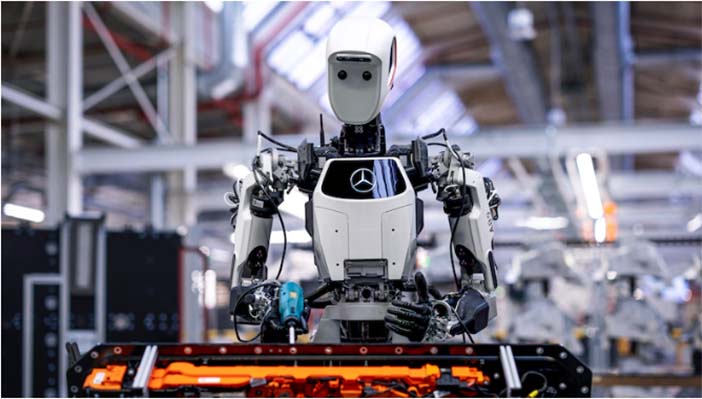
+++ MERCEDES is planning the roll-out of humanoid robots and new artificial intelligence (AI) software across its US and European manufacturing lines to streamline processes, increase efficiency and save money. The Apollo robots from American company Apptronik and AI software from Google DeepMind are currently being tested at the car maker’s Digital Factory Campus at its factory in Berlin. Apollo, a bipedal humanoid robot designed to mimic human actions, is being tested for logistics tasks, such as transporting components and assisting workers on the production line. Unlike traditional industrial robots, which are fixed in place and perform repetitive tasks, Apollo is capable of navigating factory floors and handling a variety of different, non-repetitive functions, speeding up manufacturing processes. Mercedes is initially deploying the robot in intra-logistics, moving materials between workstations to support human workers. It has also confirmed an investment of more than £85 million in Apptronik, signalling a deeper partnership that is expected to expand into other areas of manufacturing automation. Jörg Burzer, Mercedes’ director of production, quality and supply chain management, told: “We’re training tasks away from the workforce. We’re thinking hard about how we’re going to implement it. It’s important to choose the right tasks: repetitive and hazardous”. The investment in Apptronik, which has worked closely with NASA since its founding in 2016, allows Mercedes to leverage the company’s recently announced partnership with Google and its DeepMind technology. This includes 2 new AI models: Gemini Robotics and Gemini Robotics Extended Reasoning. Both models run on Gemini 2.0, which Google describes as its most capable AI model to date, going beyond text and image output into physical action and commands to control robots. The AI-enhanced automation processes are being deployed in Mercedes’ quality control and production monitoring, where assistants can analyse production anomalies, detect defects and optimise workflows. “AI takes over the tasks we enjoy less, giving us time to focus on value-adding activities. It’s a huge efficiency gain”, said Burzer. Together with these robotic advancements, Mercedes has also updated its digital production system with new AI-driven software tools, including a revised Chatbot Ecosystem. Although Mercedes operates a global network of manufacturing sites, its initial focus for the introduction of AI and humanoid robots is on its European and American factories. “We don’t have plans to introduce it to China,” Burzer told when questioned on the geopolitical implications of adopting the new production technology. This step follows other car makers in making similar moves towards integrating next-generation technologies into its manufacturing processes, such as Hyundai and JLR. +++
+++ RENAULT is plotting a new pinnacle to its range: a sexy crossover true to the Embleme concept car. It’s set to be the company’s largest pure electric car, measuring a little longer than the 7-seat Espace. “The Embleme is the purest expression of where we want to push the modern part of Renault design”, the group’s design director Laurens van den Acker told. “Don’t underestimate the Embleme concept: it’s a beautiful object. It’s one thing to seduce people with a form that you know, it’s another thing to seduce you with something that’s completely new”. Think of it as Renault’s alternative to the Citroen C5 X, which is nearly identical in size and also a crossover. Renault describes the Embleme’s bodystyle as a shooting brake, the classical term for a slender, often 2-door estate car. “For me, it’s the proportion of the future”, explains the Dutch design leader. “It’s a little bit lower than an SUV but it’s a little bit taller than a saloon for the simple reason that we need to put the batteries in the floor”. The Embleme show car runs a range-extender hybrid, with the 40 kWh battery pack charged from a plug or by a hydrogen fuel cell mounted in the nose. The battery feeds a 218 hp motor mounted on the rear axle. No current production Renault is rear-wheel drive but future iterations of the Embleme’s AmpR Medium platform should be sufficiently flexible to site an electric motor up front, in the rear or even combine motors for high-performance four-wheel drive. The big question is whether the production Embleme will be electric or hybrid? While arch rival Peugeot uses ‘multi-energy’ platforms from its parent group Stellantis, meaning both EV and electrified combustion versions can be built on one architecture and go down the same assembly line, Renault’s current strategy is to have separate platforms. Van den Acker says that if you mix the 2 powertrain types, the additional frontal area needed to safely package combustion engines makes a car longer but compromises interior space that could be allocated to an EV. “So you either have a long hybrid car that isn’t spacious enough or a short electric car that is too heavy”, he argues. The Embleme has a long, 2.90 metre wheelbase (not far off the new BMW 5 Series), relatively short overhangs and a stubby nose, the classic proportions of an EV. These could be protected or even enhanced by using the next-gen AmpR Medium platform. The Scenic E-Tech, which is 33cm shorter, can stow 87 kWh of batteries between its wheels. Renault’s future flagship could conceivably package more cells, though the thinking behind hydrogen range extenders is to halve the size of the battery and reduce raw material consumption. Thanks to the fuel cell creating electricity on board, the Embleme can drive 1.000 km with just a couple of five minute stops to gas up the tank, assuming you can find a hydrogen filling station. While Toyota may have productionised fuel cells with the Mirai, don’t expect Renault to follow suit. The powertrain choice is between petrol/electric hybrids (options already offered in the slightly shorter Rafale) or pure battery electric to create a zero emissions flagship. Given that the production Embleme isn’t expected before 2028, Renault won’t have to finalise powertrains for a while and can watch if the EV adoption curve intensifies, or if Europe’s phase-out date for petrol hybrids recedes. Regardless, Renault will soon have a second battery chemistry in production. Its current batteries are NCM (nickel cobalt manganese) but it will be adding European-sourced lithium iron phosphate (LFP) cells in 2026. As popularised by Chinese car maker BYD, LFP batteries don’t need any cobalt but are typically less energy dense than NCM batteries. Renault plans to overcome this with an efficient ‘cell-to-pack’ design that crams in more cells. Switching to LFP should reduce battery cost by 20 per cent, helping boost margins and ideally bring down EV prices. The batteries will be recyclable, in keeping with the Embleme’s philosophy: half of the concept’s materials are recycled and the carbon footprint of its components reduced by 70 percent. This is an extreme example of Renault’s corporate commitment to increase the recycled content of production vehicles to a third of its weight by 2030. It’s too early to talk about electric range but today’s 87 kWh Scenic can travel more than 560 km on a single charge. The Embleme sits fractionally lower and is peppered with aerodynamic touches: hidden windscreen wipers and door handles, cameras replacing wing mirrors, a front cooling vent that opens only when needed and a flat underbody with an active diffuser to minimise drag. If the latter sounds like something out of Formula 1, it is: the BWT Alpine F1 team assisted with digital wind tunnel testing. All those drag-reducing measures are clothed in curvaceous, clean body panels that epitomise the future of Renault design. “The Embleme is from the futuristic part of Renault, so cars with extremely desirable proportions and getting back some Latin sensuality”, says the group design director. The long wheelbase makes for a spacious occupant cell and the car is “relatively practical”, he adds. “In the next 6 to 9 months, it will be very clear what the next generation of cars should be, for 2028-29. We’re doing scenarios every day, trying to find a way”, concludes the design boss. Sounds like an innovative, electrified heir to the original Espace looms ever closer. +++