
+++ As of 2025, the once-ubiquitous humble BRAKE DRUM has practically faded into obscurity, and fade is a familiar word for most people who have ever driven a drum-braked classic car hard on a twisty downhill run. But ironically, one of the reasons they did fade under extreme use is also one of the reasons drums could make a comeback. Disc-type front brakes replaced drums on most performance cars in the 1960s. They would go on to become standard on most regular cars by the 1970s, and front drums were extinct by the mid 1980s. They still live on on the rear axle of some basic, light, low-power cars because they’re cheap and the braking demands are low. But some experts think more cars could switch to drums in future. The reason is the new Euro 7 regulations due to come into force in November 2026. Although automakers successfully lobbied to have tougher proposed tailpipe rules watered down, Euro 7 regs place a strong new focus on emissions from other areas of the car, namely tires and brakes. Automakers and their suppliers have investigated multiple methods of cutting down on brake emissions, the most obvious being the use new types of brake discs and pads. One solution is to apply a coating to steel brake rotors. Another is to switch to brake pads that wear more slowly and carbon discs like the ones used on supercars. Though expensive, they can reduce emissions by 81 percent. Still, another option is to bring back brake drums. Those work by pushing a pair of brake ‘shoes’ outwards against the inside surface of a solid drum. The fact that the friction happens inside the drum means the brakes tend to overheat under heavy or sustained use, leading to fade, but the enclosed design also means most of the dust emitted by the braking surfaces as the wear is contained within the drum. Other benefits of the tech include no nasty brake dust spoiling your expensive alloys, lower production costs and weight, and less drag when the brakes aren’t being applied. Auto parts maker Tenneco, which also produces copper-free brake pads that can reduce PM10 emissions by 60 percent, told that the rapid decline in demand for brake drums has now slowed. Could that decline be reversed altogether? EVs and hybrids that are capable of delivering braking force through regenerative means and rely less on traditional friction brakes might seem like good candidates for rear drums, despite their weight. VW already uses them on the ID.3 and ID.4 (and even on GTX models), and the new emissions rules could see the retro tech being adopted by more brands. +++
+++ In a bid to protect its car industry, as well as hit back at CHINESE CARMAKERS for receiving unfair subsidies from their government, the European Union has been imposing hefty tariffs on imported EVs from the People’s Republic since October 2024. However, Chinese brands are already looking to circumvent the tariffs as much as possible by setting up local production facilities and, at least for the time being, increasing their focus on hybrids. Hybrids sit in a relatively safe zone, since they’re only partially covered by the EU’s tariff system. Combined with the fact that they remain popular with European buyers, it’s no surprise that Chinese automakers are boosting hybrid imports at record levels. A recent report from Dataforce reveals that BYD registered 20.000 plug-in hybrids in the EU through the first half of the year, more than 3 times the number of PHEVs it imported during the whole of 2024. In addition, MG has imported more PHEVs across January-June than it did in all of 2024. Lynk & Co is also importing more PHEVs to Europe than ever. Increasing their focus on hybrids greatly benefits Chinese firms. Every EV that BYD sells in Germany is hit with a base 10 percent duty and then a 17 percent additional duty, bringing the tariff up to 27 percent. For the best-selling Atto 3, these tariffs add about €10.000 to the price of the electric SUV. By comparison, the plug-in hybrid BYD Seal U only has to deal with 10 percent duties, or the equivalent of €3,999. The impact is even more significant for SAIC, which sells MG models. It has to deal with the highest EU tariffs of 45.3 percent for its imported EVs. So, through the first 6 months of this year, it has sold 60 percent fewer EVs across the continent, but has increased registrations for the hybrid MG HS, MG ZS, and MG 3. “It was only a matter of time before the Chinese manufacturers changed their strategy after the introduction of the special tariffs in order to increase their profitability in Europe”, the director of the Center Automotive Research in Germany, Beatrix Keim told. It’s understood the European Commission is aware of the loophole being exploited by Chinese brands, but it does not appear to be concerned. Instead, it remains hopeful it’ll be able to work things out by having talks with China’s aggressively expanding automakers. +++
+++ HYUNDAI is showing no signs of leaving the small hatchback segment behind, and the i20 is lined up for another generation. Our spy photographers caught the first prototype undergoing hot-weather testing in Europe, confirming it will continue with combustion power. Fresh images from Spain suggest this next i20 will be a full redesign, unlike the larger i30 which is sticking to its third facelift. This clean-sheet approach gives Hyundai’s designers room to apply the brand’s latest styling language, resulting in a boxier stance than the outgoing model. At the front, a new pair of led headlights sit lower in the fascia, flanking a downsized grille. Along the sides, the current car’s busy character lines have been swapped for smoother surfaces, while flatter pillars and a rising beltline add a subtle crossover flavour. The rear end will get redesigned taillights. The model won’t go electric, although Hyundai will also introduce the Ioniq 2; a zero-emission sibling with similar design based on a different platform. Big changes are also expected inside the cabin, with an overhauled design for the dashboard, a more modern digital cockpit, and new materials borrowed from Hyundai’s EV line-up. While details on the underpinnings remain scarce, the car is likely to ride on an updated version of the current platform. Powertrains will continue to include mild-hybrid technology, though tougher Euro 7 emissions standards could push Hyundai to expand electrification further. As for the i20 N hot hatch with the turbo 1.6-liter engine, it was dropped from the European line-up last year due to emissions. A comeback hasn’t been ruled out, though if it returns it will almost certainly adopt hybrid assistance. The current i20 was introduced in 2020 and received a mild facelift in 2023. The next generation is expected to appear in mid 2026, with a market launch more likely for 2027. Rivals of the next Hyundai i20 will include the Renault Clio which is about to enter a new generation lather this year. It will also compete with the Citroen C3, Peugeot 208, Opel Corsa, and Lancia Ypsilon quadruplets from Stellantis, the Volkswagen Polo, Skoda Fabia, and Seat Ibiza triplets from VW Group, the MG 3 from China and the Toyota Yaris from Japan. +++
+++ NISSAN ’s recent struggles are no secret. The company is grappling with financial issues, cutting jobs at its factories, and facing class-action lawsuits over faulty engines. Unsurprisingly, its sales numbers reflect that. According to data gathered by research firm MarketLines Nissan dropped out of the top 10 in global auto sales through the first half of 2025. It’s the first time Nissan has fallen out of the top 10 in 16 years. The company’s sales dropped 6.0 percent to 1.61 million vehicles, well behind industry leaders like Toyota and Volkswagen Group. This sharp decline allowed Chinese automakers BYD and Geely to surpass Nissan, with BYD posting a 33 percent increase in sales and moving to number eight on the list. Adding to the blow, longtime domestic rival Suzuki also edged past Nissan, selling 1.63 million vehicles (just 20.000 more). It marks the first time Suzuki has outsold Nissan since 2004. Between April and June, Nissan reported a loss of ¥15.7 billion (approximately $105 million), marking its fourth consecutive quarterly loss. That’s a stark contrast to the same period last year, when the company posted a profit of ¥28.5 billion (approximately $191 million). Nissan is struggling on multiple fronts. In the US, vehicle sales remain sluggish, but the bigger concern is China (its largest market) where sales fell 18 percent in the first half of the year to just 270.000 units. At its peak in 2018, Nissan sold 720.000 vehicles in China. Sales in Japan also declined by 10 percent to 220.000 units; the company’s lowest domestic sales figure since 1993. Despite a rocky start to 2025, Nissan is making bold moves to revamp its lineup in hopes of turning things around over the next few months. +++
+++ One reason many car enthusiasts despise electric vehicles is their lack of soul and personality. They can’t benefit from the sound and feel of an engine and transmission, but automakers have introduced a tool that even PORSCHE is considering using: software that creates fake gear shifts. Is the end nigh? No, it’s not, but Porsche has realized that some people love a bit of friction in their driving experience. That’s why the automaker built an EV with paddle shifters, artificial engine noise, and fake gear shifts. The company is testing what’s possible, and Porsche’s prototype fleet manager, Sascha Niesen, drove the concept in March. He told: “I wanted to hate it because it’s artificial and it’s fake and everything”, but he ended up liking it. Porsche recorded the sounds of a Cayenne V8 engine for the artificial engine noises, which engineers then modified to fit the characteristics of an electric powertrain. According to Niesen, transmission engineers made it “feel like a proper torque converter gearbox. I could not tell the difference”. The most well-known EV with fake gear shifts on the market today is the Ioniq 5 N. It sounds like a gimmick, but we’ve called the technologies in the Hyundai “game changers” and it could do the same for Porsche’s EVs. It’s something that’s under consideration, Niesen told. It’d require new hardware, like in the upcoming Cayenne EV, which lacks paddle shifters. But that should be an easy addition, giving Porsche buyers a choice in their driving experience, even if Niesen admits fake gear shifts don’t make much sense. Sure, it might seem odd to nerf a new technology so it feels more natural, but Hyundai have proven that it can work. Even Ferrari is developing fake gear shifts for its first electric vehicle, so Porsche’s reversal on the matter doesn’t come as a surprise. Car buyers, especially enthusiasts, want to feel something when they get behind the wheel, and that’ll require a few gimmicks in the EV era. +++
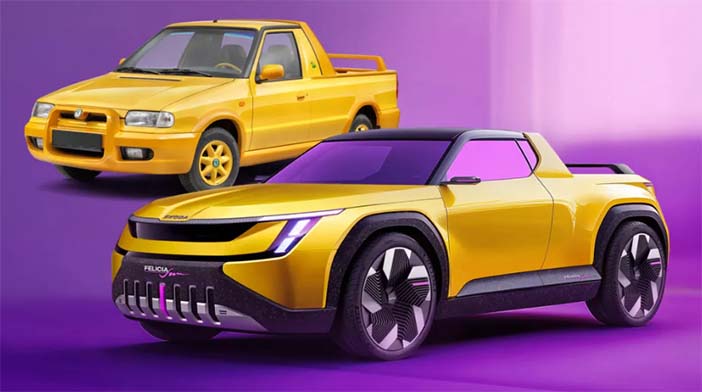
+++ SKODA might be focused on shaping the future of the Octavia, but that hasn’t stopped its designers from indulging in a few creative side quests. One of those is a fresh, modern take on a quirky classic. Julien Petitseigneur, an interior designer at the Czech brand, reimagined the Felicia Fun pickup from the 1990s, and the result feels too good to stay locked away in a digital drawer. The French designer started the project by experimenting with AI tools. He then developed the details by hand, infusing the concept with Skoda’s Modern Solid styling language. Despite utilizing the power of modern technology, Petitseigneur worked on the modern Felicia Fun for about two weeks, dedicating roughly three hours each evening after work. The finished concept is a sporty 2-door model with a small rear bed. Unlike the original that looked like a butchered up supermini, the concept has a wider stance, large alloy wheels, a long hood, and an aerodynamic roofline that gives it a more athletic silhouette. The front end is inspired by the 2022 Vision 7S concept, featuring slim LED headlights, a covered grille, and a skid plate. The profile has boxy wheel arches with a generous amount of plastic cladding contrasting with the yellow bodywork. The pink accents and the matching full-width taillights send a ’90s beach atmosphere vibe. The 2-seater cabin features a full-width digital cockpit with a frame that is reminiscent of old CRT monitors. Unfortunately, the concept doesn’t have the electric sliding partition of the original Felicia Fun that converted it into a four-seater by taking up space from the rear bed under a removable canvas roof. Skoda hasn’t provided any technical details for the concept, but judging by the design, it appears to have been envisioned as an electric vehicle. It wouldn’t be far-fetched to imagine it built on the VW Group’s MEB platform, potentially sharing components with the upcoming Epiq small crossover. The original Felicia Fun was a rare machine. Produced between 1997 and 2000, just 4,216 units rolled off the line. All came in yellow, with trim options including yellow, green, or orange bumpers, fenders, side skirts, and spoilers. As for a production version of this modern tribute? Don’t hold your breath. Still, Skoda’s CEO has hinted that if the core lineup performs well, the company could make space for a more niche, adventurous model down the line. +++
+++ The VOLKSWAGEN T-ROC R will return in 2027 with hybrid power, hot hatch performance and an aggressive design that sets it apart from the standard car. Volkswagen boss Thomas Schäfer confirmed the performance variant’s comeback as he unveiled the second edition of the Golf-based crossover, promising: “For all the petrolheads out there, we will bring a real powerful T-Roc R”. The range-topper will mark a renewed expansion of Volkswagen’s performance car line-up after the retirements of the hottest versions of the Tiguan, Arteon and Touareg left just the Golf to fly the R flag. Bosses would not be drawn on specifics of the upcoming T-Roc R’s powertrain, but the company has confirmed that the whole T-Roc line-up will be electrified. The most likely basis for the R derivative is the range-topping mild hybrid, due in 2026. Its 2.0-litre petrol engine and four-wheel drive make it a close mechanical match for the previous, pure-combustion T-Roc R. Details on power output and performance remain under wraps, but that 2.0-litre engine produced 300 hp in the old car, and its output has been ramped up as high as 333 hp in the latest Golf R. It is possible that the addition of a hybrid element could push the hot crossover even further. Autointernationaal.nl expects 340 hp. Its increased power will be signalled by a bespoke design treatment that emphasises its performance potential. Exterior design boss Stefan Wallburg told Autocar that it will look obviously different to the R-Line that will initially top the T-Roc range. “Our task is to create a strategy of making R and R-Line different, because R customers will expect a bit more than R-Line”, said Wallburg. +++