
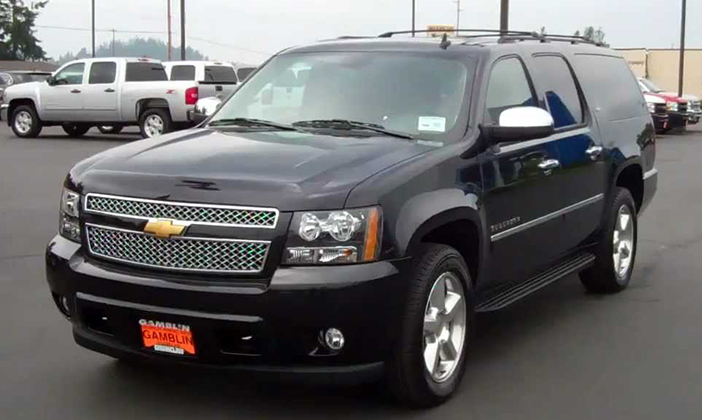
+++ The Federal Bureau of Investigation (FBI) has a bit of a public relations headache on its hands. Director Kash Patel has reportedly requested that a fleet of new armoured SUVs be ordered for his use, but instead of sticking with the American staple that is the CHEVROLET SUBURBAN , Patel reportedly requested BMW X5 Protection SUVs be ordered. These armoured luxury SUVs are produced at the German automaker’s Spartanburg Plant in South Carolina and they were selected to be “less conspicuous”. I’ll get to that in a moment, but it’s not the only reason that was given to explain the unexpected decision. FBI spokesperson Ben Williamson confirmed that the BMWs were ordered by the bureau for the director’s use and said that these were more cost-effective than other armoured vehicles that were considered. “Government agencies, including the FBI, routinely evaluate, replace and update vehicle fleets based on usage, security needs or budgetary decisions”, said Williamson. “The specific decisions were evaluated partly as a way to save taxpayers millions by picking cheaper selections or making cost structures more efficient”. The government-spec Chevrolet Suburban Shield from GM Defense can cost from $600,000 to as much as $3.6 million, while the cost of an equivalent BMW is unknown. However, the X5 Protection costs between $200,000 and $300,000. According to an insider, a new Suburban would have cost $480,000, and this was more than double what each BMW in the fleet cost. If that’s accurate, it seems that Director Patel will be riding around in a Protection-rated X5. As for the suggestion that the BMWs are less conspicuous, one might argue that it’s well-known that government agencies use vehicles like the Chevrolet Suburban for transporting officials, and it’s less common knowledge that the government has a contract with BMW for the X5 that the State Department uses to protect diplomats and other officials in high-risk environments worldwide. Therefore, perhaps the implication is that Patel using X5s is a way of sneaking under the radar, though that’s less likely given how much publicity the purchase is attracting. Either way, there’s no doubt that you’re more likely to encounter a Chevrolet in most of America than a BMW. America first saw the Suburban in 1935’s Carryall Suburban (later bearing a GMC badge), which was developed with encouragement from the U.S. Army, and now, in its 12th generation, it’s the longest-lasting moniker in American history. +++
+++ CHINA has completed the formulation and revision of 294 national standards across 13 key sectors, with electric-vehicle power-battery safety requirements formally upgraded to mandatory status for the first time, according to information released by the State Administration for Market Regulation. The standards were issued under an action plan jointly released by seven government departments and have now been approved, published, and set to take effect. The completed standards form part of the Action Plan to Promote Equipment Renewal and Consumer Goods Trade-In Through Standards, which aims to guide industrial upgrading and consumption renewal through regulatory standardization. According to official information, the newly released standards focus on three areas: upgrading energy efficiency and emissions standards, strengthening product quality and safety requirements, and expanding standards for recycling and circular utilization. In the area of energy efficiency and emissions, authorities oversaw the formulation and revision of national standards for key industries, including coal-fired power generation, steel, and building materials. A total of 113 national standards were approved and released, including updated mandatory energy consumption limits intended to support the phase-out of outdated production capacity. These standards also tighten efficiency requirements for commonly used industrial equipment, including boilers, electric motors, and transformers. A separate group of 115 national standards targets sectors closely aligned with everyday consumer demand, including automobiles, home appliances, home furnishings, and emerging consumer products. Within this category, electric vehicle power battery safety standards were revised to require that batteries not catch fire or explode, marking the first time such criteria have been explicitly defined as mandatory technical requirements at the national level. Liu Hongsheng, director of the Standards Technology Department at the State Administration for Market Regulation, said that the electric vehicle power battery safety standards represent a breakthrough in safety regulation. He stated that the mandate will require automakers to optimize battery structures and thermal management systems to improve the overall safety of new energy vehicles. According to a recent summary from GDESTL, the revised national standard GB 38031-2025 is scheduled to take effect on July 1, 2026. The summary states that new type approvals will be subject to the updated requirements from that date. In contrast, vehicles that have already received approval under previous standards are expected to follow differentiated transition arrangements, commonly extending to July 1, 2027. In addition to safety and efficiency standards, authorities approved and published 66 national standards on resource recycling and circular utilization. These standards cover key stages of the recycling, dismantling, and regeneration of used products, including home appliances, furniture, electronic devices, photovoltaic equipment, wind power equipment, and power batteries. +++
+++ It’s been a tough year for automakers in the United States, from the loss of federal tax credits causing a greater slump in EV sales to the challenge of tariffs raising prices for everything else, and FORD will be especially happy to see the back of 2025 after achieving the worst recall record in American automotive history; something it managed within the first 6 months of the year. At the time, it had amassed 89 recalls, and now, at the tail end of December, it’s surpassed 150 recalls after five new issues were lodged with the National Highway Traffic Safety Administration in a single day, taking its tally to 152. So far… The first recall concerns 87 examples of the 2022-2024 Maverick Hybrid and 2020 Escape Hybrid, whose powertrain control module software may shift the vehicles into neutral unexpectedly, causing a loss of drive power. The automaker has also been forced to recall 6.897 2025-2026 Maverick pickups over an instrument panel cover that may separate when the airbag deploys, and it’s recalled just 2 examples of the 2022 Transit for a rear view camera that may not work; an issue that has prompted the company to launch a secret owner retention program. Almost comically, 35 examples of the 2021-2022 Bronco were recalled after a previous recall failed to address a problem in which the rear view camera would continue to display after the driver had completed a reversing maneuver. The biggest recall on the day impacts 45.047 Mustang Mach-E cars. Their light driver control modules may fail, preventing the entire headlight assembly from working. That means no turn signals, daytime running lights, low-beam headlights, or high-beam headlights. Ford has been struck with numerous quality issues this year, from pickups and EVs that could roll away and faulty seatbelt retractor bolts to fuel injectors that could cause a fire and trim pieces that could fly off of tailgates. With the abovementioned Mustang Mach-E headlight problem, the automaker has now reached 152 recalls for the year, and we still have a week before 2025 comes to a close. If it gets just 2 more, it’ll have doubled GM’s previous record for the most recalls in a single calendar year (77). Ford is aware of its quality shortcomings and is implementing various changes to its quality control processes in a bid to make better vehicles, but don’t expect a miraculous turn of events in 2026. 3 years ago, Ford CEO Jim Farley said that it would take “several years” to improve overall quality, and many of the recent recalls we’ve covered have affected brand-new 2026 models. +++
+++ GENERAL MOTORS is spending a boatload of money on a 6th-generation small-block V8 engine. That new motor will power an assortment of vehicles, including the Chevrolet Corvette. It should also come in two sizes, which means the company’s iconic sports car could get an even larger engine. The 6th generation LS6 engine will have 6.7 liters of displacement. That new engine will likely upcoming 2027 Corvette Grand Sport. Previous rumours suggested GM would use the smaller engine, a new 5.7-liter unit, in vehicles like the Chevrolet Silverado 1500. The larger engine will allegedly power the Corvette, which GM will tune for power and performance. We’ll also likely see the 6.7-liter V-8 power a future version of the Cadillac CT5. The CT5-V Blackwing is a performance monster that could use a bigger engine and more power. GM introduced the fifth-generation small-block V8 in 2013. The 6th-generation engine will start arriving in GM’s full-size pickups beginning in 2027 before rolling out to other models. In 2023, GM announced that it would invest $579 million at its Flint Engine Operations to build the 6th-gen V8, and earlier this year, the company invested even more money. GM is promising that the new engines will provide more power than the current line-up. The current 5.3-liter V8 makes 355 horsepower. The larger 6.2-liter engine produces 420 hp, with the supercharged version making as much as 682 hp. The increase in power won’t hurt efficiency, either, according to the automaker. It’s also unclear if GM will pair the engine with any form of electrification. While the automaker is pulling back from some of its electric vehicle efforts, hybrids are only growing in popularity, and we expect some vehicles will feature electric assistance. +++
+++ HYUNDAI MOTOR GROUP executive Chair Chung Euisun visited the company’s autonomous driving subsidiary 42dot; a move seen as reaffirming the commitment to the advanced technology amid a leadership vacuum. According to industry sources, Chung test-rode an autonomous Ioniq 6 in the Pangyo area, where 42dot’s headquarters is located. The vehicle featured the unit’s end-to-end autonomous driving system that uses a single AI model to translate raw sensor data directly into driving actions; a core pillar of the group’s self-driving strategy. Following the test drive, Chung was said to have praised 42dot’s development progress and pledged continued support for its autonomous driving and software-defined vehicle initiatives. Chung’s visit marked the first on-site inspection by top group leadership since former 42dot CEO Song Chang-hyun stepped down. Song was a key figure in driving the group’s self-driving ambitions, having been acquired by Hyundai in 2022. Industry watchers interpret the move as more than a routine subsidiary review, believing it signals Hyundai’s intent to push ahead with its autonomous driving roadmap and dispel concerns about falling behind rivals, including Tesla and Waymo, in the self-driving race. At Kia’s 80th anniversary event held earlier this month in Yongin, Gyeonggi Province, Chung acknowledged such concerns: “Although Motional (the company’s self-driving joint venture in the US) is making strong progress, we are still somewhat behind, while Chinese companies and Tesla are moving quickly. But closing that gap is less important than ensuring safety, which will remain our top priority”. Under Chung’s leadership, the group is also accelerating investment in autonomous driving. Last month, Hyundai pledged to invest 50.5 trillion won ($35 billion) in Korea between 2026 and 2030 across new growth areas, including AI-based self-driving technologies. The group is developing its autonomous driving technology around an in-house E2E deep-learning platform known as “Atria AI”, led by 42dot and Motional, while separately leveraging Nvidia’s physical AI infrastructure for more advanced computing and simulation. At the 2025 APEC summit in Gyeongju, Hyundai announced plans to build an AI factory in Korea powered by 50.000 Nvidia Blackwell GPUs to support autonomous driving and other advanced technologies. “Chung’s visit signals a strong message that Hyundai will not allow setbacks on its self-driving roadmap anymore”, said Kim Pil-su, a car engineering professor at Daelim University. “The new 42dot CEO will have a lot on their plate, but the most pressing task will be balancing technological innovation with real-world commercialization to close the gap with rivals”. +++
+++ PLUG-IN HYBRID A plug-in hybrid vehicle (PHEV) offers several advantages, including lower fuel costs and reduced emissions, without requiring buyers to make a full transition to an all-electric vehicle. However, apart from their apparent non-eco-friendliness, PHEVs experience roughly 80 percent more problems than their purely internal-combustion counterparts, according to Consumer Reports (CR). This figure raises questions about the technology’s long-term reliability and reputation. In its latest annual survey (based on responses from the owners of about 380.000 vehicles from the 2000 through 2025 model years, and a few early 2026 models) CR breaks down which PHEV models across various segments contributed most to that disparity, offering buyers more detailed insight as they consider their next vehicle purchase. The Ford Escape PHEV ranks as the least reliable among compact SUVs, a segment that also includes the Toyota RAV4 Prime and the Mitsubishi Outlander PHEV. Owners participating in the survey cited a wide range of issues specific to the Escape PHEV, including EV battery replacement, battery cooling, EV charging, and electric accessories. In addition to PHEV-related concerns, respondents also reported non-electrification-related problems involving the steering and suspension, as well as the climate control system. Stellantis appears multiple times on the list, starting with the Jeep Wrangler and Grand Cherokee using the 4xe, the automaker’s plug-in hybrid technology paired with a 4×4 drivetrain. All reported issues were tied directly to the 4xe system, including problems with the hybrid system itself, EV battery stalling, and the electric motor. One owner claimed their vehicle was “bricked for nearly 6 months”, while another reported making 8 dealer visits to address recurring hybrid-related failures. Regulators have also taken notice. NHTSA has been involved in multiple 4xe actions, including a recall tied to loss of drive power issued earlier this year. Separately, the non-4xe Grand Cherokee was also cited in Consumer Reports’ latest survey of the most unreliable SUVs. At the larger end of the spectrum, the Mazda CX-80/CX-90 PHEV reportedly ranks as the least reliable among full-size SUVs. This finding mirrors CR’s 2026 Reliability Brand Rankings, in which Mazda dropped from the top 10 to 14th overall. The CX-80/CX-90 PHEV was flagged for a long list of problems, including issues with the EV battery, electric motor, and engine electrical system. Owners also reported faults involving the transmission (both major and minor), drivetrain and fuel system, climate controls, steering and suspension, brakes, electric accessories, body hardware, in-car electronics, noises/leaks, and paint and trim quality. One owner summarized their experience by saying their CX-90 PHEV suffered a “hybrid malfunction that causes the car to seize. It will not start, go into gear, or charge”. In the luxury segment, the Volvo XC60 PHEV earns similarly unwanted recognition. The report cites issues affecting electrical accessories, the climate system, the drivetrain, the electric motor, and the EV battery. One owner noted that after just a month of ownership, their XC60 PHEV “would not go over 40 kph and went into snail mode”; a term commonly used to describe limp mode, where power output is reduced to prevent further damage. Another Stellantis model is the Chrysler Pacifica PHEV, though, to be fair, it remains the only minivan with a plug-in hybrid powertrain currently sold in the U.S. For context, the Toyota Sienna and Kia Carnival are offered only as conventional hybrids. At the same time, the Honda Odyssey remains purely internal combustion, despite its Japan-market counterpart using a dual-motor hybrid setup similar to that found in the Civic and Accord. Pacifica PHEV owners reported issues involving the transmission, engine, in-car electronics, electric accessories, EV charging, and EV battery cooling. With automakers like Volvo now scaling back earlier all-electric timelines, this report suggests there is still considerable work to be done to ensure that multi-powertrain strategies (particularly those involving PHEVs) can deliver the reliability consumers expect. +++
+++ TOYOTA has set a global production target of more than 10 million units for 2026, including its Lexus brand, according to sources. By maintaining levels near the 2023 record of 10.03 million units, the automaker aims to satisfy consistent demand for hybrid models across the U.S. and European markets, they said. Toyota plans to set domestic production at about 3.5 million units and has been shared the plan with some suppliers. While it had been suggested that production in the United States might increase due to the impact of U.S. tariff policies, Toyota’s domestic output is now expected to exceed 3 million units for the 4th consecutive year; a level considered necessary to maintain domestic employment and preserve technical expertise. After hitting a low of 7.9 million units in 2020 amid the Covid-19 crisis, Toyota’s global output has managed to recover. For 2025, the automaker projects another year of exceeding 10 million units. +++