+++ Better late than never, AUDI is about to enter the full-size luxury SUV segment. From the Range Rover and BMW X7 to the Cadillac Escalade and Mercedes GLS, essentially all major competitors already have products in this class. Some 20 years after arch rival Mercedes launched the GL-Class, the Q9 will break cover in 2026 as Ingolstadt’s belated flagship SUV. As you can imagine, especially dealers in the United States are eager to get their hands on the Q9, Audi’s first luxo barge with a proper third row. Audi National Dealer Council chairman Tom McCollum is hyped about the upcoming product, calling it the “soccer mom vehicle that we’ve been unable to offer”. There will be far more space than in the Q7, as the upcoming range-topping SUV will be significantly larger. For reference, the outgoing Q7 measures 5,05 meter in length, while its replacement, also arriving this year, is expected to grow to 5,3 meter, roughly on par with a Rolls-Royce Cullinan or the long-wheelbase Bentley Bentayga. Audi remains tight-lipped about the first-ever Q9, but the dealers’ representative said it will feature captain’s chairs and a walk-through second row. McCollum added that the supersized SUV is expected to lure buyers who have so far opted for the Chevrolet Tahoe or Suburban due to their superior space compared to the Q7. “The Q9 is going to resolve that issue for us. Every Audi dealer will tell you: It cannot get here soon enough”. Audi certainly needs fresh metal in the United States, given the company’s poor sales results in 2025. Deliveries fell by a worrying 16 percent to 164.942 units, partly due to demand for the aging Q7 dropping by 12 percent to 20.894 vehicles. Launching an all-new Q7 alongside a larger Q9 should help rejuvenate sales. However, while both models are set to break cover later this year, any positive impact on deliveries is unlikely to be felt until 2027. You might think the market for full-size luxury SUVs is already saturated, but Audi believes there’s still room for the Q9. Complaints about the Q7’s cramped third-row seating have been heard and are set to be addressed by the upcoming range-topping SUV. It remains to be seen whether the next Q7 will retain a third-row option or if Audi will try to push buyers toward the Q9 instead. It’s also too soon to say whether, beyond the individual second-row seats, the Q9 will offer a bench that can accommodate 3 passengers. +++
+++ BMW is working on a new 4 Series to serve as a more style-focused and dynamic alternative to the bold Neue Klasse 3 Series, and it’s set once again to spawn a potent M4 coupé. The 4 Series was launched in 2013 as a more rakish take on the stalwart 3 Series, with the option of 2-door coupé and convertible body styles as well as a 5-door fastback called the Gran Coupé. It entered its second generation in 2020 and went on to provide the basis for the i4, which is essentially today’s electric alternative to the 3 Series. It has consistently been a strong seller for BMW, albeit with an inherently more niche market position than its more mainstream saloon/estate sibling. But the future of the model line had been unclear, given the 3 Series on which it is based is about to enter a new generation, gaining a pure-EV option that weakens the i4’s business case. However, Joachim Post, who oversees the engineering and development of all new BMW models, told that there is a place for the more rakish derivative in the forthcoming Neue Klasse line-up. “The 4 Series is an important car for us. It’s more sporty, and BMW is a sporty brand which has a clear heritage also on the performance side. It will play an important role also for the future”, he said. Post’s comments are the first indication BMW has given of plans for a third-generation 4 Series, and with test mules yet to break cover, it is unclear whether the company would seek to offer the same variety of body styles as today. However, bosses in Munich could have spotted a sizeable commercial opportunity created by the gradual exodus of rival firms from the coupé and fastback segments. Even if different-shaped derivatives are not as popular or profitable as the mainstream model on which they are based, BMW’s Joachim Post said it is relatively easy to sign off the business case because of the vastly reduced development costs they incur. “It’s not as expensive as making a completely new car and whenever we make a 3 Series or X3, we still think about the 4 Series or X4, to make it with synergies so that a derivative can be easily built out of the base”, he said. Indeed, BMW is just months away from unveiling a new-generation X4, spotted in prototype guise recently and expected to have ICE and EV powertrains shared with the X3 and iX3, and Post said the larger X6 is likely to make a comeback in the same vein. He said: “Coming to the X4, for example, and X6 is the same, they will play important roles in the future. That’s why we make cars with huge synergies: from X4 to X3, X6 to X5, X2 to X1. They are cars which with low effort can be made, which are high synergy and which are an additional opportunity for customers who like the proportions of cars that are a little bit more sporty, more dynamic”. The 4 Series’ long-time Audi A5 rival, for example, is no more, having given its name to what was previously the A4, and Mercedes has halved its 2-door cruiser offering, combining the short-wheelbase C-Class and E-Class derivatives into one new mid-sized model, the CLE. Either way, the suggestion that the 4 Series will follow onto the Neue Klasse architecture implies that it will likewise continue to offer a spread of pure-electric and combustion powertrains, with the next-generation ‘i4’ twinned with the upcoming i3 underneath. That means a range of updated (and Euro 7-compliant) petrol engines in the 4 Series and an EV with a choice of rear- or dual-motor powertrains and a 108 kWh battery that is likely to offer an official range of more than 800 km. It also paves the way for the return of the M4, suggested Post. “These derivatives are very often the base for the sports cars”, he said, hinting at a third outing for the performance coupé. BMW has already strongly suggested the next iteration of the M3 will be available as either a mega-powered, quad-motor EV with advanced torque vectoring or a more traditional petrol option with an updated version of its venerable ‘S58′ straight-6 engine. Post doubled down on this possibility, emphasising that BMW has a “bigger advantage in comparison to a few others” because it has engineered its next generation of ICE powertrains to be compliant with upcoming European emissions rules. “We can fulfil Euro 7 with some optimisation in the exhaust system, with things like the catalysts, so that’s why we have a big advantage in that Euro 7 is not that high an investment for us”, he said, confirming that even the 6.0-litre V12 used by BMW-owned Rolls-Royce could continue. Post stopped short of confirming exactly which engine could be used in the next M4 and M3 but he did confirm that there will be 4-, 6-, 8- and 12-cylinder engines in BMW’s next line-up. +++
+++ DS is exploring a radical new body style for the future DS No. 4, with the brand’s CEO throwing down the gauntlet to his design director and product boss to innovate. “My team is starting a very ambitious project at the moment”, DS head of design Thierry Metroz told during an exclusive chat at the Brussels Motor Show. “We are looking to create something new to replace the No. 4, something very ambitious in terms of silhouette and design approach”. The recently facelifted No. 4 has a conventional hatchback form, with a touch of crossover due to more ground clearance than a VW Golf. But the next-generation No.4 is shaping up to be much more radical, moving car silhouettes on from the SUV or sedan crossovers of recent years, vows Metroz. Work is at an early stage, with the DS design team having just completed the initial sketch work and moving into the 3D-modeling phase. His thoughts so far? “It’s wow! Very exciting, very promising for the future. Something is coming”. The dream is to create a breakthrough smash, in the way the Renault Scenic invented the compact MPV in 1997 or the Nissan Qashqai established the mid-size crossover template in 2006. The trouble is mould-breakers don’t always translate into commercial success, as the Citroen C5 X (a recent mash-up of a saloon, estate and SUV) demonstrated. The ambition stems from recently appointed CEO Xavier Peugeot, who wants to unleash the innovation that created the original DS (1955) with its alien form, hydro-pneumatic suspension, disc brakes and swivelling headlamps. “I think we should also probably invent some new segments if we can”, he told a handful of media last autumn. Advanced design teams across the industry are looking for the next big thing, or even better, the next smaller thing, given that manufacturers’ shift to boxier SUVs has impacted car efficiency, while length, width and weight have increased dramatically over the years. The unconventional silhouette of the flagship DS No. 8 may give some clues to the future DS No. 4. Metroz and his team lowered that coupe-SUV’s roof and bonnet height to improve efficiency, a core DS principle. “With DS, we would like to be the most efficient of all the Stellantis brands”, explained Metroz. “That means aerodynamic efficiency to have better range in the electric version, but also in the way we develop cars using less components. This requires less raw materials, is more sustainable and makes the car lighter to improve efficiency. We are starting this project with this vision for the future. It’s an incredible external and interior design”, he promised. Metroz will be working alongside DS product director Audrey Amar. She believes the constraints of the past that defined cars, such as length, wheel size and overall form, are breaking down. “This is the beginning of a new segmentation”, she explained. “When you look at the DS No.8, what is it: a sedan, a crossover? We named it a D-cross. For years we have been mixing the different codes of the different segments to create new concepts”. She believes all that matters is that a car looks appealing to customers and meets the expectations of their use case. “That’s the important question”, she stressed. We’ll have to wait until the end of the decade to see how Metroz, Peugeot’s and Amar’s ambitions translates into a finished car. But, based on their philosophy and determination, it’s a tantalising prospect, worthy of DS. +++
+++ FIAT boss Olivier François said he would “happily” limit the top speed of his company’s city cars to 120 kph, as an alternative to fitting them with costly safety technology that he considers unnecessary for low-speed driving. He said that most of the ADAS technology that is mandated by current EU regulations is designed to improve safety at higher speeds so has little relevance for cars like the 500, Panda and Grande Panda, which are mainly driven around town. Fitting this equipment is therefore unnecessarily hiking up the price of such models for little benefit to the consumer, and François thinks capping their top speed could be a more cost-effective answer. It wouldn’t be a particularly severe limit in relative terms, because none of those models is officially capable of cracking 160 kph, and the Grande Panda EV is restricted to 130 kph. François welcomed the EU’s proposals for a new ‘M1E’ category for small cars, because it demonstrates a recognition that the unilaterally imposed safety rules aren’t appropriate in all segments. “We fundamentally think that with all these rules, the most unsustainable portion lies in the city cars and urban driving, because all these cars are small, democratic and inexpensive, bought by younger people and so on for the daily commute in a city”, said François. “They are driven at way slower speeds. It’s not the same usage. I have a hard time understanding why we need to install all this super-expensive hardware: sensors, cameras, road sign recognition. All this is a little bit inadequate, a bit crazy, and has contributed to raising the average price of a city car by 60% over the last 5 or 6 years. I don’t think that city cars in 2018 or 2019 were extremely dangerous. Our proposal was literally to say ‘let’s go a little bit backward from overloading cars with expensive hardware’ “. For this reason, François said, Fiat “could consider lowering the maximum speed” of some of its cars. “If you take the average legal maximum speed in Europe, it’s 120 kph, so above 120 kph is often illegal, and most of the radars, ADAS and all this stuff has been developed for cars to go way above the speed limit. “I would happily limit my city cars, my smaller cars, to what is today the maximum legal speed limit. It’s already a limitation. There is something weird that I need to over-spec my cars to go above the legal speed limit”. If Fiat were to impose a blanket speed restriction across its line-up, it would be following in the footsteps of Volvo, which in 2020 capped all of its models at 180 kph as part of a push to reduce fatal accidents in its cars to zero. +++
+++ The JENSEN Interceptor is to be reborn as a new British-built, V8-powered GT, 50 years after production of the iconic original ended. It has been created by Banbury-based Jensen International Automotive (JIA), the engineering firm that specialises in restoring and modernising Interceptors, creating restomods such as the Interceptor R. This new muscle car is JIA’s first clean-sheet design and creation and will arrive next year. It will be hand-built in “ultra-low” numbers and therefore probably command a very high price. It’s claimed to be an “ultra-high-performance”, luxury proposition that will offer a fully analogue driving experience. This suggests that it will use a manual gearbox and the cabin will be flooded with physical controls and switches, similar to the original 1960s Interceptor. While further details have yet to be revealed, the new car will be powered by the engine from the latest Chevrolet Corvette. The Corvette’s 6.2-litre V8 puts out 507 hp and 600 Nm of torque as standard, but JIA said its new car’s powertrain will be “bespoke”. The original Interceptor used a 6.3-litre big-block Chrysler V8, giving it more than 250 hp and a top speed of nearly 225 kph. The as-yet-unnamed JIA GT will sit on a lightweight aluminium chassis, likely as part of an effort to give it the highest power-to-weight ratio possible. While its design has yet to be revealed, the first official picture confirms that it will follow a similar philosophy to the original, with a long bonnet, raked roofline and a low-slung stance. Director David Duerden said JIA is “taking the theme of the luxury British GT to fresh, thoroughly modern heights” with a car that “will stand proudly as a completely all-new car in its own right”. A release date has yet to be confirmed but, given that JIA is keen to highlight the car’s British roots, a debut at the Goodwood Festival of Speed in July seems plausible. +++
+++ KIA will “continue to study” opportunities in the city car market, its European marketing chief has told, suggesting that an EV1 could join the petrol Picanto. The Korean firm’s president and CEO, Ho Sung Song, confirmed last year that “homework” for a sub-€25,000 electric city car was ongoing. That new model is tipped to arrive before the end of the decade and would rival the likes of the forthcoming Renault Twingo and Volkswagen ID.Up. Kia has just unveiled the EV2 crossover at the Brussels motor show, a model that will be sold only in Europe, due to its small size, and the same would probably be true of the EV1. The pair would play a key role in helping Kia to meet its ambitious planned sales growth in Europe. Asked at the unveiling of the EV2 about plans for an EV1, European marketing boss David Hilbert said: “The whole industry is looking at how they make EVs more accessible. Of course we’re doing that as well. We will continue to look at where the opportunities are and, obviously, it’s called EV2 for a reason”. Hilbert added that the EV2 was designed largely with an urban focus but its near-480 km range means it “can go beyond just being a city car. Longer-term, we continue to study the A-segment. The Picanto is still an important model for us, and we continue to have a very important sales volume from that”. Notably, the EU is currently developing a new ‘E-car’ category for affordable small EVs made in the region. That could benefit both the EV2, which is built in Slovakia, and any future EV1. Alex Papapetropoulos, Kia Europe’s planning boss, said that the firm was “looking very closely at what the EU was doing”. Further details on the E-cars regulations are tipped to be released later this month, but Papapetropolous said: “I’m not worried, because we have in our product plan the toolkit that allows us to adjust and adapt to whatever is going to be announced”. +++
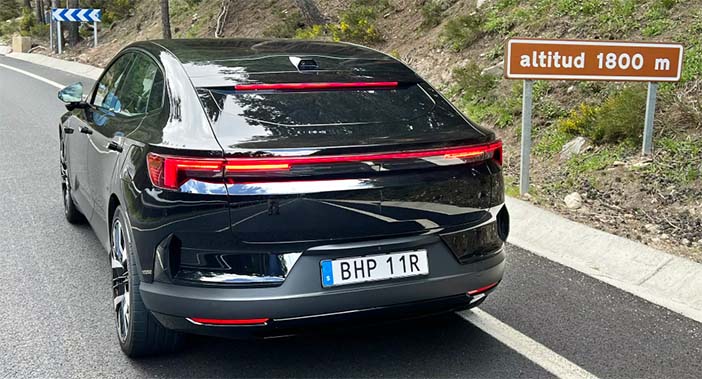
+++ Designing a car without a REAR WINDOW might sound crazy at first, but it’s actually becoming more realistic than you’d expect. Thanks to better rear view cameras and bigger, sharper displays inside the cabin, something that once felt impossible is now totally viable: ditching the rear glass altogether. The Polestar 4 is the first production car to fully commit to this idea, but it’s far from alone. Concept cars from Jaguar and Audi (and even a few ultra-rare Ferraris) show that this isn’t a one-off experiment. Rear windows may genuinely be on their way out. And the reasons behind this shift are a lot more interesting (and technical) than they seem at first glance. The Polestar 4 is the first production car to completely eliminate the rear window. There’s no glass, no hidden opening – just a solid rear section. Instead, Polestar relies on a wide-angle HD camera that feeds a live image to the digital rear view mirror. It’s a bold move, but one driven by practicality rather than shock value. Without a rear window, designers can stretch the roofline, improve aerodynamics, and create more headroom for rear passengers. The fastback shape looks cleaner, sure, but it also improves visibility. The camera isn’t blocked by passengers, headrests, rain, or the body shape itself, meaning the view out back is actually clearer than before. Jaguar’s Type 00 concept, unveiled in 2024, caused plenty of debate (and for good reason). It’s a great example of how removing the rear window can dramatically change a car’s look, especially something sporty. The rear is fully enclosed, with horizontal design elements built into the lower section of the tail. This isn’t about pure function: it’s a design statement. The roof flows cleanly into the rear with no visual break, and cameras handle all rearward visibility, just like in the Polestar. The Type 00 shows what’s possible when designers remove a rule that’s been around for over a century. Whether Jaguar carries these ideas into production cars is still an open question. Audi’s Concept C takes a slightly different approach. Instead of a traditional rear window, it uses 3 narrow horizontal slots. There’s no large glass surface at all: the goal is a smoother, more aerodynamic rear end, with cameras doing the work instead. It hints at where Audi could be heading and fits nicely with the brand’s long-standing focus on aerodynamics and clean design. How much of it reaches production remains to be seen. Ferrari, unsurprisingly, goes even further. The 812 Competizione removes the rear glass entirely, replacing it with a solid aluminium panel complete with vortex generators to manage airflow and boost downforce. There’s zero transparency – just performance-focused design and camera-based visibility. The same thinking applies to Ferrari’s one-off SP38 and SP48 Unica models, where the rear ends are treated as sculpted, uninterrupted surfaces shaped entirely by aerodynamics. Even the newer 12Cilindri follows this trend. While it technically still has rear glass, it’s almost swallowed by the design – used more as a visual element than a window. This move away from rear windows isn’t just a futuristic gimmick. It’s the result of two technologies finally being good enough: external HD cameras and high-resolution interior displays. Once visibility no longer depends on glass, designers are free to rethink the entire rear of the car. The benefits are obvious: better aerodynamics, more design freedom, fewer structural compromises, and no fragile glass panel at the back. The Polestar 4 kicked the door open, while Jaguar, Audi, and Ferrari are all exploring the idea in their own ways. What a rear-window-free future actually looks like is still up in the air, but it’s clearly closer than we thought. +++