
+++ BYD reported January 2026 new energy vehicle sales of 210.051 units, with passenger vehicle sales reaching 205.518 units and exports totalling 100.482 units, according to figures released on February 1. The data show a significant sequential decline at the start of the year and quantify the share of overseas deliveries in total sales. Passenger vehicles accounted for most of BYD’s January volume, while commercial new energy vehicle sales reached 4.533 units. Exports accounted for nearly half of total monthly sales, indicating a measurable gap between domestic and overseas delivery volumes during the period. The January decline occurred within a seasonal cycle affecting China’s automotive industry. Manufacturer disclosures and industry data released in early 2026 show that multiple automakers recorded month-on-month fluctuations in January, reflecting changes in production schedules, logistics activity and consumer purchasing patterns associated with the Lunar New Year period. China’s new energy vehicle market in early 2026 also showed intensified competition. Industry data indicates that manufacturers adjusted pricing and product positioning at the beginning of the year, while demand varied across segments. Delivery trends varied across brands and model line-ups, reflecting uneven market performance in the passenger new energy vehicle sector. Chinese customs and industry statistics released in 2026 show that overseas shipments accounted for a growing share of output among major domestic automakers. BYD’s January export volume exceeded 100.000 units, while domestic deliveries declined sequentially, illustrating differing momentum between international and domestic markets during the month. Industry data released in early 2026 indicates that new energy vehicle sales are expected to remain volatile in the first quarter, driven by seasonal factors and shifting demand. Automaker disclosures show that production and sales typically normalize after the Lunar New Year period, as logistics operations and dealership activity return to normal levels. Chinese automotive data platforms reported elevated inventory levels among several manufacturers entering 2026, suggesting that near-term sales performance will be affected by inventory adjustments and dealer activity. Industry reports also indicate that price competition among new energy vehicle brands continued into early 2026, influencing market conditions across multiple segments. In January 2026, BYD recorded the highest new energy vehicle sales volume among automakers in China, with passenger vehicles and exports accounting for most of its monthly deliveries. +++
+++ CHINA ’s passenger car market recorded a significant decline in internal combustion engine vehicle sales over the past 6 years, with total annual volume falling from 17.8 million units in 2020 to 10.85 million units in 2025. The change coincided with the penetration of new energy vehicles (i.e. plug-in hybrid cars and electric models), which reached 59 percent by December 2025, thereby reshaping demand across major market segments. The contraction in internal combustion engine vehicle sales represents a reduction of approximately 7 million units over 6 years, equivalent to a decline of about 39 percent. This shift occurred alongside broader changes in consumer purchasing behaviour and accelerating adoption of electrified powertrains in China’s passenger car market. Among the top-10 internal combustion engine models by sales in 2025, joint-venture brands accounted for the majority of positions from ranks 6 through 10. The Volkswagen Magotan recorded sales of 202.000 units, representing a year-on-year increase of 15.6 percent. Volkswagen Tiguan L sold approx. 200.000 units, with year-on-year growth of 18.9 percent, while Toyota RAV4 sold 200.000 units, with year-on-year growth of 5.6 percent. Toyota Camry achieved nearly 210.000 units in sales with year-on-year growth of 32 percent, and Volkswagen Passat recorded close to 230.000 units with a year-on-year decline of 7.7 percent. Chinese brands accounted for 2 positions in the top-5 rankings. The Geely Xingyue L recorded sales of 240.000 units; a 11 percent year-on-year increase. Geely Boyue recorded sales of 230.000 units with a year-on-year increase of 148 percent, representing the highest growth rate among the top-ranked internal combustion engine models. The top-3 internal combustion engine models in 2025 were the Volkswagen Sagitar, the Volkswagen Lavida and the Nissan Sylphy. The Sagitar recorded sales of 256.000 units, the Lavida 270,000 units with a year-on-year decline of 16.2 percent and the Nissan Sylphy recorded sales of 320,000 units with a year-on-year decline of 6.5 percent. Historical comparisons indicate that several leading internal combustion engine models experienced substantial long-term declines in sales volumes. Nissan Sylphy fell from a peak of 538.000 units in 2020 to 320.000 units in 2025, while Volkswagen Lavida declined from nearly 500.000 units in 2019 to 270.000 units in 2025. The ranking shows that internal combustion engine vehicle sales leadership remained concentrated among established joint venture and domestic brands despite overall market contraction. +++
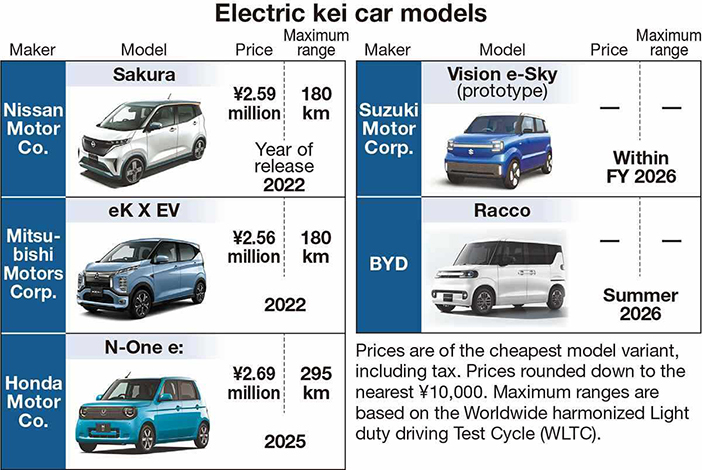
+++ Japanese and Chinese automakers are strengthening their line-ups of lightweight electric vehicles. Suzuki and BYD are scheduled to release new ELECTRIC KEI CARS by the end of fiscal 2026. A shortage of charging facilities, a perceived disadvantage of EVs, is less of an obstacle for electric kei cars, as they are typically used for shorter journeys. The impact of these kei cars on overall EV sales in Japan will be closely watched. At the Tokyo Auto Salon, a custom car exhibition held in Chiba in January, BYD announced that the maximum range of its Racco electric kei car, scheduled for release in Japan this summer, will be extended beyond 300 km. The ranges of popular electric kei cars currently sold in Japan are 180 km for Nissan’s Sakura and Mitsubishi ’s eK X EV, and 295 kilometers for Honda’s N-One e: . Though the price of the Racco has yet to be announced, it will likely be a strong rival for its Japanese counterparts. BYD also plans to release a model with a maximum range of over 200 kilometers. Thus, its line-up may be a powerhouse in Japan. Atsuki Tofukuji, president of BYD Auto Japan, said: “We will release vehicles reflecting BYD’s high-level technological capabilities and accelerate the expansion of our business in the Japanese market”. Suzuki, which topped the 2025 sales rankings for kei cars, plans to unveil a new electric model by the end of fiscal 2026. The company has showcased the Vision e-Sky, a prototype electric kei car, and said that its maximum range will be at least 270 kilometers. Toyota, Suzuki and Daihatsu are scheduled to release an electric kei van jointly developed by the 3 companies, under their respective names, by March. Sales of new kei cars in 2025 totalled 1.667.360 units, up 7% from the previous year. But that of electric kei cars fell 19% to around 20.000 units. Sales of the Honda N-One e:, first released in September, totaled about 5.000 by the end of December. But sales of the Nissan Sakura, first released in 2022, fell about 40% from the previous year to 14.093 units, pushing down the overall figure. The lack of recharging facilities, and thus the fear one’s battery running out, is a major hurdle for the spread of EVs. However, kei cars are usually used for short journeys for everyday purposes, such as shopping and commuting. Therefore, this particular issue has less impact on those driving electric kei cars. The central and local governments have also implemented measures such as subsidies for the purchase of electric kei cars, and thus automakers expect the market will continue to grow. Sanshiro Fukao, a research fellow at Itochu Research Institute. who is an expert in the auto-industry, said: “The number of petrol stations has been on the decline in regional areas, generating demand for electric kei cars. If reasonably priced models increase, it is possible that the consumer shift to EVs will accelerate”. +++
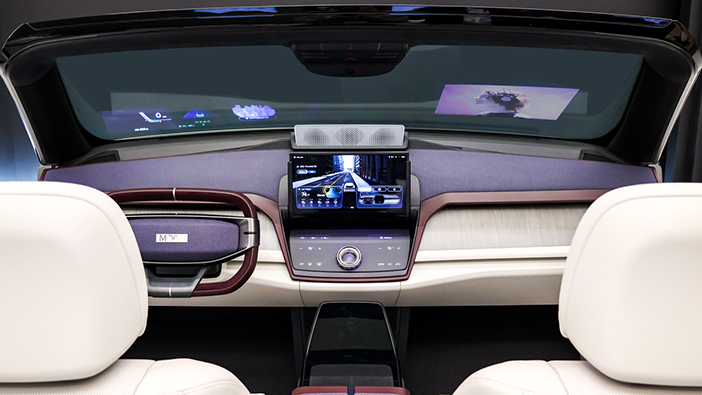
+++ HYUNDAI MOBIS says it has partnered with German optical system maker Zeiss, German adhesive tape maker Tesa, French automotive glass maker Saint-Gobain Sekurit to develop and produce a next-generation holographic windshield display by 2029. The 4-company alliance expands on the Korean auto parts-maker’s exclusive mobility partnership with Zeiss launched in 2024, aiming to commercialize the advanced technology. Under the contract, Hyundai Mobis will oversee system integration and the design and production of projectors. Zeiss will develop the holographic film to enhance clarity and readability, Tesa will handle mass production of the film, and Saint-Gobain Sekurit will bond the film to windshield glass. The end product will turn the windshield into a full-width display without a separate screen, allowing drivers to view information without taking their eyes off the road. Using holographic optical elements, a transparent film projects real-time information aligned with the driver’s and passengers’ lines of sight. The film is as transparent as glass, but the display can be up to twice as bright as outdoor led display boards, ensuring clear visibility even in bright sunlight. The alignment means passengers and drivers can be shown different things on the same display. Since the driver cannot see passenger-side content, it reduces distractions and helps helping protect passengers’ privacy, the company said. Hyundai Mobis noted that the alliance creates a unified supply chain covering display design, component production and assembly, enabling greater quality and reliability in mass production through both technological capability and proactive supply-chain management. “We will deliver our differentiated value to customers through core technologies that will shape the future of automotive displays,” said Jung Soo-kyung, executive vice president of Hyundai Mobis and head of its automotive electronics business unit. “By working closely with our global partners through to mass production, we aim to strengthen our technological competitiveness and reinforce our position as a leader in auto-innovation”. +++
+++ The HYUNDAI MOTOR GROUP is overhauling its overseas operations to prioritize future mobility technologies, while scaling back investments in conventional sales areas. Following last month’s CES tech fair, the carmaker is presenting itself not as a conventional automaker, but as a tech firm driving future mobility in the age of physical artificial intelligence (AI). The move is clear when looking at the company’s latest overseas business realignment. The group made headlines after deciding not to repurchase its factory in Russia, a move that officially ends its manufacturing presence in the country amid persistent geopolitical risks tied to the Russia-Ukraine war. In December 2023, the carmaker sold its 100 percent stake in the St. Petersburg plant to a Russian firm for just 140,000 won ($96), with a buyback option allowing Hyundai to repurchase the facility within two years. That option expired at the end of January. Hyundai and Kia were the top-selling carmakers in Russia together before the war broke out in 2021. Their combined market share reached 23.6 percent that year, but after the group suspended operations at the plant in March 2022, Chinese brands quickly gained ground in the market. According to data from the Korea Automobile and Mobility Association, Chinese carmakers held a 60.4 percent share of Russia’s car market in 2024. Industry officials said the move signals the automaker’s strategy to shift its overseas focus to emerging markets like India, instead of resuming sales in politically risky regions. “The Hyundai Motor Group appears to have shifted its focus into other rapidly growing markets with strong demand, rather than resuming its business there even in the face of toughening rivalry against Chinese counterparts and lingering geopolitical uncertainties”, an official from the industry said. Auto experts said the carmaker’s exit from Russia highlights its focus on emerging growth areas, including robotics and eco-friendly mobility. “As evidenced by the group’s series of recent announcements, the car maker is expanding its presence in next-generation growth areas, such as humanoid robots and hydrogen and electric vehicles, and the Russia business is far from such a future vision”, said Kim Pil-soo, a professor of automotive technology at Daelim University College. According to Kim, the carmaker’s exit from Russia remains debatable, since the market could serve as a stable revenue stream until profits from its future mobility ventures materialize. Hyundai Motor Group’s move to strengthen a hydrogen energy partnership with Canada also shows the firm’s strong commitment to boosting its presence in future mobility. Last week, the group’s Executive Chair Chung Euisun joined a government-led delegation to support Korean shipbuilders’ bid to win a high-profile patrol submarine deal from Canada. The Korean carmaker seeks to deepen its energy ties with Canada by utilizing the latter’s rich natural resources and building a co-prosperity model, particularly in hydrogen energy. +++
+++ The Stellantis-backed Chinese automaker LEAPMOTOR aims to break 1 million units in global sales in 2026, the company’s COO Xu Jun shared. It is 76% more than the brand’s worldwide deliveries in 2025. Leapmotor is a rapidly developing Chinese automaker that made headlines in late 2023 with Stellantis acquiring a 20% of its stake in the company for 1.5 billion euro. In December 2025, Chinese state-owned enterprise FAW acquired 5% equity in Leapmotor for around 3.74 billion yuan (530 million dollar). Last year, Leapmotor delivered 596.555 units worldwide, up 103% Y-O-Y. The brand’s current model line includes 9 vehicles: the Lafa 5 (B05) and T03 hatchbacks, the B01 and C01 sedans, and the A10 (B03X), the B10, the C10, the C11 and the C16 crossovers. This year, the automaker will also launch the D19 flagship SUV with an 80.3 kWh battery and the D99 luxury MPV. It seems that Leapmotor’s top managers expect to get a sales boost from the launches of new models and the broadening of international presence. The brand’s chief operating officer, Xu Jun, revealed the brand’s exact sales target for 2026 in his letter to colleagues dedicated to the Chinese New Year celebration. According to the letter, Leapmotor aims to sell 1.050.000 units in 2026; up 76% year-over-year. It is worth noting that Leapmotor delivered 32.059 cars in January 2026. It is 27.4% more than the same period last year. However, the brand’s monthly sales declined by 47%. Leapmotor Chief Operating Officer, Xu Jun, highlighted that the company will act in a “protective mode” this year, ensuring that each model achieves stable sales instead of creating blockbuster models. Other goals of the automaker are simplifying policies and increasing profits. Leapmotor holds a strong position in the Chinese car market, exploring overseas markets. It seems that the company learned from the mistakes of another domestic car manufacturer, Li Auto. The latter sold over 500.000 units in 2024, but made 2 strategically wrong decisions: to keep the focus on domestic sales and launch 2 electric models instead of arranging a major update to the current line. As a result, Li Auto sales slid to 400.000 units. The current Leapmotor strategy seems more promising. +++x
+++ SOUTH KOREA ’s electric vehicle exports to the United States plunged nearly 90 percent last year, hit by Washington’s auto tariffs and the rollback of subsidies under the administration of American president Donald Trump, industry data showed. According to the data from the Korea Automobile & Mobility Association, South Korea’s EV exports to the US totalled 12.166 units in 2025, down 86.8 percent from 92.049 units the previous year. It marks the lowest annual figure since 2022, when EV shipments began gaining momentum. The trend intensified near the end of the year, with South Korea exporting just 13 EV units to the US in November alone, logging the lowest monthly figure on record. As a result, the share of US shipments among South Korea’s total global EV exports shrank to 4.6 percent last year, compared with 35 percent in 2024. Industry watchers expect EV exports to the US to remain sluggish for the time being due to the tariffs and Washington’s rollback of related subsidies. “South Korean automakers may need to focus more on other markets, such as Europe, where carbon-neutral policies are gaining traction”, an industry observer said. +++