
+++ BENTLEY ’s grand 4-door saloon is about to undergo another round of changes, this time focusing on a new look that will bring the model right up to date with its Continental GT sibling. Bentley hasn’t commented on when we can expect to see the new model, but I suspect it will arrive some time later this year or in early 2027, alongside the forthcoming electric ‘Urban SUV’. Key changes are initially hard to spot, but the headlights will get a new design reminiscent of the Continental GT. This will replace the 2 individual round units with just the 1, shorn off at the top for a more ‘angry’ face. These will sit either side of the familiar Bentley grille, with a new lower bumper helping to complement the slimmer headlights. There are no other visual changes to the exterior, but expect new rear lights mounted within the same casings to give the back end a lift. New wheels and colour choices are also set to be offered, plus other personalisation elements including coloured brake calipers, bright or blacked-out exterior trim pieces and grille inserts. Under the skin, Bentley’s V8 plug-in hybrid system will remain in use on most models, but this will also be a chance for the firm to introduce a new entry-level V6 plug-in hybrid system, similar to the previous generation. While this will produce less power and have a more muted soundtrack than the brawny V8, it should reduce the entry price and possibly bring a longer electric range thanks to improved efficiency within the hybrid components and a lower weight figure. The new Flying Spur will rival high-grade versions of luxury 4-door saloons such as the Mercedes S-Class Maybach and BMW’s new Alpina 7 Series. +++
+++ The turbocharged, straight-6 petrol engine found in the BMW M2, M3 and M4, along with several Alpina models, has been given a lifeline as BMW looks to keep its hot M cars compliant with upcoming emissions regulations. The S58 engine, as it’s codenamed, will receive ‘BMW M Ignite’ technology which will help meet the Euro 7 emissions standard that is set to come into force in November 2026. BMW says production of M3 and M4s fitted with the revised engine will begin in July, while the M2 will get the technology from August. ‘BMW M Ignite’ is the German company’s marketing terminology for pre-chamber combustion; essentially meaning the engine has 2 spark plugs per cylinder. Alongside this, there’s also new variable turbine geometry of the turbochargers and a higher compression ratio. BMW says the new set-up “enables a significant reduction in fuel consumption”. More importantly for BMW M car enthusiasts, there’s no drop-off in power with the increase in efficiency. The base car in BMW’s range to use the S58 is the M2 with 480 hp, while CS versions of the M3 and M4 come with 550 hp. Alexander Karajlovic, Head of Development at BMW M, says the sound has been improved as well “particularly at higher revs and under heavy load” where the firm has achieved “a more throaty and even more emotive sound”. He continued: “In the lower rev and load ranges, however, the sound differs hardly at all from the familiar S58”. The M Ignite system is patented by BMW and while it’s only set for the S58 right now, Karajlovic says there is potential for other engines to utilise the tech. “In an increasingly dynamic market environment with ever-growing regulatory requirements, this concept is, in principle, scalable with a view to the future”. BMW isn’t the only company looking to keep its performance engines alive through stricter emissions tests. Mercedes says its entire ICE portfolio, comprising 4-cylinder, 6-cylinder, V8 and V12 engines, is ready for Euro 7. It’s unclear whether the new tech will have an impact on pricing of BMW models equipped with S58 engines. +++
+++ CUPRA will “never” stray from its greyscale colour palette, according to creative director Francesca Sangalli. Broadening the range with more colourful hues “risks losing the brand because you go with what everyone else does”, Sangalli said. The new Raval, for example, can be had in white, black, copper, matt grey, matt black, a greyish pearl and a matt green. Sangalli explained further: “We took a strategic decision to make design the pillar of Cupra. We said Cupra is raw. “Cupra is about neutral colour with a twist and this is why we give much more importance to matt finishes and the very oily treatment of colour. “You choose a Cupra if you like the brand, and you choose the range of colours that fits with the brand and not vice versa. You will never find a red Cupra. “There is not even a yellow Cupra. We will leave that to Ferrari or other brands with strong colours. This is linked to their brand identity, but for us, this doesn’t fit”. +++
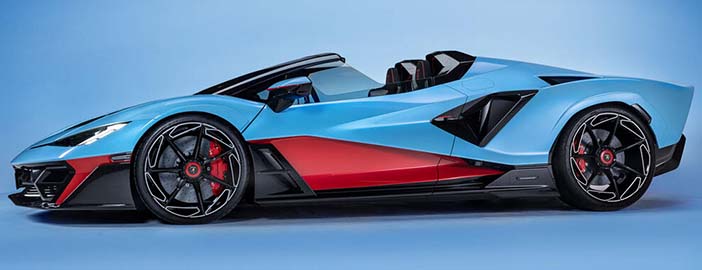
+++ LAMBORGHINI has unveiled an ultra-exclusive open-top version of its most powerful model to date, the 1.080 hp motorsport-derived Fenomeno. The new machine is the latest model in the Italian firm’s Few Off series and just 15 examples will be built. That makes the Fenomeno Roadster even more exclusive than its €568.809 coupé sibling, of which 30 are scheduled to be produced. The Fenomeno Roadster uses the same plug-in hybrid powertrain as the coupé, which is a tuned development of the powertrain from the Revuelto. Based around a 6.5-litre V12 engine and a trio of electric motors (2 powering the front axle and 1 mounted to the 8-speed dual-clutch gearbox), the total system output is 1080 hp, up from 1015 hp in the Revuelto. The V12 alone is tuned to deliver 835 hp at 9.250rpm and a torque peak of 700 Nm ft at 6.750rpm. The 3 motors are powered by a 7kWh lithium ion battery. The hybrid powertrain allows the Fenomeno Roadster to achieve 0-100 kph in 2.4 seconds (all but matching the coupé) while it has a top speed that is claimed to exceed 340 kph. Although the powertrain is largely carried over from the coupé, Lamborghini says the Fenomeno Roadster features an all-new aerodynamic package that is honed to maximise efficiency, and the firm claims it has nearly identical values for downforce, stability and balance. An additional spoiler above the windscreen guides air over the cockpit and into the bespoke engine cover at the back of the car. This enables the V12 to receive cool air whenever the car is being driven, even though the roadster lacks the motorsport-style S-duck channel that appears on the coupé. The new engine cover features hexagonal air intakes, a design feature also used on the air vents and instrument display in the interior. Lamborghini claims that the rollover protection bars for the roadster presented a “particular challenge” because of the need to offer occupant protection while also being aerodynamically efficient to minimise wind noise and turbulence. As a result, the firm has integrated them behind the sport seats, making them part of the car’s structural design. As with the coupé, the new roadster features a carbonfibre monocoque and a front structure made from forged composites. The use of what Lamborghini calls a “novel combination” of long and short carbonfibre strands means that the drop-top offers a similar level of stiffness to the coupé. While Lamborghini has not disclosed a weight for the car, the firm says it is very close to the coupé’s, which is 1.772 kg dry. As with the coupé, the new roadster has an aggressive front end that has been sculpted for aerodynamic performance. Along the side of the car, the wide sills and air intakes are also designed to aid engine cooling. The rear retains a large diffuser and an active rear wing. The car features CCM-R Plus carbon-ceramic brakes and manually adjustable racing shocks. For everyday use, there are bespoke Bridgestone Potenza Sport high-performance tyres, which measure 265/30 ZRF21 at the front, and 355/25 ZRF22 at the rear. But semi-slick Bridgestone tyres will also be offered for track use in 20 inch and 21 inch sizes. +++
+++ PEUGEOT is considering an e-308 GTi to follow the e-208 GTi, with CEO Alain Favey suggesting that a hot version of the electric hatchback “makes a lot of sense”. The revered performance badge will return in June on the e-208 GTi, which is to be launched at the 24 Hours of Le Mans race, and Favey said he wants to build a range of performance EVs, confirming an e-308 is a contender. “I would love to have a range of GTis, of course, so we’re looking at options, possibilities with the technology that we have”, said Favey. “For sure, we want a GTi to be really something special, something really top in terms of what it promises. The 308 would obviously make a lot of sense”. However, Favey suggested creating an e-308 GTi would be no mean feat, due to several challenges. “It’s difficult to find technology that will allow us to get there at a price that is still affordable”, he said. “That’s what we struggle to achieve at the moment: to find the technology and the right price balance”. Earlier this year, Autointernationaal.nl reported fellow Stellantis brand Opel’s plans to produce a hot electric Astra GSE, following the Mokka GSE and Corsa GSE. This is likely to use a front-driven powertrain with 280 hp, plus a limited-slip differential. Given the e-308 and Astra share underpinnings, the French EV would probably receive the same set-up. Pushed further on how Peugeot would expand the GTi range, Favey confirmed that, unlike Opel, it has no SUVs planned. “I don’t think an SUV as a GTi makes a lot of sense”, he said. Speaking more about the e-208 GTi, the first EV to wear the badge and the first Peugeot GTi since the hot 308 went off sale in 2021, Favey said: “A lot of people are excited about the prospect of this car being launched. It got a number of question marks as to why is it an electric car. What I’m most excited about personally is to see a lot of these questions being turned into excitement when people will actually drive the car and discover how exhilarating it is to drive this car with 280 horsepower as an electric car, and the chassis being absolutely top of what you can expect in that category of hot hatches. I’m looking forward to seeing these very petrolhead kind of persons turned into fans of the electric world through the 208 GTi”. +++
+++ It’s been 100 years since the original SPYKER company went out of business. It returned in 1999, but like its forebear, it went bankrupt again, not once, but twice. The first collapse came in 2014, followed by another in 2021. Now, CEO and founder Victor Muller believes the third time’s the charm and is making another attempt to revive the troubled Dutch exotic brand. Spyker’s resurrection was originally announced last October, and now there’s a promise of a new car. First seen a decade ago at the Geneva Motor Show, the C8 Preliator is making a surprising comeback. Whether it’s an evolution of the 2016 car or an entirely new development remains unclear, but we do know it will feature a twin-turbo V8 engine producing 800 horsepower. While the original C8 Preliator (Latin for “fighter” or “warrior”) also had a V8, it used a supercharged 4.2-liter unit of Audi origin with 518 hp. Spyker hasn’t said whether the new engine is linked to Audi or another Volkswagen Group brand, such as Porsche or Bentley, but it has confirmed one thing: it will be a pure V8. “I can reassure a lot of fans and potential customers that this car is not going to be electric in any way, shape or form, not even hybrid”. The undisclosed V8 will help the new Spyker exceed 350 km/h. The first new model in a long time carries chassis number 270, suggesting that only 269 vehicles have been built by Spyker in the modern era. The reborn C8 Preliator is heading to Pebble Beach and will debut on August 14 at Quail Lodge in Carmel Valley. While previous attempts to revive the brand have failed, Muller insists things will be different this time. Spyker says this will be the first of “many, many new cars we’re going to build in the next few years”. Before reaching the spotlight, the new C8 Preliator is being shipped from the United Kingdom to the Netherlands, where final assembly will take place. +++
+++ The VOLKSWAGEN GROUP is in the midst of a large-scale restructuring plan that will wipe out tens of thousands of jobs in Germany by the end of the decade. In a recent letter to shareholders, CEO Oliver Blume revealed that around 50.000 jobs will be cut within the next four years across the Group in its home market. Aside from axing jobs, it’s also scaling down global annual vehicle production to 9 million to avoid overcapacity. Before the coronavirus pandemic wreaked havoc across the automotive industry, the VW Group consistently built over 10 million vehicles per year, even surpassing 11 million in 2018. Last year, that number fell to just 8.9 million vehicles. Sales so far this year haven’t been great, as every passenger car brand has suffered a decline except for Skoda. The VW core brand dropped by 7.6 percent in the first quarter of 2026 to 1.048.300 units. Demand for Seat/Cupra was down 1 percent to 145.300 vehicles, while Audi suffered a 6.1 percent drop to 360.100 cars. Porsche took the biggest hit, falling 14.7 percent to 61.000 units. Even the more exotic Bentley and Lamborghini brands had a difficult Q1. The former saw deliveries drop by 9.9 percent to 2.200 units, while the latter declined by 11.7 percent to 2.600 cars. The only bright spot in the VW Group was Skoda, which rose by 14 percent to 271.900 units. But Skoda’s continued ascent isn’t enough to offset the global problems its parent company is facing. VW Group CFO & COO Arno Antlitz points out that the rise of Chinese brands in Europe is putting “competitive pressure.” To make matters worse, tariffs in the United States have taken a toll on the company’s financial health. The solution? Even more cuts. “We must fundamentally transform our business model and achieve structural, sustainable improvements. This includes improving the cost structure of our vehicles without compromising product substance, significantly reducing overhead costs, increasing the efficiency of our plants, and accelerating technology development and decision-making”. In short, VW wants to reduce costs without hurting quality while speeding up development to bring fresh products to market more quickly. That’s easier said than done with so many brands under the same corporate umbrella. In the coming months, the company aims to reduce complexity in its “product portfolio and technology platforms”, In other words, some models and variants may get the axe, while the number of architectures could decrease. Arno Antlitz is not the first VW Group executive to warn about the business model. In July 2025, when he was still Porsche CEO, Oliver Blume told employees in an internal letter seen by Bloomberg that the “business model, which has served us well for many decades, no longer works in its current form”. Blume has since stepped down as Porsche CEO while retaining the same position at the helm of the VW Group. +++