
+++ The original KIA CEED made the Korean car company a force to be reckoned with and the hatchback’s success helped to spawn a jacked-up variant called the XCeed in 2019. 7 years later Kia has revealed a second ‘mid-life’ update for its XCeed, with a significant overhaul inside and out. The exterior of the XCeed has been revised to tie in with Kia’s ‘Opposites United’ design language. This means the new car gets an entirely new front end with ‘star map’ headlights and a more upright, bulky-looking grille.
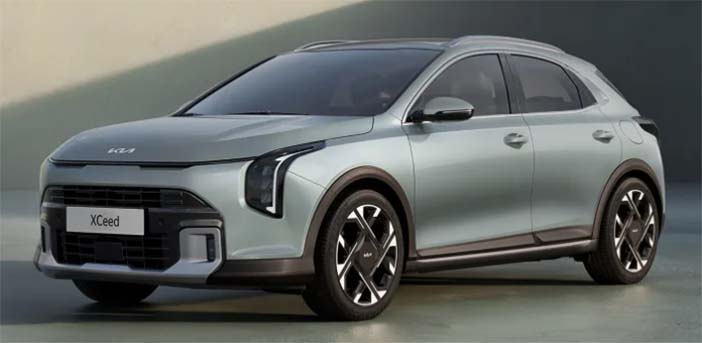
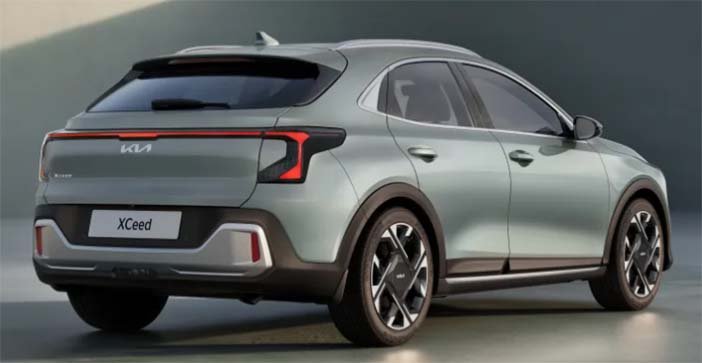
There are also new alloy wheels and the rear light clusters have been swapped out in favour of a new full-width lightbar along with a reshaped rear bumper.
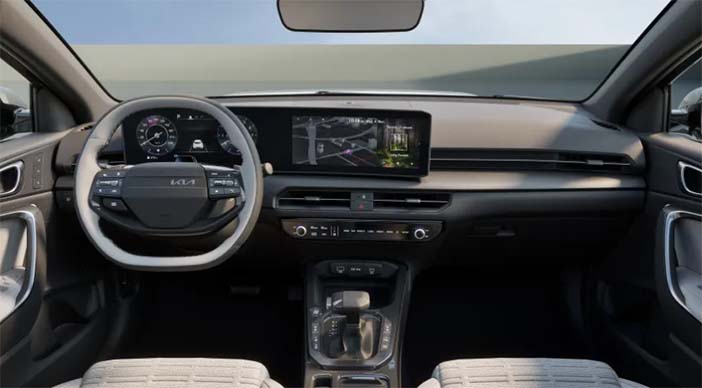
Kia’s been busy inside too. The XCeed gets a new twin-screen display along with Kia’s latest infotainment system, while the restyled dashboard features elements such as the control touchpad in the middle taken from the Kia Sportage, and a new steering wheel that’s already been seen on the K4 and EV4.
Kia claims it’s also improved the ride comfort of the XCeed, while as announced last year, the XCeed gets a new mild-hybrid 1.0-litre T-GDi engine in 2026, replacing the old 1.5-litre unit. The 1.0-litre petrol engine produces just 115 hp, which is some way off the old 1.5-litre’s 160 hp output, but it’s 5 percent more efficient. The 1.0-litre unit comes with a choice of 6-speed manual or 7-speed dual-clutch automatic gearboxes. There’s still no mention of a return for the plug-in hybrid version of the XCeed that went off sale back in 2023. Kia has already got the upper B-segment and C-segment pretty well catered for with the all-electric Kia EV3 and EV4, the new Kia EV2, the petrol and hybrid-powered Kia Niro and Sportage, plus the K4 hatch, the revamped Kia Stonic and upcoming Kia Seltos. Finding space for the XCeed in this line-up might prove to be difficult, especially with it being one of the oldest models in Kia’s range. For this reason, the facelifted XCeed won’t be sold in the Netherlands. +++
+++ MERCEDES-AMG seems to have its mojo back and is looking to prove it by revamping its entire line-up in as little as 12 months. The focus is on what the performance division is best known for: mighty V8 engines, loud evocative soundtracks, bold designs and cars brimming with character. In the past few years, AMG has been going through something of an identity crisis and a controversial love affair with a 2.0-litre 4-cylinder engine. Its latest creations have, undeniably, been very technically capable (and very fast) but they’ve lacked some of the drama, charm and other characteristics of its earlier cars that made them so beloved. That’s about to change however. “AMG must become more AMG than ever before, the division’s CEO Michael Schiebe says. “That doesn’t only mean performance, but also emotion and design”. The new GLC 53 is the first opportunity for us to see how AMG has learned from the vast amount of feedback it’s received from critics and customers alike. The 4-cylinder engine from the old GLC 43 and 63 SE E Performance is gone, replaced by a brand-new 3.0-litre in-line 6-cylinder engine. This pumps out a hearty 449 hp, but is also more free-revving, Schiebe promises, and delivers a “much more emotional sound”, helped by a new exhaust system designed to amp up the noise. Schiebe added that the new GLC 53 has been set up to provide a greater spread between the Comfort setting and the more focused Sport+ mode, “because we wanted to put a little bit more emphasis on bringing back the emotions of AMG”. The same straight-6 engine will be making its way into the C 63 sports saloon as well later this year, replacing the divisive plug-in hybrid 4-cylinder powertrain in AMG’s answer to the BMW M3 and Alfa Romeo Giulia Quadrifoglio. The V8 engine is also very much a part of AMG’s future, confirmed Schiebe, who owned a W204 C 63 with the brand’s famous 6.2-litre V8. In fact, the company has developed a new V8 that meets Europe’s latest emissions regulations and is being added to the line-up later this year. It hasn’t been confirmed which model will be the first to be fitted with the new twin-turbo flat-plane-crank V8. But we know the engine is going to make its way into SUVs, such as the facelifted Mercedes GLS, plus the hotly anticipated CLE 63 coupe, a new E 63 super-saloon to rival the BMW M5 and, I suspect, a new S 63 limousine, too. I assume this engine is also what lies under the very long bonnet of the new AMG GT Black Series, which is a true motorsport homologation special with a different chassis and powertrain to the current road-going AMG GT. Plus a gigantic rear wing. A flat-plane crankshaft can sometimes give an engine a less characterful noise than the cross-plane style AMG has traditionally used. However, Mercedes’ engineers have addressed this with a specially designed camshaft that should give the new V8 the kind of muscular soundtrack AMG’s customers expect. Meanwhile, the AMG GT and SL are both about to receive mid-lift facelifts that are likely to be accompanied by a shake-up of their engine line-up. The V8 will be sticking around, of course, but the entry-level four-pot will probably go and Schiebe admitted that a decision has yet to be made about whether plug-in hybrid power remains available in the pair. Regardless, plug-in hybrids (or long-range hybrids as Schiebe calls them) will still have a place in the AMG range, the CEO told me. “The GLE 53 and E53 PHEVs will definitely continue, because we see it’s a very good compromise for people that live in areas where there are certain restrictions in terms of CO2 emissions”. “We see that, with the next generation of our V8, we will even have more power coming from the engine. If you ask me, I see now with the new EVs coming up, you can actually differentiate them even more. So there will be customers that want to still have the combustion feeling, drive the combustion engine, and you can give them a really puristic V8 experience. And for those who want to have, let’s say, all the EV capabilities in terms of acceleration, also the possibility to drive a car in complete quietness, they can go all electric, yeah? And then for the ones in between, we still have the long-range hybrids”. But while AMG is going big on loud-mouthed combustion-powered cars, it’s also working on a new breed of EVs that Schiebe is confident will live up to its customers’ expectations of design, performance and, most importantly, emotion. Leading the charge will be the AMG GT 4-Door Coupe – the production version of the show-stopping GT XX concept we saw last year. It’ll have well over 1.000 hp, of course, but setting it apart from all the other fast EVs will be a synthesised yet authentic-sounding V8 roar. Mercedes’ now-former chief technology officer Markus Schäfer told ast year that driving the Porsche Taycan rival will be “an emotional experience. It has to be authentic when it comes to power, drivability and track performance. But the AMG is also an emotional experience from an acoustic standpoint, from noise, vibration and hardness. And that’s exactly what you can expect in this car as well”. The GT 4-door Coupe will be a bespoke AMG creation, using a brand-new architecture called AMG.EA. However, the performance division is also launching a hot version of the highly efficient Mercedes CLA (in both saloon and Shooting Brake estate forms) which is almost certainly electric. Schiebe remained tight-lipped about the new CLA 45, but I’m expecting it to get dual motors for all-wheel drive and probably around 450 hp, plus a suitably mean-looking AMG bodykit. It’s also worth noting that when the A 35 and A 45 hot hatchbacks are axed (a result of their M139 4-cylinder not meeting the latest emissions standards), the CLA car will become the entry-point to the AMG range. Schiebe emphasised that AMG wants to give its customers a choice of powertrains, whether they be gas-guzzling or not. “This is why I’m bringing back the V8 and at the same time, we are doubling down on the electric car”. The design of AMG’s new cars is set to become more in your face and aggressive, too. Schiebe joked that AMG had to convince some of the board members at Mercedes about its latest designs, but said he was “100 percent convinced that this is the right direction, because exterior design is one of the main reasons why people buy an AMG. They want to have a distinct and most of the time also revolutionary, bold, aggressive design,” he added, “and this is what we will deliver”. Those cars were styled by Bastian Baudy, who was the chief designer for AMG until recently when he took on the role of head of design for Mercedes-Benz. “All of those cars have been made by Bastian”, said Schiebe, “and I was so happy to have him with me on this journey, because we always found ourselves on a Saturday morning in Affalterbach in our little design studio and we were smiling because we were allowed to do crazy things”. +++
+++ MINI isn’t planning to further expand its line-up, new boss Jean-Philippe Parain has said, but offering increased options and customisation can help it to continue growing. The Frenchman, who has previously held senior management roles within the BMW Group, took over at the British brand late last year. In recent years Mini has renewed its line-up, with fresh versions of the electric Cooper and Countryman, updates for the 3- and 5-door petrol Cooper hatchbacks and the new Aceman. At the Beijing motor show, Parain said: “We have the biggest product range we’ve ever had, with 5 models. For a relatively small brand like Mini, it’s a very large range, and we’re very happy with where we are”. Parain explained that Mini would instead focusing on broadening its appeal through expanding its range of options and personalisation, along with further derivates, particularly in its John Cooper Works performance line, where there “are still some possibilities”. He added: “We are pushing John Cooper Works very strongly. We believe in our combustion-engine cars and we achieved an all-time high with John Cooper Works sales last year”. Mini recently added more options for its models, shifting away from the simplification of such items in its recent model rollout. “We had some ideas in terms of simplification, but that proved not exactly what the customer wants”, said Parain. “If you look at our configurator, we’ve really reopened the possibility to have single options and to customise and individualise our cars. We’ll play with that to the full, because it’s something really only Mini can do”. Mini also recently revealed a range of special editions with outside collaborators, and Parain said “there are possibilities to explore there” still. He noted that Mini’s size limits its offerings in this area but said “we’re really working to improve the diversification of our product offer”. “With customisation there is a profitability aspect, of course, and it’s very Mini to make every Mini unique”, he added. Parain also said that Mini will try to “really sharpen our Mini-ness”, explaining: “We want to exploit even more our heritage, our Britishness, but in a way that is modern and not cheesy. But it’s a very strong differentiation factor for us”. +++
+++ NISSAN will close one of its two production lines at its Sunderland plant as part of a cost-cutting exercise in which the Japanese firm will eliminate 900 positions in Europe. Sunderland builds the new Leaf, the Juke and the Qashqai, and all will now run down the same line. Nissan confirmed that no jobs at the plant would be lost as a result of the move, but some roles in the United Kingdom could go as part of the 900 across Europe. The closure of the line marks the decline of production numbers at Nissan’s sole European plant. The factory built 273.174 cars last year, down from a high of more than half a million. Nissan said in a statement that it was taking measures “to create a leaner, more resilient business that adapts quickly to market changes”. Measures under review include the partial closer of its Barcelona parts warehouse and a move to an importer model in Nordic countries. Nissan is hoping to attract a second car maker to take over line one at Sunderland in the future, with Chinese makers Chery and Dongfeng both linked to production at the site. The successful sale of line one would preserve jobs and increase production at the company, Nissan said. The closure of the line is expected to happen in the second half of the year, with line-2 moving to 3 shifts to compensate for the loss of capacity. Former Nissan executive Andy Palmer, who started his career at Sunderland, expressed sadness at the announcement. “Any reduction in capacity is bad news for Nissan and bad news for Sunderland”, he told. Like all Japanese manufacturers, Nissan has been hit hard by increased competition in Europe, especially from the Chinese. Its market share in the United Kingdom fell to 3.7% in the first 4 months of 2026, down from 5.6% in 2016. Chery, meanwhile, had a share of almost 5% through April, thanks to the success of its Jaecoo, Omoda and Chery brands, according to data from the SMMT. MG also beat Nissan at 4%, while BYD was close behind at 3.45%. Nissan has been slashing costs globally, including shuttering 7 plants, as part of a campaign under CEO Ivan Espinosa to restore its fortunes following a 4.4 billion euro loss in the financial year ending March 2025. Globally the company has been hit by increased competition in all markets, including China, as well a hike in import tariffs on its exports to the US. Before the announcement of the closure of line one at Sunderland, the plant had been relatively unaffected by the cuts. Support from the British government helped secure it production of the new electric Juke, due to start at the end of the year. +++
+++ SKODA ’s new baby electric SUV, the Epiq, will be revealed in full on Tuesday 19 May. A near-production design was previously displayed at the Munich motor show, described as a “concrete glimpse” of Skoda’s answer to the Renault 4, and it is expected to arrive in showrooms mostly unchanged. At 4.1 meter long, the Epiq will be the smallest of Skoda’s electric SUVs, sitting underneath the 4.4 meter Elroq, and effectively the electric equivalent to the Fabia. Yet it will still seat 5 “comfortably”, have a 475-litre boot and offer a range of up to 435 km. Based on the same MEB Entry architecture as the other Volkswagen Group small EVs, including the new Volkswagen ID.Polo, the Epiq will have a 136 hp motor on the front axle as standard. A hot RS version, twinned with the ID.Polo GTI, is possible and could ramp that up to 225 hp. It is described as the first car designed completely according to Skoda’s minimalist new Modern Solid design principles (first deployed on the updated Elroq and Enyaq) both inside and out.
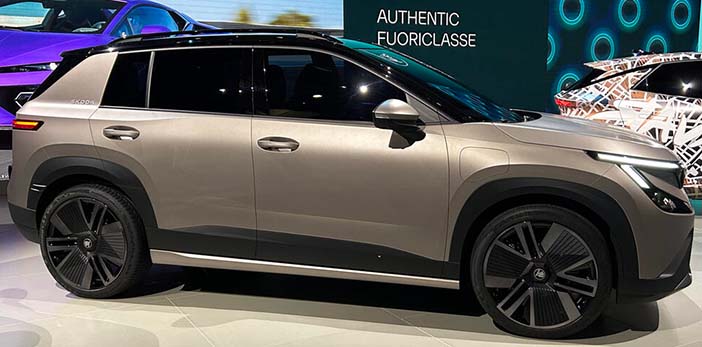
To that end, it wears Skoda’s new ‘Tech Deck’ face, T-shaped light signatures, chunky bumpers and a distinctive new shade of ‘Cashmere’ paint, which contrasts with the grey lower bodywork. The cabin is visually separated from the rest of the car by an accentuated shoulder that Skoda refers to as a ’tornado line’. The interior, in keeping with Skoda tradition, majors on practicality and everyday usability, with ‘Simply Clever’ features like bag hooks, fasteners and hidden cubbies dotted throughout. The touchscreen will be the main control interface, but physical buttons and haptic scrollers feature as part of an emphasis on intuitive utility.
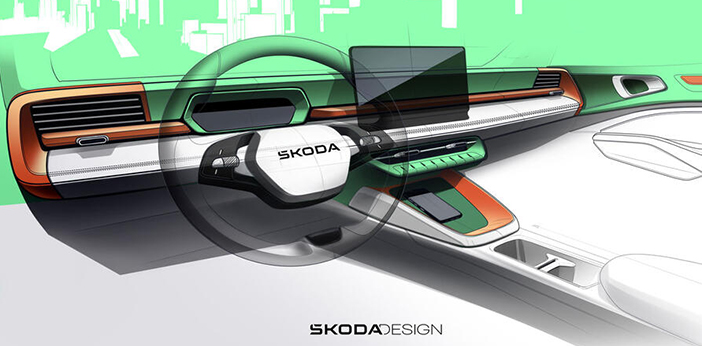
Skoda said the Epiq will be priced to match its petrol-powered counterpart, the Kamiq. The Czech firm said “this further underlines Skoda’s commitment to meeting the growing demand for sustainable and accessible mobility solutions”. CEO Klaus Zellmer said: “It embodies the essence of Skoda: Modern Solid design, a spacious interior within a compact footprint, user-friendly, intuitive digital interfaces, and Simply Clever details that ensure a seamless experience and, above all, at an attractive price point. +++
+++ A new TOYOTA YARIS is on the way and it will fully embrace electric power. However, the popular supermini will also retain hybrid and petrol options as it bids to cater for buyers in Europe and other markets around the world. Toyota’s European vice president of strategy and marketing, Andrea Carlucci, said: “If there is a maker with a strong presence in the lower categories, it’s Toyota. We have a position of leadership, with a lot of consistency over time. If electrification is the direction, I think we cannot avoid having a fully electrified version. When, I cannot comment, but it looks to be quite obvious”. But Toyota wants to be ready with the right product for its customers at the right time. And although it was confirmed that a new electric Yaris is on the cards, it won’t come at the expense of a hybrid-powered variant. Carlucci continued: “For now, the platform has to be strong, especially on small cars, when it comes to delivering a hybrid powertrain. The ideal path is to offer a platform where we have multi-energy options, so delivering different powertrains that are the right solution for every customer. Let me put it to you this way: a multi-energy approach isn’t just one solution. It has to be the solution”. So when will we see the new Yaris? Traditional model cycles suggest a replacement should be due to arrive in 2027, but Toyota has a habit of stretching these when there’s a big change on the horizon, as happened with the Aygo X. The Yaris will need to adopt a new and far more flexible architecture, so don’t expect much news until then, or possibly even 2028. Toyota has already announced a ‘multi-energy’ platform for the next-generation Corolla, so the Yaris is expected to follow it. This will see the development of a new platform capable of supporting ICE, hybrid and BEV powertrains. All Corollas will have the same styling, interior tech and branding, offering buyers a suitable powertrain no matter where in the world they are. The same will be true of the next Yaris. Core to this flexibility is that new platform, which will be variable enough to support the vastly different requirements of its future powertrains. These will have to perform, because the electric Yaris will need to offer a 400 km range comparable to that of rivals such as the Renault 5, Volkswagen ID.Polo and Cupra Raval. On the ICE front, the current Yaris hybrid is one of the most efficient new cars on sale, so would need to at least match, if not improve on the current car’s rating. This is a different choice to the ones made by key supermini rivals such as Volkswagen and Renault, which both offer distinct models with ICE/hybrid or all-electric powertrains. The ID.Polo will join an updated version of the existing car under the same name, while the French brand has entirely distinguished its Renault 5 from the latest Clio hybrid. But what will the future Yaris look and feel like? Carlucci gave a clue by telling us: “My main concern today from a planning perspective is to make sure that we keep an authenticity to what we do. For an electric car, this is a challenge. With hybrids, it was an easier game because we have so much goodwill in this area. So this is where we have to focus right now”. It will have typical supermini exterior proportions, with a short bonnet and rear overhang. New-age Toyota design cues, such as technical-looking headlights and a single lower grille to give the Yaris a far more contemporary feel, will be paired with a diving windowline. This won’t just look interesting, it will improve forward visibility and give the cabin a greater sense of space. The current rounded wheelarches and soft surfacing will be a thing of the past – Toyota’s new models are all about giving buyers something that looks and feels more substantial, expensive and technical than previous generations. This will be a small car, but it’s not designed to be cheap. I expect to see more striking colour, wheel and trim options, and a doubling down on contrasting roof finishes and clever design touches that reference the Corolla Concept seen at the 2025 Tokyo Mobility Show. The Yaris will remain a 5-door hatchback in its mainstream form, but any new generation of GR Yaris (a 3-door car) is still yet to be confirmed. Looking at Gazoo Racing’s future projects, I know a new 2.0-litre 4-cylinder petrol engine is in the works for the brand’s high-performance models, but I don’t know if it could be used in something as small as the future Yaris. There’s a good chance that the brand will trickle down some of its motorsport knowledge to a less extreme, but still performance-focused model, though. Reports in Japan suggest a new turbocharged 1.3-litre 3-cylinder engine is in development and it could form the basis of a new front-wheel-drive hot hatch derived from this same platform. Just like the full-fat GR Yaris, this is being built to homologate a rally car and it will compete in the lower Rally4 class that demands front-wheel drive. Inside, there will be a total overhaul of the digital interfaces, with a more open feeling, larger glass area and simplified surfaces. The current Yaris, which is known for its complex and rather chunky dashboard, will instead use floating screens and clever new storage solutions; something the original Yaris was well known for.From a hardware perspective, the torsion-bar rear suspension set-up will be designed for maximum space efficiency on mainstream models, helping to keep rear boot space and legroom competitive for the class. When will we see the new Yaris? Traditional model cycles suggest a replacement should be due to arrive in 2027, but Toyota has a habit of stretching these, especially if there’s a big change on the horizon. Considering the Yaris will need to adopt a new and far more flexible architecture, this is likely to be the case. We don’t expect much news until then, or possibly 2028. +++
+++ Much like all traditional automakers, the VOLKSWAGEN GROUP is caught between a rock and a hard place. The European Union’s push toward electrification is forcing the German juggernaut to sell more EVs to offset the CO₂ emissions from its combustion-engine vehicles. Otherwise, it risks paying hefty fines for exceeding fleet targets. However, it’s a known fact that EV profit margins are still not at ICE levels, meaning the VW Group must juggle making money on more profitable gas cars while keeping CO₂ levels in check by selling electric cars to avoid fines. Until EVs become as profitable as ICE, it’s a lose-lose situation. “We make a trade-off between money we lose due to the CO₂ fine and money we lose to the margin loss of the EVs (compared to combustion cars)”, according to VW Group CFO & COO Arno Antlitz. Meanwhile, fines are unavoidable. Antlitz mentioned during the first-quarter earnings call that the company risks paying up to €1.5 billion for exceeding emissions targets in the 2025–2027 period. Even with the ID.Polo arriving this year and a smaller, cheaper electric car due in 2027, the company projects it won’t be able to meet the EU’s fleet-wide emissions target. “€300 million–€400 million, €400 million–€500 million CO₂ cost per year. Basically, almost €1.5 billion for the 3-year period”, declared Antlitz. The Volkswagen Group doesn’t expect electric vehicles to match the profitability of gas cars until the SSP platform launches late this decade. In the meantime, the company is working to narrow the gap between ICE and EV margins. The upcoming crossover version of the ID.Polo, called ID.Cross, is estimated to achieve 70–80 percent of the T-Cross’ profit margin. Data published by the European Automobile Manufacturers’ Association (ACEA) shows that EVs reached a 20.6 percent share of new car registrations in the first 3 months of the year. But even with 1 in 5 cars being electric, the VW Group says it must sell “more electric cars than the natural demand in Europe is” to lower its fleet emissions and reduce CO₂ fines. The VW Group has reasons to be optimistic, as demand for its EVs in Europe grew by 11.5 percent compared to the first quarter of 2025, reaching 176.400 units. In Western Europe, about a fifth of the vehicles it sells don’t have a combustion engine. Still, EVs are not as profitable as similarly sized combustion-engine vehicles, models VW would otherwise prefer to sell more of if not for the EU’s draconian CO₂ targets. +++