
+++ Rumors about BMW developing a rugged off-roader to rival the Mercedes-Benz G-Class sounded a little far-fetched from the get-go. After all, BMW does offer a rival for the G-Class, albeit not a direct one: the XM ultra-luxury performance SUV costs about the same as the G-Class. Mind you, the XM and the G-Class are entirely different types of SUVs. According to sources familiar with the program, the rumored rugged SUV known internally as the G74 has not cleared its final approval round. This puts the future of BMW’s G-Class rival in uncertain territory. BMW has never acknowledged that the G74 was under development, but the same sources claim the reason for its alleged shelving is that the vehicle was targeting a segment too small to justify the investment. After all, bringing a bespoke luxury off-roader to market costs a bit more than peanuts. But that may not be the only reason for the G74’s failure to get the green light from BMW’s head honchos. The Bavarian automaker is currently in the midst of streamlining its line-up (and workforce), which prevents it from chasing every niche out there. The times when BMW would launch niche models like the 3 Series GT or 5/6 Series GT are gone, which may be why the carmaker may not be willing to bet on a direct rival for the G-Class and Range Rover right now. Needless to say, you should take all of this with a grain of salt as nothing is official at this point. BMW can still cancel or approve a new project 18 months prior to the start of production, so the G74 can still happen. Originally, the rugged SUV was allegedly targeted to launch in 2029, so there’s plenty of time left to put the project back on track if Munich has a change of heart. Furthermore, BMW’s current multi-platform strategy allows it to change course faster than many of its rivals. BMW’s plans to launch a G-Class rival first surfaced in 2024, when the project allegedly started as a Rivian R1T benchmarking exercise. Since the electric pickup reportedly impressed BMW engineers and executives, the company started considering an adventure-capable product. The first concept was purely electric and based on the Neue Klasse NA5 platform. A full-scale design model was reportedly built, but it’s unclear whether it evolved into a running prototype. Then the EV market’s downturn allegedly led BMW to switch the project to the CLAR flexible platform, which also underpins the next-generation X5 (G65). That would have allowed the G74 rugged SUV to offer multiple drivetrains, including plug-in hybrid and fully electric versions, as well as proper off-road hardware to match the rugged styling. For now, though, BMW has apparently hit the brakes on all that. +++
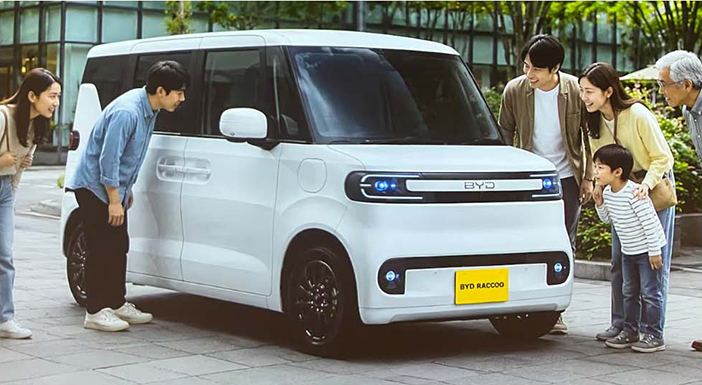
+++ BYD has launched a new ultracompact electric vehicle developed specifically for Japanese customers to challenge the country’s minicar market, long dominated by domestic automakers. The Racco, standing 180 centimeters tall, has ample interior space, as the Chinese leading EV maker aims to meet strong demand for tall minicars in Japan’s competitive segment, which accounts for around 40 percent of new vehicle sales. “We want to deliver unprecedented convenience and enjoyment to all people in Japan through our technology”, said BYD-Japan president Liu Xueliang at a launch event held in Tokyo. BYD seeks to sell 10.000 units per year, with the starting price set at just under 2.15 million yen ($13,000). The government’s 150.000 yen subsidy for clean energy vehicles applies to all 3 types, bringing the actual cost of purchasing the entry-level model below 2 million yen. Intending to make all new passenger vehicle sales electrified by 2035, the Japanese government has been offering subsidies to promote purchases of more environmentally friendly cars, such as EVs, fuel cell vehicles and plug-in hybrid EVs. BYD’s ultracompact EV is the first mini EV in Japan to feature power sliding doors on both sides and is available with either a 210-kilometer or 320-kilometer range, the automaker said. When a passenger approaches the premium model with the key, a light guide is projected onto the ground, and waving a foot over it automatically unlocks and opens the sliding door. Since entering the Japanese auto market in 2023, BYD has launched 5 models, but sales remain sluggish. +++
+++ DS is poised to introduce a crucial new models: the N°3 supermini as it begins a fightback after sales slumped to a record low. The French premium brand sold just 13.793 cars in Europa during the first half of this year. That’s an 19,4% decline from the first 6 months of 2025. The sharp fall is primarily due to the changeover in generations of the ‘7’, which has long been its best-seller. Production of the left-field Range Rover Evoque rival wound down throughout the course of the year before finally concluding earlier this month. In addition, sales of the ‘3’ fell sharply during the first half of 2026. DS parent company Stellantis doesn’t disclose financial performance figures for each of its brands individually, so it’s unclear what impact DS’s low sales volumes have on its bottom line. DS has long contested that, despite being a niche player, it is a profitable contributor to the group. Should DS fail to recover the momentum it had built with the ‘4’ and ‘7’ in terms of sales, it will face a significant challenge in ensuring its long-term viability. Xavier Peugeot, CEO at DS, said the brand would be in a position to “recapitalise” following the launches of the N°8, N°4 and N°7 and that he felt “trust in the future for DS”. He added that DS should not be judged solely on its sales volumes, it being a profitable contributor to Stellantis on a global level. However, it needs to provide some volumes to ensure the profitability of its dealer network, he said. “The coming launches will be key to ensuring the success of DS”. Stronger sales for the N°7 and N°4 will prove vital if the brand is to guarantee its future. Notably, DS is undergoing a significant strategic pivot. Stellantis announced in May that DS will be moved back under the stewardship of Citroën, from which it was originally spun off to become a stand-alone marque. It will now be considered a specialty brand alongside Lancia, which is being rolled back into Fiat, but it remains to be seen what this means for its sales network. Citroën’s influence will manifest in the replacement for the ‘3’, named the N°3. This is tipped to return to a more traditional hatchback body. It will draw on the Citroën DS3, the chic spin-off of the Citroën C3 that was successful enough to justify launching DS as a brand in its own right. This car was retired in 2018 and replaced by the current-generation crossover a year later. The brand’s sales immediately plummeted and they have yet to recover. DS’s decision to return to the traditional hatchback market could be the first step towards claiming some meaningful volume in Europe. DS design director Thierry Métroz said it would take inspiration from the Citroën DS3 “because it was so successful on the market”. CEO Xavier Peugeot said he believed DS is “now in a position to recapitalise on this success story, based on the launch of these new products”, referring to the N°4, N°7 and N°8. But he added that the brand’s previous best annual result of around 55.000 sales has to become the baseline. The success of the Renault 5 and Peugeot 208 gives reassurance of the N°3’s potential, but it could still be a year from showrooms, so DS’s larger models must work hard to sustain its operations in the meantime. +++
+++ FORD will unleash a flagship family crossover, effectively the new Ford Kuga, in 2029, with an exciting design shaped by the firm’s rally car heritage and diverse powertrains to satisfy a broad range of customers. The new crossover will be the culmination of a wholesale reinvention of the Blue Oval’s European range, in partnership with Renault for small electric cars and Chinese car maker Geely for the Kuga replacement. The Chinese and American companies have forged a new joint-venture at Ford’s 50-year-old manufacturing hub in Valencia, Spain. Beginning operations in 2027, the JV will co-develop, jointly source and manufacture 3 vehicles on a shared vehicle architecture. The first of 2 Geely electric SUVs is set to roll off the line by the end of 2028, with Ford’s all-new Kuga following in 2029. Future Ford cars will be defined by 3 strands of distinct DNA. The Ford Mustang muscle car or steroidal Raptor pick-up are ‘thrill’ cars, while ‘adventure’ shapes another Ford coming out of Valencia, a European-sized and homologated version of the rugged Bronco, due in 2028. Its classical, blocky 4×4 design intentionally creates space for the next-generation Kuga to build on its more rounded, crossover positioning. “We’re going on a product offensive with a rally-bred, thrilling, unmistakably Ford passenger vehicle portfolio”, said Jim Baumbick, president of Ford of Europe. The Kuga will be the king of that hill. Expect a dramatic SUV, with exaggerated wheel arches clad in plastic body protection and aggressive body vents, hinting at rally-bred capability. The headlamps are split, with smaller central LEDs reminiscent of the Alpine A110’s auxiliary spotlights for illuminating dimly lit forest tracks. The more Ford turns up the emotional dial, the more distinctive it will be from Geely’s typically functional designs. Ford’s European design team has experience of taking a third-party architecture (Volkswagen’s MEB platform) and distinctively reskinning it to create the Explorer. With its blocky, Tonka truck vibes, Murat Güler and Jordan Demkiw’s design sits closer to the Bronco’s pure adventure pillar than the new Kuga will. And the Explorer’s design freedom (a shorter rear overhang and more upright windscreen pillar, compared with the Volkswagen ID.4 donor car’s) will apply to Ford’s new car too. “Make no mistake, the Ford product will have a completely unique body. This is not a reskin”, Baumbick told. “We don’t do boring cars. This is a uniquely engineered, truly unmistakably Ford product that will be differentiated from Geely’s and their target customers”. Despite a more rakish look than the Bronco, Ford knows the Kuga must deliver on passenger space and cargo-carrying capability. It will sit in the heart of Europe’s most popular market, ‘C-segment’ midsize SUVs, where rivals typically measure around 4.5 meter-long and include cars such as the Volkswagen Tiguan, Kia Sportage and slightly longer Toyota RAV4. The new Kuga is set to tap into the latest update of Geely Holding’s Global Intelligent New Energy Architecture (GEA), which underpins the Geely brand’s launch vehicles for Europe, the Geely EX5 electric SUV and Geely Starray E-Mi plug-in hybrid electric vehicle. Both are front-wheel drive and have a 400-volt electrical system, with DC charging capability even for the plug-in hybrid. Motors can also be rear-mounted or paired for all-wheel drive, and it’s this flexibility that has caught Ford’s eye. “Valencia is going to be launching vehicles that are multi-energy”, explained Baumbick. “We’ll start with EV first, but there are extended-range electric vehicles (EREVs) and plug-in hybrids. We think that a whole portfolio of solutions are absolutely critical to the goal of achieving net zero over time”. Ford has had its fingers burnt by the Explorer and Capri launching strictly as EVs, with more than 70 percent of the market still buying combustion-based drivetrains. The revamped Cologne factory is not running at full capacity as a result; the new Valencia set-up will give the Blue Oval flexibility to adjust powertrains to consumer demand. “If you think about the adoption curve of new technology, even if the first 50 percent is incentivised to quickly move to EVs, it’s the second 50 percent that’s the Achilles’ heel”, said the European boss. “We need everybody to move towards that electric future, and for some customers it may take 2 steps: from a current internal combustion engine into a partial electric, next-generation hybrid or extended range EV, then they will see the benefits and move to EVs in the second step”. The Geely Starray EM-i’s plug-in hybrid (PHEV) is supplied by Horse Powertrain, the joint-venture drivetrain supplier formed by Ford’s 2 newest partners, Geely and Renault. This combines a naturally aspirated 1.5-litre 4-cylinder petrol engine with two electric motors, one on the crankshaft which acts as a starter / generator and adds torque to the driveline, the other at the end of the transmission to drive the wheels. Plugging in the batteries provides a decent electric range on start-up: around 135 km for the bigger, 29.8 kWh variant. On the go, the Starray operates much like a range-extender hybrid, with the efficient petrol engine mainly charging the battery so the driving experience feels like an EV’s. But there’s one big difference: under heavy load the engine can help spin the wheels. Total system output is 262 hp, good for a 0-100 kph run in 8 seconds. That’s hardly going to win any rallies, though the Starray’s sister EV, the EX5, is slightly quicker. While Ford’s engineers will overhaul the ride and handling and tune the PHEV’s drive modes to enhance its character, deviating from the fundamental hardware defeats the object of entering into the partnership: “to unlock ruthless speed and efficiency”, vowed Baumbick. Pooling component sourcing and tapping into Geely’s battery supply chain will help Ford deliver new cars at a lower price for consumers. “The reason we’re co-developing is to leverage scale,” explained Baumbick. “The environment in Europe has changed forever. The battle we’re in is at a new level of cost. What we’re trying to do is ensure that we can actually demonstrate the lowest possible cost while building products specifically in Europe for European customers”. Production of the current Kuga, which hit the market in 2019, is set to continue, bridging the gap to the new models in 2028-29. And it’s very likely the nameplate will continue on the new family car: Ford is sensitive to the power of bringing back beloved nameplates (think of how the Puma coupe’s name was revived in 2019) and the Kuga name has rights clearance and a strong following. +++
+++ HONDA and NISSAN have decided to jointly develop an operating system that will serve as the brain of next-generation vehicles, based on Nissan’s OS, a source familiar with the matter said. The decision is a key part of the companies’ standardization efforts and was apparently made following progress in development, with the aim of accelerating next-generation vehicle development to compete with leading automakers in the United States and China. The automakers also plan to share electronic control units, which control the vehicle’s systems based on instructions from the operating system. They are expected to formally agree on the move as early as August. As part of their collaborative efforts, the companies also considered have Nissan manufacture Honda vehicles in the United States, but they decided to prioritize cooperation on next-generation vehicle development, which they see as critical for the future. +++
+++ MERCEDES boss Ola Källenius says touchscreens in cars could continue to grow in the future, but he believes the industry might have reached peak “low button”. As with many of its rivals, the Stuttgart firm’s cars have focused on introducing large touchscreens in recent years at the expense of physical buttons. The tri-screen MBUX Hyperscreen can measure up to 1.410 mm wide in some cars, making it the largest such display in any production car. There have been complaints about the increasing number of controls moved from physical switches to the screen. However, while Källenius acknowledged such concerns, he said: “We spend countless hours on UI [user interface]. I spend hours every year discussing this with our engineers and we joke it needs to be so easy that either a 5-year-old kid or a Mercedes board member can use it. That is the hurdle, and once you familiarise yourself with it, it becomes second nature”. Källenius also cited efforts to improve voice control systems but conceded “the industry as a whole might have gone a little bit too far” towards digital controls. He noted Mercedes has now introduced physical controls on the steering wheels in its cars and said: “Sometimes you get a bit ahead of yourself and do technology for the sake of technology and maybe forget a little bit about the customer. So from now on, you will see us reintroduce the most sensible buttons”. Asked if that meant the car industry had reached ‘peak screen’, Källenius said: “I don’t know if we’re at peak screen, but we’re at low button”. +++
+++ Europe’s car makers have agreed an action plan to jump start the continent’s stagnant car market, but the EU must implement it, urges RENAULT GROUP boss François Provost. Freezing regulation impacting new cars will enable car makers to invest more engineering capability in slashing prices for consumers, argues the CEO. It will have the added benefit of protecting Europe’s car industry (and employment levels) from the ravages of Chinese new entrants, who benefit from lower cost bases and deep pockets to conquer market share. Provost told that the car industry (often riven by factions, with Germany seeking advantages for large premium cars and the French defending its compact car market share) was speaking in one voice and calling for urgent action. “I think the European industry and all automotive makers within the European car makers’ lobbying body ACEA now have one voice”, he told on a media call to discuss the group’s half-year financial results. “I have one voice with my colleagues in Germany and that is important because how will you convince the EU and governments about moving forward to rebound the automotive industry in Europe, if automakers are not capable to agree a concrete proposal for lawmakers”. The CEO said car making groups were putting their divisions to one side and supporting each others’ interests, such as Germany wanting dispensation to continue selling plug-in hybrid technology, as Renault switches to a new vehicle architecture powered by range-extender hybrids, while French car makers are embracing the EU’s ‘M1E’ proposal to support investment in small, affordable electric cars. Provost argued that Renault and the industry are not reneging on their promise to embrace electrification, just lobbying for a more gradual flightpath to soften the transition’s blow, which calls for combustion-engined new car sales to cease in 2035. “We want to continue electrification, but we want flexibility on 2035”, urged the CEO. He is acutely concerned about 1 January 2030, the ‘cliff edge’ beyond which the total emissions for a brand’s new car sales must average 49.5g/km of CO2, a huge drop on today’s 95g/km baseline. Provost said car makers were staring down the barrel of “billions of euros” in fines; his solution is to spread out meeting that target over the 5-year average from 2028-2032. Renault is on a tear with its electric sales, but its current growth trajectory won’t be enough, claimed Provost. “We are at 26% EV mix for the Renault brand in Europe, up 7 points compared with last year. I think we are leading the trend. But with all of this, we would have a risk in 2030 because a 100% electric trend is just not realistic. That’s why Renault, together with all the automakers in Europe, say to the EU: we need 5 years to cope with the minus 46-gramme decrease of the current regulation”. Last year, Europeans bought 13.2-million new cars, still below the 15 million retailed before the Covid-19 pandemic. And without convincing consumers to replace older, more polluting cars, the environment will not improve and consumers won’t benefit from improved safety features, the industry argues. “When will the EU stop the decline of the auto-industry, which is linked to regulation, unrealistic electrification and also maybe not enough protection of the value chains in Europe?” asked Provost. “As Renault, we recommend the EU works on some very simple political decisions: confirm electrification but in a flexible way and freeze all regulation on all cars in Europe for 10 years to help us focus on cost reduction and price reduction for European customers. Today, Europe is a place in the world, where, due to regulation, the price of cars is much too high”. Announcing Renault’s financial results, chief finance officer Duncan Minto said re-homologating its cars to meet the new Euro 6e-bis powertrain regulation contributed to a €425million hit on the sales margin in the last 6 months. “Euro 6e-bis put additional cost into several engines both across Renault brand and Dacia for which it was very difficult to pass on: there was very little gain for consumers as it was just to answer regulatory requirements”, he stated. Despite some 25 percent of all Renault’s engineers being deployed to meet regulatory requirements, the car maker has still managed to rip up its development practices and engineering operation to deliver the new Twingo E-Tech at around €20.000. Slashing the number of parts, learning from the Chinese to cut development time to under 2 years and introducing new, cheaper battery chemistry is critical to cutting prices, and Renault will utilise this knowhow in its FutuREady strategy to deliver all upcoming cars at prices competitive with the Chinese. Announcing its half-year financial results, Renault Group collected €30.3-billion in revenue, up around 10 percent, with a 5.2 percent operating margin. Renault and Dacia sales dipped slightly in Europe, offset by growth in international markets (India climbed 61 percent) and Alpine posting a similar growth rate, from 5.100 to 8.500 cars in the period. +++
+++ TOYOTA remains top automaker in 1st-half global sales in 2026 for the 7th straight year, with its group companies selling 5.39 million vehicles worldwide to outperform German rival Volkswagen. Global sales in the January-June period, however, fell 2.8 percent from a year earlier, marking the first year-on-year decline in 2 years, reflecting sluggish demand in China hit by higher gasoline prices amid tensions in the Middle East. Volkswagen sold roughly 4.13 million units in the same period. With logistics disruptions stemming from the Middle East situation also weighing on operations, the Toyota group’s global output edged down 0.3 percent to 5.51 million vehicles in the first half. Toyota alone saw its exports from Japan to the Middle East drop 36.0 percent to 104.093 cars. The group’s overseas sales dropped 4.5 percent to 4.30 million vehicles, while domestic sales totaled 1.10 million units, up 4.4 percent, driven by strong sales of the BZ4X electric vehicle. Toyota’s global sales of electrified vehicles, led by hybrid vehicles, grew 9.1 percent to 2.71 million cars, while EV sales jumped about 2.4-fold to 193.172 vehicles, both marking record highs for the first half. By country and region, sales in China slid 17.1 percent to 694.670 units, while the Middle East saw a 21.6 percent drop in sales to 218.855 cars. Sales in North America edged up 0.9 percent to 1.45 million vehicles, helped by solid demand for hybrid vehicles. In June alone, Toyota group’s global sales slipped 1.1 percent to 926.688 units, while global production climbed 2.2 percent to 984.408 cars. Although the group had included Hino Motors as its subsidiary as with Daihatsu until March, Hino is no longer Toyota’s consolidated subsidiary following its merger with Mitsubishi Fuso Truck and Bus Corp. in April. +++